Feb 1, 1995 | Advocacy, Non-legal submissions
The time is right for an International Criminal Court, and the momentum is strong, says the ICJ.
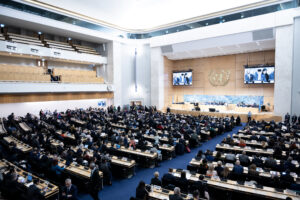
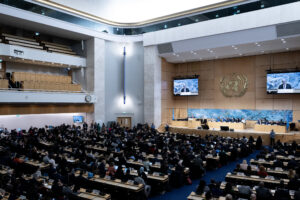
The General Assembly of the United Nations will convene an Ad Hoc Committee at the U N Headquarters in New York from 3 to 13 April 1995, and, if necessary, from 14 to 25 August 1995, to discuss the establishment of such a court.
In June 1994, the International Law Commission (ILC) finalised its consideration of the issue and proposed a Revised Draft Statute to the General Assembly. During the last General Assembly meeting, States were requested to comment on the Statute by 15 March 1995.
The ICJ has some concerns on what is overall an excellent and realizable framework for an International Criminal Court.
ICJ Campaign International Criminal Court-non-legal submission-1995-eng (full text in English, PDF)
ICJ Campaign International Criminal Court-non-legal submission-1995-fra (full text in French, PDF)

Feb 1, 1994 | Advocacy, Non-legal submissions
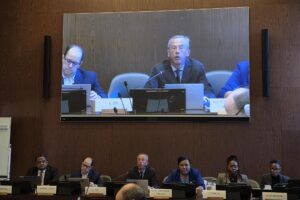
A group of 40 distinguished legal experts and media representatives, convened by the ICJ’s Centre for the Independence of Judges and Lawyers, and the Spanish Committee of UNICEF, met in Madrid, Spain, between 18 – 20 January 1994.
The objectives of the meeting were
- to examine the relationship between the media and judicial independence as guaranteed by the 1985 UN Basic Principles on the Independence of Judiciary;
- to formulate principles addressing the relationship between freedom of the expression and judicial independence.
The Basic Principle is as follows:
- Freedom of expression (including freedom of the media) constitutes one of the essential foundations of every society which claims to be democratic. It is the function and right of the media to gather and convey information to the public and to comment on the administration of justice, including cases before, during and after trial, without violating the presumption of innocence.
- This principle can only be departed from in the circumstances envisaged in the International Covenant on Civil and Political Rights, as interpreted by the 1984 Siracusa Principles on the Limitation and Derogation Provisions in the International Covenant on Civil and Political Rights (U.N. Document E/CN.4/1984/4).
- The right to comment on the administration of justice shall not be subject to any special restrictions.
The document contains the Principles, an Annex: Strategies for Implementation, the List of Participants at the Seminar and extracts from the International Covenant on Civil and Political Rights (ICCPR) and from the Syracusa Principles on the Limitation and Derogation Provisions in the ICCPR.
Madrid Principles Media Judicial Independence-non-legal submission-1994-eng (full text in English, PDF)
Feb 1, 1994 | Advocacy, Non-legal submissions
The document consists of three parties. The first is a general review of the basic rules regarding reservations to treaties. The second part contains a country-by-country review, outlining the reservations made by Bangladesh, China, India, Indonesia, South Korea, Myanmar, Pakistan and Thailand. The third part contains conclusions, focusing on the best strategies for NGO advocacy with regard to these reservations to the Convention of the Rights of the Child.
Asia-Convention Rights of the Child-non-legal submission-1994-eng (full text in English, PDF)
Jun 1, 1992 | Advocacy, Analysis briefs
Since the ICJ is committed to the Rule of Law and legal protection of human rights, the ICJ is pleased with a number of developments in Africa in the past few years.
The apparent waive of democratization as seen in Benin and Zambia is a noteworthy indication that political pluralism and free and fair elections are not alien to Africa. The transitions to civilian rule scheduled for 1993 in Ghana and Nigeria, two countries plagued in the past by military intervention, are hopeful examples of positive change.
In addition, African countries, as member states of the OAU, have pledged in the preamble to the OAU Charter “to
promote international cooperation, having due regard for the Charter of the United Nations and the Universal Declaration of Human Rights.”
Also worth noting is that forty-three of the fifty-one African states have ratified the African Charter on Human and Peoples’ Rights. Although only a few African states have submitted their periodic reports to the Commission, the ICJ is encouraged by indications that other states will do so in the near future. It is also our hope that the eight States which have not as yet ratified the African Charter will do so as soon as possible.
Despite these innovations, however, legal protection of human rights remains inadequate in Africa, exemplified by recent human rights violations in many African states. The ICJ is deeply concerned about the continuing violations.
The OAU Summit in conjunction with the African Commission has a responsibility to address these violations and to assure that African countries respect their legal obligations under the African Charter on Human and Peoples’ Rights and the UN Charter and other relevant international instruments.
Specific human rights violations are of particular concern to the ICJ due to their severity of harm and their frequency of occurrence throughout Africa. These include: killings and lack of accountability, arbitrary detention, torture, lack of personal protection and arbitrary use of power due to the lack of an independent judiciary, lack of protection of civilians during armed conflict and deportation.
The examples of violations used in the following legal analysis are based on international and local sources. While some changes may have occurred that are not indicated in this brief, examples are meant to illustrate potential consequences when the law is inadequate to protect human rights.
human rights situation in Africa-analysis brief-1992-eng (full text in English, PDF)
human rights situation in Africa-analysis brief-1992-fra (full text in French, PDF)
Jun 1, 1992 | Plaidoyer
La CIJ oeuvre depuis quarante ans pour la promotion de la primauté du droit et la protection juridique des droits de l’Homme partout dans le monde.
En Afrique, la Conférence de la CIJ sur la primauté du droit, tenue en 1961 à Lagos, Nigéria, fut la première étape d’une entreprise de longue haleine menée par la CIJ pour l’amélioration des droits de l’Homme en Afrique, dont le point d’aboutissement fut l’adoption en 1981 de la Charte africaine des droits de l’Homme et des peuples par la réunion au sommet de l’OUA.
La CIJ a soutenu la Commission africaine des droits de l’Homme et des peuples. Au cours des neuf mois passés, la CIJ a organisé deux ateliers consacrés à la participation des ONG à la Commission. La CIJ prépare également pour l’avenir d’autres activités visant à renforcer le rôle de la Commission.
Etant donné son engagement en faveur de la primauté du droit et la protection juridique des droits de l’Homme, la CIJ se réjouit d’un certain nombre de développements qui ont eu lieu en Afrique au cours de ces dernières années. Les signes concrets de démocratisation constatés au Bénin et en Zambie sont une indication significative que le pluralisme politique et la tenue d’élections libres et loyales ne sont pas des choses méconnues de l’Afrique.
Le passage à un gouvernement civil annoncé pour 1993 au Ghana et au Nigéria, deux pays qui ont été, dans le passé, tourmentés par les interventions militaires, est un exemple heureux d’une évolution positive.
En outre, les pays africains, membres de l’OUA, se sont engagés dans le préambule de la Charte de l’OUA “à favoriser la coopération internationale en tenant dûment compte de la Charte des Nations Unies et de la Déclaration universelle des droits de l’Homme.”
Il convient également de noter que quarante-trois des cinquante et un Etats africains ont ratifié la Charte africaine des droits de l’Homme et des peuples. Bien que seuls quelques Etats africains aient présenté leurs rapports périodiques à la Commission, certaines indications laissent penser à la CIJ que d’autres Etats suivront dans un proche avenir.
human rights situation in Africa-analysis brief-1992-fra (Texte complet en PDF)