Nov 18, 2020
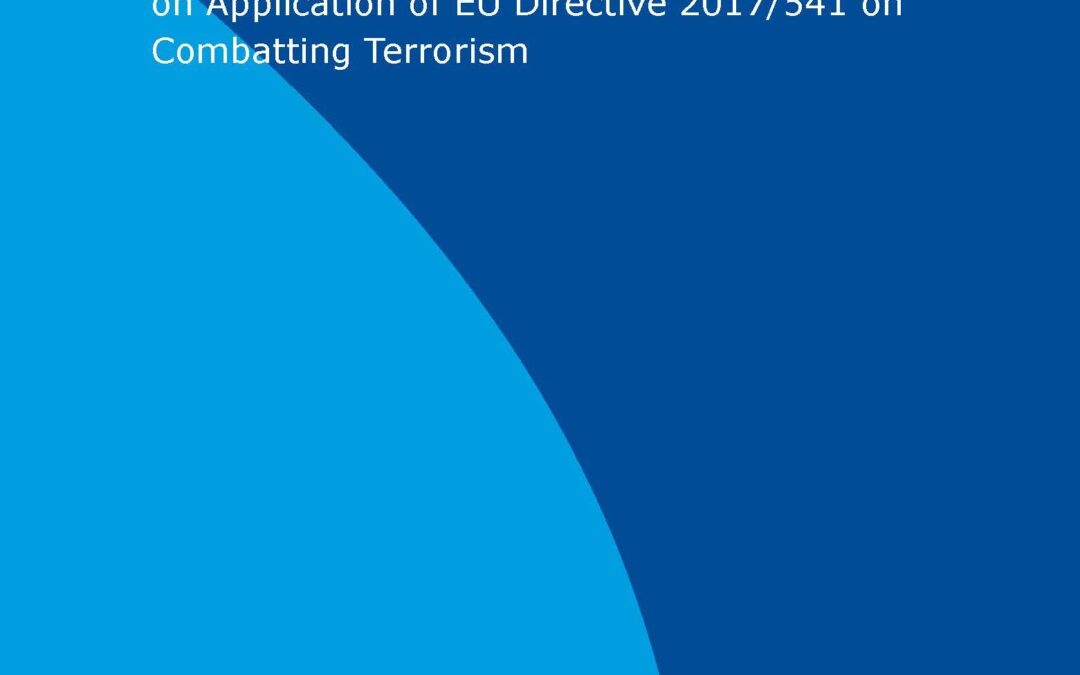
The ICJ and partners published today Counter-terrorism and human rights in the courts: guidance for judges, prosecutors and lawyers on application of EU Directive 2017/541 on combatting terrorism (the Guidance).
The Guidance, published by the ICJ together with its partners Human Rights in Practice, Nederlands Juristen Comité voor de Mensenrechten (NJCM) and Scuola Superiore Sant’Anna di Pisa, addresses the appropriate interpretation and application of the EU Directive in practice throughout investigation, prosecution and trial, consistently with international and EU human rights law and standards.
The Guidance (Counter-terrorism and human rights in the courts: guidance for judges, prosecutors and lawyers on application of EU Directive 2017/541 on combatting terrorism) was prepared as part of the JUSTICE project, building on expert roundtables held in 2019 across the EU (in Pisa, the Hague, Madrid and Brussels) with judges, lawyers, prosecutors and other relevant experts from a number of EU Member States, as well as national studies and consultations with judges, lawyers and prosecutors in Belgium, the Netherlands, Germany, Spain, Italy and France. The project was further supported by associate partners: Magistrats Européens pour la Démocratie et les Libertés (MEDEL), Juezas y Jueces para la Democracia in Spain and Neue Richtervereinigung in Germany.
It gives a comprehensive overview of the relevant international and EU legal standards and criminal law principles on investigation, prosecution and trial of terrorism cases, based on the EU Directive, to ensure that the Directive is applied in a human rights compliant manner.
The Guidance provides in its section II an overview of applicable international law and standards in law and practice. It covers counter-terrorism law in states of emergency, rights of victims of terrorism and human rights implicated by the Directive offences (principle of legality, non-discrimination, restrictions on freedom of movement, expression, association, assembly, privacy, private and family life and the right to political participation). Section III provides specific guidance and related commentary on each of the Directive offences and section IV covers the rights of suspects in the criminal process – investigation, prosecution and trial.
The Guidance is being launched today in an on-line webinar co-hosted by MEP Saskia Bricmont the Greens from the European Parliament and the speakers include national judges and lawyers, international experts, and representatives of the European Commission, Eurojust, the EU Fundamental Rights Agency and Members of the European Parliament, see the agenda here.
Contact:
Róisín Pillay, Director Europe and Central Asia Programme; roisin.pillay(a)icj.org
Karolína Babická, Legal adviser Europe and Central Asia Programme; karolina.babicka(a)icj.org
Download:
Guidance-counterterrorism-ENG-2020 (Guidance in English)
Guidance-counterterrorism-FR-2020 (Guidance in French)
Guidance-counterterrorism-ITA-2020 (Guidance in Italian)
Guidance-counterterrorism-DE-2020 (Guidance in German)
Guidance-counterterrorism-ESP-2020 (Guidance in Spanish)
Background research documents:
The summary of baseline studies related to national legal frameworks in Belgium, Italy, the Netherlands, Germany and Spain
The summary of research on national legislation in France, Greece, Cyprus, Poland, Portugal, the Czech Republic and Romania
Reports from four expert Roundtables held in April-November 2019 in Pisa (Italy), the Hague (the Netherlands), Madrid (Spain) and Brussels (Belgium)
Articles/blogs published within the Justice project:
Adélaïde Jacquin: Religious discrimination in counterterrorism in France, Opinio Juris, 28.5.2020
Mohamed Rafik: Using Administrative Powers in Order to Combat Terrorism Brings Down the Democratic Constitutional State, Opinio Juris, 22.10.2020
Simon Bekaert: The Spanish Rapper Extradition Case Before a Belgian Court Fires up the Legal Discussion on Freedom of Expression and Other Fundamental Rights, Opinio Juris, 13.11.2020
Karolina Babicka: EU Counter-terrorism Directive 2017/541: impact on human rights and way forward at EU level, Opinio Juris, 20.11.2020
Sizaire, Vincent, On a proper application of the European Union directive on combating terrorism / Vincent Sizaire. – In: European human rights law review, issue 3 (2020), p. 205-210
Duffy, Helen, “The EU Directive and the Expansive Criminalisation of Terrorism” in Paulussen and Capone, “Returning Foreign Fighters: Responses, Challenges and Ways Forward” (2nd ed), to be published in 2021
DAUSTER, Manfred , Nationality at Stake: Repatriation of German Foreign Fighters and their Families under German Law / Manfred Dauster. – In: European Human Rights Law Review, issue 6 (2020).
Gaetana Morgante: From the perspective of the national partner to the project in Italy.

Nov 17, 2020 | News
The ICJ today denounced the renewed threat of criminal proceedings by prosecutorial authorities against Judge Igor Tuleya on charges arising from the judge’s independent exercise of his judicial functions, as his case is appealed before a panel of the Supreme Court Disciplinary Chamber.
Judge Tuleya faces prosecution for having allowed the presence of media in a sensitive case concerning the investigations on the 2017 budget vote in the Polish House of Representatives (Sejm) that took place without the presence of the opposition.
He has been charged with ‘failing to comply with his official duties and overstepping his powers’ for having allegedly disclosed a secret of the investigation to ‘unauthorized parties’.
The accusations stem from the initiative of the judge to allow media and the public in the courtroom while issuing his ruling. Usually rulings on investigations are issued behind closed doors in Poland, but the criminal procedure code allows judges to make the hearing public “in the interest of justice”.
“Judge Tuleya’s immunity should be maintained. Actually he should not face any criminal proceedings to begin with as its decisions were in accordance with the law and the principles of transparency and public trials,” said Massimo Frigo, Senior Legal Adviser for the ICJ Europe and Central Asia Programme.
“His case is a further demonstration of the relentless attacks against the independence of judges ongoing in Poland.”
The Disciplinary Chamber, in a single-judge formation, upheld Judge Tuleya’s immunity on 9 July but the prosecution appealed the ruling that will be now decided by the same Chamber before a three-judge panel, Tomasz Przelawski, Slawomis Niedzielak and Jaroslaw Sobutka.
These proceedings are the first case of implementation the draconian Act amending the Law on the Common Courts, the Law on the Supreme Court and Some Other Laws, signed into law on 4 February and widely known as the ‘Muzzle Act’, which has given competence to waive judicial immunity to the Disciplinary Chamber of the Supreme Court.
“Immunity claims against a judge should be decided only by an independent body,” Massimo Frigo added.
“As EU Court of Justice held, the Disciplinary Chamber of the Supreme Court is not independent and is open to undue influence or interference by political authorities. It should therefore not rule on this case.”
Background
On 19 November, the Court of Justice of the European Union (CJEU) delivered a ruling in the case A.K. and others (C-585/18, C-624/18, C-625/18), on a preliminary question by the Supreme Court of Poland. The preliminary question asked whether the recently established Disciplinary and Extraordinary Chambers of the Supreme Court could be considered to be independent.
The CJEU ruled that a court cannot be considered independent “where the objective circumstances in which that court was formed, its characteristics and the means by which its members have been appointed are capable of giving rise to legitimate doubts, in the minds of subjects of the law, as to the imperviousness of that court to external factors, in particular, as to the direct or indirect influence of the legislature and the executive and its neutrality with respect to the interests before it and, thus, may lead to that court not being seen to be independent or impartial with the consequence of prejudicing the trust which justice in a democratic society must inspire in subjects of the law.”
Based on this ruling, the Labour, Criminal and Civil Chambers of the Supreme Court declared that the Disciplinary and Extraordinary Chambers of the Supreme Court were not properly constituted and independent.
According to the UN Basic Principles on the Independence of the Judiciary, judges are entitled to a fair hearing in all disciplinary proceedings (principle 17). In order for such a hearing to be fair, the decision-maker must be independent and impartial.
International and European standards on the independence of the judiciary provide that judges should have immunity from criminal prosecution for decisions taken in connection with their judicial functions in the absence of proof of malice, and any procedure for removing immunity must itself be independent (see for instance, UN Special Rapporteur on the Independence of Judges and Lawyers, paras 65-67 and 98; Council of Europe Committee of Ministers, para 68; Consultative Council of European Judges, para 20; ICJ Practitioners Guide no 13, pp. 27-30).
On 26 February 2020, the Polish Prosecutor’s Office requested a waiver of Judge Tuleya’s immunity in order to press criminal charges which might lead to imprisonment. The waiver was rejected on 9 June 2020 by the Disciplinary Chamber of the Supreme Court appointed by the government, in a single-judge formation. The Prosecutor’s Office appealed the ruling. The case will be now considered by the same Disciplinary Chamber in a three-judge formation. A first hearing was scheduled for 5 October 2020 but was postponed. It will take place on 18 November.
In an open letter of 5 February 2020, 44 ICJ Commissioners and Honorary Members denounced the recent legislative changes adopted by the Polish government threatening the role and the rights of judges and denouncing the risks faced by legal practitioners when fighting for the rule of law. Two weeks later, the risks highlighted by the letter have become reality for an increasing number of Polish judges, including Judge Tuleya.
Contact:
Massimo Frigo, Senior Legal Adviser, Europe and Central Asia Programme, e: massimo.frigo(a)icj.org, t: +41 797499949

Nov 15, 2020 | Editorial, Noticias
Una opinión editorial de César Landa, Comisionado de la CIJ.
El pasado 9 de noviembre el Congreso peruano destituyó al Presidente de la República Martín Vizcarra, al declararlo incapaz moral para mantenerse en el cargo, debido a la difusión de audios y declaraciones en los medios de comunicación sobre supuestos actos de corrupción, pese a que el Presidente ha estado dispuesto a colaborar con las investigaciones independientes que los fiscales del caso realizan actualmente.
Esa drástica decisión parlamentaria se adoptó en medio de una de las mayores crisis sanitaria, social y económica originada por la pandemia de la COVID-19, y ante la convocatoria a elecciones políticas generales congresales y presidenciales previstas para el 11 de abril del 2021.
Además, este procedimiento sumario se realizó sin tener en cuenta que el debido proceso previsto en la Constitución es el impeachment establecido en los artículos 99, 100 y 117 de la Constitución; este último artículo señala taxativamente las excepciones a la inmunidad presidencial. Las causales que permiten la destitución de un presidente son traición a la patria, impedir las elecciones, disolver el Congreso “salvo en los casos previstos en el artículo 134 de la Constitución”, e impedir la reunión o funcionamiento del parlamento u órganos electorales.
En cambio, el Congreso utilizó una cláusula amplia de “permanente incapacidad moral o física” contenida en el numeral 2 del artículo 113 de la Constitución, que está establecida para decretar una vacancia presidencial excepcional, en una suerte de simulación o fraude a la Constitución y sin las garantías del debido proceso que son propias del impeachment. Dicha cláusula, que no es objetiva, está bajo examen constitucional ante el Tribunal Constitucional que debe resolver un proceso presentado por el Poder Ejecutivo en contra del Congreso por uso abusivo de dicha causal.
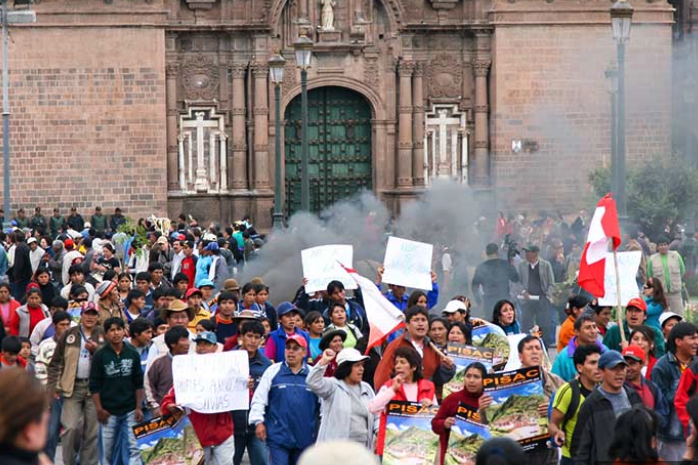
El rechazo a la forma de llevar la vacancia ha sido expresado por varias instituciones nacionales como la Defensoría del Pueblo, universidades, gremios y académicos. Pero, sobre todo, por la movilización social espontánea en las calles de todo el país, que inició el 9 de noviembre y que continúa día tras día bajo represión policial. Las manifestaciones se deben a la ruptura del orden constitucional en la sucesión presidencial, en especial dado que, de los 130 congresistas del Congreso Unicameral peruano, 68 tienen investigaciones penales y judiciales, incluido el Presidente Congreso, Manuel Merino, quien asumió la Presidencia de la República.
Esta situación es amenazante al principio de separación de poderes, pues el poder queda concentrado en miembros del Congreso, porque ahora la Presidencia la ocupa el presidente del Congreso. Además, el Congreso ha decidido reemplazar a seis magistrados de los siete integrantes del Tribunal Constitucional que, si bien tienen su mandato vencido, se presenta sin las garantías de transparencia, meritocracia y pluralidad. Ello es importante debido a que el Tribunal Constitucional es el máximo órgano encargado de interpretar la Constitución, para proteger los derechos fundamentales y rechazar los excesos de los poderes públicos.
También es relevante, por cuanto antaño los conflictos políticos entre el Congreso y el Ejecutivo se resolvían mediante golpes de Estado militares o civiles –el último fue el de Alberto Fujimori en año1992-; de modo que, el Tribunal Constitucional, en tanto se mantenga como un órgano independiente y autónomo, seguirá siendo garante de la democracia constitucional contemporánea. Por eso, la demanda del Ejecutivo contra el Congreso al inicio del proceso de la vacancia presidencial está en proceso de ser resuelta por el Tribunal Constitucional, con base en estándares constitucionales e internacionales de respeto al principio de control y balance de poderes, a fin de que en este grave período de emergencia sanitaria por la COVID-19, se aseguren los derechos fundamentales políticos, económicos y sociales, sobre todo de las personas más vulnerables.
Este fenómeno de populismo parlamentario autoritario ha concitado el rechazo de la opinión pública, porque revela un patrón de conducta que se expresa en las leyes que ha dictado el Congreso desde su instalación en marzo limitando los derechos ciudadanos, como la Ley N° 31012, Ley de Protección Policial, que prohíbe a los jueces evaluar los requisitos de necesidad y proporcionalidad en el uso de la fuerza cuando la policía es denunciada por abusos. Asimismo, como la promulgación de la Ley N° 31018 que afecta la seguridad contractual, porque anuló los contratos de los concesionarios de las autopistas, declarando además que no tenían derechos compensatorios; esta ley fue declarada inconstitucional por el Tribunal Constitucional. Además, el Congreso dictó otras normas que fueron objeto de observaciones por parte del Presidente depuesto, por sus visos de abierta inconstitucionalidad.
De esta forma, Perú atraviesa una crisis política y de su estado de derecho a raíz de la inconstitucional decisión del Congreso de declarar la vacancia del Presidente. Por ello, la instalación del nuevo gobierno, pese a que están convocadas las elecciones generales para el 11 de abril de 2021, ha creado inestabilidad en el equilibrio y balance de poderes, inseguridad en las instituciones autónomas (como el Tribunal Constitucional y el Jurado Nacional de Elecciones), y existe preocupación por la posible reforma del proyecto de presupuesto público ya elaborado para el 2021. También, existe fundada preocupación por la paralización de la profunda reforma educativa universitaria que desterró a grupos de poder en el manejo mercantil de varias universidades –sin calidad académica-, cuyos propietarios son algunos de los actuales congresistas promotores de la vacancia presidencial, y, porque el abogado de una de la universidad cuestionadas ha sido nombrado Presidente del Consejo de Ministros –Flores Araoz-.
Por eso, es necesario salvaguardar la separación de poderes, garantizar la independencia judicial, y asegurar la protección de los derechos humanos en el país. Para ello, se debe condenar el uso de las instituciones constitucionales para fines que afectan el principio de separación de poderes, base para el control y balance de poderes en una democracia. También, se debe asegurar que las elecciones de los nuevos magistrados del Tribunal Constitucional cumplan con los estándares internacionales y se realicen a través de un proceso transparente y público, que sea llevado a cabo por el nuevo Congreso que el pueblo peruano elija libremente el año 2021.
Nov 15, 2020 | Artículos, Noticias
La destitución del presidente de Perú Martín Vizcarra por el Congreso del país ha socavado el respeto al principio de separación de poderes y ha precipitado una crisis del Estado de Derecho, dijo hoy la CIJ.
El 9 de noviembre, el Congreso de Perú utilizó el artículo 113 (2) de la constitución del país, que rara vez se utilizaba, para ‘vacar’ el mandato de Vizcarra por motivos de “incapacidad moral permanente” para el cargo y juró al presidente del Congreso, Manuel Merino, como Presidente del país.
La justificación para la destitución de Vizcarra fueron las acusaciones de corrupción durante la época en que Vizcarra fue gobernador de la región de Moquequa en 2011-2014. Estas denuncias ya están siendo investigadas por la Fiscalía.
La CIJ observa que la Corte Constitucional de Perú tiene un caso pendiente para revisar la consistencia constitucional del uso de la cláusula de causal de “incapacidad moral permanente” para delitos comunes. La Constitución peruana contempla un procedimiento separado de acusación que no se ha seguido en este caso. Sin embargo, el Congreso aplicó la cláusula de “incapacidad moral” en un procedimiento apresurado y con la decisión de la Corte Constitucional pendiente.
“El Congreso de Perú se ha adelantado a la decisión de la Corte Constitucional y aplicó una interpretación legal excesivamente expansiva y altamente controvertida del artículo 113 (2) para derrocar a un presidente, comprometiendo así la autoridad del Poder Judicial y del Ejecutivo”, dijo el Secretario -General de la CIJ, Sam Zarifi.
“Esta extralimitación del Poder Legislativo ha llevado al país a una crisis de estado de derecho que también amenaza el respeto a los derechos humanos en el país”, agregó.
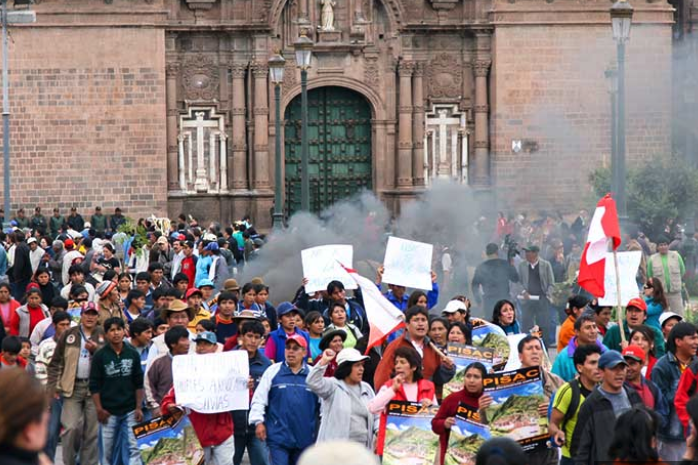
Los manifestantes que se manifestaban contra la expulsión de Vizcarra se han enfrentado a malos tratos y detenciones arbitrarias por parte de la policía y las fuerzas de seguridad.
La CIJ pide a las autoridades peruanas que respeten el derecho a la libertad de reunión y protesta pacífica y que desistan de cualquier forma de uso ilegal de la fuerza. Las denuncias de violaciones de malos tratos y otras violaciones de derechos humanos deben investigarse con prontitud, de forma exhaustiva e imparcial. La CIJ también insta a que se respete la independencia del poder judicial, en particular en lo que respecta al Tribunal Constitucional y sus funciones.
Nov 15, 2020 | News
The removal of Peru’s President Martin Vizcarra by the country’s Congress has undermined respect for the principle of separation of powers and precipitated a rule of law crisis, the ICJ said today.
On 9 November, Peru’s Congress used the seldom-used article 113(2) of the country’s constitution to ‘vacate’ Vizcarra’s term on the ground of “permanent moral incapacity” for office and swore in the President of the Congress, Manuel Merino, as President of the country.
The underlying justification for Vizcarra’s removal was allegations of corruption stemming from the time when he was Governor of Moquequa state in 2011-2014. Those allegations are already under investigation by the Office of the Prosecutor.
The ICJ notes that Peru’s Constitutional Court has a pending case to review the constitutional consistency of the use of the grounds of “permanent moral incapacity” clause for ordinary crimes. The Peruvian Constitution contemplates a separate procedure of impeachment that has not been followed in this case. Yet Congress applied the clause of “moral incapacity” in hasty proceedings with that decision pending.
“Peru’s congress has preempted the decision of the Constitutional Court and applied an overly expansive and highly contested legal interpretation of article 113(2) to oust a president, thus implicating the authority of the Judicial branch as well as the Executive,” said ICJ Secretary General Sam Zarifi.
“This overreach by the Legislative branch has launched the country into a rule of law crisis that also threatens respect for human rights in the country,” he added.
Protesters demonstrating against Vizcarra’s removal have faced ill-treatment and arbitrary arrest by police and security forces.
The ICJ calls on the Peruvian authorities to respect the right to freedom of assembly and peaceful protest and to desist from any form of unlawful use of force. Allegations of violations of ill-treatment and other human rights violations must be investigated promptly, thoroughly and impartially. The ICJ also urges respect of the independence of the judiciary, particularly as concerns the Constitutional Court and its functions.