Oct 31, 2018 | News
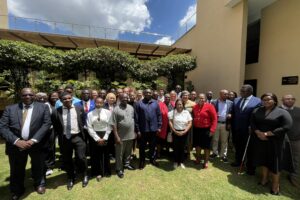
On 28‒31 October 2018, the ICJ hosted two seminars for 30 judges and prosecutors and 26 lawyers from Libya.
The events were co-organized with the Libyan Network for Legal Aid and commenced with opening remarks by ICJ Commissioner, Justice Kalthoum Kennou of Tunisia.
The first seminar on 28‒29 October on “Fair Trial Guarantees in Libya in light of International Standards” aimed to deepen the understanding of Libyan judges and prosecutors of the application of international law and standards regarding fair trials.
The seminar covered pre-trial rights, such as the right to liberty, to effective legal counsel and to be brought promptly before a judge, and rights at trial, such as the right to defend oneself in person, to call and examine witnesses and to an appeal.
International fair trial standards were considered in light of Libyan domestic law and cases, including case 630/2012 involving 37 Ghaddafi-era officials.
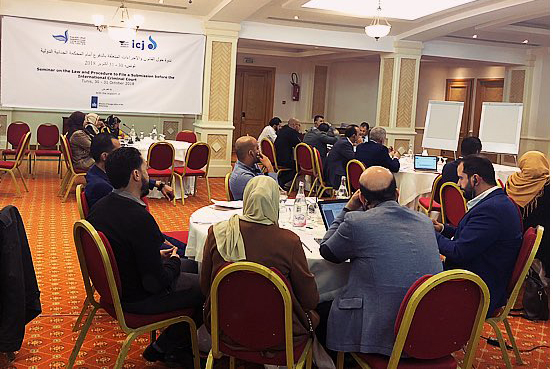
The second seminar on 30‒31 October on “The Law and Procedure to File a Submission before the International Criminal Court” aimed to increase Libyan lawyers’ understanding of how to properly file a successful submission to the Office of the Prosecutor.
The Seminar covered the structure and functioning of the ICC, the jurisdictional and admissibility requirements, and the standards for collection and admissibility of evidence.
The Seminar further discussed the roles of NGOs, lawyers and victims in ICC proceedings, providing practical guidance on how and when to file a communication under Article 15 of the Rome Statute of the ICC.
Speakers included judges and prosecutors from international courts and tribunals as well as ICJ staff.
Oct 30, 2018 | News
The ICJ today called upon the Government of Sri Lanka to abide by the Constitution and its international obligations in peacefully resolving the current political crisis, and for all political leaders to commit to respect for human rights and the rule of law.
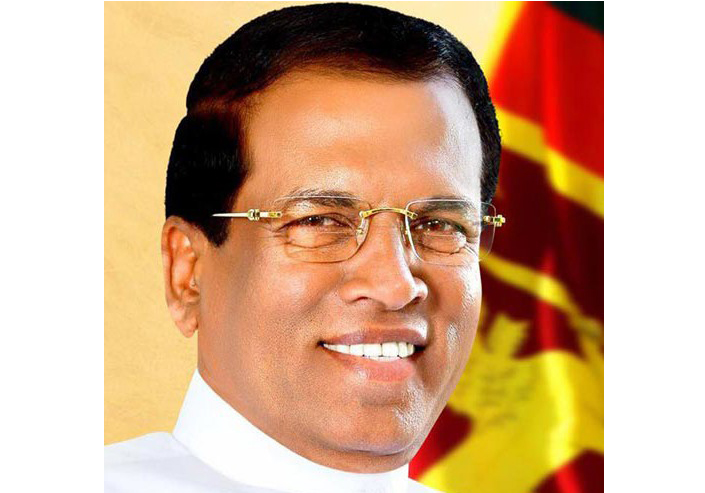
To this end, President Maithripala Sirisena (photo) should reconvene Parliament to end the constitutional crisis in line with the rule of law and democratic norms.
The ICJ urged the Government to deliver on its commitment to the transitional justice process, including by holding those responsible for human rights violations and abuses accountable, and complying with the obligations set out in United Nations Human Rights Council Resolutions 30/1 and 34/1.
It is with grave concern that the ICJ has observed the unfolding of events in Sri Lanka since the evening of October 26, 2018.
Following the withdrawal of the United People’s Freedom Alliance from the National Unity Government, President Maithripala Sirisena, in an unexpected move, appointed Former President and Member of Parliament Mahinda Rajapaksa as the Prime Minister of Sri Lanka.
These actions have transpired in disregard of safeguards set out in the 19th Amendment to the Constitution, which limit the power of the President to remove the Prime Minister at will.
The Amendment spells out specific instances during which the Prime Minister of Sri Lanka ceases to hold office under the law.
The ICJ is concerned at the President’s move to prorogue Parliament until 16 November in what appears to be an effort to avoid parliamentary scrutiny of his actions. The move has exacerbated political tensions.
“The ICJ is alarmed that Mahinda Rajapaksa, who has yet to be held accountable for the well-documented human rights violations committed during his previous tenure, has been appointed Prime Minister – in apparent violation of the Constitution,” said Frederick Rawski, Asia Pacific Director for the ICJ.
Incidents of violence and the takeover of government-controlled media by supporters of Mahinda Rajapaksa raise fears of an imminent return to the human rights violations and abusive practices which were widespread during his term.
ICJ also noted with concern ongoing crackdowns on the media and other attacks on human rights and fundamental freedoms.
The ICJ stressed that the removal of the Prime Minister in violation of the law or constitutional provisions would constitute a violation of Sri Lanka’s commitments to the international community, set out in UN Human Rights Council resolutions in 2015 and 2017, to strengthen good governance and protect democratic institutions.
The ICJ also expressed concern that political instability, or the return of an unrepentant and unaccountable Mahinda Rajakpaksa to political power, would endanger progress made on fulfilling Sri Lanka’s commitments to press forward with transitional justice processes, and its legal obligations to ensure accountability for past human rights violations and abuses, as set out in both resolutions.
“The failure to address past abuses, and to fully implement UN Human Rights Council Resolutions 30/1 and 34/1, has helped set the stage for the current political turmoil, and the possible return of an authoritarian figure who has proven his disrespect for human rights and the rule of law over and over,” said Frederick Rawski.
“The Human Rights Council will be watching closely to assess whether Sri Lanka is in breach of its commitments. Any serious threat to progress on human rights accountability will compel the establishment of an independent accountability mechanism,” he added.
Contact
Frederick Rawski, ICJ’s Asia Pacific Regional Director, t: +66 2 619 84 77 ; e: frederick.rawski(a)icj.org
Oct 26, 2018 | News
At a media event in Bangkok, Thailand, today, the ICJ reiterated its call for Turkey to work with the United Nations to establish a special independent mechanism to carry out an investigation into the killing of Khashoggi with a view to identifying the perpetrators.
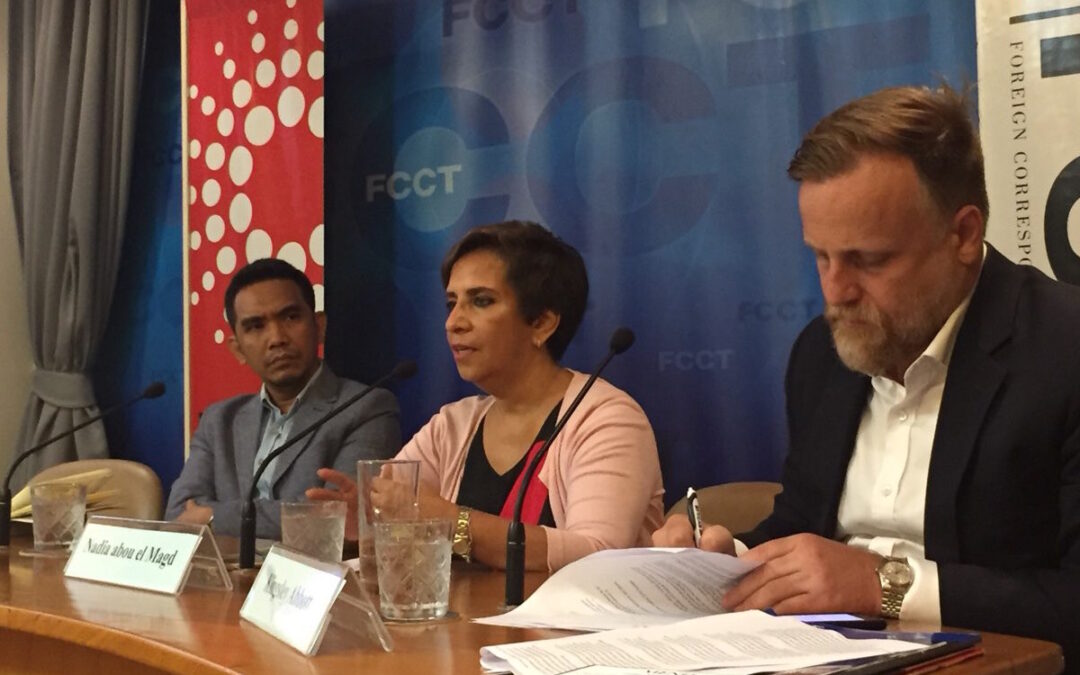
The Foreign Correspondents Club of Thailand (FFCT) in Bangkok hosted a special panel discussion entitled Death of a journalist – Fallout from the killing of Jamal Khashoggi, which was attended by approximately eighty journalists, diplomats and club members.
On the panel, Kingsley Abbott, ICJ Senior Legal Advisor for Global Accountability, began by making two positive observations, namely that there exists a clear international legal framework which applies to cases of suspected unlawful deaths including extra-judicial executions and enforced disappearance; and that a considerable amount of information about Khashoggi’s fate appears to be available.
He set out the international legal framework that applies to violations of the right to life noting the state duty to conduct a prompt independent, impartial, effective and transparent investigation consistent with the UN Principles on the Effective Prevention and Investigation of Extra-legal, Arbitrary and Summary Executions and the revised 2016 Minnesota Protocol on the Investigation of Potentially Unlawful Death.
Kingsley Abbott noted that in nearly all cases where there is reasonable suspicion of unlawful death, an autopsy should be performed and called for Khashoggi’s body or remains to be produced.
Kate Vigneswaran, ICJ Senior Legal Adviser, Middle East and North Africa (MENA) Programme, discussed options for accountability in the MENA region, in particular in Saudi Arabia, Turkey, Egypt and the United Arab Emirates.
She noted that Saudi Arabia provided little to no opportunity for meaningful justice given executive and Royal Court control over the judiciary and prosecutors. She further highlighted Saudi Arabia’s targeting of critics exercising their right to freedom of expression through criminal prosecutions, abductions and enforced disappearances, and egregious fair trial rights violations in the criminal justice system. She went on to state that similar human rights violations in Egypt and the United Arab Emirates make them unlikely credible options for accountability.
She also noted some concerns about aspects of the justice system in Turkey and in that regard said it was too early to determine whether the conduct of investigation and prosecution of the perpetrators in that country would meet international standards.
Other speakers included Nadia abou el Magd, who has 30 years’ experience as a journalist and commentator covering the Middle East, working mainly for the Associated Press, and Dr. Muhammad Ilyas Yahprung from the Faculty of Political Science, Ramkhamheang University, who focuses on Muslim World Issues.
The panel was moderated by Anneliese Mcauliffe who has worked as a journalist across Asia and the Middle East for over two decades.
Contact:
Kingsley Abbott
Kate Vigneswaran
Senior Legal Adviser
Middle East and North Africa Programme
Phone: +31624894664
Email: kate.vigneswaran(a)icj.org
Twitter: @KateVigneswaran
Oct 24, 2018 | News
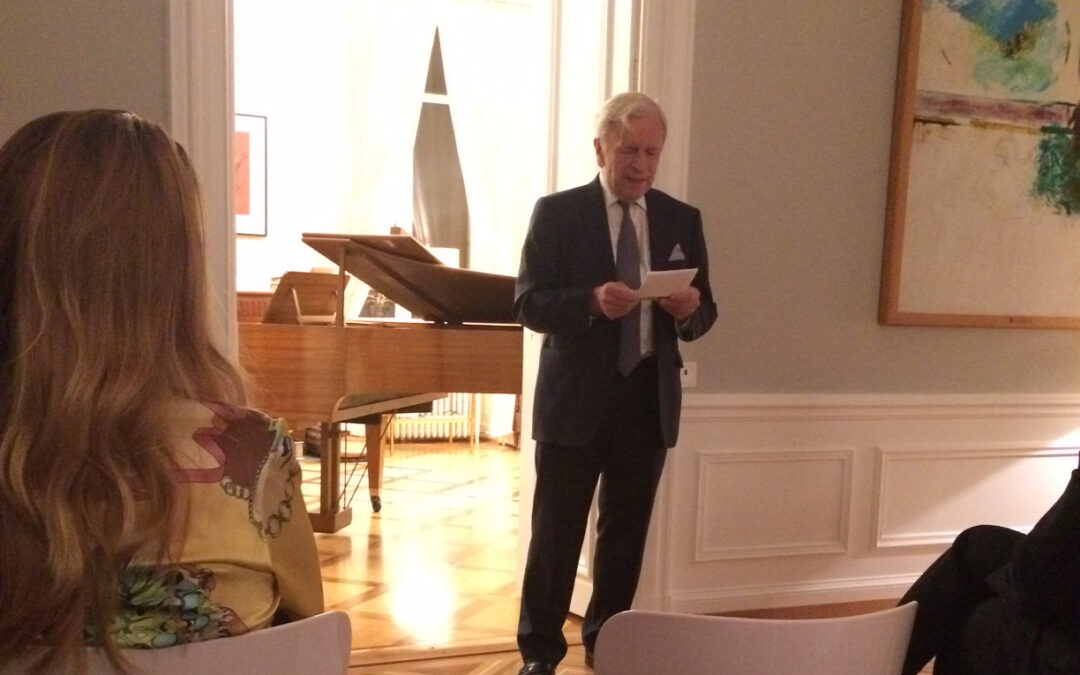
The ICJ started its 60th anniversary in Geneva with an evening gala hosted by Ambassador Julian Braithwaite, at his residence on 18 October 2018. A moving speech by Sir Nicolas Bratza (photo), ICJ Commissioner and Executive Committee member, on the importance of the defence of the rule of law opened the evening.
It was followed by a magnificent concert by Menuhin Academy virtuoso, violinist Vasyl Zatsikha. A magical evening.
The speech of Sir Nicolas Bratza
“I feel very privileged to have been asked to say a few words by way of introduction to the speech of the Secretary General of the ICJ.
May I begin by expressing on behalf of us all the warmest thanks to the British Ambassador for hosting this very special celebration of the 60th anniversary of the ICJ in its home in Geneva.
Anniversaries are always important occasions and never more so than when they mark a milestone in the life of a remarkable organization that has throughout its existence worked tirelessly to safeguard the rule of law and human rights and that has done so, in particular, by protecting and defending the independence of judges and lawyers.
My association with the ICJ has been relatively brief but for many years I have admired its work from afar, as a member of the European Commission of Human Rights for five years and as a judge of the Strasbourg Court, for fourteen.
The Court and the ICJ share the common purpose – to protect the fundamental principles of democracy, the rule of law and human rights.
Without the independent and impartiality of judges, both national and international, those principles would be meaningless and might as well have been written on water.
With the alarming growth of populism in countries across the world, the threats to the independence of the judiciary are regrettably as real today as they have been at any time.
In the international Court of which I was a member, judges are nominated by the States from which they are drawn.
But they are in no sense representatives of those States and are not infrequently faced with having to decide cases, sometimes cases of acute sensitivity, against their own countries.
The pressures on judges of the Court are often intense and there are notorious examples where the courage shown by a judge in maintaining his or her rigorous independence has come at a cost, the judge being punished by not being renominated by the State, by returning to the country at the end of their mandate without employment or means of livelihood, or by being unable to return safely to their home at all.
But if the position of the international judge is difficult enough, that of the national judge in certain States, including member States of the Council of Europe, is far worse, their independence and security, both physical and professional, being under constant threat.
In the 1990s and in the early years of this century, the signs were promising. One was able to witness a slow but steady improvement in adherence to the rule of law on the part of new democracies.
This was in no small measure due to the work of organizations such as the ICJ which, through its writings, seminars and training of judges and lawyers worldwide, did so much to strengthen and support judicial independence and to expose the most flagrant examples of abuse and undermining of that independence.
I regret to say that in more recent years the landscape has become much darker, with open and insidious attacks on members of the judiciary, the arbitrary removal of judges from their posts and measures taken to curtail the powers of judges and courts or to undermine their authority and independence.
In my official visits to member States as President of the Strasbourg Court, I met several judges who voiced their deep concern about the steps being taken both by the legislature and the executive to compromise their independence and to diminish their authority. It is not only in the new democracies that such a phenomenon has become apparent.
There has been a growing trend in many parts of Europe to undermine the standing and authority of the judiciary by outspoken attacks on judges for unpopular decisions, by members of the executive, by parliamentarians and by the media.
It is these challenges to judicial independence and to the rule of law that make the role of the ICJ and the continued support of the diplomatic community not only more relevant but more vital than they have ever been.
It is with pride and pleasure that I wish the ICJ a very happy anniversary on this its first 60 years of life in this great city.
But I combine this with a fervent hope that, with the support of us all, the ICJ is able to continue its extraordinary work for the next 60 years and far beyond. The protection of the rule of law and human rights depend on it.”
Oct 24, 2018 | Comunicados de prensa, Noticias
Eren Keskin (Turquía), Marino Cordoba Berrio (Colombia) y Abdul Aziz Muhamat (Papua Nueva Guinea / Australia) competirán por este prestigioso premio otorgado a los defensores de los derechos humanos que han demostrado una profunda compromiso y afrontan altos riesgos personales. La CIJ es miembro del jurado.
Los finalistas han sido seleccionados por la Comunidad Internacional de Derechos Humanos (los miembros del jurado son la CIJ, Amnesty International, Human Rights Watch, Human Rights First, International Federation for Human Rights, World Organisation Against Torture, Front Line Defenders, EWDE Germany, International Service for Human Rights y HURIDOCS).
Los galardonados son seleccionados porque han demostrado un profundo compromiso con los derechos humanos, a menudo trabajando bajo amenaza de encarcelamiento, tortura o algo peor. El reconocimiento internacional otorgado por el Premio, además de elevar su perfil y su trabajo, a menudo proporciona una protección significativa.
El Premio Martin Ennals 2019 se entregará el 13 de febrero de 2019 en una ceremonia organizada por la Ciudad de Ginebra, que durante muchos años ha apoyado firmemente el Premio.
Marino Córdoba Berrio (Colombia)
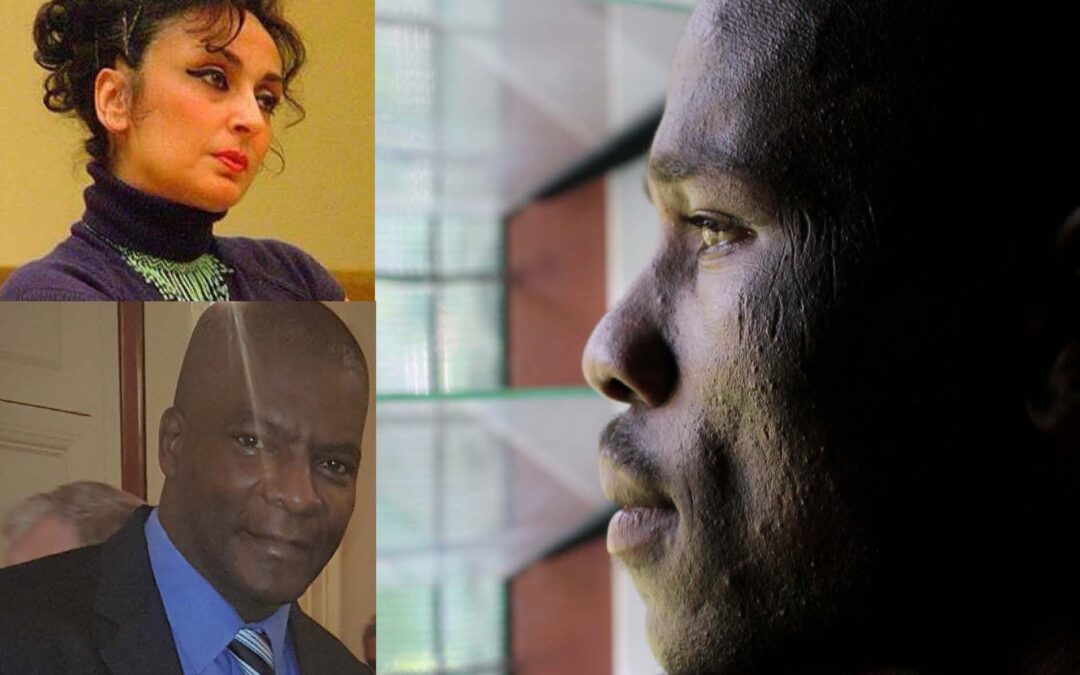
Miembro de la comunidad afro-colombiano, Marino Córdoba Berrio (abajo a la izquierda en la foto) dirigió a su comunidad al enfrentar la pérdida de sus tierras ante poderosos intereses comerciales, en particular en la tala de bosques y la minería.
Después de trabajar con éxito para obtener el reconocimiento legal de los derechos sobre la tierra de su comunidad, gran parte de su comunidad fue expulsada por la fuerza en 1996.
Las amenazas y los ataques constantes lo llevaron a buscar Asilo Político en los Estados Unidos en 2002, donde construyó una red de partidarios en apoyo a su comunidad y la paz.
Regresó a Colombia en 2012 y desde entonces viene trabajando para garantizar inclusión de las comunidades étnicas en el acuerdo de paz, en particular como miembro de la “Comisión Étnica para la Paz y la Defensa de los Derechos Territoriales” que proporciona información a medida que se implementa el acuerdo de paz.
Él ha recibido regularmente amenazas de muerte y está bajo seguridad constante.
Afirmó que: “históricamente hemos sido excluidos política, social y económicamente, desproporcionadamente afectados por la discriminación estatal, también afectados por la crueldad de la guerra, por lo que proporcionar medidas de superación e inclusión del pueblo Afrocolombiano es una responsabilidad primordial del Estado. Creo en el poder de mi mente y en mis manos como un factor determinante para hacer lo correcto por la paz, por lo tanto, la justicia que se aplique a mi pueblo es crucial para su supervivencia, por lo que está en nuestras manos promover cambios justos y humanos, aun en momentos de constantes persecución y asesinatos de líderes importantes y soñadores en mi país y, aun por encima de mi propia vida. Si este esfuerzo implica exponer mi vida creo que será siempre con amor a mi causa y a mi gente”.
Eren Keskin (Turquía)
Eren Keskin (parte superior izquierda de la foto) es un abogado y activista de derechos humanos.
Durante más de treinta años, ella ha luchado por los derechos y libertades fundamentales en Turquía, especialmente por los Kurdos, las mujeres y la comunidad LGBTI.
En el contexto del empeoramiento de la situación de los derechos humanos en Turquía, Keskin se encuentra una vez más en el centro de los intentos de intimidación.
Como parte de una campaña de solidaridad para apoyar al periódico Özgür Gündem, Keskin sostuvo el título de “editor en jefe” del periódico desde 2013 hasta 2016, cuando fue clausurado por las autoridades.
El 30 de marzo de 2018, fue condenada y sentenciada a 12,5 años de cárcel por haber publicado artículos que se consideraba que habían “degradado” a la nación turca e “insultado” al presidente turco. Actualmente está libre mientras se apela el caso.
Ella afirmó: “Defender los derechos humanos no es fácil en nuestro territorio. Estoy siendo procesado con 143 cargos por mi solidaridad con un periódico de la oposición en el contexto de la libertad de expresión. Los premios internacionales y la solidaridad tienen características “protectoras” y tranquilizan a quienes estamos en sociedades represivas. También nos da un impulso moral y ayuda a nuestra motivación para la lucha. Gracias por no olvidarnos. Tu solidaridad y protección significan mucho”.
Abdul Aziz Muhamat (Papua Nueva Guinea / Australia)
Abdul Aziz Muhamat (Aziz, en la derecha en la foto), de Sudán, es un defensor convincente e incansable de los derechos de los refugiados.
En busca de asilo, se encuentra recluido en detención de inmigrantes en Australia en la isla Manus, Papúa Nueva Guinea, desde octubre de 2013, cuando las autoridades australianas interceptaron su barco.
Aziz ha visto morir a sus amigos. Ha recibido disparos de la policía local. También fue enviado a una prisión local por negarse a comer en protesta por la crueldad y el sufrimiento infligido a otros.
Aziz es una de las principales voces públicas entre los hombres detenidos en la isla Manus.
A pesar de la ubicación aislada, ha expuesto las duras condiciones allí a través de podcasts y entrevistas con los medios. Él ha pagado un precio por esto, ya que es visto como un “líder de la banda” tanto por parte de PNG como de las autoridades australianas.
Ella declaró: “Mi trabajo para exponer este sistema cruel me ayuda a preservar mi autoestima y la dignidad humana inherente. Me ayuda a luchar por los derechos de cada refugiado en todo el universo, lo que haré hasta mi último aliento. No siempre es fácil cuando se vive en condiciones de miedo y persecución. Sin embargo, incluso bajo la maquinaria más aplastante del estado, el coraje se levanta una y otra vez, porque el miedo no es el estado natural y haré todo lo posible para seguir adelante”.
Contactos
Olivier van Bogaert, Director de comunicación de la CIJ, miembro del jurado, t: +41 22 979 38 08 ; e: olivier.vanbogaert(a)icj.org
Michael Khambatta, Director, Fundación Martin Ennals, t: +41 79 474 8208 ; e: khambatta(a)martinennalsaward.org
COL-Marino Cordoba Bio-News-2018-SPA (biografía completa de Marino Córdoba Berrio, en PDF)
TUR-Eren Keskin_Bio-News-2018-ENG (biografía completa de Eren Keskin, en inglés, PDF)
AUS-Abdul Aziz Muhamat Bio-News-2018-ENG (biografía completa de Abdul Aziz Muhamat, en inglés, PDF)