Apr 4, 2018 | Comunicados de prensa, Noticias
La CIJ está hondamente preocupada ante la falta de independencia de los miembros de la comisión de postulación para la elección de fiscal general.
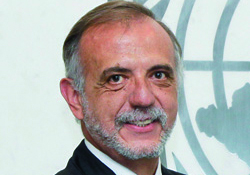
Desde el 27 de agosto de 2017, cuando el Presidente de la República declaró “persona non grata” al Comisionado de la Comisión Internacional contra la Impunidad (CICIG), Iván Velásquez (foto), el Estado de Derecho de Guatemala viene siendo seriamente afectado por diferentes funcionarios al más alto nivel.
En dicha ocasión, la Corte de Constitucionalidad jugó un papel primordial en la defensa del Orden Constitucional y a favor del rescate del Estado de Derecho, al emitir varias resoluciones que lograron detener las acciones ilegítimas, que intentaron implementar al más alto nivel, el Presidente de la República y las y los diputados del Congreso de la República, para consolidar la impunidad.
En este contexto, se ha llevado a cabo la primera fase de la elección de Fiscal General por parte de la Comisión de Postulación. Informes, como el de la organización “Insight Crime”, señalan que los miembros de la Comisión de Postulación para la elección de Fiscal General, en lugar de actuar para cumplir correctamente con su mandato constitucional y coadyuvar para que el Estado de Guatemala logre alcanzar el bien común, lo hacen únicamente para satisfacer intereses de grupos vinculados al poder político, económico o militar.
Este actuar arbitrario socava el Estado de Derecho y provoca que la ciudadanía en general pierda la credibilidad en las instituciones de justicia y en el Estado de Derecho.
La CIJ considera oportuno recordar, en este momento del proceso de elección de Fiscal General, a los miembros de la Comisión de Postulación, que son funcionarios públicos sujetos a la Constitución Política de la República de Guatemala, a los Convenios internacionales de derechos humanos ratificados por el Estado de Guatemala, a las leyes ordinarias y a las decisiones de la Corte de Constitucionalidad en la materia.
La Constitución prescribe que el nombramiento en empleos o cargos públicos sólo se debe hacer sobre “razones fundadas en méritos de capacidad, idoneidad y honradez” (artículo 133).
En ese contexto, la CIJ recuerda el precedente de la elección de Fiscal General en el año 2010, cuando la Corte de Constitucionalidad ordenó repetir y reiniciar todo el proceso. En dicha oportunidad, varios de los comisionados tuvieron que inhibirse y se retiraron del proceso. Cuatro de dichos comisionados, vuelven a integrar hoy la Comisión de Postulación, lo cual introduce más dudas acerca de la legitimidad del proceso.
La CIJ recuerda que, para la realización de investigaciones independientes e imparciales, que garanticen el acceso a la justicia de las víctimas de los delitos y para romper el círculo de la impunidad, es fundamental que la Fiscalía pueda llevar a cabo su labor de modo independiente, autónomo e imparcial.
En ese sentido la Comisión Interamericana de Derechos Humanos y el Relator de las Naciones Unidas para la Independencia de los Magistrados y Abogados, han señalado que la relación de dependencia que puedan tener la Fiscalía respecto de otros órganos – como el Poder Ejecutivo- puede tener un impacto negativo en su actuación independiente e imparcial, socavar la efectividad de las investigaciones y ser un factor de impunidad.
La CIJ considera que el “pacto de impunidad” que está en marcha, pretende cooptar al Ministerio Público y afectar el buen trabajo que realiza el comisionado Iván Velásquez, a favor de la lucha contra la impunidad.
De llegar a ser electo un o una Fiscal General que no reúna los requisitos establecidos en el artículo 113 de la Constitución, el daño a la sociedad guatemalteca en su conjunto, puede llegar a ser de múltiples dimensiones, difíciles de cuantificar y causar “daños irreparables al sistema de justicia”, por su falta de independencia frente a cualquiera de los tres poderes del Estado o por su compromiso de defender los intereses de grupos del poder político, económico, militar o del crimen organizado.
La CIJ esta hondamente preocupada por el hecho de que exista un potencial conflicto de intereses por parte del Presidente de la República en el proceso de seleción y nombramiento del Fiscal General, toda vez que el primer mandatario ha sido sido cuestionado por su posible involucramiento en el Caso Hogar Seguro, en el que resultaron muertas 41 niñas, hechos que deben ser investigados por el Ministerio Público y además, su hijo y hermano están siendo procesados por casos denunciados por el Ministerio Público y vinculados a la lucha contra la corrupción.
Ramón Cadena, Director de la CIJ para Centro América, expresó: “La decisión final de la Comisión de Postulación deberá estar bien fundamentada y de ninguna manera podrán elegir personas que no reunan las condiciones previstas por el artículo 113 de la Constitución, que generen la más mínima duda con respecto a su independencia, honestidad e idoneidad o que resulten ser parte del pacto de impunidad existente.”

Apr 3, 2018 | News
The secret military trials of civilians charged with terrorism-related offences are a continuing breach of Pakistan’s international human rights obligations, the ICJ said today.
Military courts were first empowered to try civilians for certain terrorism-related offences on 7 January 2015 by the 21st amendment to the Constitution and amendments to the Pakistan Army Act, 1952, which were in operation for a period of two years.
One year ago, on 31 March 2017, President Mamnoon Hussain signed into law the 23rd amendment to the Constitution to renew military courts’ jurisdiction over civilians until 6 January 2019.
“The renewal of military trials for civilians accused of terrorism last year has only weakened the rule of law, and undermined the right to fair trial and equality before the law in Pakistan,” said Matt Pollard, ICJ’s Senior Legal Adviser.
“Pakistan should end the role of military courts in such cases, and instead strengthen the ability of ordinary courts and law enforcement to ensure investigations and trials that are both fair and effective, in line with its domestic law and international human rights obligations,” he added.
According to the military’s media office and information collected by the ICJ, military courts have convicted 346 people since January 2015, out of which 196 people have been sentenced to death and 150 people have been given prison sentences.
At least 56 people have been hanged. Only one person has been acquitted.
The ICJ has documented serious fair trials violations in the operation of military courts, including: denial of the right to counsel of choice; failure to disclose the charges against the accused; denial of a public hearing; failure to give convicts copies of a judgment with evidence and reasons for the verdict; and a very high number of convictions based on “confessions” without adequate safeguards against torture and ill treatment.
Such use of military courts to try civilians is inconsistent with international fair trial standards, and the imposition of the death penalty after such trials violates the right to life.
Families of more than a hundred people convicted by military courts have alleged the convicts were denied a right to a fair trial in petitions to the Supreme Court and various high courts in the country.
Despite acknowledging possible denial of fair trial, the ordinary courts have thus far refused to provide relief to the petitioners due to their lack of jurisdiction over military courts.
The expansion of the jurisdiction of military tribunals through the amendments to the Constitution and the Pakistan Army Act were a part of the Pakistani government’s 20-point “National Action Plan”, adopted following the horrific attack on the Army Public School in Peshawar in December 2014.
The NAP contemplated military courts only as a short-term “solution” to try “terrorists”, on the basis that they would be operational only for a short period during which the Government would bring about necessary “reforms in criminal courts system to strengthen the anti-terrorism institutions.”
However, with less than a year left before the extension under the 23rd Constitutional Amendment is set to expire, no such reforms have taken place.
Contact
Matt Pollard, ICJ Senior Legal Adviser and UN Representative (Geneva); e: matt.pollard@icj.org
Reema Omer, ICJ International Legal Adviser for South Asia (London), t: +447889565691; e: reema.omer@icj.org
Background
The 23rd constitutional amendment allows military tribunals to try civilians who allegedly belong to “a terrorist group or organization misusing the name of religion or a sect” and are suspected of committing a number of offences, including: abducting any person for ransom; raising arms of waging war against Pakistan; causing any person injury or death; using or designing vehicles for terrorist attacks; creating terror or insecurity in Pakistan; and attempting, aiding or abetting any of these acts.
In July 2017, in its Concluding Observations after Pakistan’s first periodic review under the International Covenant on Civil and Political Rights (ICCPR), the UN Human Rights Committee stated that it was concerned by the extension of the jurisdiction of military courts over civilians and allegations of fair trial violations in military courts’ proceedings.
The Human Rights Committee recommended that Pakistan “review the legislation relating to the military courts with a view to abrogating their jurisdiction over civilians and their authority to impose the death penalty” and “reform the military courts to bring their proceedings into full conformity with articles 14 and 15 of the Covenant in order to ensure a fair trial.”

Apr 3, 2018 | Events, News
The ICJ will present a panel discussion on the continued role of the rule of law in the 70th anniversary year of the Universal Declaration of Human Rights on Monday 16 April, 18.30-20.00, Room C1, Maison de la Paix, Geneva.
In a global context where pushback against rights protection is becoming increasingly more pronounced this panel discussion, organized in co-ordination with the Graduate Institute and supported by the Permanent Mission of Germany, will address critical areas of concern for the rule of law in upholding the universal rights set out in the UDHR 70 years ago.
The event, composed of diplomats, academics and legal experts from around the world, will look at issues around the realisation of rights set out in the UDHR, particularly in relation to gender and women’s rights, and will consider how these have been implemented domestically as well as how breaches of the UDHR have been treated as international crime.
Panellists will also comment on the role of the rule of law as set out in the Sustainable Development Goals in ensuring rights protection as an essential element of sustainable development.
The event will also assess how problems in human rights frameworks can be addressed in a way that strengthens the rule of law and human rights and will consider the increasing role of developing countries in taking ownership of the international rights framework initiated by the UDHR.
Introduction:
- Saman Zia-Zarifi, Secretary General of the ICJ
Panellists:
- Carlos Ayala, ICJ Vice-President and former Chair of the Inter-American Commission on Human Rights
- Andrew Clapham, Professor of Public International Law, The Graduate Institute, Geneva; Member of the UN Commission on Human Rights in South Sudan
- Luis Gallegos, Permanent Representative of Ecuador to the United Nations in Geneva
- Sanji Monageng, ICJ Commissioner and Judge at the International Criminal Court, The Hague
- Patricia Schulz, Member of the UN Committee on the Elimination of Discrimination against Women
Moderator:
- Robert Goldman, Acting ICJ President and Professor of Law, Washington College of Law, American University, Member of Eminent Jurists Panel on Terrorism, Counter-terroism and Human Rights
Sign up to the event via the link on the Graduate Institute’s website.
Universal – Rule of Law UDHR 70 – News – Events – 2018 – ENG (Event flyer in PDF)

Mar 28, 2018 | Адвокаси, Неюридические заявления
Сегодня МКЮ представила доклад Комитету ООН против пыток, в котором содержится призыв к рекомендациям по предотвращению и подотчетности для дальнейшего применения пыток и жестокого обращения в Таджикистане.
Представление МКЮ проводится до рассмотрения Комитетом против пыток в апреле-мае 2018 года третьего периодического доклада Таджикистана о выполнении его обязательств по Конвенции против пыток и других форм жестокого, бесчеловечного или унижающего достоинства обращения или наказания.
В докладе МКЮ говорится о более раннем исследовании, «Обеспечение правосудия в случаях грубых нарушений прав человека в Таджикистане», и призывает Комитет против пыток вынести рекомендации относительно:
- Обязательство адекватно санкционировать пытки;
- Обязательство предотвращать пытки и другие формы жестокого обращения, в том числе в местах содержания под стражей;
- Обязательство расследовать утверждения о пытках и жестоком обращении;
- Использование амнистий и помилований лицами, совершившими пытки;
- Запрет на использование доказательств, полученных в результате пыток;
- Право жаловаться на пытки и жестокое обращение; а также
- Право жертв на эффективные средства правовой защиты и возмещение.
Tajikistan-CAT-Advocacy-AlternativeReport-2018ENG (скачайте представление МКЮ на английском, PDF)

Mar 27, 2018 | News
The ICJ and Suara Rakyat Malaysia (SUARAM) today urged Malaysia’s Parliament not to pass the Anti-Fake News Bill 2018.
The two organizations are concerned that the bill will unduly limit freedom of opinion or expression in Malaysia, and could be used to suppress legitimate criticism of the government.
“The bill is flawed in its design and will be open to abuse by the Malaysian government which maintains a poor track record in upholding freedom of expression,” said Sevan Doraisamy, SUARAM’s Executive Director.
“The term ‘fake news’ is in itself problematic. It is defined in an overbroad manner in the draft law, and therefore vulnerable to arbitrary interpretation and enforcement,” said Emerlynne Gil, ICJ’s Senior International Legal Adviser.
“Given past experience in Malaysia, it is highly likely to be used to suppress legitimate criticism of the government on matters of opinion or where the facts are contested,” she added.
The right to freedom of opinion and expression is guaranteed by the Federal Constitution of Malaysia, as well as the Universal Declaration of Human Rights.
The bill makes no provision for exceptions or defences such as honest mistake, parody, artistic merit, or public interest. The bill would allow up to ten years imprisonment.
“The penalties are wildly disproportionate,” said Gil. “Indeed, under international standards, imprisonment is never an appropriate penalty for such offences.”
On 3 March 2017, the UN Special Rapporteur on Freedom of Opinion and Expression, together with his counterparts from the Organization for Security and Cooperation in Europe (OSCE), the Organization of American States (OAS), and the African Commission on Human and People’s Rights (ACHPR), issued a joint declaration on ‘fake news’, disinformation, and propaganda.
The joint declaration emphasized that “the human right to impart information and ideas is not limited to ‘correct’ statements, that the right to also protects information and ideas that may shock, offend and disturb.”
It also said that “general prohibitions on the dissemination of information based on vague and ambiguous ideas, including ‘false news’ or ‘non-objective information’ are incompatible with international standards for restrictions on freedom of expression.”
The ICJ and SUARAM also note that the timing and the lack of transparent consultation on how it was developed raise concerns about the government’s motivation behind the introduction of this bill.
The bill has been introduced during the final days of Parliament sitting and is expected to be voted on within this week, leaving little time for deliberation or consultation.
“Allowing this bill to be passed would only serve as an affront to democratic values. It will be another strike on Malaysia’s already shoddy human rights record,” Doraisamy said.
“Adopting a law that would unduly limit the right to freedom of opinion and expression is not the optimal way to counter disinformation and propaganda,” said Gil.
“The best way is to disseminate accurate information and to make such information accessible to everyone,” she added.
The ICJ and SUARAM strongly urge the Malaysian parliament not to pass the Anti-Fake News Bill 2018 and uphold the right to freedom of opinion and expression in the country.
Contact
Emerlynne Gil, Senior International Legal Adviser for Southeast Asia of ICJ, t: + 662 619 8477 (ext. 206) ; e: emerlynne.gil@icj.org
Background
The Anti-Fake News Bill 2018 has been tabled for first reading at the Malaysian Parliament on 26 March 2018 and may be voted on this week or early next week.
The bill defines ‘fake news’, without any defences or exceptions, as including “any news, information, data and reports” which are “wholly or partly false”.
Furthermore, the bill states that ‘fake news’ may be “in the form of features, visuals or audio recordings or in any other form capable of suggesting words or ideas.”
If passed, any person may be subject to a penalty of up to ten (10) years imprisonment and/or a fine amounting to MYR 500,000 (approximately USD 127,681) if convicted of knowingly creating, offering, publishing, printing, distributing, circulating, or disseminating any ‘fake news’ or publication of ‘fake news’.
The bill also seeks to penalize both Malaysians and foreigners alike, even if they are outside of Malaysia, as long as the fake news concerns Malaysia or a Malaysian citizen.