

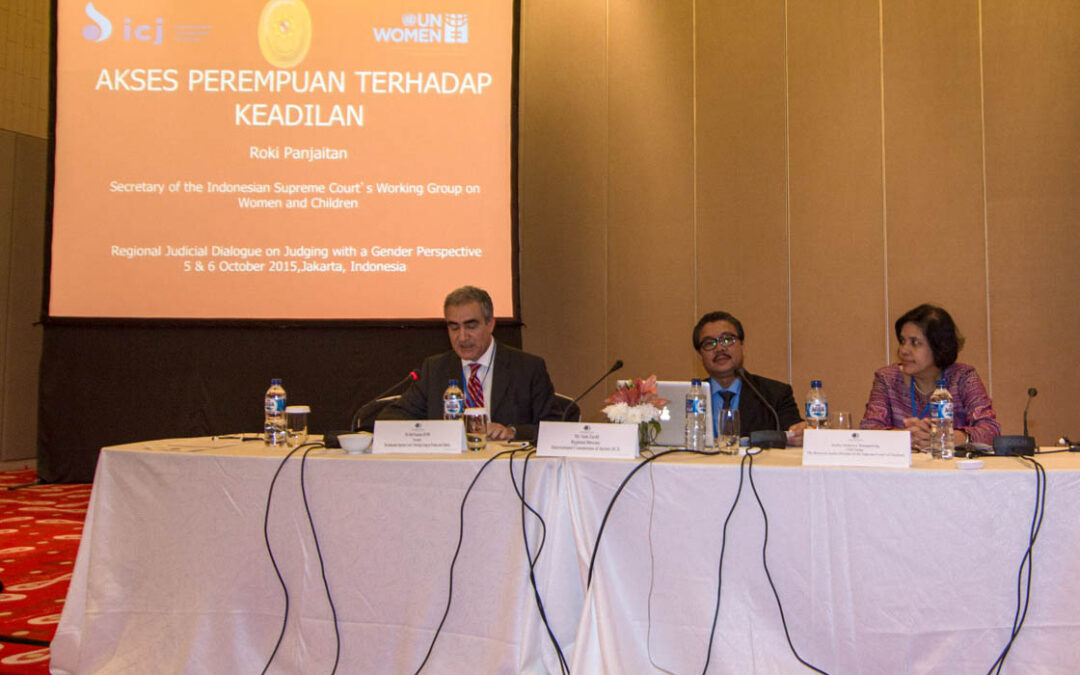
Rights groups and the Indonesian Supreme Court convene regional judicial dialogue on judging with a gender perspective
Judges and representatives of judicial training institutions from 9 countries across Southeast Asia gathered in Jakarta, Indonesia, to discuss how judicial decision-making can be further strengthened from a gender perspective.
A two-day event (5-6 October 2015), this judicial dialogue, entitled Regional Judicial Dialogue on Judging with a Gender Perspective, was organized by the ICJ, in collaboration with the Supreme Court of Indonesia and UN Women.
Participants discussed key topics such as initiatives of various courts in Southeast Asia that promote and protect women’s human rights, what are gender stereotypes and how gender stereotyping could be avoided in judicial decisions.
Speakers from the Supreme Court of Mexico were invited to speak about the initiative taken by the judiciary in the country to establish a protocol on judging with a gender perspective.
Senior judges from courts in Southeast Asian countries attended the event: Justice Dr. Takdir Rahmadi of the Supreme Court of Indonesia, Justice Suntariya Muanpawong, Chief Judge of the Research Division of the Supreme Court of Thailand; Justice Teresita De Castro of the Supreme Court of the Philippines, Justice Maria Natercia Gusmao Pereira of the Court of Appeal of Timor Leste; and Ms. Natalia Calero Sanches and Ms. Macarena Saez of the Mexican Supreme Court.
This dialogue is aimed at strengthening the participants’ ability to make decisions based on the rights to equality and freedom from discrimination.
UN Women also launched an online interactive platform that seeks to enhance dialogue among judges, prosecutors, court personnel, judicial training institutions, women’s machineries, scholars and other experts in the region.
The platform called, “Equality for All: community of change makers”, will enable users to access tools such as e-discussion forums, blogs and quick fact sheets that offer tailored learning solutions.
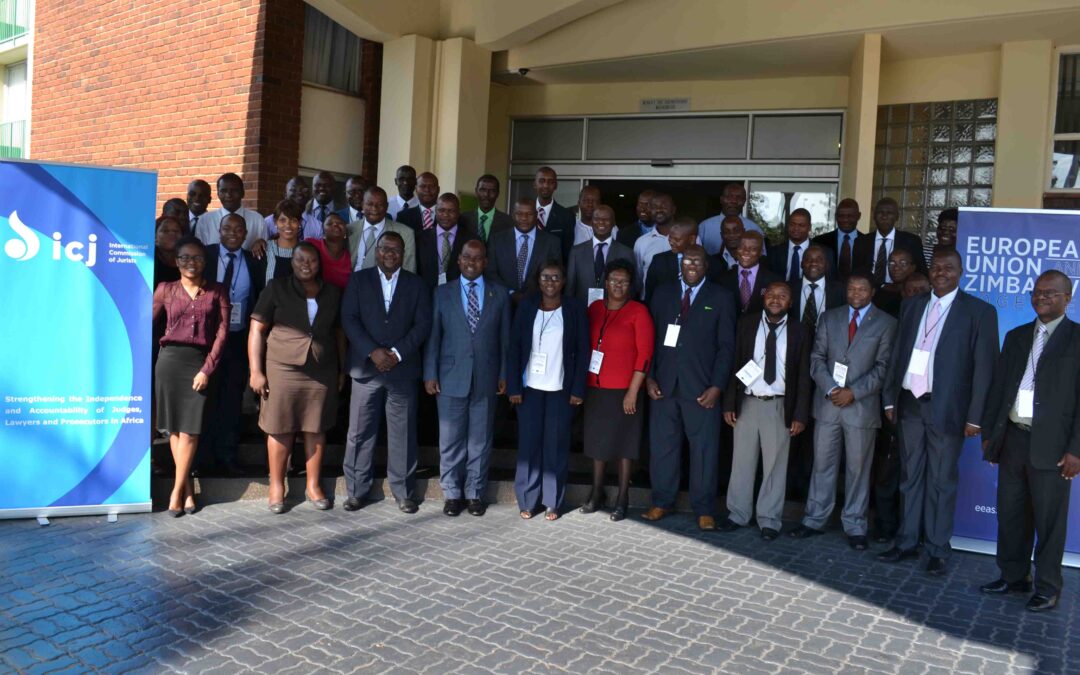
Zimbabwe: prosecutors training of trainers on regulation, code of ethics and prosecutorial guidelines
With support from the European Union (EU) and ICJ, the National Prosecuting Authority (NPA) held the first of two training of trainers in Bulawayo from 2-4 October 2015.
The training focused on regulations, code of ethics and prosecutorial guidelines and was attended by 50 senior prosecutors, senior law officers and office directors in attendance.
The participants are expected to then roll out the training at their various stations to cover the entire 500 women and men strong team of prosecutors.
Prior to adoption of the 2013 Constitution, prosecutors were supervised by the Attorney General under the Ministry of Justice.
Issues in respect of conduct, discipline, appointment, performance appraisal and other related conditions of service were dealt with through the line ministry and civil service commission.
The passage of the Constitution and the enactment of the NPA Act introduced the office of the Prosecutor General equally tasked with regulating the conduct of its staff through the NPA Board or any other delegated authority within the NPA.
The regulations and code of ethics were gazetted on 7 August 2015.
The code of ethics provides for the independence, integrity, propriety, impartiality, political engagement, competence and diligence of prosecutors in Zimbabwe.
The Prosecutor General also developed prosecutorial guidelines as mandated by the Constitution and the NPA Act on the institution of and conducting of criminal proceedings.
The objectives of the training were to equip senior officials with skills to conduct trainings for middle and lower officers to ensure greater compliance with the requirements of the new constitution of Zimbabwe; to familiarize senior officials on the regulations and code of conduct to ensure greater compliance with the requirements of the new constitution of Zimbabwe and to familiarize and train senior officials on the application of prosecutorial guidelines consistent with the requirements of the new constitution of Zimbabwe.
Following the completion of the trainings, the ICJ and NPA will conduct routine and random visits to different stations for purposes of observing the implementation, roll out of trainings and spot checks.
Remote support will also be provided in terms of statutes, such as the NPA Act, the regulations and code of ethics.
Further work is being explored to produce an updated prosecutor’s handbook that covers issues of prosecutorial conduct, ethics and guidelines.
Contact
Arnold Tsunga, ICJ Regional Director for Africa, t: +27 73 131 8411, e: arnold.tsunga(a)icj.org

Ukraine: lawyer Andriy Vishnevsky wrongfully disbarred for exercising freedom of expression
The ICJ is concerned at the recent disbarment of lawyer Andriy Vishnevsky, Director of the Coordination Centre of Legal Aid of the Ministry of Justice of Ukraine.
The ICJ considers that his disbarment, which resulted from his public comments critical of the Ukrainian bar association, interferes with his capacity to freely discharge his professional functions as a lawyer.
Furthermore, it constitutes a violation of his right to freedom of expression, and risks unduly constraining lawyers in legitimate participation in public debate.
The ICJ calls on the Ukrainian bar association to reinstate Andriy Vishnevsky to the bar so that he can resume his status as an accredited lawyer.
Andriy Vishnevky was disbarred on 10 September, following a hearing before the Qualification-Disciplinary Commission of Kiev Region Advokatura. Disciplinary proceedings were initiated based on two separate complaints: one submitted by the Ukrainian national bar association on 24 June 2015; and the other by Ukrainian Parliament Member Rybalka S.V. on 22 June 2015.
The complainants alleged that Andriy Vishnevsky “humiliated the bar, every lawyer, destroyed respect of the society to the bar in the State, in contradiction with the European standards”.
They cited his comments made at a conference on 15 June 2015 at the premises of the Supreme Court of Ukraine, where he presented his report “The bar and free legal aid: approaches to the reform”.
He made a number of comments critical of the legal profession.
These included his assessment that the bar association was “in a dire state”; a reference to “low ethical standards and professional level of the bar”, including that lawyers are “the main corruption element”; and a claim that “the phenomenon of police lawyers is not counteracted by the national bar association and not commented upon in any way”.
The decision quoted him as saying that “if the bar is not reformed as soon as possible in accordance with the principles and standards of the Council of Europe, it can become a hindrance to the implementation of the judicial reform”.
The Disciplinary Chamber came to the decision that the statements of Andriy Vishnevsky were contrary to the law and the Code of Lawyers’ Ethics and that he should therefore be disbarred for the statements made during the conference.
The ICJ considers the Chamber’s decision to contravene fundamental and universal principles on the independence of the legal profession.
If applied generally, this interpretation of the Code of Ethics would effectively prevent lawyers from critically debating the governance of the legal profession.
The UN Basic Principles on the Role of Lawyers provide that while lawyers should “maintain the honour and dignity of their profession as essential agents of justice” they, like other persons, “shall have the right to take part in public discussion of matters concerning the law, the administration of justice and the promotion and protection of human rights.”
The right to freedom of expression is protected in international human rights law, including the International Covenant on Civil and Political rights and the European Convention on Human Rights, treaties to which Ukraine is a party.
Under the European Convention on Human Rights, where matters of public interest are discussed there is a particularly narrow scope for restriction of freedom of expression.
Disciplinary action against a lawyer, solely on the grounds of comments critical of the bar association, made at a conference convened to debate aspects of the justice system, amounts to an illegitimate interference with freedom of expression.
The ICJ is concerned that such punitive measures are likely to have a chilling effect on freedom of expression of lawyers in Ukraine and in particular on their ability to engage in debate on reform of the justice system.
It is important, for any justice system, that such debate take place with the active participation of the legal profession, as lawyers are amongst those best placed to identify and criticize the deficiencies of the justice system and make informed proposals for reform.
The ICJ calls on the Ukrainian bar association to reinstate Andriy Vishnevsky as a lawyer.
Furthermore, the ICJ recommends that the interpretation of the Code of Ethics should be reviewed and guidance should be issued to ensure that the Code of Ethics is not applied to stifle public debate among lawyers on ways to reform the justice system in Ukraine.
Contact:
Róisín Pillay, Director, Europe Programme, roisin.pillay(a)icj.org
Temur Shakirov, Legal Adviser, Europe Programme, temur.shakirov(a)icj.org
The full statement with background information can be downloaded here:
Ukraine-Lawyer Vishnevsky statement-News-web story-2015-ENG (in PDF)
Ukraine-Lawyer Vishnevsky statement-News-web story-2015-UKR (Ukrainian version, in PDF)
Таджикистан: МКЮ обеспокоена арестом адвоката
МКЮ встревожена арестом таджикского адвоката Бузургмехра Ёрова.
Арест г-на Ёрова может быть связан с тем, что он представляет интересы тринадцати членов руководства Партии исламского возрождения Таджикистана (ПИВТ).
Это уже третий случай ареста адвоката в Таджикистане за последнее время, и особенности этих арестов вызывают серьёзную обеспокоенность с точки зрения защиты прав человека и соблюдения международных стандартов, касающихся роли адвокатов.
В 10 часов утра 28 сентября в офис адвокатской конторы «Сипар», которую возглавляет Бузургмехр Ёров, прибыли сотрудники милиции. Они изъяли документы по делу членов ПИВТ, интересы которых представляет г-н Ёров. Около 14.00 другие сотрудники МВД задержали адвоката в его офисе, заявив, что ему необходимо ответить на ряд вопросов. Впоследствии адвокат сообщил по телефону о своём аресте и заключении под стражу.
29 сентября Министерство внутренних дел Таджикистана опубликовало пресс-релиз, согласно которому Бузургмехр Ёров «путём мошенничества присвоил себе денежные средства граждан в особо крупном размере».
Согласно заявлению Министерства внутренних дел, житель г. Истаравшана Комилджон Бозоров уплатил адвокату 4000 долларов США, чтобы тот помог добиться положительного исхода по делу его сына, обвиняемого в покушении на убийство. Предположительно, г-н Бозоров заявил о том, что адвокат не оказал ему никакой правовой помощи, «злоупотребив его доверием и воспользовавшись его сложной ситуацией».
Кроме того, г-н Ёров обвиняется в подделке документов в отношении технического состояния автомобиля.
МКЮ опасается, что на деле решение о задержании адвоката Бузургмехра Ёрова связано с тем, что он защищал интересы членов ПИВТ.
МКЮ напоминает о том, что в соответствии с Основными принципами ООН, касающимися роли юристов, «(ю)ристы не отождествляются со своими клиентами или интересами своих клиентов в результате выполнения ими своих функций»; они должны иметь возможность «выполнять все свои профессиональные обязанности в обстановке, свободной от угроз, препятствий, запугивания или неоправданного вмешательства»; юристы не должны подвергаться «судебному преследованию и судебным, административным, экономическим или другим санкциям за любые действия, совершенные в соответствии с признанными профессиональными обязанностями, нормами и этикой, а также угрозам такого преследования и санкций».
Обеспокоенность, которую вызывает у МКЮ данное дело, отчасти связана с особенно тревожной тенденцией ареста адвокатов, представляющих клиентов по «громким» делам, которую в последнее время можно проследить в Республике Таджикистан.
Необходимо напомнить, что в задачи адвокатов входит защита лиц, обвиняемых в совершении преступлений. Система правосудия не может функционировать в соответствии с международными стандартами, если адвокаты лишены возможности представлять интересы своих подзащитных.
Для защиты права на справедливое судебное разбирательство в соответствии с гарантиями международного права в области прав человека необходимо, чтобы обвиняемые имели доступ к адвокату, который сможет эффективно представлять их интересы в обстановке, свободной от угроз и вмешательства.
МКЮ призывает власти Таджикистана обеспечить, чтобы все адвокаты имели возможность осуществлять свою профессиональную деятельность без страха подвергнуться угрозам или запугиванию, включая произвольное задержание и судебное преследование.
МКЮ призывает следственные органы обеспечить, чтобы Бузургмехр Ёров не подвергался судебному преследованию с целью запугивания или в качестве возмездия за оказание правовой помощи подзащитному, а также чтобы любое производство в его отношении соответствовало международному праву в области прав человека, в том числе праву на справедливое судебное разбирательство, и учитывало международные стандарты, касающиеся роли юристов.
Вне зависимости от того, с чем на самом деле связано задержание адвоката – с ведением дела членов ПИВТ или же с обвинением в мошенничестве, – г-н Ёров должен быть незамедлительно освобождён из-под стражи.
Даже если задержание адвоката действительно связано с обвинением в мошенничестве, МКЮ неизвестно о наличии в деле г-на Ёрова каких-либо доказательств или оснований, которые могли бы оправдать необходимость его длительного досудебного содержания под стражей в свете международных стандартов, касающихся права на свободу и запрета произвольного задержания и заключения под стражу.
Общая информация:
Тринадцать граждан, интересы которых представляет Бузургмехр Ёров, были арестованы 16-17 сентября 2015 года в связи с вооруженными нападениями в Душанбе и Вахдате, совершёнными в этом году.
Членам ПИВТ вменяется «создание преступного сообщества (преступной организации) для совершения тяжких или особо тяжких преступлений», наказуемое по статье 187, часть 1 Уголовного кодекса Республики Таджикистан.
Арест и заключение под стражу г-на Ёрова – уже третий случай судебного преследования адвоката, представляющего интересы подзащитных по «громкому делу», в Таджикистане за последние два года. 13 января 2015 года адвокат Шухрат Кудратов был приговорён к 9 годам лишения свободы по обвинению в мошенничестве и получении взятки.
В 2014 году еще один адвокат, Фахриддин Зокиров, был задержан и предстал перед судом по обвинению в мошенничестве при совершении банковских операций. В ноябре 2014 года он вышел на свободу по амнистии.
Tajikistan-Lawyer Yorov statement-News-web stories-2015-RUS (полный текст на русском, PDF)
Дополнительную информацию имеется в пресс-релизах МКЮ:
Таджикистан: Арест адвоката угрожает независимости профессии
Recent News
 HRC63: ICJ Raises Concern over Widespread and Systematic Arbitrary Detention in Egypt16 Sep 2026
 Myanmar: As armed conflict rages and military rule continues, critical measures can be taken towards eventual justice and accountability for victims of Enforced Disappearance10 Sep 2026
 HRC63: ICJ Raises Alarm over Repression in Tunisia and Arbitrary Detention in El Salvador09 Sep 2026
 HRC63: ICJ Calls for Protection of Lawyers and Accountability in Myanmar07 Sep 2026