Feb 5, 2015 | News
The ICJ is concerned by yesterday’s attack on lawyer Murad Magomedov in Makhachkala, near the Supreme Court of Dagestan building. The ICJ calls on the authorities to take effective measures to guarantee the security of lawyer Magomedov.
The attack took place during a break in a Supreme Court hearing in which Murad Magomedov was defending his client, Akhmed Israpilov, on charges of terrorism.
The lawyer was severely beaten by a group of five people, and sustained serious head injuries.
He was taken to the Republican Central Clinical Hospital, where he remains, recovering from concussion, multiple injuries and fractures of the jaw.
“This is yet another in a series of physical attacks against lawyers in Dagestan and shows the urgent need for the authorities to take effective measures to protect lawyers in the region,” Temur Shakirov, ICJ Legal Adviser, said today. “Both local and federal authorities in the Russian Federation must ensure a prompt investigation leading to those responsible for this violent act being brought to justice.”
The UN Basic Principles on the Role of Lawyer provide that “where the security of lawyers is threatened as a result of discharging their functions, they shall be adequately safeguarded by the authorities”.
Under international human rights law, the State must take steps to protect the security of persons who the authorities know or ought to know are under threat, and must ensure an independent, prompt, and thorough investigation of any attacks on the life or physical integrity of individuals.
Murad Magomedov has worked as a lawyer with “Memorial” Human Rights Centre since autumn 2014 and represents individuals affected by of a “special operation” in Dagestan’s Vremenyi village in September 2014. In this case Magomedov does not act as a Memorial representative.
The ICJ has previously highlighted cases of assault and killing of lawyers in Dagestan.
Contact:
Róisín Pillay, Director, Europe Programme, roisin.pillay(a)icj.org
Temur Shakirov, Legal Adviser, Europe Programme, temur.shakirov(a)icj.org
Feb 3, 2015 | News
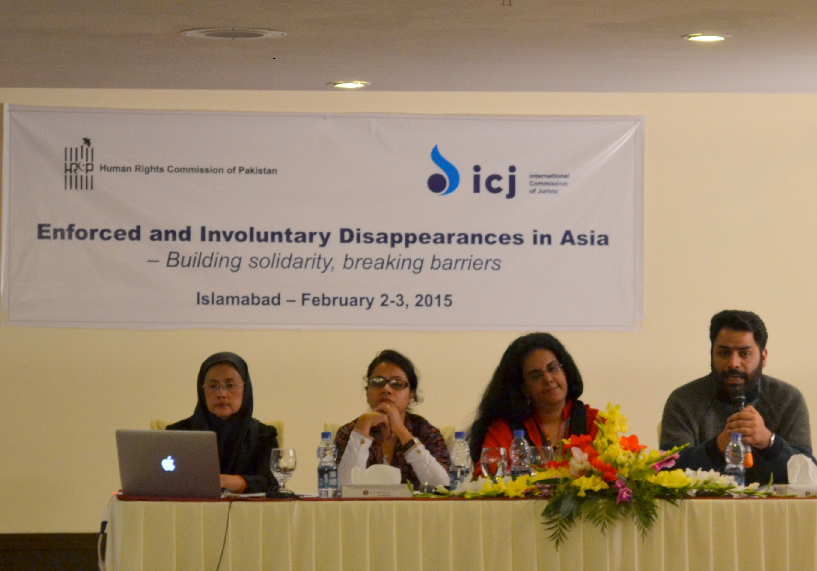
In partnership with the Human Rights Commission of Pakistan (HRCP), the ICJ convened a two-day conference in Islamabad on 2-3 February 2015.
The conference brought together civil society activists, lawyers and journalists from across Asia, including Thailand, the Philippines, Sri Lanka, India, Nepal and Pakistan with experience of working on enforced disappearances in the their national contexts as well as regional and international forums.
The participants expressed alarm at the continuing practice of enforced disappearances in the region and regretted that a culture of moral, political and legal impunity prevented perpetrators to be brought to justice.
They also urged their respective states to promptly ratify the International Convention for the Protection of all Persons from Enforced Disappearance, criminalize enforced disappearances, and meet their obligations under international law to provide remedy and reparations for human rights violations.
At the end of the two-day event, the participants of the conference adopted a resolution (download below) resolving to work together to address the common challenges and hurdles they encounter in their work on enforced disappearances.
Asia-Enforced disappearances Resolution final-Advocacy-2015-ENG (full text in PDF)
Asia-Enforced disappearances Resolution final-Advocacy-2015-URD (full text in PDF)
Feb 3, 2015 | Multimedia items, News, Video clips
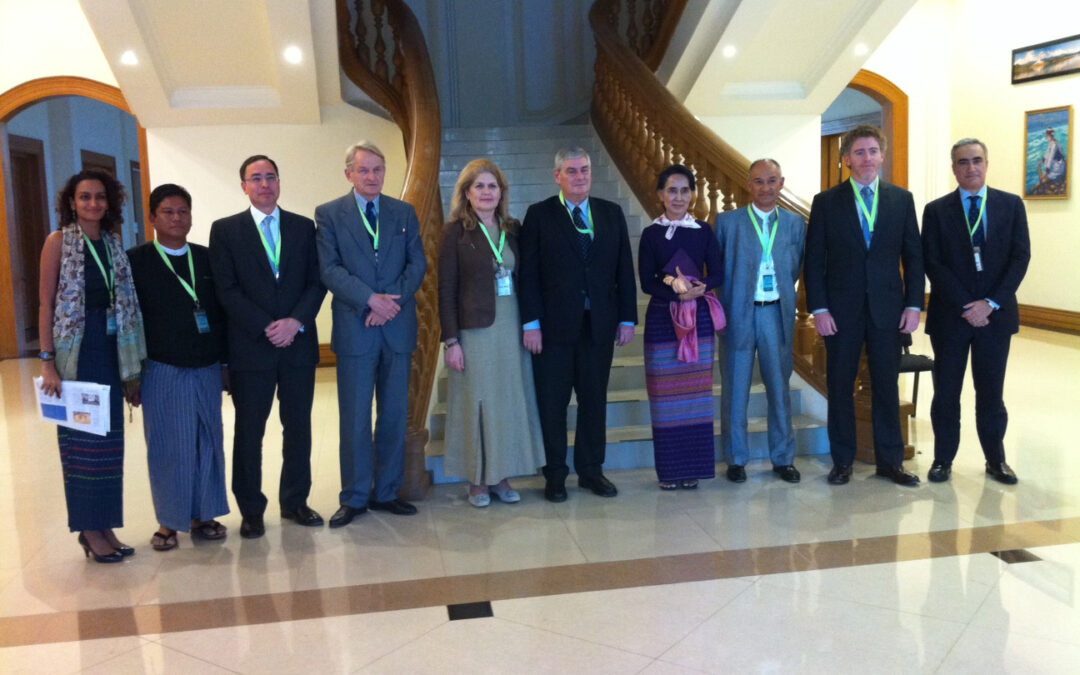
On video, ICJ Commissioner Azhar Cachalia and ICJ Asia & Pacific Regional Director Sam Zarifi, talk about a workshop with the Supreme Court of the Union of Myanmar. In parallel with this event, the ICJ met with Daw Aung San Suu Kyi.
The ICJ’s workshop with the Supreme Court of the Union of Myanmar was on the subject of judicial ethics and the rule of law, while at the meeting with Daw Aung San Suu Kyi, discussions covered the ICJ’s focus in Myanmar to support the judiciary in taking important steps towards asserting its independence from other branches of government; and to overcome significant individual and institutional obstacles, such as undue influence by the Executive in politically sensitive and criminal cases, corruption and a lack of resources.
Daw Suu and her colleagues shared information about the Rule of law Centres being initiated as a step towards building the capacity of local legal practitioners and contributing to rule of law reforms in Myanmar.
The ICJ delegation was led by Secretary-General Wilder Tayler, and included Asia & Pacific Regional Director Sam Zarifi, ICJ Commissioners Justices Azhar Cachalia, Ketil Lund and Radmila Dicic, International Legal Advisers Vani Sathisan and Daniel Aguirre and National Legal Adviser Kyawmin San.
Daw Aung San Suu Kyi is the Chairperson of the Lower House Committee for Rule of Law, Peace and Tranquility in the Myanmar Parliament and Chairperson of the National League for Democracy, and members of her Committee. She was awarded the Nobel Peace Prize in 1991.
Justice Azhar Cachalia, ICJ Commissioner and Chair of ICJ’s Executive Committee, talks about his participation in, and contribution to, an ICJ workshop with the Supreme Court of Myanmar.
Sam Zarifi, Director of ICJ’s Asia & Pacific Programme talks about ICJ’s workshop with the Supreme Court of Myanmar

Feb 3, 2015 | News
The ICJ condemns yesterday’s decision of the Giza Felonies Court to confirm the death sentences of 183 individuals that had been simultaneously imposed in one mass trial.
The charges include murder, mutilation and attempted murder and relate to an attack on a police station in Kerdasa that took place in August 2013.
According to the ICJ, the trial has involved a litany of violations of fair trial rights, including denying many of the accused the right to legal counsel, denying the right to a public hearing, refusing to allow defence witnesses to testify, prohibiting the cross-examination of prosecution witnesses by defence counsel, and failing to produce credible evidence as to the individual guilt of each accused.
“Once again, Egypt’s judiciary has abdicated its fundamental responsibility to uphold the rule of law and human rights, instead resorting to unfair mass trials and death sentences as a technique to suppress dissent and to crack down on critics of the military and Government,” said Said Benarbia, Director of the ICJ MENA Programme.
“Egypt’s judiciary must act independently, impartially, with integrity and as a check against the Executive’s arbitrary powers and policies, not as a tool to implement them,” he added.
The imposition of death sentences following unfair mass trials constitutes a gross violation of Egypt’s obligations under international human rights law, including those relating to the right to life, the prohibition of torture and other cruel, inhuman or degrading treatment or punishment, and fair trial rights.
The ICJ opposes the use of the death penalty in all circumstances as a violation of the right to life and a form of cruel, inhuman and degrading punishment.
The UN General Assembly has repeatedly, by a large majority, called for a moratorium on its use.
Even those states that retain the death penalty have acknowledged that any imposition of the death penalty through a process that fails to meet the most stringent fair trial standards, inherently violates the right to life.
Contact:
Said Benarbia, ICJ Director of the ICJ Middle East and North Africa Programme, t: 41 22 979 38 17, e: said.benarbia(a)icj.org

Feb 3, 2015 | News
On 2 February, the ICJ observed the trial of lawyer Kalid Baghirov, before the Nizami District Court of Baku.
In the case, the Azerbaijan Collegium of Lawyers seeks disbarment of the prominent lawyer (photo), who recently acted in a number of high profile cases in Azerbaijan, including on behalf of human rights defenders.
Following a letter of the Sheki Court of Appeal alleging misconduct by Khalid Baghirov during the trial against Ilgar Mammadov, leader of the “Republican Alternative” movement and former presidential candidate, on 10 December 2014 the Presidium of the Collegium of Lawyers suspended Khalid Baghirov’s practice.
At the same time, the Presidium applied to the Nizami District Court seeking complete termination of his right to practice law. The Court accepted the case for consideration.
The ICJ commissioned an international observer, Liliya Vigel, a lawyer practicing in the Republic of Uzbekistan, to observe the hearing in the case before the Nizami District Court.
The ICJ observer also met with the representative of the Collegium of Lawyers, with lawyer Baghirov, with members of the Presidium of the Collegium, and with a number of non-governmental organizations to collect information about the case.
The ICJ continues to monitor the case in relation to international standards on human rights and the rule of law, including as regards respect for the role of lawyers, and plans to publish a report on the proceedings in due course.
Contact:
Róisín Pillay, Director, Europe Programme, roisin.pillay(a)icj.org
Temur Shakirov, Legal Adviser, Europe Programme, temur.shakirov(a)icj.org