
Bulgaria: ICJ raises concern at dismissal of Judge Todorova
The ICJ today expressed its concern at the dismissal of Judge Miroslava Todorova, a judge of the Sofia City Court, and Chairperson of the Bulgarian Judges Association.

The ICJ today expressed its concern at the dismissal of Judge Miroslava Todorova, a judge of the Sofia City Court, and Chairperson of the Bulgarian Judges Association.

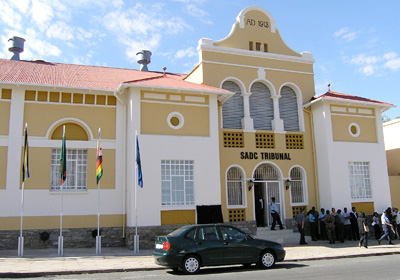 L’ICJ, SADC LA et SALC expriment leur très profonde déception quant à la décision prise par le Sommet des Chefs d’Etats et de Gouvernements de la Communauté de développement de l’Afrique australe (SADC) sur le Tribunal de la SADC.
Une telle décision prive le peuple de la SADC du droit d’accéder au Tribunal pour obtenir justice, estiment les trois organisations.
Le Communiqué Final du Sommet relève que les Présidents de la sous-région ont “décidé qu’un nouveau protocole sur le Tribunal soit négocié et que la compétence de ce dernier soit confinée à l’interprétation du Traité de la SADC et aux Protocoles prévoyant le règlement des disputes entre Etats-membres.
Cette décision torpille sérieusement un organe à part entière de la SADC – le Tribunal actuellement établi – et prive le peuple de la SADC du droit d’accéder au Tribunal pour obtenir justice.
Tribunal SADC décision-nouvelle web 2012 (Communiqué complet en FR, PDF)
Photo: Salc bloggers
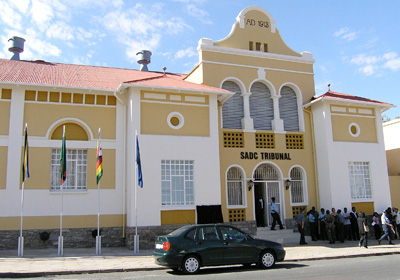
The ICJ and other human rights and legal groups say that the the SADC Summit of Heads of State’s decision on SADC Tribunal denies the SADC people the right to approach the court for justice.The ICJ, SADC LA and SALC express their deepest disappointment at the decision taken by the SADC Summit of Heads of State and Government on the SADC Tribunal.
The Summit’s Final Communiqué explains that the region’s leaders had “resolved that a new protocol on the Tribunal should be negotiated and that its mandate should be confined to interpretation of the SADC Treaty and Protocols relating to disputes between member states”.
That decision effectively destroys an integral SADC organ – the currently established Tribunal – and denies the SADC people the right to approach the court for justice.
It is, as Archbishop Emeritus Desmond Tutu observes, “a tragedy. It is a blow against accountable government and individual rights.”
SADC Tribunal decision-web story 2012 (Download in English)
Photo: Salc bloggers

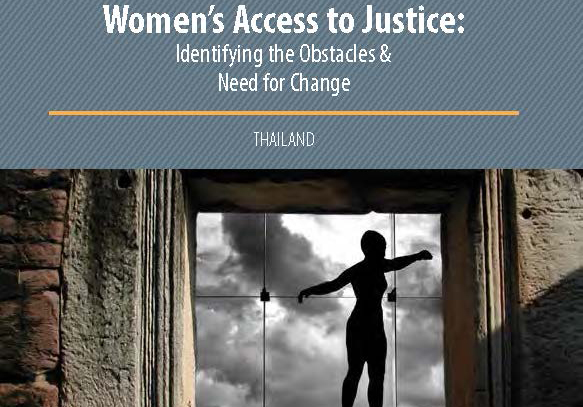 In a new report released today, the ICJ and Justice for Peace Foundation (JPF) call for a series of changes in law, practice, approach and behaviour to address the justice needs of women across Thailand.

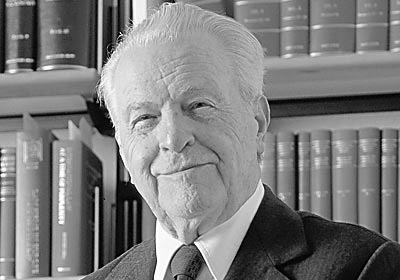 It is with great sadness that the International Commission of Jurists received the news of the passing of Dr. Jean-Flavien Lalive. He was one of the pillars of our organisation in its early days.
Dr. Lalive was involved in the work of the ICJ for over fifty years. As the Secretary-General from 1958 to 1961, Dr. Lalive played a vital role in establishing our organization in the international human rights community. He is especially noted for bringing the ICJ closer to the United Nations, both in terms of the organization’s political relationships and our physical location. Under his leadership, the ICJ gave more pronounced support for the international standards and enforcement procedures advocated by the UN. He was also responsible for moving the ICJ Secretariat’s headquarters from The Hague to Geneva, where it remains to this day.
While at the ICJ, Dr. Lalive continued to direct the organization’s efforts towards the search for universal procedural and substantive safeguards required for the proper administration of justice, while seeking to encompass the world’s different legal traditions. At the ICJ’s Congress in New Delhi in 1959, Dr. Lalive helped to define principles of the Rule of Law and Human Rights. The Declaration of Delhi, in particular, was to prove a seminal instrument in shaping the Rule of Law, with its conception of the Rule of Law as “a dynamic concept for the expansion and fulfillment of which jurists are primarily responsible and which should employed…to safeguard and advance [human] rights.”
Dr. Lalive later served as an Honorary Member of the ICJ, supporting the work of our organization at conferences and missions over many decades.
Dr. Lalive was an outstanding jurist and an exceptional advocate for human rights and the Rule of Law. He will be truly missed both by our organization and the wider human rights community.
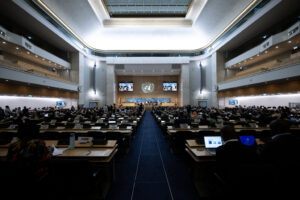 HRC63: ICJ Calls for Renewal and Strengthening of the Venezuela Fact-Finding Mission
 Joint Statement: Attacks on the Rule of Law, Judicial Independence and Access to Justice in Zambia
 HRC63: ICJ Raises Concern over Widespread and Systematic Arbitrary Detention in Egypt
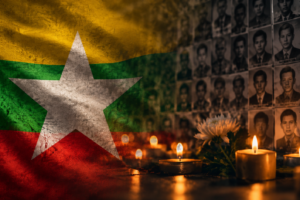 Myanmar: As armed conflict rages and military rule continues, critical measures can be taken towards eventual justice and accountability for victims of Enforced Disappearance