Aug 27, 2020 | Advocacy, News
The ICJ, in collaboration with the Zimbabwe Anti-Corruption Commission (ZACC), convened a virtual Asset Recovery Training Workshop from 18-26 August. The training was part of the ICJ efforts to advance the rule of law in Zimbabwe.
The training was held with investigators from ZACC. It was led by Dr Prosper Maguchu, a legal expert on human rights and financial crimes.
The objective of the training was to enhance the capacity of ZACC investigators to conduct financial investigations and apply asset tracing techniques in relation to corruption and money laundering cases.
Over the past 50 years, it is estimated that Africa has lost in excess of one trillion US dollars in illicit financial flows (IFFs) with claims that this is roughly equivalent to all of the official development assistance received by the continent during the same timeframe.
Zimbabwe is not immune to this challenge of IFFs.
ZACC chairperson Justice Loice Matanda-Moyo remarked that financial crimes and illicit financial flows had become a serious threat the Zimbabwe economy and beyond our borders. She pointed to the prevalence of tax evasion, smuggling, corruption, fraud, drug trafficking and money laundering and noted that ill-gotten proceeds involving money were moving across borders. In such instances it is a daunting task for investigators and asset recovery officers to follow the money trails and recover proceeds of crime. She noted that the virtual asset recovery workshop was an opportune moment time to enhance the capacity of investigators and asset recovery officers.
“This training was very timely and critical. It enhanced the capacity of ZACC in its pursuit to recover assets accumulated though corruption. The investigators were equipped with the requisite skills and techniques involved in asset recovery that include collecting evidence, issuing restraint and freezing orders and making mutual legal assistance requests. Recovering stolen assets is an important process in the fight against corruption as it deters corruption by turning it into a high-risk, low-reward activity. Additionally, asset recovery is a means to obtain resources for the development of the country, which resources can also be channelled towards strengthening the fight against corruption in Zimbabwe, thus contributing to the greater respect for the rule of law,” said ICJ Senior Legal Adviser Blessing Gorejena.
The training workshop provided a comprehensive overview on what asset recovery means, exploring approaches and tools in asset recovery and enhance the technical capacity of the investigators to trace, seize and confiscate and repatriate illicitly acquired assets.
Participants in this workshop included 18 investigative officers and two Commissioners. Overall there were 11 female and 9 male participants in attendance.
This workshop was supported by the European Union Delegation in Zimbabwe.
Contact:
Shaazia Ebrahim (ICJ media officer), c: +277 167 067 19 e: shaazia.ebrahim(a)icj.org
Vimbai Mutandwa (ICJ legal advisor), c: +263 77 351 7733 e: vimbai.mutandwa(a)icj.org

Aug 21, 2020 | News
The order of the Magistrates’ Court of Zimbabwe barring lawyer Beatrice Mtetwa from continuing as defence legal counsel for journalist Hopewell Chin’ono is a violation of Chin’ono’s right to a fair trial and Mtetwa’s right to express her opinions freely, said the ICJ today.
“Hopewell Chin’ono is already facing persecution because of his reporting on alleged corruption and now his lawyer is prevented from defending him properly. The Magistrate Court’s decision violates Zimbabwe’s domestic, international and regional legal obligations regarding freedom of expression and the right to a fair trial,” said ICJ Secretary General Sam Zarifi.
Hopewell Chin’ono, a prominent Zimbabwean journalist, is currently in custody and is facing trial on charges of inciting public violence, related to his reporting on corruption.
He appointed Beatrice Mtetwa, a prominent Zimbabwean human rights lawyer to act as his defence legal counsel.
After Hopewell Chin’ono was denied bail, it is alleged that a Facebook page by the name “Beatrice Mtetwa and The Rule of Law” posted the following statements:
“Where is the outrage from the international community that Hopewell Chin’ono is being held as a political prisoner? His life is in serious peril. Raise awareness about his unlawful imprisonment. Do not let him to be forgotten. You or someone you love could be the next one abducted from your home and put in leg irons.”
On account of these alleged statements and at the instance of an application by the State, the Magistrates’ court barred Beatrice Mtetwa from continuing as defense legal counsel on grounds that she made statements which demonstrates that “she is no longer detached from the case to continue appearing in it” and has lost the “requisite objectivity of an officer of the court”.
The full judgment by the court can be accessed here.
Beatrice Mtetwa denied ownership of or control over the said Facebook page. Filmmaker Lorie Conway is listed as the only administrator of the said Facebook page. Despite this, the Magistrate’s Court ruled that Beatrice Mtetwa is aware of the page, approved its creation and therefore, these statements are attributable to her.
“Regardless of whether or not these statements can be attributed to Beatrice Mtetwa, the International Commission of Jurists is concerned about the chilling effect which the judgment has on the exercise of freedom of expression by lawyers, the accused persons’ right to legal representation and the right to fair trial. The judgment seems to suggest that if a lawyer makes public statements such as those allegedly attributed to Beatrice Mtetwa, the lawyer should be barred from continuing as legal counsel in the matter—and that is contrary to international standards regarding the role of lawyers,” Zarifi said.
This right is underscored in Principle 23 of the United Nations Basic Principles on the Role of Lawyers which states that:
“Lawyers like other citizens are entitled to freedom of expression, belief, association and assembly. In particular, they shall have the right to take part in public discussion of matters concerning the law, the administration of justice and the promotion and protection of human rights…”
The right to legal representation is recognised in section 70(1)(d) of the Constitution of Zimbabwe. This guarantees an accused person the right to appoint a legal practitioner of their choice to act as their defence attorney. The same right is underscored in article 14(3)(b) of the ICCPR and article 7(1) of the African Charter. The right to legal representation is an integral element of the right to fair trial as elaborately explained under the Principles and Guidelines on the Right to a Fair Trial and Legal Assistance in Africa.
Contact
Shaazia Ebrahim (Media Officer) email: Shaazia.Ebrahim(a)icj.org

Jul 31, 2020 | Agendas, Events, News
The ICJ, together with the Global Initiative on Economic, Social and Cultural Rights (GI-ESCR) and the Right to Education Initiative (RTE), held webinars on 24 and 31 July.
The discussions explored The Guiding Principles on the Human Rights Obligations of States to provide public education and to regulate private involvement in education (Abidjan Principles) and their application in the context of COVID-19.
The webinars focused respectively on public education and private education.
Participants included judges and representatives of civil society organizations from Kenya, Uganda, South Africa and Sierra Leone.
“The aim of the conversation in these webinars is to better understand the problems facing civil society and judiciaries in the four countries in ensuring the protection of the right to education in the context of Covid-19 and the increased privatization of education,” said ICJ Commissioner Justice Jamesina King of Sierra Leone.
The Abidjan Principles, based in large measures on existing international law and standards, were developed by leading international experts and adopted in 2019.
They clarify and set out elements of State obligations to uphold the right to education and related standards in both public and private educational settings.
Participants were able to deepen their understanding of the Abidjan Principles as well as the increased pressure placed on education systems across Africa as a result of COVID-19.
“COVID-19 has dramatically exacerbated already well-known issues in the realization of the right to education” and the “divide in quality of access to education between public and private sectors,” added Justice King.
“Private actors in particular… have been reported to have capitalized on the pandemic to extend their business in the education sectors.”
Participants raised concerns about the use of public funds to support private actors in education, an issue which is addressed by the Abidjan Principles.
Ashina Mtsumi from the GI-ESCR, summarized the Abidjan Principles and emphasized that “States’ first priority should be public education, as there is no obligation for states to fund private actors in education.”
A theme emerging from the discussions was the important role of the State in regulating private actors in education in the context of the global pandemic. Judges discussed the role of the judiciaries in their respective countries in ensuring the protection of the right to education.
“Can courts force private institutions to continue [operating] or even reduce school fees as an incidence of the right to education?,” Justice Joel Ngugi of Kenya asked.
Justice Ngugi also highlighted the need for governments to ensure that schools are safe for all learners in the context of COVID-19.
Judge Lydia Mugambe said that while in Uganda the pandemic had seen some private schools continuing with online learning, learners in public schools had had to depend on State provision of learning through newspapers and news stations which had not been sufficient. In the COVID-19 context, States must ensure that they continue to “require private instructional educational institutions to meet the minimum standards set by the State”, as indicated by the Abidjan Principles.
“The real problem is that our infrastructure is bad, the education system is bad and we have had a constitutional right to education since 1994 and I am embarrassed to say that the Covid-19 crisis has not exacerbated the problems, but has exposed the problems and have left no place to hide for years and years of government negligence,” said former Justice of the Constitutional Court in South Africa Zak Yacoob.
Representative from civil society organizations from all four countries emphasized the increasing risks introduced to the right to education as a result of privatization of education in Africa.
Watch the first webinar here.
Contact:
Khanyo Farisè (ICJ Legal Adviser) e: Nokukhanya.Farise(a)icj.org
Tim Fish Hodgson (ICJ Legal Adviser) t: +27828719905; e: timothy.hodgson(a)icj.org
Jul 10, 2020 | Advocacy, Non-legal submissions
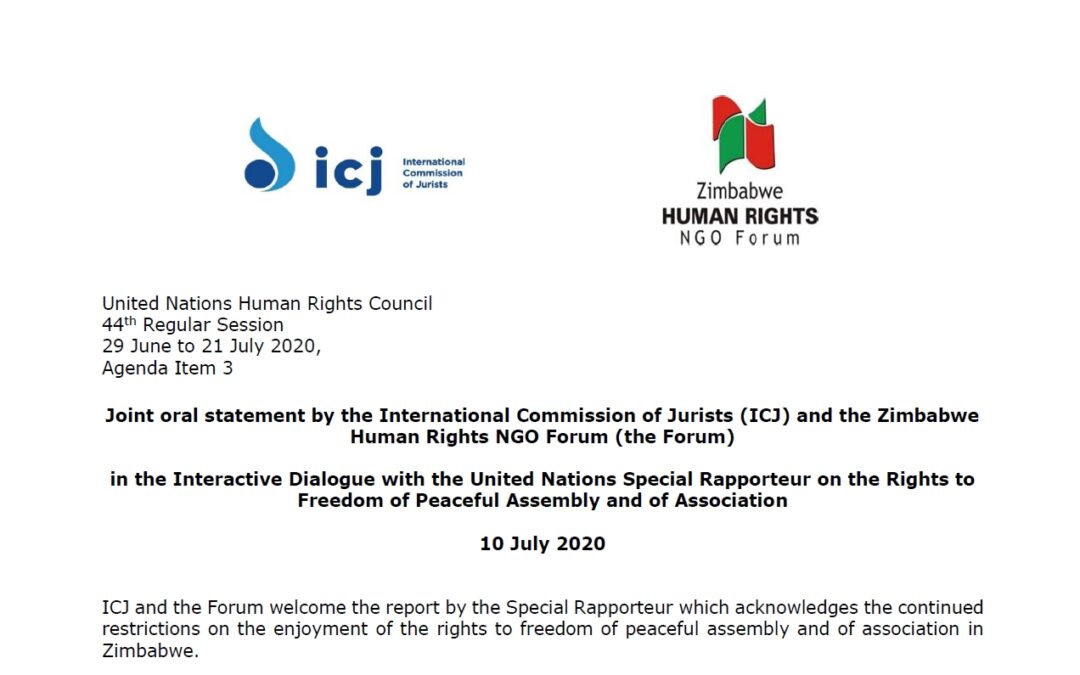
The ICJ and the Zimbabwe Human Rights NGO Forum highlighted today concerns on freedom of association and assembly in Zimbabwe, on the occasion of discussion by the Human Rights Council of a report of the relevant UN expert’s visit to the country.
The statement was prepared for delivery in an oral interactive dialogue with the UN Special Rapporteur on freedom of association and assembly on his reports to the Human Rights Council, including the report of his visit to Zimbabwe in September 2019.
The statement could not actually be read aloud due to the limited time for civil society statements in the dialogue.
The joint statement reads as follows:
“ICJ and the Forum welcome the report by the Special Rapporteur which acknowledges the continued restrictions on the enjoyment of the rights to freedom of peaceful assembly and of association in Zimbabwe.
The report mentions the use of excessive and lethal force by security forces; the use of military forces in managing protest; and the subsistence of repressive laws that curtail the enjoyment of the rights to Freedom of assembly and association.
ICJ and the Forum agree with the findings by the Special Rapporteur that the use of disproportionate and excessive force by the security has resulted in massive violations against protestors. In January 2019 following the “shutdown protests”, the Forum documented at least 1800 violations including 17 killings, 16 cases of rape and 81 victims were treated for gunshot wounds while ICJ documented at least 77 incidences of violation of fair trial rights of protestors.
The Maintenance of Peace and Order Act [Chapter 11:23] (MOPA) was enacted into law in November 2019 to repeal the Public Order and Security Act (POSA). MOPA reveal common similarities with POSA and maintains problematic provisions that do not guarantee the right to peaceful assembly.
ICJ and the Forum wish to draw the attention of the Special Rapporteur to the ongoing violations which have escalated in the context of the COVID-19 lockdown enforcement and the declining economic and social situation in Zimbabwe. While public health measures are crucial, these must be advanced in ways that do not unduly infringe on the rights to freedom of peaceful assembly and of association.
The government of Zimbabwe must be encouraged to comply with International human rights standards and guidelines such as the Guidelines for the Policing of Assemblies by Law Enforcement Officials in Africa; the United Nations Basic Principles on the Use of Force and firearms by law enforcement officials and the 10 principles for the Proper Management of Assemblies developed by the mandate in 2016.
ICJ and the Forum would to like to ask the SR what follow up he will do to monitor whether the Government of Zimbabwe complies with its international human rights obligations?”
The statement can be downloaded in PDF format here: UN-HRC44-statement-SRFoAA-2020
Jun 9, 2020 | News
As of 9 June, at least ten prominent lawyers have been arrested and criminally charged in Zimbabwe.
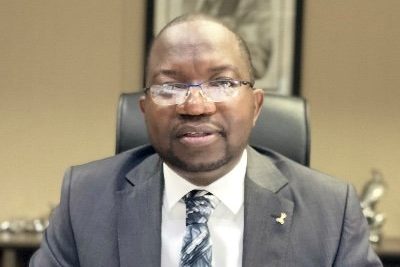
Among them, Advocate Thabani Mpofu (photo), Advocate Choice Damiso, Mr Tapiwa Makanza and Mr Joshua Chirambwe have been arrested and charged with the crime of defeating or obstructing the course of justice.
These lawyers are alleged to have falsified information in the papers filed in a legal matter in which they were representing a citizen, who was challenging the legality of President Mnangagwa’s decision to appoint Mr Kumbirai Hodzi as the Prosecutor General.
Mr Dumisani Dube was arrested on similar charges but his charges arise from a different case.
Mr Patrick Tererai was charged with disorderly conduct after he demanded access to his client who had been detained at a police station.
The ICJ notes that the criminal charges laid against all the six lawyers are linked to the performance of their duties as legal practitioners.
The ICJ reminds the Government of Zimbabwe of its domestic and international obligations pertaining to the right to fair trial and protection of the independence of lawyers, as underscored in the United Nations Basic Principles on the Role of Lawyers and the African Commission on Human and Peoples’ Rights Principles and Guidelines on the Right to a Fair Trial and Legal Assistance in Africa
These elaborate standards relevant to the right to a fair trial including under article 14 of the International Covenant on Civil and Political Rights (ICCPR) and article 7 of the African Charter on Human and Peoples’ Rights.
Of particular significance is Principle 16 of the UN Basic Principles which states that “Governments shall ensure that lawyers are able to perform all of their professional functions without intimidation, hindrance, harassment or improper interference;…. and [lawyers] shall not suffer, or be threatened with, prosecution or administrative, economic or other sanctions for any action taken in accordance with recognized professional duties, standards and ethics.”
In addition, Principle 20 provides that “Lawyers shall enjoy civil and penal immunity for relevant statements made in good faith in written or oral pleadings or in their professional appearances before a court, tribunal or other legal or administrative authority.” Similar provisions are included in Part I of the African Principles and Guidelines.
A lawyer would not generally be immune from criminal proceedings where allegations of perjury or intentionally providing false information to a court were well-founded.
In relation to this recent group of cases, the Law Society of Zimbabwe has expressed the concern that the arrests appear calculated to hinder the members of the profession from undertaking their professional duties.
In this context, the ICJ calls upon the Government of Zimbabwe to ensure that the right to fair trial for these lawyers is fully respected and that the criminal charges brought against these lawyers are not abused to subvert the independence of the legal profession.
“The arrest of ten lawyers within one week on criminal allegations arising from the performance of their duties as legal practitioners is a cause of concern. The state must ensure that these cases are handled fairly and that the criminal justice system is not abused to harass and intimidate lawyers who represent clients who are perceived as political opposition to the sitting government,” said ICJ Africa Director Arnold Tsunga.
Of late, Advocate Thabani Mpofu has represented opposition leader Mr Nelson Chamisa in a series of cases. These include the presidential election petition and the cases in which Mr Chamisa’s rise to the leadership of the opposition party has been challenged.
Contact
Arnold Tsunga, Director of the ICJ Africa Regional Programme, t: +263 77 728 3248, e: arnold.tsunga(a)icj.org