Sep 30, 2019 | Advocacy, Non-legal submissions
The ICJ has made a submission to the UN Human Rights Committee in advance of its forthcoming examination of Pakistan’s follow-up report under International Covenant on Civil and Political Rights (ICCPR).
In its submission, the ICJ has brought to the Committee’s attention concerns in relation to the following issues:
- Shortcomings in the legal framework relevant to enforced disappearances;
- The continuing practice of enforced disappearances and, in this context, the ongoing impunity of law enforcement and security agencies;
- The promulgation of the Actions (in aid of civil power) Ordinance, 2019; and
- The ineffectiveness of the Commission of Inquiry on Enforced Disappearances.
The Human Rights Committee will examine Pakistan’s follow-up report during its 127th session, which will be held in Geneva from 14 October to 9 November 2019.
The UN Human Rights Committee issued its Concluding Observations in August 2017, following its review in July 2017 of Pakistan’s first periodic report. Among its many recommendations, for follow-up the Committee prioritized recommendations related to the death penalty; enforced disappearances and extrajudicial killings; and freedom of religion, conscience and belief.
The Committee requested Pakistan to provide information on the implementation on these recommendations within one year of the adoption of the Concluding Observations, which was due on in August 2018.
Pakistan submitted its follow up report to the Committee in May 2019.
Download
Pakistan-UNHCR submission-advocacy-non legal submission-2019-ENG(submission in PDF)

Sep 30, 2019 | Advocacy, News, Publications
The ICJ today published a “Strategic Litigation Handbook for Myanmar.” In this, the ICJ seeks to offer an accessible, concise and substantial overview of the conceptual basis and purpose of strategic litigation.
The Handbook shows the potential impacts of strategic litigation in Myanmar, by drawing on experiences from Myanmar and other countries, while recognizing the related challenges and opportunities, as expressed by legal professionals and civil society actors. It is intended to be useful to all legal practitioners and community activists in Myanmar.
While there is no universal definition or conception of ‘strategic litigation,’ the term is typically used to describe litigation whereby the interests may go beyond those of the primary litigants. The various adjudication processes it entails are sometimes referred to as ‘public interest litigation’, ‘impact litigation’, ‘test case litigation’, or ‘community lawyering’. What they all have in common is the idea that courts and the law can be used as part of a campaign to achieve broader change in relation to matters seen to be in the broader public interest.
Part one of the Handbook explores core aspects of strategic litigation, including its origins, key concepts, potential impacts, challenges and forums. In part two, areas of law are identified which offer potential options for strategic litigation actions, including procedures, legislation and constitutional writs. Practical steps for the planning and application of strategic litigation, such as media strategy and case selection, are outlined in part three. Finally, part four of the Handbook discusses related challenges in the Myanmar context, including a discussion of requisite reforms required in the justice sector more broadly.
The Handbook (first edition) is published in Burmese and English.

Sep 27, 2019 | News
ICJ today denounced the promulgation of the Khyber Pakhtunkhwa Actions (In Aid of Civil Power) Ordinance, 2019, by the Governor of the Khyber Pakhtunkhwa province on 5 August 2019.
The ICJ said that implementation of the Ordinance will lead to serious human rights violations and miscarriages of justice, contrary to the purported aims of the measures.
“The Ordinance is yet another example of Pakistan’s resort to ‘exceptional’ measures that are grossly incompatible with human rights protections, ostensibly to combat terrorism and other serious crime,” said Frederick Rawski, ICJ’s Asia Director.
“Pakistan must reject this dangerous, oppressive, and counter productive strategy and instead strengthen its judicial process and law enforcement in line with its domestic law and international human rights law obligations,” he added.
The Ordinance gives sweeping powers to members of the armed forces, including the power to detain people without charge or trial on a number of vaguely defined grounds where it appears that such “internment” would be expedient for peace. Individuals may be detained for an unspecified period without any right to be brought before a court of law or to challenge the lawfulness of detention before a court.
In addition to the vague and overbroad detention provisions, the Ordinance provides that statements or depositions by members of the armed forces shall on their own be sufficient for convicting the detainees if they are tried for any offence.
The Ordinance also provides wide immunity for armed forces for any action done, taken, ordered to be taken, or conferred, assumed or exercised by, before or after the promulgation of the Ordinance.
The Ordinance is incompatible with “fundamental rights” guaranteed by the Constitution of Pakistan, as well as Pakistan’s international legal obligations, including under the International Covenant on Civil and Political Rights (ICCPR), the ICJ said.
Article 9(4) of the ICCPR, for example, guarantees the right of all detainees to take proceedings before a court to challenge the lawfulness of their detention, and to be released if the court finds such detention unlawful.
The President of Pakistan passed similar regulations, namely, the Actions (In Aid of Civil Power) Regulations in 2011, which were applicable in the former Federally Administered Tribal Areas (FATA) and the Provincially Administered Tribal Areas (PATA). The Actions (in Aid of Civil Power) Regulations were extensively used as a legal cover for arbitrary detention and enforced disappearances.
In their review of Pakistan’s implementation of the ICCPR and the Convention against Torture (CAT), the UN Human Rights Committee and the UN Committee against Torture in 2017 expressed concern about the Regulations, and recommended that Pakistan “review the Actions (in aid of Civil Power) Regulation, 2011 with a view to repealing it or bringing it into conformity with international standards.”
“It is regrettable that not only did Pakistan flout these express recommendations of the UN Committees, but that it extended the scope of the regulations,” added Rawski.
“This step also calls into question Pakistan’s pledge for election to the UN Human Rights Council in 2017, where Pakistan ‘firmly resolved to uphold, promote and safeguard universal human rights and fundamental freedoms for all’,” Rawski said.
ICJ urges the Pakistan Government to immediately revoke the Khyber Pakhtunkhwa Actions (In Aid of Civil Power) Ordinance, and to review all national security legislation to ensure it is fully compatible with international human rights law and standards.
Contact
Frederick Rawski (Bangkok), ICJ Asia Pacific Regional Director, e: frederick.rawski(a)icj.org
Reema Omer, ICJ Legal Advisor (South Asia) t: +447889565691; e: reema.omer(a)icj.org
–
Full statement, with additional information: Pakistan-Khyber Pakhtunkhwa Actions Ordinance-Press releases-2019-ENG (PDF)
Sep 25, 2019 | Advocacy, Non-legal submissions
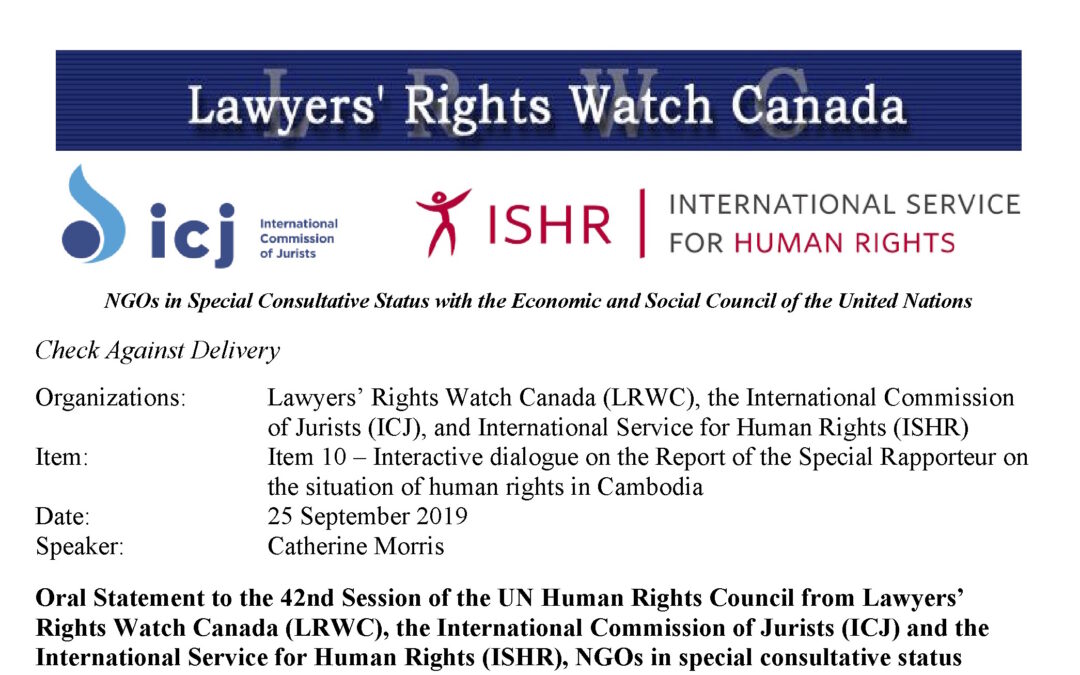
The ICJ today joined other NGOs in drawing the UN Human Rights Council’s attention to the role of the Government of Cambodia in widespread human rights violations and abuses in the country, and called for renewal of the mandate of the UN Special Rapporteur.
The joint NGO statement was delivered by Lawyers’ Rights Watch Canada in a dialogue on the situation in Libya. The statement read as follows:
“Lawyers’ Rights Watch Canada (LRWC), the International Commission of Jurists (ICJ), and the International Service for Human Rights (ISHR) thank the Special Rapporteur for her reports. Implementation of the Sustainable Development Goals, ensuring that no one is “left behind,” necessitates equal access to remedies for rights violations within a trustworthy and independent legal system.
Cambodia has not fulfilled its treaty obligations to establish judicial independence and integrity. Civil society’s rights advocacy is continually resisted. Lawyers, defenders, journalists, politicians, or activists reporting on corruption, election irregularities, labour rights violations, illegitimate land acquisition, environmental degradation, or other rights abuses, often by businesses, are routinely subjected to official vilification; intimidation; interference with rights to expression, association, and assembly; criminalization; arbitrary detention; and even unlawful killings with impunity.
Since 2017, political opposition has been systematically suppressed, including through misuse of the judiciary. Despite the Special Rapporteur’s repeated calls for release of opposition leader Kem Sokha, he remains under court-imposed restrictions tantamount to house arrest. The Special Rapporteur has been denied visits with him contrary to Special Procedures terms of reference for country visits. In May, 25 former opposition members were summoned to court for questioning over two weeks. In September, the government threatened to arrest anyone supporting opposition politician Sam Rainsy’s return to Cambodia.
Cambodia’s responses to Special Procedures’ recommendations for the past twenty-five years have been characterized by disregard, delay, resistance, or hostility. Continued support for the Special Rapporteur’s mandate is critical to ensure that Cambodia fulfils its international human rights obligations. We request that the Council extend the mandate.”
The full written statement, including references, can be downloaded in PDF format here: UN-HRC42-Cambodia-2019
Sep 17, 2019 | Advocacy
In a statement issued today, the ICJ and other human rights groups, as well as lawyers and members of the legal profession, expressed deep concern over the increasing attacks against lawyers under President Duterte’s administration.
Find the full statement available as PDF here: Philippines-attacks against lawyers escalating-advocacy-2019-ENG