Mar 12, 2019 | Events, News
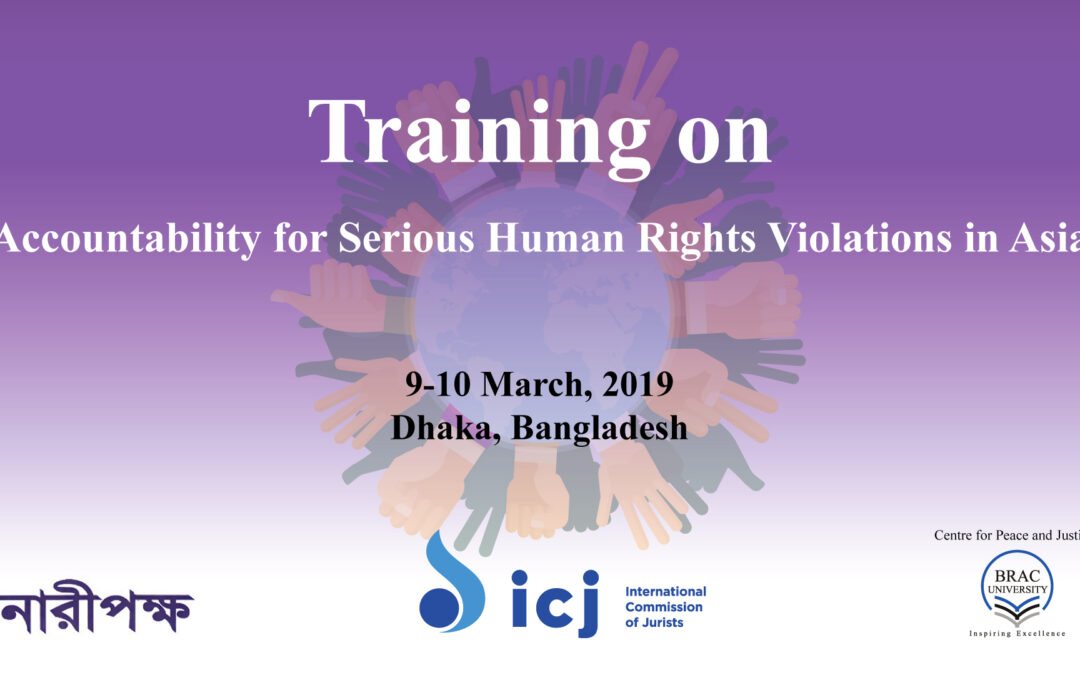
The ICJ convened a two-day workshop from 9th to 10th March 2019 in Dhaka, Bangladesh to discuss applicable international legal mechanisms designed to achieve accountability for serious human rights violations in Asia.
Bangladesh-based non-government organizations the Centre for Peace and Justice and Naripokkho co-hosted the event with the ICJ, with a representative of AJAR (Asia Justice and Rights) also joining. Twenty Bangladeshi lawyers, activists and academics attended the event.
Legal advisers from the ICJ provided an overview of the Independent Investigative Mechanism for Myanmar (IIMM), currently being established following a UN Human Rights Council resolution in September 2018.
They also discussed the structure and procedures of the International Criminal Court (ICC), whose prosecutors are currently conducting a preliminary examination into the deportation of Rohingyas from Myanmar into Bangladesh. Unlike Myanmar, Bangladesh is a State Party to the Rome Statute of the ICC, and its pre-trial chamber has indicated the Court has jurisdiction over crimes listed in the Rome Stature were one element, or part of a crime, was committed inside the territory of Bangladesh.
AJAR’s co-founder provided an overview of transitional justice processes, drawing upon international and regional experiences of truth-seeking, prosecutions, reparations and reforms to guarantee non-repetition of human rights violations.
Two of the ICJ’s legal advisers also travelled to Cox’s Bazar, Bangladesh, where they met relevant stakeholders to discuss the situation of Rohingya refugees from Myanmar, and to share information about accountability mechanisms, including about expected timelines, outcomes and limitations.
The activity is part of the ICJ’s global work on promoting accountability and redress for gross human rights violations to facilitate justice and deter repetition.
Contact: Kingsley Abbott, ICJ Senior Legal Advisor for Global Redress and Accountability e: kingsley.abbott@icj.org
Mar 11, 2019
A new ICJ report examines the right to freedom of religion or belief in Malaysia, analyzing the country’s legal framework to identify protections of and limitations on the exercise of this right in law and in practice.
The report highlights that jurisdictional disputes affecting the adjudication of matters relating to religion and belief – between civil courts which apply federal and state laws, and Syariah courts, which apply Islamic laws – have emerged as the main arena of contestation.
These disputes have arisen amidst a national legal framework where there remains a lack of clarity in existing jurisprudence and law about the dual jurisdictional regime and insufficient legal safeguards exist to protect the rights of individuals with respect to personal and family matters concerning religion and belief.
Protective mechanisms for persons who wish to change or adopt a new religion also remain inadequate in law, while laws have been misused in practice to curtail the right to religion and belief of religious minorities.
The report explains the general international legal framework governing the right to freedom of religion or belief, before highlighting several concerns relating to the protection and promotion of this right in Malaysia. These include:
- Discrimination against religious minorities;
- Limitations on the rights of children relating to personal matters governed by Islamic Law;
- Discrimination against persons who wish to change or adopt a new religion;
- Criminalization and prosecution of proselytism among Muslims;
- Prohibitions on the use of the word ‘Allah’ by non-Muslims;
- Criminalization of free expression through the crime of sedition.
These concerns are detailed in the report. In light of these challenges, the report offers a number of recommendations to the Government of Malaysia to assist authorities in ensuring Malaysia’s legal framework is implemented in accordance with international human rights law and fully protects the right to freedom of religion or belief.
The report situates its legal analysis within Malaysia’s socio-political context, where religion and ethnicity play significant roles in politics and society, and concerns are emerging of rising intolerance against religious and ethnic minorities.
This report is part of a series of ICJ publications on the right to freedom of religion or belief, produced with the support of the International Panel of Parliamentarians for Freedom of Religion and Belief (IPPFoRB).
Contact
Frederick Rawski, ICJ Asia-Pacific Regional Director, frederick.rawski@icj.org
See also
New primer on freedom of religion or belief in international human rights law
New briefing paper: challenges to freedom of religion or belief in Nepal
Download
Malaysia-Freedom of religion Exec sum-Advocacy-Analysis brief-2019-ENG (executive summary, in PDF)
Malaysia-Freedom of religion brief-Advocacy-Analysis brief-2019-ENG (full report, in PDF)
Mar 11, 2019 | Advocacy
The “Independent Commission of Enquiry” (ICOE) on Rakhine State, announced by the Government of Myanmar in May 2018 and established in July, has not demonstrated any reasonable prospect of meeting international standards of independence, impartiality or effectively contributing to justice or accountability for human rights violations constituting crimes under international law.
The ICOE is not transparent about how its information gathering will, if at all, shed light on the truth, or contribute to accountability and redress, while protecting individuals it comes into contact with. It is also yet to fulfill conditions called for by the UN Human Rights Council in its September 2018 resolution 39/2.
Any move to shift reference in the Council resolution currently under discussion, to include more positive recognition of the ICOE, would be wholly unjustified.
Furthermore, the government continues its unwillingness to address credible allegations of crimes under international law, including in its report to the CEDAW Committee in February in which rape allegations were dismissed as “wild claims.”
The International Commission of Jurists (ICJ), in response to a “Call for Submissions” on 12 December 2018, inviting “individuals, groups, witnesses and alleged victims to submit their complaints or accounts, with supporting data and evidence,” wrote to the ICOE Chairperson with four questions, summarised as:
- Are any measures in place to protect complainants and witnesses against threats of violence, legal action or other forms of reprisals for providing information to the ICOE? What specific measures have been taken to ensure the confidentiality of any materials submitted, and to protect the identities and wellbeing of witnesses?
- Given statements by commissioners that accountability is not part of their mandate, as the ICOE is seeking submissions of data and evidence from victims and witnesses, please clarify the ICOE’s position on how these submissions will be utilized – including for possible criminal investigations.
- Can you provide information on any measures taken to deal with real or perceived conflicts of interests that may affect the public’s trust in the ICOE’s impartiality and independence, including victims and witnesses and others who may submit materials in response to your call?
- The recommendations of past Commissions of Inquiry have not been fully implemented. Given the sensitive nature of the ICOE’s mandate, what considerations have been taken into account to increase the likelihood that recommendations will be more effectively implemented than in the past?
The ICOE did not respond to these questions, despite having formally acknowledged receipt of the letter. The deadline for public submissions to the ICOE has now passed. Its silence in this instance illustrates a broader failure to demonstrate independence or transparency and underlines protection concerns.
The ICJ is unaware of efforts by the ICOE to genuinely seek cooperation with the UN Independent International Fact Finding Mission or the Special Rapporteur on the situation of human rights in Myanmar, as has been called for by the Council.
Based on extensive experience and research in Myanmar and globally, and recalling a 5-page legal assessment of the ICOE published in September 2018, the ICJ remains of the view that the ICOE, like previous government-backed inquires, cannot effectively contribute to or deliver justice or accountability.
Myanmar-Inquiry Rakhine-Advocacy-2019-BUR (Burmese version, in PDF)
Mar 8, 2019 | Advocacy, Non-legal submissions
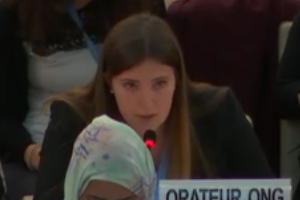
The ICJ today addressed the UN Human Rights Council on the need for a time-bound implementation plan, developed with the Office of the High Commissioner for Human Rights, for Sri Lanka to implement its commitments and obligations on transitional justice.
The statement, delivered during an interactive dialogue with the UN High Commissioner for Human Rights on her annual report, read as follows:
“Madame High Commissioner,
The International Commission of Jurists (ICJ) appreciates the efforts undertaken by the OHCHR in advancing transitional justice in Sri Lanka, mentioned in paragraph 69 of your report.
Any progress made by Sri Lanka, especially in relation to the implementation of transitional justice mechanisms under Resolution 30/1, albeit slow and wholly insufficient, has been primarily due to the continued engagement of the Council, OHCHR and international community. Therefore, keeping Sri Lanka on the agenda of the Council is paramount to ensure progress on all remaining commitments set out in Resolution 30/1.
As the Council is poised to provide Sri Lanka with an extension of two years to fulfill its commitments under Resolution 30/1, ICJ considers the expeditious development of a time-bound implementation plan with a deadline for delivery as essential. It is also pertinent that the implementation process is not a mere procedural exercise, but holistic and contextually appropriate.
At present, it appears that women are largely excluded from meaningfully participating in transitional justice processes, despite having been at the forefront in demanding truth and justice. Even mechanisms that have been put in place so far lack a comprehensive gender strategy. It is imperative that problems faced by women during and in the aftermath of the conflict are effectively identified and addressed in order to ensure that they are not left behind as the country seeks to move forward. The OHCHR with its expertise and experience in the field is well-placed to provide the necessary advice and technical assistance, especially in relation to matters that often get ignored or marginalized.
Madam High Commissioner, how would you see OHCHR fulfilling its role in relation to the development of the time-bound implementation plan and the due accomplishment of all remaining commitments made under Resolution 30/1?”
The statement can be downloaded in PDF format here: HRC40-OralStatement-IDwHCitem2-2019
The oral statement follows a joint open letter from NGOs, calling for such a plan, here.
The ICJ earlier submitted a written statement on Sri Lanka, available here.
Mar 7, 2019 | Advocacy, News
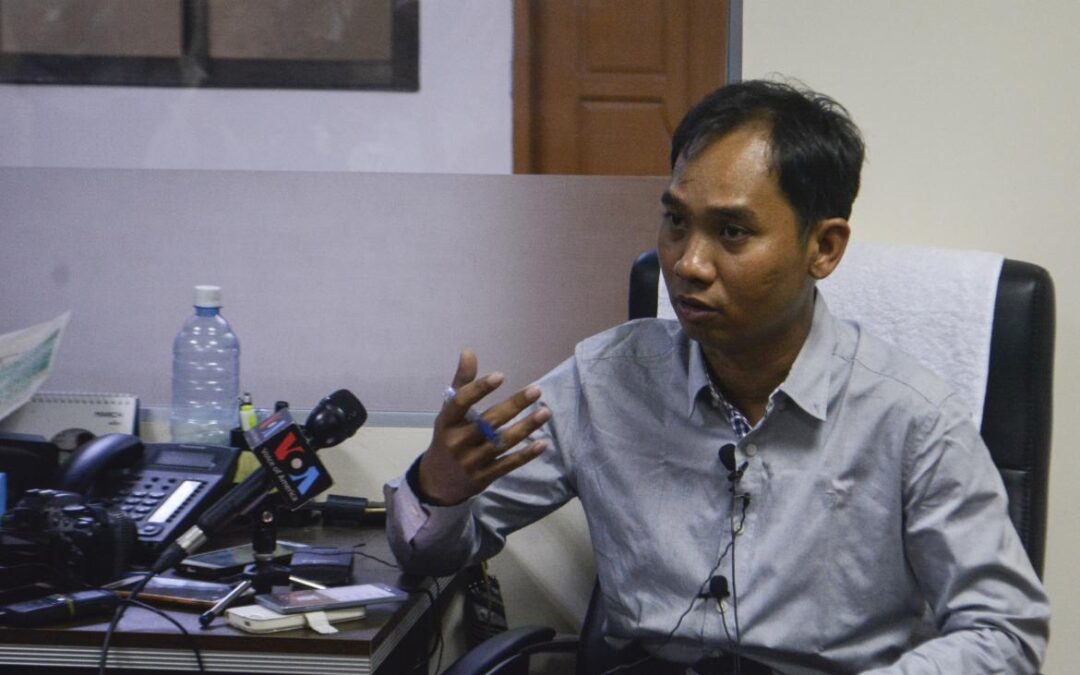
The ICJ joined a list of 77 civil society organizations to call on relevant authorities in Myanmar to drop spurious charges against journalist Ko Swe Win, to decriminalize defamation, and to release human rights defenders currently imprisoned under repressive criminal defamation laws.
The statement reads:
On the second anniversary of the defamation charges brought upon Ko Swe Win, editor at online newspaper Myanmar Now, we, the undersigned 77 civil society organisations, call on the relevant authorities to drop the case against him. Spurious defamation charges under Article 66(d) of the Telecommunications Law were filed against him on 7 March 2017 by ultranationalists intent on suppressing free speech. The Government of Myanmar must take concrete steps in parliament to decriminalise defamation, repeal Article 66(d) of the Telecommunications Law and drop the charges and release all activists and human rights defenders currently in prison and being charged under this repressive legislation.
Article 66(d) of the Telecommunications Law of 2013 was amended in 2017, but notably, defamation is still criminalised and carries a punishment of up to two years of imprisonment or a fine of up to one million kyat or both. The law is still frequently used to stifle free speech in Myanmar and silence critics. To date, a reported 173 cases have been filed under Article 66(d) since its enactment.
The UN Human Rights Committee has called on all states to decriminalise defamation, indicating that imprisonment for defamation is a penalty that can never be appropriate or compatible with the right to freedom of expression. In addition, the Special Rapporteur on the promotion and protection of the right to freedom of opinion and expression has stated that defamation should be treated as a matter of civil rather than criminal law, stressing that criminal prosecution for defamation inevitably becomes a mechanism of political censorship, which contradicts freedom of expression and of the press. In the case of Article 66(d), Myanmar law allows for agents of the offended party to file charges for defamation and initiate criminal proceedings on their behalf. In effect, this means that powerful organisations and individuals can operate via proxies to target those that they consider disturbing, a form of judicial harassment with severe implications for the individuals who are accused.
Ko Swe Win was charged with defamation under Article 66(d) of the Telecommunications Law for sharing a story by Myanmar Now on Facebook. The story quoted a senior monk who said that well-known ultranationalist monk U Wirathu’s actions could be cause for him to be expelled from the monkhood as they violated the tenets of Buddhism. U Wirathu, notorious for using Facebook to agitate against Muslims, had previously expressed support for and thanked U Kyi Lin – the recently convicted gunman who shot and killed prominent lawyer U Ko Ni in January 2017. U Ko Ni was an expert on constitutional law and was working to change the military-drafted 2008 Constitution. The plaintiff, a follower of U Wirathu, brought the charges in March 2017 and the court proceedings started in July 2017.
Since then, Ko Swe Win has had to travel regularly to the courthouse in Mandalay, where the charge was filed, from his home in Yangon and back – a distance of over 1,200 kilometres. The court hearings, now totaling 55, have been ongoing for almost two years, but the court has still only heard the plaintiff’s side, which has consistently been stalling the process. On some occasions, Ko Swe Win has travelled from Yangon only to find that the plaintiff or witnesses have failed to appear in court and that the proceedings have been postponed. The plaintiff himself was arrested in August 2017 and has since been detained, which has caused significant delays to the process.
U Wirathu has been summoned twice but failed to appear. On the first occasion, his lawyer informed the court that U Wirathu could not make the hearing because he was attending a donation ceremony. On the second occasion, U Wirathu’s lawyer requested that the hearing be held at his monastery compound. That request was denied by the township court, but U Wirathu appealed to the higher district court, which also denied the request. While the district court considered the request, no hearings could be held in the township court. Ko Swe Win however, was still required to make an appearance every two weeks before the township court judge just to be informed of the next date he was due to appear in court. This procedure, which required him to travel from Yangon to Mandalay, was typically over in a matter of minutes.
The many irregularities of this case highlight the lack of independence of the Myanmar judiciary. It appears that the authorities are determined to target those that are working to expose troubling truths and terrible crimes, rather than those who commit them. Those responsible for spreading dangerous speech and inciting violence face no consequences, while those who criticise such dangerous actions continue to be prosecuted. In a recent parallel case, also fraught with controversies, two Reuters reporters – Wa Lone and Kyaw Soe Oo – were convicted to seven years in prison for exposing a mass killing of Rohingya men and boys carried out by the Myanmar military in northern Rakhine State.
In Myanmar, high-ranking military commanders, some of whom are accused by UN investigators for war crimes, crimes against humanity, and even genocide, remain at large, while journalists who expose the truth and report on human rights violations in the country are charged under repressive laws. This inverted idea of justice needs to come to an end if Myanmar is to continue its path towards democracy.
As long as Article 66(d) remains, people in Myanmar, especially those who criticise powerful individuals, officials and government policies online, will be at risk of being imprisoned for their peaceful exercise of the right to freedom of expression.
In light of the above, we call on the Government of Myanmar and its relevant authorities to:
- Drop the defamation charges under Article 66(d) of the Telecommunications Law against Ko Swe Win and other activists and human rights defenders and release those currently imprisoned under this repressive legislation;
- Repeal Article 66(d) of the Telecommunications Law, or at a very minimum, amend it to ensure that:
- defamation is no longer criminalised by deleting references to “defamation” as well as vague language such as “disturbing”;
- only a government prosecutor can file a criminal complaint under Article 66(d);
- where recognisably criminal acts such as “extortion” and “threats” occur in the law they are clearly and narrowly defined in line with international human rights law, to ensure it is not used to criminalise the peaceful expression of views.
Download
Myanmar-statement on defamation-Advocacy-2019-ENG (full statement in English, PDF)
Myanmar-statement on defamation-Advocacy-2019-BUR (full statement in Burmese, PDF)