Sep 21, 2017 | Advocacy, Non-legal submissions
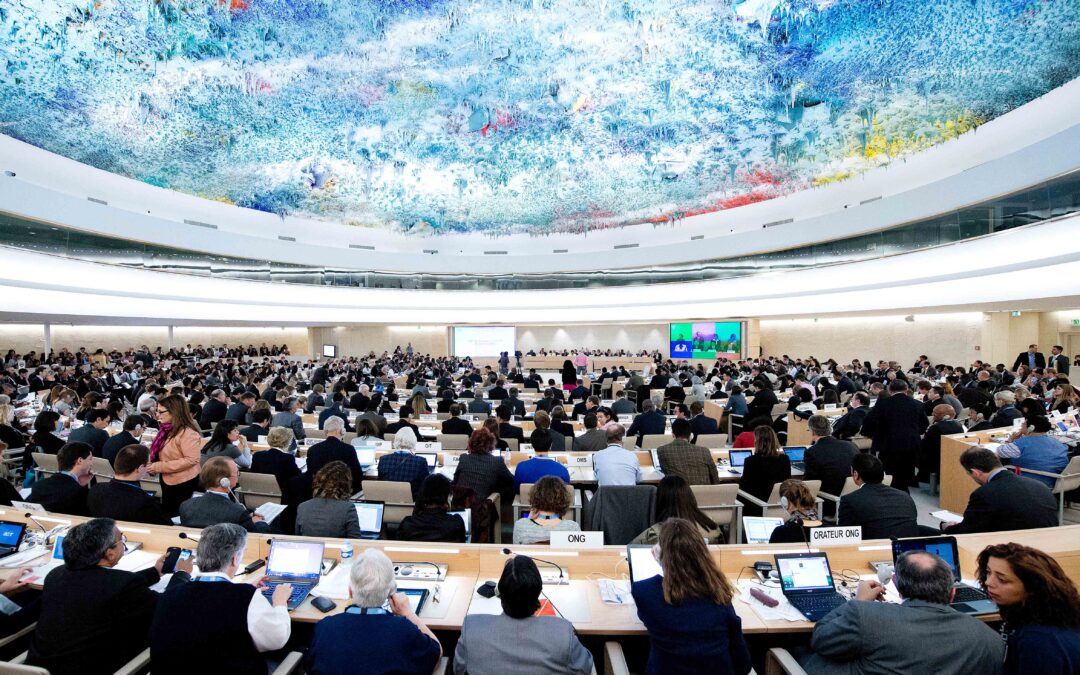
Speaking at the UN today, the ICJ called on India to reconsider its refusal to accept recommendations for decriminalisation of consensusal same-sex relations, abolition of the death penalty, and ensuring accountability for human rights violations.
The oral statement was made during the consideration by the UN Human Rights Council of the outcome of India’s Universal Periodic Review (UPR) process. It read as follows:
“The International Commission of Jurists (ICJ) regrets that India has not supported recommendations related to decriminalizing consensual same-sex relations, abolishing the death penalty, and combatting impunity for serious human rights violations.
The ICJ has documented how by allowing the criminalization of consensual same-sex relations, section 377 of the Indian Penal Code has facilitated numerous human rights violations, including violations of the principle of non-discrimination and the rights to equality before the law and equal protection of the law, liberty and security of person, freedom of expression, health, and privacy. Section 377 has also perpetuated homophobic and transphobic attitudes in India, leading to discrimination and violence against LGBT individuals.
The Government has also failed to take steps to combat impunity for serious human rights violations such as extrajudicial killings, enforced disappearances, and torture and other ill treatment, which are facilitated by laws such as the Armed Forces Special Powers Act (AFSPA) and other national security and public safety legislation. Despite repeated commitments to do so, India has also not enacted legislation to recognize torture as a distinct, autonomous offence in its penal code.
The ICJ therefore urges the Government to reconsider, accept and implement UPR recommendations to:
- Decriminalize consensual same-sex sexual relations (161.71, 161.76, 161.77, 161.78, 161.79);
- Enact legislation consistent with the Supreme Court’s recognition of the rights of transgender persons and international human rights standards (161.80);
- Repeal AFSPA and other state and central level laws that similarly violate international human rights law (161.97, 161.248, 161.249);
- Become a party to the CAT; OPCAT; the Second OP to the ICCPR; the ICPPED and other international instruments (161.13, 161.15, 161.29, 161.30, 161.31); and
- Establish a moratorium on the use of the death penalty, with a view towards its abolition (161.104 – 161.115).”
Sep 18, 2017 | Events
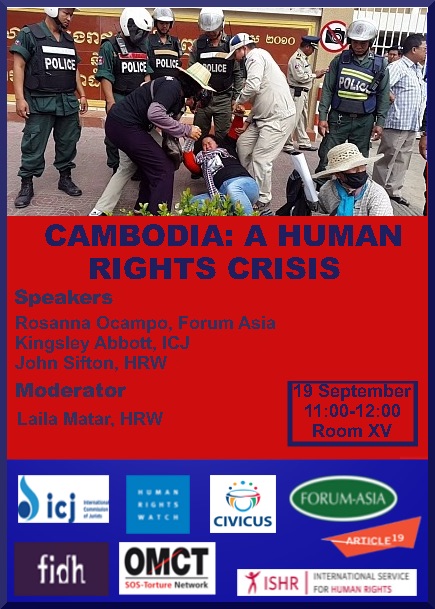
On 19 September, the ICJ and other leading international NGOs are convening a panel to discuss the crisis for human rights and rule of law in Cambodia, at a side event to the UN Human Rights Council session taking place in Geneva.
The side event comes as States consider a new draft resolution on Cambodia for adoption by the Human Rights Council. Before the session, the ICJ joined other organizations in calling for strengthening of the resolution and its measures for monitoring, reporting on and discussing the situation for human rights in the country.
Moderator:
- Laila Matar, Senior UN Advocate, Human Rights Watch
Speakers:
- Rosanna Ocampo, Forum Asia
- Kingsley Abbott, International Commission of Jurists
- John Sifton, Human Rights Watch
The event takes place Tuesday, 19 September 2017, 11:00 – 12:00, in the Palais des Nations, Room XV.
ICJ is organizing the event together with Human Rights Watch, Forum-Asia, Civicus, Article 19, FIDH, OMCT, and ISHR.
For more information, contact un(a)icj.org
Sep 14, 2017 | Advocacy
In a joint statement released today, the ICJ joins several other organisations in calling on the Supreme Court of the Maldives to rescind the indefinite suspension of 56 lawyers.
The lawyers had signed a petition to the Supreme Court calling for the independence and reform of the judiciary.
The statement, made jointly with Maldivian Democracy Network, Front Line Defenders, Transparency International and FORUM-ASIA, can be downloaded here: Maldives-Advocacy-Lawyers-2017

Sep 13, 2017 | Advocacy, News
As proceedings resume in India v. Pakistan (Jadhav case) before the International Court of Justice (ICJ), the ICJ has published a briefing paper to clarify the key issues and relevant laws raised in the case in a Question and Answer format.
The case concerns Pakistan’s failure to allow for consular access to an Indian national detained on charges of serious crimes.
India has alleged “egregious violations of the Vienna Convention on Consular Relations (VCCR)” by Pakistan in connection with the detention, trial and conviction of Indian national Kulbhushan Sudhir Jadhav.
Pakistani authorities arrested Jadhav on 3 March 2016.
India was informed of the arrest on 25 March 2016. On 10 April 2017, Pakistan’s military announced Jadhav had been convicted and sentenced to death by a military court for “espionage and sabotage activities against Pakistan.”
India’s requests for consular access, made at least sixteen times starting from 25 March 2016, were either denied by Pakistan or made conditional upon India’s assistance in the investigation against Jadhav.
India alleges that denial of consular access breaches Pakistan’s obligations under Article 36(1) of the VCCR, to which both States are parties.
In May 2017, the ICJ accepted India’s request for provisional measures and directed Pakistan to “take all measures at its disposal” to ensure Jadhav is not executed pending the final decision of the Court.
India is due to file its written memorial with supporting documents today, 13 September.
Pakistan will have three months to file a counter-memorial.
The ICJ will then decide on dates for oral hearing of arguments.
Following the hearings, the Court will deliberate and issue a judgment.
While the case at issue is limited to denial of consular access under the VCCR, it engages other critical fair trial concerns that arise in military trials in Pakistan.
The International Commission of Jurists has documented how Pakistani military courts are not independent and the proceedings before them fall far short of national and international fair trial standards.
Judges of military courts are part of the executive branch of the State and continue to be subjected to military command; the right to appeal to civilian courts is not available; the right to a public hearing is not guaranteed; and a duly reasoned, written judgment, including the essential findings, evidence and legal reasoning, is denied.
The case also underscores one of inherent problems of the death penalty: that fair trial violations that lead to the execution of a person are inherently irreparable.
The International Commission of Jurists considers the death penalty a violation of the right to life and cruel, inhuman or degrading punishment and notes that a large majority of States, in repeated UN resolutions, have called on retentionist states to declare a moratorium on the practice with a view to abolition.
Contact:
Frederick Rawski (Bangkok), ICJ Asia Pacific Regional Director, e: frederick.rawski@icj.org
Reema Omer (London), ICJ International Legal Adviser, South Asia t: +447889565691; e: reema.omer(a)icj.org
Download the Q&A:
India-ICJ Q&A Jadhav case-Advocacy-2017-ENG (in PDF)
Sep 11, 2017
The 36th Session of the UN Human Rights Council, which commenced today, should adopt a resolution which directly addresses the unfolding human rights crisis in Cambodia, said the ICJ today.
The resolution should also urge the Cambodian government to curb its rights violations, and take steps to ensure that the upcoming elections take place in an environment in which everyone is able fully to exercise relevant human rights.
“It is imperative that the Human Rights Council addresses the rapidly deteriorating human rights situation in Cambodia,” said Frederick Rawski, ICJ Regional Director of Asia and the Pacific.
“The international community should strongly urge Cambodia to curb its human rights violations and adopt a course which fosters an environment that ensures respect for human rights as enshrined in the 1991 Paris Peace Agreements,” he added.
On 8 September 2017, the ICJ, together with Asian Forum for Human Rights and Development (FORUM-ASIA), CIVICUS, Human Rights Watch, International Federation for Human Rights (FIDH), and the World Organisation Against Torture (OMCT), wrote to the Human Rights Council Member and Observer States.
The letter urged them to speak out against the latest abuses clearly during the Human Rights Council session, and for the Human Rights Council to adopt a resolution that explicitly condemns the current situation of violations and accordingly.
1. The resolution should request a report by the UN High Commissioner for Human Rights, in consultation with the Special Rapporteur, that would:
- assess the civil and political rights situation in Cambodia in the pre-election period; and
- identify concrete actions that the Cambodian government and international community need to take to ensure that the conditions in which th election takes place accord with international human rights standards; and
2. The resolution should request the High Commissioner to provide an oral update to the Council at its 37th session in March 2018, and present his report at the 38th session in June 2018; and
3. The resolution should provide that at its sessions in March and June, the Council will hold an Enhanced Interactive Dialogue on relevant issues in Cambodia, including stakeholders such as staff from Cambodia’s OHCHR office, the Special Rapporteur on Cambodia, other relevant UN Special Procedures and members of local and international civil society.
The letter sets out a detailed list of examples of human rights violations which form part of a comprehensive campaign of intimidation, violence and misuse of legal mechanisms in the lead-up to next year’s national election.
These include the recent charging of the leader of the opposition, Kem Sokha, with treason in a case that has all the hallmarks of being politically motivated, the expelling of the leading pro-democracy NGO, the National Democratic Institute, and the intimidation and forced closure of several independent media outlets including the Cambodia Daily and Mohanokor Radio.
The 36th Session of the Human Rights Council, which is being held in Geneva from 11-29 September 2017, will address a number of human rights situations and issues from around the world, including the human rights situation in Cambodia.
At 11am on 19 September 2017, the ICJ, Human Rights Watch and other organizations plan to hold a public side event in Geneva to the Human Rights Council at which the rapidly deteriorating human rights situation in the country will be discussed.
On 26 September, the UN Special Rapporteur to Cambodia is scheduled to report to the Human Rights Council on the implementation of her mandate and the Council is likely to adopt a resolution to extend the mandate of the Special Rapporteur.
The Special Rapporteur will present her report and engage in a formal “interactive dialogue” with States, civil society and Cambodia on the human rights situation in the country (currently scheduled for 26 September).
The UN Secretary General is also due to report on the role and achievements of OHCHR in “assisting the Government and the people of Cambodia in the promotion and protection of human rights”. This report will be discussed, together with other country situations, during a General Debate taking place on 27-28 September.
Contact
Frederick Rawski (Bangkok), ICJ Asia Pacific Regional Director, e: frederick.rawski(a)icj.org
Kingsley Abbott, ICJ Senior International Legal Adviser for Southeast Asia, t: +66 94 470 1345 ; e: kingsley.abbott(a)icj.org
Cambodia-Joint Civil Society letter-Advocacy-Open letters-2017-ENG (text of letter, in PDF)