Jan 30, 2018 | Agendas, Events
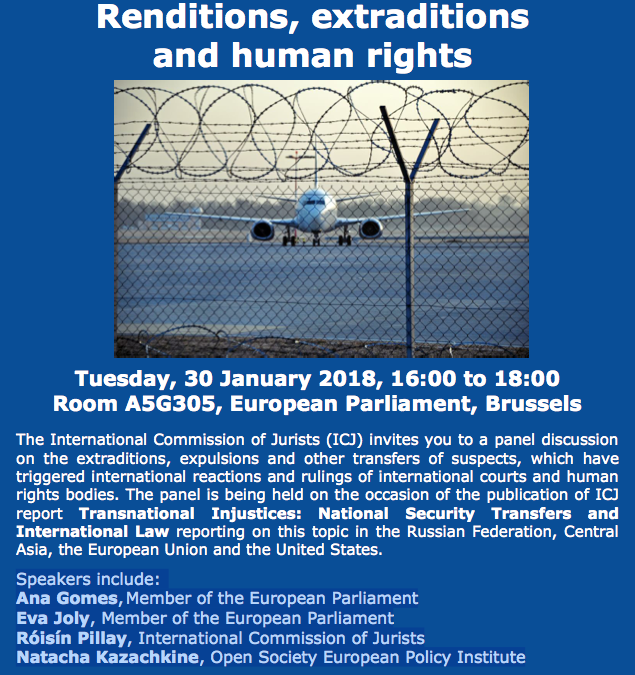
The ICJ invites you to an event to discuss challenges in prevention of, and accountability for, violations of human rights in renditions and other transfers of suspects, including through past European complicity in US-led renditions, and in ongoing transfers of suspects in the CIS region.
Join us for a discussion marking the EU launch of the International Commission of Jurists’ report, Transnational Injustices: National Security Transfers and International Law. The event is kindly hosted by Ana Gomez and Eva Joly, MEPs.
Panelists will discuss the ongoing practice of states unlawfully rendering people accused of terrorism, accountability for violations of human rights in past renditions, and how the EU institutions and EU Member States should address these.
When: Tuesday 30 January 16.00 – 18.00
Where: Room A5G305, European Parliament, Brussels
RSVP to: anamaria.gomes@europarl.europa.eu
Speakers include:
- Ana Gomes, Member of the European Parliament
- Eva Joly, Member of the European Parliament
- Róisín Pillay, International Commission of Jurists
- Natacha Kazachkine, Open Society European Policy Institute
A flyer for this event is available in PDF format by clicking here.
Jan 26, 2018
An opinion piece by Massimo Frigo, Senior Legal Adviser, ICJ Europe Programme.
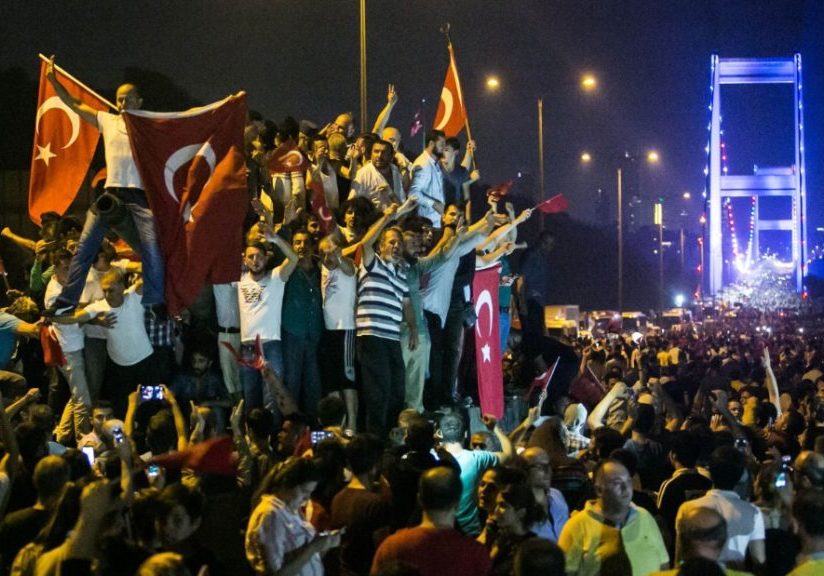
A legal dispute between first instance ordinary courts and the Constitutional Court in Turkey is leading the country into a major constitutional conflict and severely limiting the chance of people in Turkey to access effective remedies for human rights violations.
On 11 January, two criminal courts in Istanbul refused to apply the rulings of the Constitutional Court ordering a remedy for breaches of the right to liberty and freedom of expression of two journalists, Mehmet Altan and Şahin Alpay, detained on remand while under trial for terrorism offences and alleged links to the attempted coup of 15 July 2016.
The full piece and legal analysis can be read on the Opinio Juris blog.
Jan 15, 2018 | News
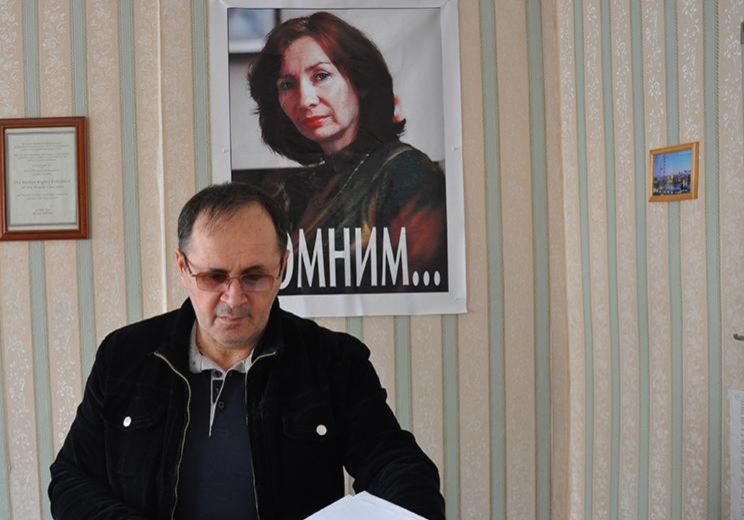
The ICJ is concerned at allegations that the recent arrest and detention of Oyub Titiev, the head of the Chechen branch of the Russian human rights organisation Memorial, were carried out as retaliation for his human rights activity.
The ICJ is particularly concerned at the more recent reports that family members of Oyub Titiev have had to leave Chechnya for security reasons following threats.
The ICJ calls on the Russian federal and local authorities to conduct a prompt, thorough and independent investigation into allegations that criminal charges against Oyub Titiev have been fabricated by police.
Oyub Titiev should be immediately released pending the outcome of this investigation, and measures should be taken to protect his security and that of his family.
On 9 January 2018, at 10.30, according to an official statement of the Ministry of Interior of Chechnya, Oyub Titiev’s car was stopped near Kurchaloy town to check his documents.
During a search of his car, a plastic bag with approximately 180 grams of a substance identified as marijuana was allegedly found.
Titiyev was charged with possession of a large quantity of narcotics under article 228 of the Criminal Code of the Russian Federation. However, he has stated that the narcotics were planted and has filed a complaint with the Prosecutor’s Office to initiate an investigation into these allegations.
Oyub Titiev, the head of Memorial in Chechnya, is one of very few human rights defenders who continue their work in Chechnya despite significant obstacles and threats.
He took over this position following the murder of the former head of Memorial in Chechnya, Natalya Estemirova in 2009.
In accordance with Article 2(a) of the Declaration on Human Rights Defenders (Declaration on the Right and Responsibility of Individuals, Groups and Organs of Society to Promote and Protect Universally Recognized Human Rights and Fundamental Freedoms), human rights defenders have a right to conduct human rights work individually and in association with others.
Under the same Declaration, States have a duty to take all necessary measures to ensure the protection of everyone against any violence, threats, retaliation, adverse discrimination, pressure or any other arbitrary action as a consequence of his or her legitimate activities as a human rights defender.
Threats of violence and the falsification of evidence by public officials constitute crimes under the Russian Criminal Code. Reliance in criminal proceedings on evidence falsely planted by the police or other State actors would violate international human rights law including fair trial guarantees under the UN Covenant on Civil and Political Rights and the European Convention of Human Rights.
Attacks on human rights defenders working in an extremely difficult human rights environment such as that of Chechnya, or attacks on their family members, have a chilling effect on work to defend human rights there. If further such attacks are to be prevented, individuals responsible for them must be brought to justice through a fair procedure, the ICJ stressed.
Jan 15, 2018 | Новости, Статьи
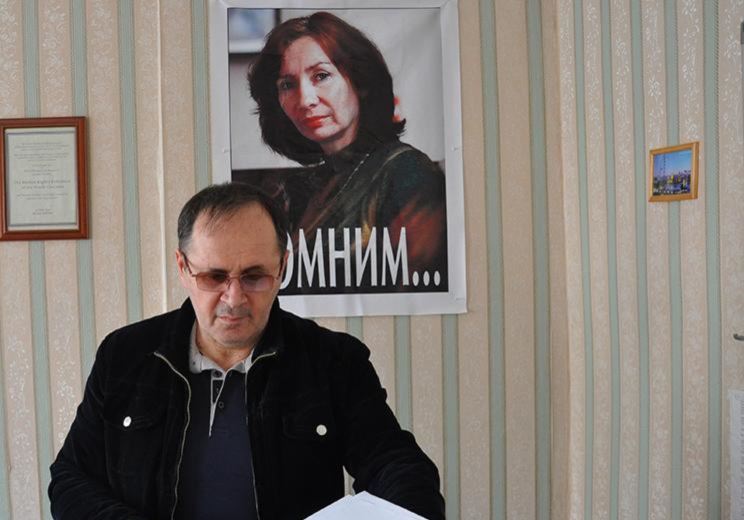
МКЮ обеспокоена заявлениями о том, что недавний арест и содержание под стражей главы чеченского отделения российской правозащитной организации «Мемориал» Оюба Титиева проводились в качестве возмездия за его правозащитную деятельность.
МКЮ особенно обеспокоена более поздними сообщениями о том, что членам семьи Оюба Титиева пришлось покинуть Чечню по соображениям безопасности после угроз.
МКЮ призывает федеральные и местные власти России провести незамедлительное, тщательное и независимое расследование утверждений о том, что уголовные дела против Оюба Титиева были сфабрикованы полицией.
Оюба Титиева следует немедленно освободить в ожидании результатов этого расследования, и необходимо принять меры для защиты его безопасности и безопасности его семьи.
9 января 2018 года, в 10.30, согласно официальному заявлению Министерства внутренних дел Чечни, автомобиль Оюба Титиева был остановлен возле города Курчалой, чтобы проверить его документы.
Во время обыска его машины был найден пластиковый пакет с примерно 180 граммами вещества, идентифицированного как марихуана.
Титиеву было предъявлено обвинение в владении большого количества наркотиков по статье 228 Уголовного кодекса Российской Федерации. Однако он заявил, что наркотики ему подбросили, и подал жалобу в прокуратуру, чтобы начать расследование этих утверждений.
Оюб Титиев, глава «Мемориала» в Чечне, является одним из немногих правозащитников, которые продолжают свою деятельность в Чечне, несмотря на значительные препятствия и угрозы.
Он занял эту позицию после убийства бывшего главы «Мемориала» в Чечне Натальи Эстемировой в 2009 году.
В соответствии со статьей 2 (а) Декларации о правозащитниках (Декларация о праве и обязанности отдельных лиц, групп и органов общества поощрять и защищать общепризнанные права человека и основные свободы) правозащитники имеют право проводить работу индивидуально и совместно с другими в области прав человека.
В соответствии с той же Декларацией государства обязаны принимать все необходимые меры для обеспечения защиты всех людей от любого насилия, угроз, возмездия, неблагоприятной дискриминации, давления или любых других произвольных действий в результате его законной деятельности как защитника прав человека.
Угрозы насилия и фальсификация доказательств государственными должностными лицами представляют собой преступления, предусмотренные Уголовным кодексом РФ. Основание по фактам, ложно установленным полицией или другими государственными субъектами, в уголовном судопроизводстве, нарушает международные права человека, включая гарантии справедливого судебного разбирательства в соответствии с Пактом ООН о гражданских и политических правах и Европейской конвенцией о правах человека.
Нападения на правозащитников, работающих в крайне сложных условиях прав человека, таких как Чечня, или нападения на членов их семей, оказывают повреждающее влияние на работу по защите прав человека. Если дальнейшие подобные нападения должны быть предотвращены, лица, ответственные за них, должны быть привлечены к ответственности через справедливую процедуру, подчеркнула МКЮ.

Jan 11, 2018 | Advocacy, Cases, Legal submissions
The ICJ responded today to the observations of the Czech Government on the merits of the collective complaint brought against it earlier last year by the ICJ and Forum for Human Rights.
The complaint to the European Committee of Social Rights (ICJ v. the Czech Republic, No. 148/2017) argues that the Czech Republic fails to ensure equal legal protection and participation of children below the age of criminal responsibility in the pre-trial stage of juvenile justice procedures.
The ICJ and Forum for Human Rights reinforced the complaint, relying on Article 17 of the Social Charter, in relation to the State party’s failure to ensure that children below the age of criminal responsibility but recognised as having infringed the penal law are treated in a manner consistent with the promotion of the child’s sense of dignity and worth, which reinforces the child’s respect for the human rights and fundamental freedoms of others and which takes into account the child’s age and the desirability of promoting the child’s reintegration and the child’s assuming a constructive role in society.
Europe-ECSR-ICJvCzechRepublic-ChildrenJustice-ICJresponse1-2018-ENG (download the ICJ reply)