Jan 8, 2018 | Advocacy, Cases, Legal submissions, News
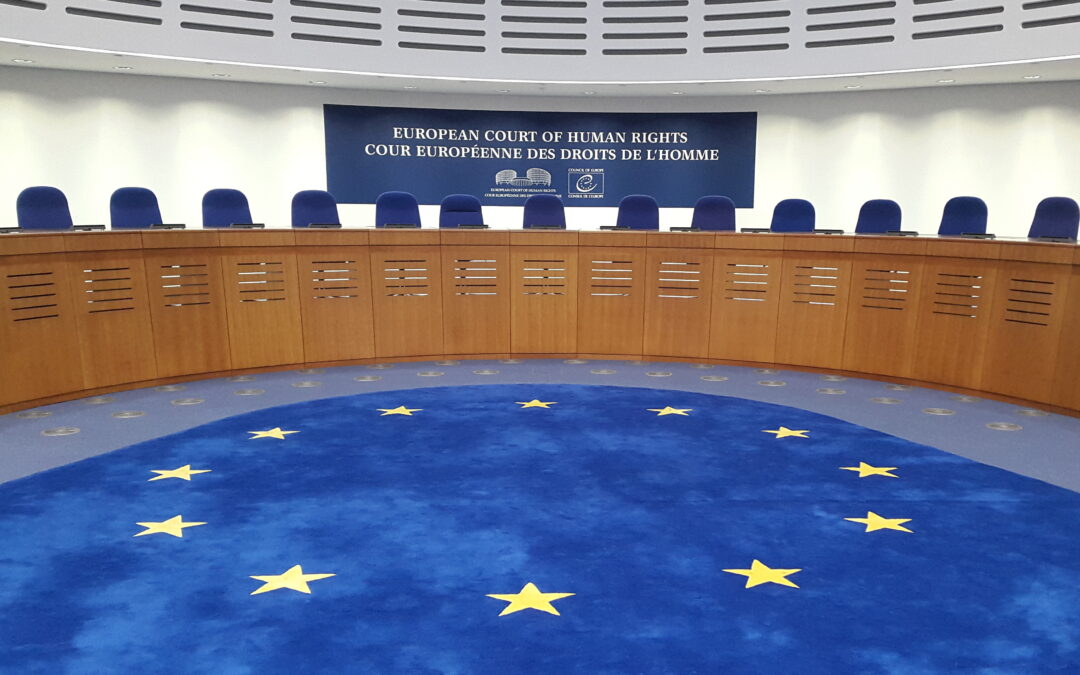
The ICJ and other organizations have intervened today before the European Court of Human Rights challenging expulsions of asylum seekers from Hungary to Serbia.
The International Commission of Jurists (ICJ), the European Council on Refugees and Exiles (ECRE) and the Dutch Council for Refugees have submitted today a third party intervention before the Grand Chamber of the European Court of Human Rights in the case of Ilias and Ahmed v. Hungary.
The case challenges the systematic practice by the Hungarian authorities to send back to Serbia foreign nationals asking for asylum under the pretention that Serbia is a safe third country in which to ask for international protection.
The intervening organizations have argued before the Court that:
- a removal that exposes an applicant to the risk of refoulement and deprives them of protections under international and EU law, is prohibited regardless of whether the decision was taken on the basis of the safe third country concept or the country was included in a “safe third country” list.
- International law requires, inter alia, a rigorous scrutiny of the applicant’s arguable claim of potential prohibited treatment, access to an effective remedy following a negative decision, and access to the rights under the 1951 Refugee Convention.
- Application of the safe third country concept for EU Member States is contingent on the applicant being admitted to the territory and having effective access to a fair asylum procedure in the safe third country
- An assessment of whether restrictions on the freedom of movement of migrants, imposed in a border or international zone, amount to deprivation of liberty under Article 5 ECHR must be based on the impact of these measures on the individuals concerned.
Hungary-ECtHR-amicusbrief-cases-Ilias&Ahmed-ICJ&others-2018-ENG (download the third party intervention)
Background
Ilias Ilias and Ali Ahmed, both Bangladeshi nationals, fled their home country in arrived at the Hungarian-Serbian border on 15 September 2015 after having briefly crossed through Serbia during their trip.
Having asked immediately for asylum in Hungary, they were confined for days in a transit zone, a ” a confined area of some 110 square metres, part of the transit zone, surrounded by fence and guarded by officers”.
Their applications were rejected on the very same day of their application on the grounds that they could have asked for asylum in Serbia, considered by Hungary a safe third country, and appeals were rejected.
They were removed to Serbia on 8 October 2015.
Dec 11, 2017 | News
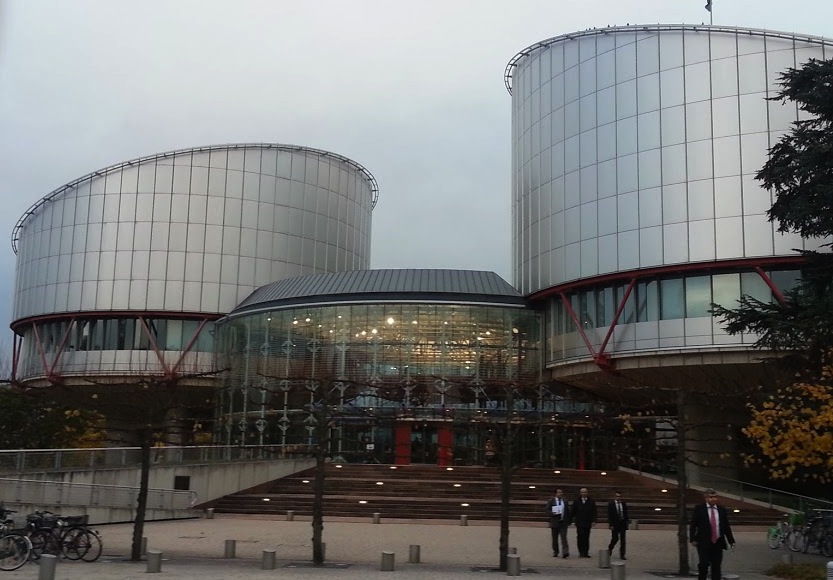
Discussions on the future of the European human rights system should focus on effective national implementation of human rights obligations and should protect the Court from undue political pressure, the ICJ and other NGOs said today.
The ICJ and other human rights NGOs that participated in the High-Level Expert Conference ‘2019 and Beyond: Taking Stock and Moving Forward from the Interlaken Process’, held in Kokkedal, Denmark from 22-24 November 2017, commended the Danish Chairmanship of the Council of Europe for its stated commitment to involving civil society throughout the process leading up to the adoption of a political Declaration on the European Convention on Human Rights’ system in April 2018.
The NGOs believe that the anticipated Copenhagen Declaration should emphasize:
- The need for enhanced measures at the national level to prevent and address violations of the Convention rights – in particular to remedy systemic and institutional problems – and to implement the Court’s judgments.
- The need for the Committee of Ministers to take more effective action to support and ensure thorough and prompt execution of judgments, through individual and general measures.
- The importance of nominating the most- qualified candidates as judges of the Court.
- That it is a fundamental principle of the rule of law that the Court should be free from political interference.
The NGOs urged the Danish Chairmanship and all Member States to refrain from any reforms that would place undue pressure on the Court in its interpretation and application of the Convention. Any undermining of established jurisprudential principles, such as the dynamic interpretation of the Convention, must be rejected.
Europe-NGO statement on ECHR reform-News-web story-2017-ENG (full story in PDF)
Dec 9, 2017 | Agendas, Events, News
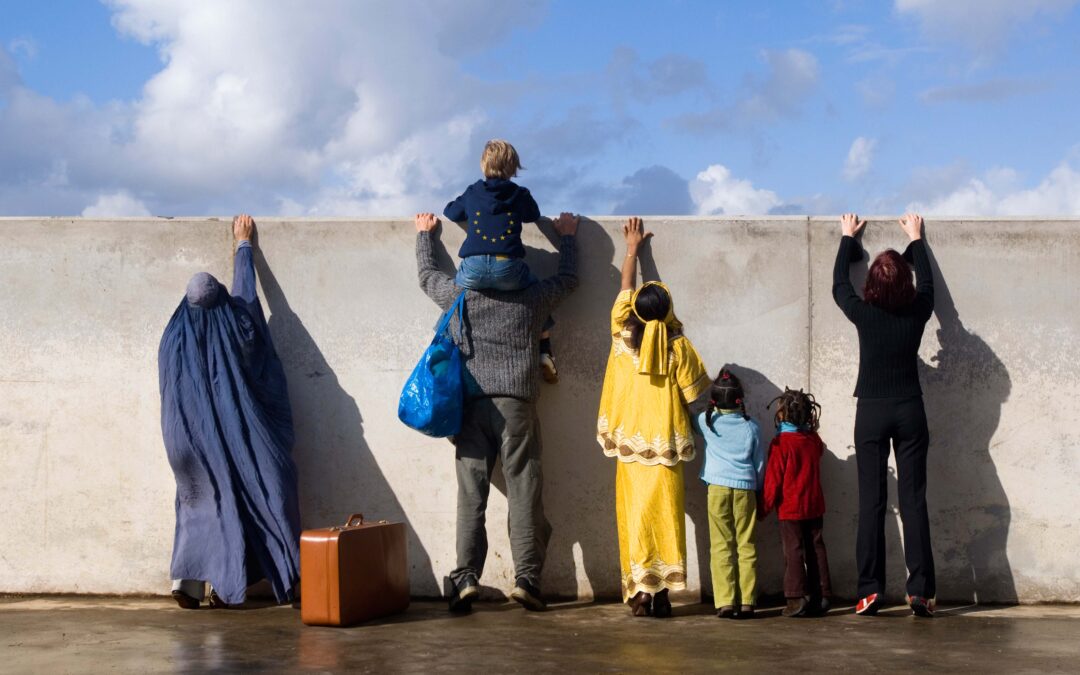
Today begins in Izmir (Turkey) a two-day training for lawyers and CSO practitioners representing and working with migrants, refugees and asylum-seekers.
This event is organized by ICJ, in cooperation with its partners Refugee Rights Turkey, the European Council on Refugees and Exiles (ECRE), Mülteci-Der (MD) and ICJ-EI, as part of the EU co-financed project Fostering Access to Rights for Migrants, Refugees and Asylum-Seekers in Turkey.
30 lawyers and civil society practitioners – representing nine different bar associations and relevant organisations from the Istanbul area and other nearby key migration and asylum locations – are taking part in the training on 9 and 10 December.
The training aims to update lawyers and CSOs on the international and national law on the rights of refugees, migrants and asylum-seekers in order to be effective in their work at both the national and international levels. It aims at an effective implementation of the Turkish legal framework on asylum and migration.
The main thematic areas to be discussed will be the principle of non-refoulement, international protection, detention and access to economic, social and cultural rights.
The training will use as a basis the draft training materials prepared by the ICJ and its partners (to be published an the end of 2019) and, among other sources, the ICJ Practitioners Guide no. 6: Migration and International Human Rights Law.
The project “Fostering Access to Rights for Migrants, Refugees and Asylum-Seekers in Turkey” is funded by the European Instrument for Democracy and Human Rights (EIDHR) of the European Union.
Turkey-Training-Izmir-MigrationAsylum-Agenda-2017-tur-eng (download the agenda in Turkish and English)
Dec 5, 2017 | Новости, Статьи
МКЮ, по итогам миссии в Казахстан для оценки законопроекта, направленного на реформу регулирования юридической профессии, призвала отложить принятие закона и привлечь представителей адвокатуры к более активному участию в его подготовке.
МКЮ подчеркнула, что любая реформа адвокатуры должна усиливать независимость адвокатов с тем, чтобы обеспечить всестороннее соблюдение международного права и стандартов, касающихся роли юристов.
Независимость адвокатуры является необходимым условием для того, чтобы адвокаты могли защищать права человека в отношении своих клиентов, в том числе право на справедливое судебное разбирательство и доступ к правосудию.
МКЮ обеспокоена тем, что законопроект предусматривает изменение дисциплинарной системы адвокатуры: вместо независимой процедуры он предполагает процедуру, которая будет находиться под значительным влиянием со стороны исполнительных органов власти.
Так, законопроект предусматривает участие представителей исполнительной власти в дисциплинарных органах.
МКЮ напоминает, что независимая дисциплинарная процедура является одним из столпов независимой адвокатуры и должна гарантироваться как на уровне закона, так и на практике.
В свете принципа независимости адвокатуры МКЮ также считает, что из текста законопроекта следует исключить положение, предусматривающее создание «государственной адвокатуры».
Одним из недостатков сложившейся системы управления адвокатурой в Казахстане является тот факт, что доступ к профессии адвоката не является процедурой, независимой от исполнительных органов власти.
МКЮ подчеркивает, что реформа предоставляет законодателю возможность сделать процедуру допуска адвокатов полностью независимой и подконтрольной только профессиональной ассоциации адвокатов.
Это позволит обеспечить соответствие действующего законодательства международной практике и принципу независимости адвокатуры.
МКЮ отметила, что адвокатские объединения не принимали достаточно активного участия в обсуждении реформы адвокатуры. В качестве профессионального объединения адвокатов Республиканская коллегия адвокатов должна играть существенную роль в подготовке законодательства, регулирующего ее функционирование, и, в идеале, должна возглавить дискуссию по реформе адвокатуры.
МКЮ считает, что не следует спешить с принятием закона; прежде чем перейти к следующему этапу рассмотрения законопроекта, следует организовать его обсуждение с участием всех заинтересованных сторон.
Реформа, проведенная в соответствии с предложенными рекомендациями, будет соответствовать международным обязательствам Казахстана, в частности, по Международному пакту о гражданских и политических правах и Основным принципам ООН, касающимся роли юристов.
Справочная информация:
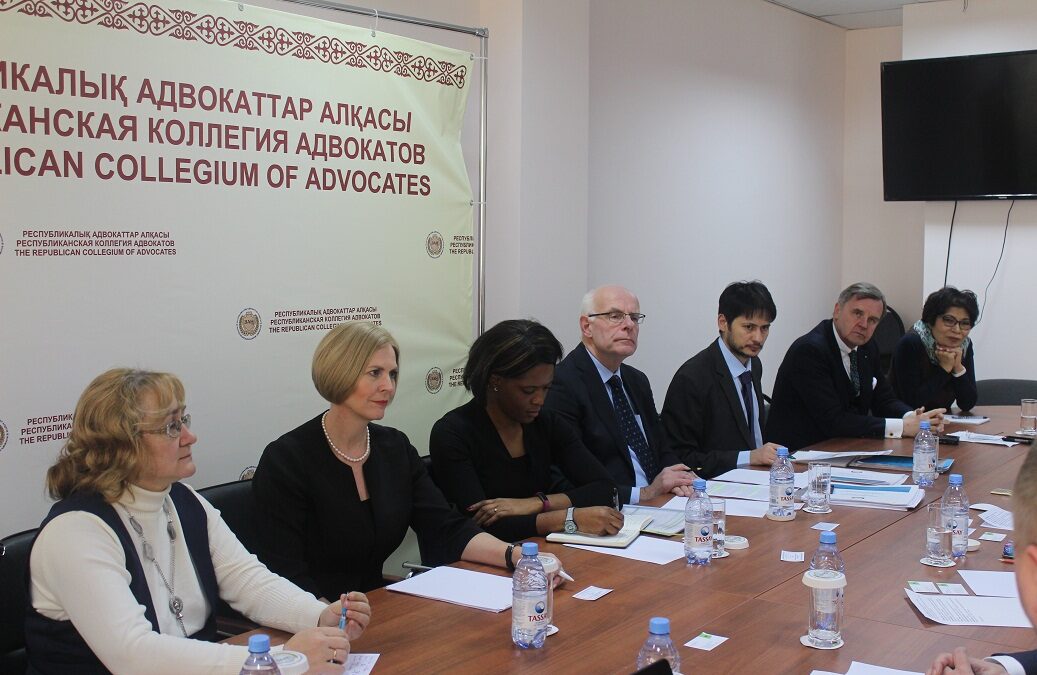
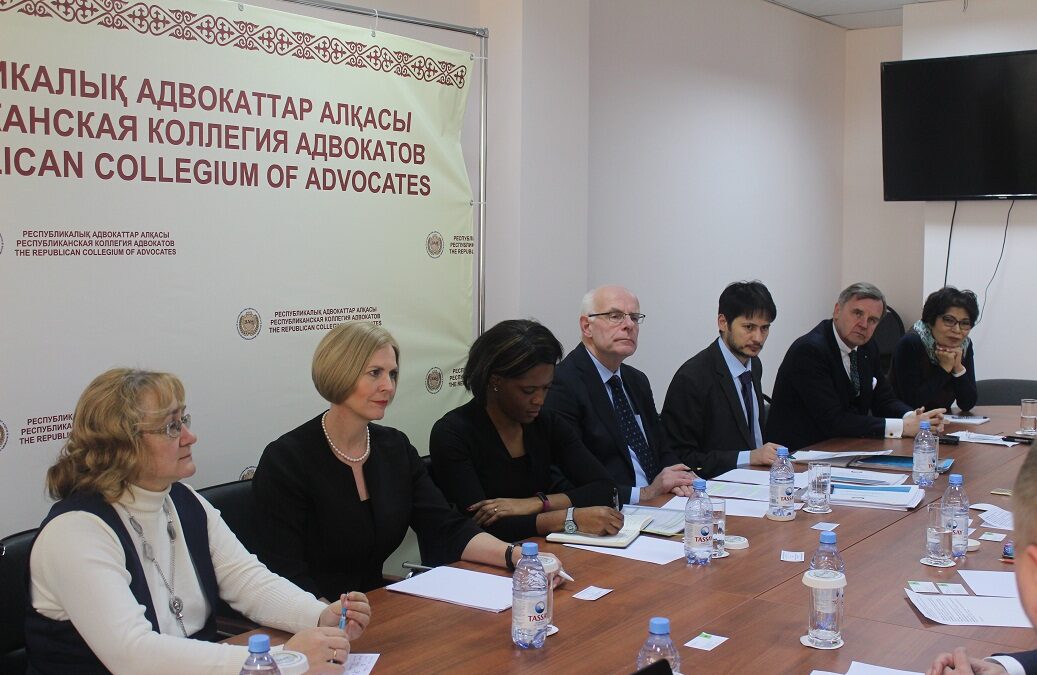
4 и 5 декабря МКЮ посетила Астану, где был проведен ряд встреч на высоком уровне. Данный визит был связан с нынешней реформой адвокатуры и соответствующим законопроектом, вынесенным на рассмотрение Парламента.
МКЮ выражает признательность представителям различных стран, которые согласились принять участие в миссии:
Отмар Кури, Председатель Палаты адвокатов г. Гамбург, председатель Комиссии Федеральной палаты адвокатов Германии по Федеральному закону об адвокатуре
Йерун Брауер, Председатель Комиссии по этике Ассоциации адвокатов Нидерландов и бывший Председатель Ассоциации адвокатов Нидерландов
Георг Става, Председатель Европейской комиссии по эффективности правосудия (CEPEJ)
Кристина Блэклоз, Заместитель Председателя Общества права Англии и Уэльса
Чика Мура, Советник по вопросам международной стратегии, Общество права Англии и Уэльса
МКЮ благодарна всем тем, кто любезно согласился встретиться с представителями миссии. В частности, Миссия выражает признательность Министру юстиции Казахстана, Верховному Суду, членам Парламента, Председателю Республиканской коллегии адвокатов, РОО «Казбар» и всем остальным, кто принял участие во встречах.
Kazakhstan-MissionLawyers-News-pressreleases-2017-RUS (полная история на русском, PDF)
Dec 5, 2017 | News
The ICJ, following a mission to Kazakhstan this week to assess the proposed draft law reforming the regulation of the legal profession, called for the postponement of the adoption of the law and more active participation of the legal profession in its development.
The ICJ stressed that any reform of the legal profession should strengthen the independence of lawyers to ensure that it is fully in line with international law and standards on the role of lawyers.
The independence of the legal profession is vital for lawyers to protect the human rights of their clients, including the right to a fair trial and access to justice.
The ICJ is concerned that the Draft Law changes the disciplinary system for lawyers from an independent procedure to one under significant influence of the executive.
In particular, the Draft Law provides for participation of representatives of the executive in disciplinary bodies.
The ICJ recalls that an independent disciplinary procedure is one of the pillars of an independent legal profession and should be guaranteed by law and in practice.
In line with the principle of an independent legal profession, the ICJ also believes that the provision in the Draft Law allowing for the creation of a “State Advokartura” should be removed.
One of the weaknesses of the current administration of the legal profession in Kazakhstan is that the qualification process for lawyers is not independent of the executive.
The ICJ stresses that the reform creates an opportunity to make the qualification procedure for lawyers fully independent, and administered by the Bar Association.
This would bring the current legislation in line with best international practices and with the principle of the independence of the legal profession.
The ICJ has noted that the Bar Association has not been sufficiently involved in the discussion of the reform of the profession. As a professional association of lawyers, the Bar Association should play a significant role the development of the legislation regulating its functioning and should ideally lead the discussion on the reform.
The ICJ believes that the adoption of the law should not be rushed and further discussion among all interested parties should take place before the Draft Law progresses further.
Reforms along the lines set out above would be consistent with Kazakhstan’s international obligations and commitments under, for instance, the International Covenant on Civil and Political Rights, and the UN Basic Principles on the Role of Lawyers.
Background
On 4 and 5 December, the ICJ carried out a visit to Astana where a number of high-level meetings were held. The visit was prompted by the reform of the legal profession and the related draft law which has been submitted to the Parliament.
The ICJ is grateful to its delegates from different jurisdictions who agreed to join the ICJ mission:
Mr. Otmar Kury, President of the Hamburg Bar Association, Chairman of the Commission on Federal Lawyers Act of the German Federal Bar
Jeroen Browder, President of the Ethics Commission of the Bar Association of the Netherlands and former President of the Bar Association of the Netherlands
Georg Stawa, President of the European Commission for the Effectiveness of Justice (CEPEJ)
Christina Blacklaws, Vice President of the Law Society of England and Wales
Chika Muorah, International Policy Adviser of the Law Society of England and Wales
The ICJ expresses its gratitude to all who kindly agreed to meet with it. In particular, the Mission thanks the Minister of Justice of Kazakhstan, the Supreme Court, members of the Parliament, the President of the Republican Bar Association, the “Kazbar” NGO and all others who it met with.
Kazakhstan-News-Web stories-Independence of the judiciary-2017-ENG (full report, in English)
Kazakhstan-MissionLawyers-News-pressreleases-2017-RUS (full story in Russian, PDF)




