Hong Kong: the ICJ welcomes court’s decision to permit transgender woman to marry
On 13 May, the Hong Kong Court of Final Appeal granted W, a transgender woman, the right to marry her male partner. The ICJ, which made submissions in the case, applauds this decision.
W is a resident of Hong Kong who has undergone gender reassignment surgery, paid for by the Hong Kong Government, and who holds a national identity card and passport recording her sex as female.
In 2008 she applied to the Registrar of Marriages seeking confirmation that she could marry her male partner.
The Registrar denied her request on the grounds that “the biological sexual construction of an individual is fixed at birth and cannot be changed.”
Because “only an individual’s sex at birth counts,” the Registrar would not celebrate the marriage.
The trial court and court of appeal upheld the Registrar’s interpretation of the Marriage Ordinance and Matrimonial Causes Ordinance and ruled that it did not conflict with Hong Kong’s Basic Law or its obligations under the International Covenant on Civil and Political Rights.
These courts relied on the 1970 British case of Corbett v. Corbett, which held that sex was fixed immutably at birth.
W won her case at the Court of Final Appeal, which ruled in a 5-4 decision that the Marriage Ordinance and Matrimonial Causes Ordinance ignored the “psychological and social elements of a person’s sexual identity” and thus were inconsistent with the constitutional right to marry.
Furthermore, the ordinances were unconstitutional because they denied W the right to marry at all and thus impaired the very essence of the right.
While the Court granted the parties leave to make further submissions as to the exact nature of the declaratory relief, it held that “a transsexual in W’s situation” should in principle be granted a declaration that she is in law a woman within the meaning of the marriage ordinances and “therefore eligible to marry a man.”
Importantly, the Court also stated: “We would not seek to lay down a rule that only those who have had full gender reassignment surgery involving both excising and reconstructive genital surgery, qualify. We leave open the question whether transsexual persons who have undergone less extensive treatment might also qualify.”
“This is a historic decision,” said Alli Jernow, Senior Legal Advisor at the International Commission of Jurists. “Not only has W won her own case at the Court of Final Appeal, her courage and commitment have changed the lives of transgender people in Hong Kong.”
The parties have an additional 21 days to file written submissions. The Court’s proposed order gives the Hong Kong legislature time to respond but indicates that even in the absence of intervening legislation, the marriage ordinances would be given a remedial interpretation to include W.
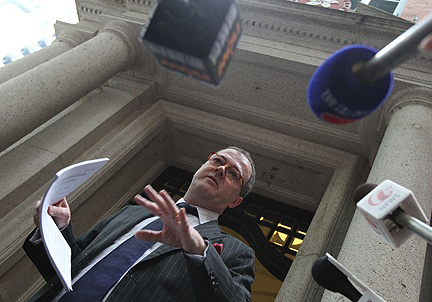
Photo by K.Y. Cheng: Michael Vidler, solicitor of the appellant, holds the judgment in his hand outside Court of Final Appeal.