Jun 27, 2013 | News
The ICJ welcomes the decision of Ukraine’s High Qualification-Disciplinary Commission to reinstate Larisa Gerasko, a lawyer previously disbarred because of her involvement in seeking to register a local lawyers’ association.
Following a hearing on 21 June, which was attended by ICJ Commissioner Gulnora Ishankhanova, the High Qualification-Disciplinary Commission (HQDC) found that there were no valid grounds for disbarment.
The decision of the HQDC came in the context of a series of disciplinary proceedings against lawyers in Ukraine, which followed a law on “Advokatura and Lawyers’ Activities” adopted in 2012.
“Following the enactment of the new law, two parallel structures of self-governance of the legal profession were established, only one of which was registered,” said Gulnora Ishankhanova. “As a result of the conflict, disciplinary sanctions have been initiated against a number of lawyers on the grounds of organization and participation in ‘an alternative congress’ as well as other related and unrelated grounds.”
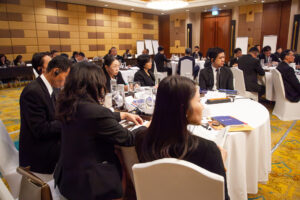
The ICJ commissioner visited Kiev on 20-22 June to examine the situation and meet with the main stakeholders including lawyers subjected to disciplinary action, relevant bodies of the Association of Lawyers and the HQDC and NGO representatives.
On 21 June, she observed disciplinary hearings against several lawyers including Larisa Gerasko, who had been disbarred on the grounds of submitting documents for state registration of a lawyers’ association of Zakarpatk Region, and Roman Martynovsky, a member of the HQDC, whose status as a lawyer was suspended for a period of six months for non-attendance of one meeting of this body.
The decision regarding lawyer Martynovsky was postponed until the following meeting of the HQDC.
“We are concerned that disciplinary action remains pending in a number of cases against lawyers involved in the creation of the unregistered lawyers’ association, the National Association of Lawyers,” Gulnora Ishankhanova added.
The ICJ recalls that, according to the UN Basic Principles on the Role of Lawyers, “all disciplinary proceedings shall be determined in accordance with the code of professional conduct and other recognized standards and ethics of the legal profession and in the light of these principles”.
Disciplinary action against a lawyer may only be initiated for violations of published standards of professional conduct, and any disciplinary sanctions must be proportionate to the offence committed.
Where a disciplinary system allows for practically any form of conduct to be construed by the responsible disciplinary body as grounds sufficient for disbarment, the sanction is likely to be arbitrary and to violate international human rights law.
The ICJ expresses its gratitude to the Ukrainian Helsinki Human Rights Union, the HQDC and others who facilitated or co-operated with the mission.
The ICJ will continue to monitor developments in the ongoing disciplinary action against lawyers in Ukraine and will in due course publish a more detailed report on the visit to Ukraine with recommendations.
Contact:
Róisín Pillay, Director, ICJ Europe Programme: +41 22 979 3830; e-mail: roisin.pillay(a)icj.org
Ukraine-ICJ welcomes decision to reinstate disbarred lawyer-press release-2013-rus (full text in pdf)
Photo by Serdar Yagci

Jun 19, 2013 | Адвокаси, Краткий анализ
МКЮ публикует настоящий краткий анализ международных стандартов, касающихся оснований и порядка привлечения к дисциплинарной ответственности адвокатов в странах СНГ.
Анализ публикуется в ответ на практику лишения или приостановления адвокатского статуса на основе ненадлежащих оснований в странах СНГ.
В анализе изложены международные стандарты, касающиеся роли юристов; гарантии функционирования юридической профессии; а также принципы, регулирующие дисциплинарное производство.
Данные стандарты укрепляют независимость юридической профессии и отдельно взятых адвокатов; они направлены на обеспечение возможности адвокатов содействовать справедливому отправлению правосудия в соответствии с принципом верховенства права.
Рекомендации, предлагаемые в конце документа, основываются на правовом анализе. Они призваны быть руководством для национальных ассоциаций адвокатов и компетентных государственных органов.
CIS-icj opinion lawyers discipline law-advocacy-analysis brief-2013-rus (PDF, полный текст на русском)
CIS-icj opinion lawyers discipline law-advocacy-analysis brief-2013-eng (PDF, полный текст на английском)

Jun 19, 2013
The ICJ issues this brief analysis of international standards regarding grounds and procedures for disciplinary action against lawyers in CIS countries.
It is published in response to a pattern of disbarment or suspension of lawyers on improper grounds, in CIS countries.
It outlines the international standards on the role of lawyers; guarantees for the functioning of lawyers; and the principles governing disciplinary action.
These standards reinforce the independence of the legal profession and of individual lawyers; they aim to ensure that lawyers can contribute to the fair administration of justice under the rule of law.
The recommendations, at the end of the document, are based on the legal analysis. They aim to provide guidance for national bar associations and the relevant state bodies.
CIS-icj opinion lawyers discipline law-advocacy-analysis brief-2013-eng (full text in pdf)
CIS-icj opinion lawyers discipline law-advocacy-analysis brief-2013-rus (full text in pdf)
Jun 13, 2013
The ICJ has submitted an alternative report to the Human Rights Committee on Tajikistan’s compliance with the International Covenant on Civil and Political Rights (ICCPR).
The report focuses on questions arising under Articles 7, 9 and 14 of the International Covenant on Civil and Political Rights (ICCPR) concerning the weak framework of protection against torture and other ill-treatment for those apprehended and detainees; the practices of arbitrary arrest and detention; and the inadequate protection of the right to a fair trial.
The ICJ raises various concerns about the criminal justice system, including the use of pre-trial detention in the majority of cases as the sole measure of restraint, and the use of torture and ill-treatment to extract “confessions”. The ICJ also addresses the lack of equality of arms in the criminal process; and impediments to lawyers in the exercise of their professional duties.
Tajikistan-HRCttee108-ICJ-AlternativeReport-LegalSubmission-2013 (download full alternative report by the ICJ)

Jun 10, 2013
In a statement delivered today by UPR-Info, the ICJ joined 72 NGOs to draw the Human Rights Council’s attention to attacks on the integrity of UPR Working Group reports.
In a general debate under Item 6 (Universal Periodic Review), the statement drew attention to recent amendments to the draft UPR Working Group report on the Russian Federation in which recommendations were removed by the State under review for reasons of their being irrelevant. The statement emphasised that both accepted and noted recommendations should be included in Working Group reports, irrespective of the country making them or of the issues raised.
The statement was delivered during the Human Rights Council’s 23rd regular session (27 May to 14 June 2013).
HRC23-Item6GD-LegalSubmission-2013 (download full oral statement in PDF)