Nov 30, 2018 | News
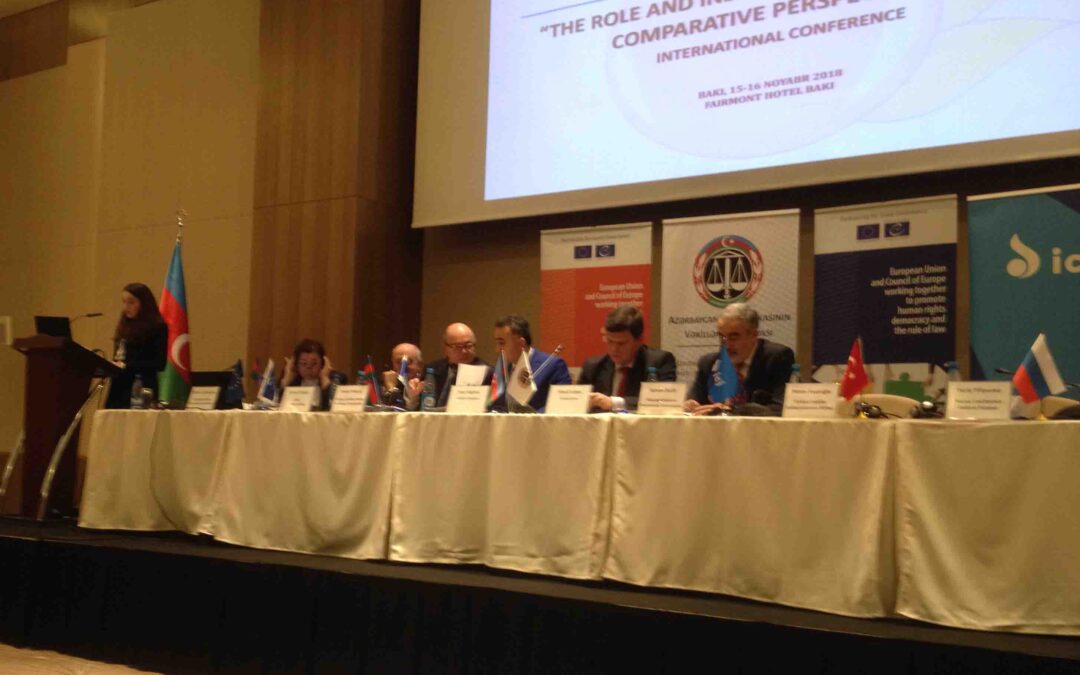
The International Commission of Jurists (ICJ) together with the Council of Europe and the Azerbaijan Bar Association held the international conference on the independence of the legal profession in Azerbaijan on 15-16 November 2018.
The conference on the Role and Independence of Lawyers brought together comparative perspectives from countries of the Council of Europe region and Central Asia as well as from international organizations. Representatives of bar associations and individual lawyers from Azerbaijan, Georgia, Kazakhstan, the Netherlands, the Russian Federation, Switzerland, Turkey, Ukraine, the United Kingdom and Uzbekistan shared their experiences and best practices in addressing challenges to the independence of lawyers.
The ICJ considers the conference to be a landmark event which has created much-needed space for further dialogue on the issue of independence of lawyers in Azerbaijan both with the national and international stakeholders.
The ICJ appreciates the engagement of the Azerbaijan Bar Association and the open debate on these issues at the conference, as a step towards implementation of its previous recommendations that the Bar Association “should initiate, through a consultative process, an internal reform based on the principles of independence of the profession, high standards of legal practice, the protection of lawyers from threats, harassment and hindrance in their work, and the democratic participation of its members.” Defenseless Defenders: Systemic Problems in the Legal Profession of Azerbaijan
The ICJ stresses the need for the Azerbaijan authorities to respect both the institutional independence of the legal profession, and the individual independence of lawyers, in accordance with the international standards outlined at the conference and in the above-mentioned report. Decisions of competent international human rights authorities, including the European Court of the Human Rights, in cases concerning the rights of lawyers, must be implemented in full.
The ICJ looks forward to future dialogue and co-operation with the Azerbaijan Bar Association and other concerned stakeholders in Azerbaijan on the essential elements of an independent legal profession, including as regards lawyers’ professional ethics, qualification of lawyers and the disciplinary system. The new impetus for international engagement on these issues creates room for discussing the most acute institutional challenges and individual cases where the independence of the legal profession may be at stake.
Speaking at the Conference, Róisín Pillay, Director of the ICJ Europe and Central Asia Programme said that “the requirement of independence places responsibilities not only on the bar association itself but also on the executive and legislative powers to respect this independence, refrain from interference, and put in place – and respect in practice – appropriate legislative and institutional safeguards.”
Participants underscored problems relating to the ethical responsibilities of lawyers and their enforcement in disciplinary proceedings, in particular as regards potential friction with the exercise of freedom of expression of lawyers.
Temur Shakirov, ICJ Senior Legal Adviser, focused on the independence of lawyers as an ethical requirement of individual lawyers, saying that “Independence is an essential principle both for the bar association as an institution and for an individual lawyer. It is known that the institutional independence of the legal profession should be ensured, in accordance with international standards, both in law and in practice. However, the independence of lawyers is also an ethical requirement for each lawyer.”
Henry Reznik, Vice-President of the Federal Chamber of Lawyers of the Russian Federation, stressed in his presentation that “the primary role of the association of lawyers is to protect their [lawyers’] independence and freedom.” He added that “Advokatura is an institute of the civil society. Advokatura is not part of the State and municipal bodies. And Advokatura must have the trust of the society.”
Yuri Pilipenko, President of the Federal Chamber of Lawyers of the Russian Federation, highlighted the natural tensions between the legal profession and government, noting that “… the government and an independent self-regulating professional organization, which has goals to protect rights and freedoms and access to justice, are by definition opponents in a certain sense.”
In his concluding remarks at the Conference, Anar Baghirov, President of the Azerbaijan Bar Association, highlighted that the most crucial mission of the Bar Association was “to protect interests of lawyers and the institutionalized legal profession.”
In that regard he mentioned the need for modification of the Law on Advocates and Advocates’ Activity, stating that the most important role of the Bar Association should be reflected in the law. In addition, among other things he mentioned that issues to be addressed included the number of lawyers, increasing availability of pro bono legal aid, enhancing lawyers’ professional capacity, and cooperation with other countries’ bar associations and international organizations.
In his closing remarks at the Conference, ICJ Secretary General Sam Zarifi stressed the importance of lawyers in the protection of human rights and the rule of law. He stressed that around the world, lawyers were attacked because of their role in defence of their clients: for what they say, what the individuals they represent say, and that such attacks violate the clear prohibition of identifying lawyers with their clients.
He stressed the key role of the bar association in this regard: “To maintain the role of lawyers we have heard again and again how important it is that lawyers have the independence and an association that can pretend this independence. It is part of international law and standards and we would like that standard to be implemented around the world and of course here [in Azerbaijan]. We need bar associations, which are independent and strong to defend the independence of lawyers.”
The ICJ will continue to closely follow issues of the independence and role of lawyers in Azerbaijan. It will continue its international engagement on such matters including with UN and Council of Europe institutions, as well as with lawyers and civil society in Azerbaijan in order to facilitate the independence of lawyers, their protection from harassment and reprisals, and other key principles in line with the UN Basic Principles on the Role of Lawyers.
Background information
Problems regarding independence of the legal profession in Azerbaijan were outlined in the ICJ report “Defenseless Defenders: Systemic Problems in the Legal Profession of Azerbaijan” https://www.icj.org/azerbaijan-the-independence-and-role-of-lawyers-must-be-respected-icj-report-says/
The ICJ has raised concerns regarding cases of abusive disciplinary proceedings and other threats to the independence of lawyers, including:
Cases of Democracy and Human Rights Resource Centre v. Azerbaijan and Mustafayev and Democracy and Human Rights Resource Centre v. Azerbaijan: https://www.icj.org/azerbaijan-icj-intervenes-before-european-court-of-human-rights-in-defence-of-harassed-lawyers-and-civil-society/
Azerbaijan: Lawyer Irada Javadova disbarment decided in unfair proceedings, https://www.icj.org/azerbaijan-lawyer-irada-javadova-disbarment-decided-in-unfair-proceedings/
Alayif Hasan oglu Hasanov v. Azerbaijan case: https://www.icj.org/azerbaijan-icj-intervenes-before-the-european-court-of-human-rights-in-a-case-concerning-restrictions-of-lawyers-rights/
Cases of Annagi Hajibeyli, Khalid Bagirovand Intigam Aliyev v Azerbaijan, https://www.icj.org/wp-content/uploads/2016/11/ICJ-Bagirovothers-AmicusBrief-Azerbaijan-2016-Final.pdf
Nov 23, 2018 | News
The ICJ is concerned at increasing government interference with the independence of the legal profession, including through intimidation and harassment of the leadership of the National Bar Association and individual lawyers in Kazakhstan.
In the last two months, there have been a series of resignations in the leadership of the National Bar, including Anvar Tugel, ex-President of the National Bar Association who publicly announced that his resignation was the result of “disagreement with the reform proposed by the Ministry of Justice”.
He explained that the “reform” aimed to remove the leadership of the Bar Association.
In his public statement, Tugel points out that several presidents of the local bar associations, faced pressure.
Indeed, Yakubenko Raisa and Vladimir Zolotov presidents of Aktyubinsk and Pavolodar bar associations respectively faced disbarment proceedings in the Kazakhstan courts, initiated by the Ministry of Justice.
The disciplinary charges against them are related to their administration of the bar associations.
He also pointed out that pressure was also exerted on individual lawyers, who had been invited to the Ministry of Justice and instructed which decisions to vote for at the National Conference of delegates of the regional bar associations.
Furthermore, Sergei Sizintsev, the Executive Director of the National Bar Association, has been unexpectedly dismissed from his position following the resignation of Anvar Tugel.
“Instructions about the outcome of the vote, apparently unjustified disciplinary proceedings against high profile lawyers and other such actions constitute interference with the independence of the legal profession and are of concern” Temur Shakirov, ICJ Europe and Central Asia Programme Senior Legal Adviser, said today.
“These developments cannot but create a chilling effect on the lawyers in Kazakhstan, including those independent lawyers who openly spoke against the reform of the legal profession,” he added.
Such measures are inconsistent with international law and standards on the independence of the legal profession, including the United Nations Basic Principles on the Role of Lawyers.
The ICJ calls on the State authorities, including the Ministry of Justice, to refrain from interference with the internal matters of the Bar, especially with the election of its governing bodies.
The interim leadership of the National Bar Association should ensure that elections to positions in the governing bodies are fair and transparent and are not a result of inappropriate interference from whatever quarter.
The ICJ will continue to monitor developments regarding the Kazakhstan legal profession, including disbarment proceedings against heads of regional bar associations, and other instances of apparent pressure on lawyers related to their opposition to reforms of the profession earlier criticized by the ICJ.
Background
The UN Basic Principles on the Role of Lawyers state that lawyers are entitled to form and join self-governing professional associations to represent their interests, promote their continuing education and training and protect their professional integrity.
The executive body of the professional associations shall be elected by its members and shall exercise its functions without external interference (Principle 24)
International principles on the role of lawyers also require the State to ensure that neither disciplinary sanctions, nor other measures such as criminal penalties, are unfairly or arbitrarily imposed on lawyers for action taken in accordance with their professional duties, and in accordance with accepted standards of professional conduct, including those enshrined in the Basic Principles on the Role of Lawyers
According to Principle 16 of the UN Basic Principles it is the obligation of the governments to ensure that lawyers “are able to perform all of their professional functions without intimidation, hindrance, harassment or improper interference” and that they do not “suffer, or be threatened with, prosecution or administrative, economic or other sanctions for any action taken in accordance with recognized professional duties, standards and ethics”.
The Law ‘On the Professional Activities of Advocates and Legal Assistance’ was signed into law on 10 July 2018.
Earlier the ICJ expressed concern in respect to the new law, as contradicting international law and standards on the independence of the legal profession, by enabling the executive to influence or to have control over who is allowed to practice law and substantial influence on disciplinary proceedings against lawyers. Read the full text here.
Read also
ICJ statement following the mission to Kazakhstan on the independence of the legal profession.
Nov 23, 2018 | Новости
Сегодня МКЮ совместно с Центром исследования правовой политики и Союзом адвокатов Таджикистана проводит в Душанбе региональную конференцию по вопросам независимости и роли адвокатов.
Адвокаты из Таджикистана и других стран Центральной Азии, СНГ и Европы обсудят правовые гарантии, которые должны быть предоставлены адвокатам, чтобы обеспечить их способность защищать права человека в отношении своих доверителей, а также роль адвокатских объединений с точки зрения защиты безопасности и независимости адвокатов.
Они рассмотрят вопрос о роли комитетов по защите прав адвокатов, образованных в составе адвокатских объединений ряда стран региона, а также о том, как обеспечить наиболее эффективную работу данных специализированных органов.
По итогам конференции будут подготовлены рекомендации по защите адвокатов региона.
Контакты:
Тимур Шакиров, старший правовой советник, Программа по Европе и Центральной Азии
temur.shakirov(a)icj.org
Nov 20, 2018
The ICJ said today that the Nepal Army’s petition before the Supreme Court seeking to overturn convictions of soldiers for the 2004 killing of 14-year-old Maina Sunuwar was riddled with legal flaws. Its success would be a blow to the fight against impunity in Nepal.
On the 12th Anniversary of the signing of the Comprehensive Peace Agreement (CPA), the ICJ released an analysis of the Nepal Army’s legal arguments in the petition to upend the convictions issued by the Kavrepalanchowk District Court for the killing Maina Sunuwar while in Army custody.
“The Nepal Army has sought to overturn the convictions of Maina’s killers by putting forth specious legal arguments that do not hold up under Nepali or international law, or in light of the past decisions of the Supreme Court,” said Frederick Rawski, ICJ Asia Pacific Director.
In the legal briefing, the ICJ sets out (i) Nepal’s obligations under international law and the Nepal Supreme Court’s jurisprudence to investigate and prosecute perpetrators of human rights violations; (ii) the impropriety of jurisdiction by a military court-martial in cases of serious human rights violations; and (iii) refutes the argument that the convictions violated principles of ‘double jeopardy’.
The briefing sets out international law and jurisprudence establishing the Government’s duty to prosecute serious human rights violations as distinct and separate from its obligation to establish the truth, including as part of a transitional justice process.
The briefing comes at a moment when the future of justice for conflict era crimes and human rights violations in Nepal is uncertain.
In July, a draft bill amending the existing legislative framework governing the transitional justice process was criticized by civil society, victim groups and human rights organizations – including in a joint analysis by the ICJ, Amnesty International and Trial International.
While a government panel elicited comments at consultations with victims and civil society, the government never produced a revised draft or conducted follow-up.
“How can the people of Nepal, and particularly conflict victims, have faith in government proposals to press forward on transitional justice when the Nepal Army continues to fight even minimal accountability with disingenuous legal arguments, such as in the case of Maina Sunuwar?” said Rawski.
“The foundation for any process moving forward must be the best interests of victims, a commitment to accountability, and respect for international human rights obligations. This has been affirmed many times over by the Supreme Court,” he added.
Contact
Frederick Rawski, ICJ Asia Pacific Director, t: +66 64 478 1121 ; e: frederick.rawski@icj.org
Background
Maina Sunuwar was subjected to enforced disappearance, torture and unlawful killing after a covert military operation, which included the involvement of then captain Niranjan Basnet on 17 February 2004.
The military refused to acknowledge Maina’s detention for many months.
After overcoming a number of procedural and political hurdles stretching over years, on 16 April 2017, the Kavre District Court sentenced three retired army officers to life imprisonment for Maina Sunuwar’s murder.
In September 2017, the Nepal Army filed a writ petition in the Supreme Court challenging the decision of the Kavre Court on several grounds, including that military courts had proper jurisdiction over the original case, that the District Court convictions violated the principle of ‘double jeopardy’ because the defendants had already been tried by a court-martial, and that the court system no longer had jurisdiction over conflict-related cases following the establishment of transitional justice institutions.
Nepal-Petition to overturn convictions for Maina Sunuwar killing-Advocacy-Analysis brief-2018-ENG (Full Analysis brief, in PDF)
Nov 16, 2018 | Новости, Статьи
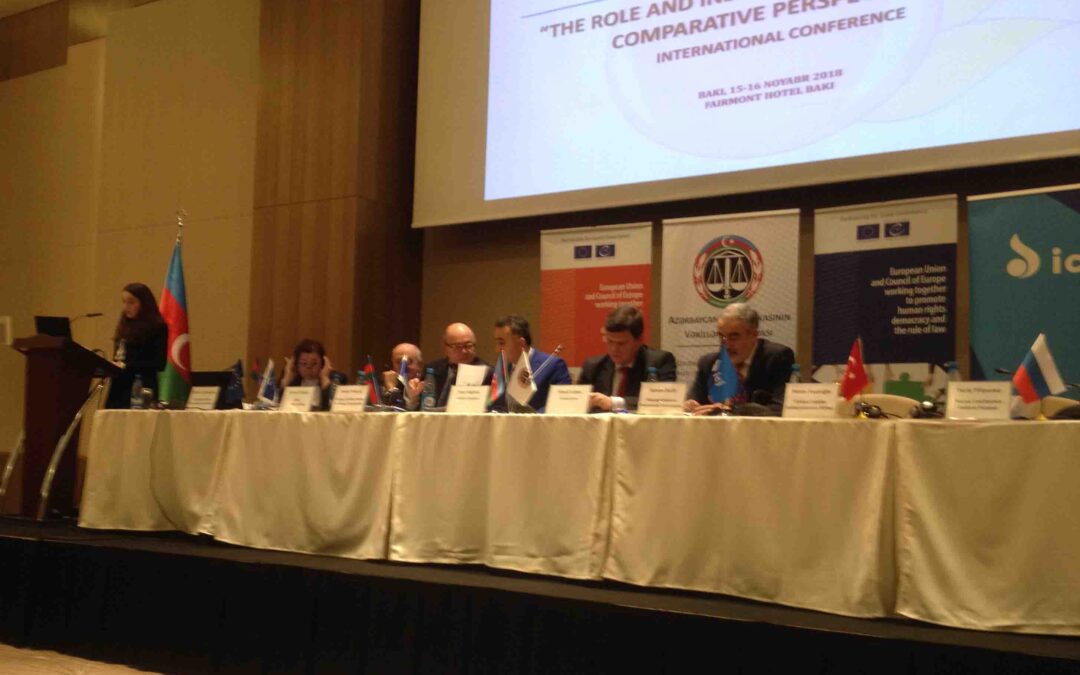
15 и 16 ноября МКЮ совместно с Советом Европы (СЕ) и Коллегией адвокатов Азербайджана (КА) проводит в Баку международную конференцию, посвященную «роли и независимости адвокатов: сравнительные подходы».
Данная конференция является первым мероприятием, посвященным роли и независимости адвокатуры, которая организуется в стране. В рамках конференции международные эксперты и представители адвокатских ассоциаций целого ряда стран, в том числе Совета Европы и Центральной Азии, а также представители международных организаций, обсудят сравнительные подходы к управлению адвокатурой и ее роли.
В рамках выступлений будут освещены различные взгляды на те требования и условия, которым должны соответствовать адвокаты при выполнении своей профессиональной обязанности по защите прав человека в отношении доверителей.
В частности, участники Конференции рассмотрят вопрос об организации и управлении адвокатурой, адвокатской этике и аттестации адвокатов.
Контакты:
Тимур Шакиров, старший правовой советник, Программа по Европе и Центральной Азии
temur.shakirov(a)icj.org
Azerbaijan-Conference Independence Lawyers-News-Agenda-2018-RUS
Azerbaijan-Conference Independence lawyers-News-Agenda-2018-AZE
Прямая трансляция: https://www.youtube.com/watch?v=POVlaKXjUrg&feature=youtu.be