Apr 30, 2015 | News
The ICJ welcomes yesterday’s adoption, by the UN Working Group on Arbitrary Detention, of the Working Group’s “Basic Principles and Guidelines on Remedies and Procedures on the Right of Anyone Deprived of His or Her Liberty by Arrest or Detention to Bring Proceedings Before Court”.
Under its resolution 20/16 (2012), the UN Human Rights Council requested the Working Group to prepare draft basic principles and guidelines on habeas corpus. The Working Group set out a first draft set of principles and guidelines ahead of its global consultation on the subject in September 2014. From 2 to 5 February 2015, the Working Group met to continue its elaboration of the Basic Principles and Guidelines, resulting in the adoption of a second draft. The Working Group adopted its final iteration of the document at the conclusion of its session on 29 April 2015. The Basic Principles and Guidelines will be presented to the Human Rights Council during the Council’s 30th regular session, to be held from 14 September to 2 October 2015.
The ICJ welcomes the Basic Principles and Guidelines as a means of assisting States to enhance, in law and in practice, respect for the right to habeas corpus. It especially welcomes certain aspects of the document, including:
- Paragraph 68, in which applicable qualifications are set out to any derogating measures to accommodate constraints on the application of some procedural elements of the right to habeas corpus;
- Principle 6 and Guideline 4 which reaffirm that habeas corpus petitions must be heard by courts that bear all characteristics of competence, independence and impartiality (paras 27, 70 and 72(a)), that competence includes the power to order immediate release if detention is fund to be arbitrary or unlawful (para 27), that immediate implementation of such orders is required (para 71(c)) and that courts must give reasoned and particularized decisions (para 71(d));
- Guideline 7, in which it is provided that individuals are entitled to take proceedings multiple times (paras 81 and 82), that expediency is required, including in cases of subsequent challenges, and especially in cases alleging, among other things, torture or ill-treatment (para 83) and that authorities remain obliged to ensure regular review of the continuing need for detention (para 84);
- Principle 9 and Guideline 8 concerning legal representation and legal aid;
- The clarifications in Principle 10 and Guideline that persons able to bring proceedings include counsel, family members or other interested parties, whether or not they have proof of the consent of the detainee (paras 34 and 92) and that no restrictions may be imposed on a detainee’s ability to contact such persons (para 35);
- The express recognition in Guideline 12 that information obtained by torture or other forms of ill-treatment may not be used in evidence;
- Guideline 13 concerning disclosure and limitations applicable to any non-disclosure of information on security or other grounds;
- Guideline 14, reflecting authorities’ obligation to justify the need and proportionality of detention;
- Principle 15 and Guideline 16 (on remedies), reflecting the overarching right to remedies and reparation (paras 43), the need for authorities to give immediate effect to an order for release (para 44) and the right to compensation, restitution, rehabilitation, satisfaction and guarantees of non-repetition (paras 109-112); and
- Principle 16 concerning the application of Article 9(4) of the International Covenant on Civil and Political Rights (ICCPR) alongside international humanitarian law (paras 45 and 47), the application of Article 9(4) to civilians in an international armed conflict (para 47), the application of habeas principles to prisoners of war (para 48), and the question of administrative detention or internment in the context of a non-international armed conflict (para 49).
The ICJ has engaged in all stages of the Working Group’s elaboration and consultations. It made written submissions in November 2013, April 2014 and March 2015. Its staff, Matt Pollard and Alex Conte, gave panel presentations at the September 2014 global consultation.
Apr 22, 2015 | Multimedia items, News, Video clips
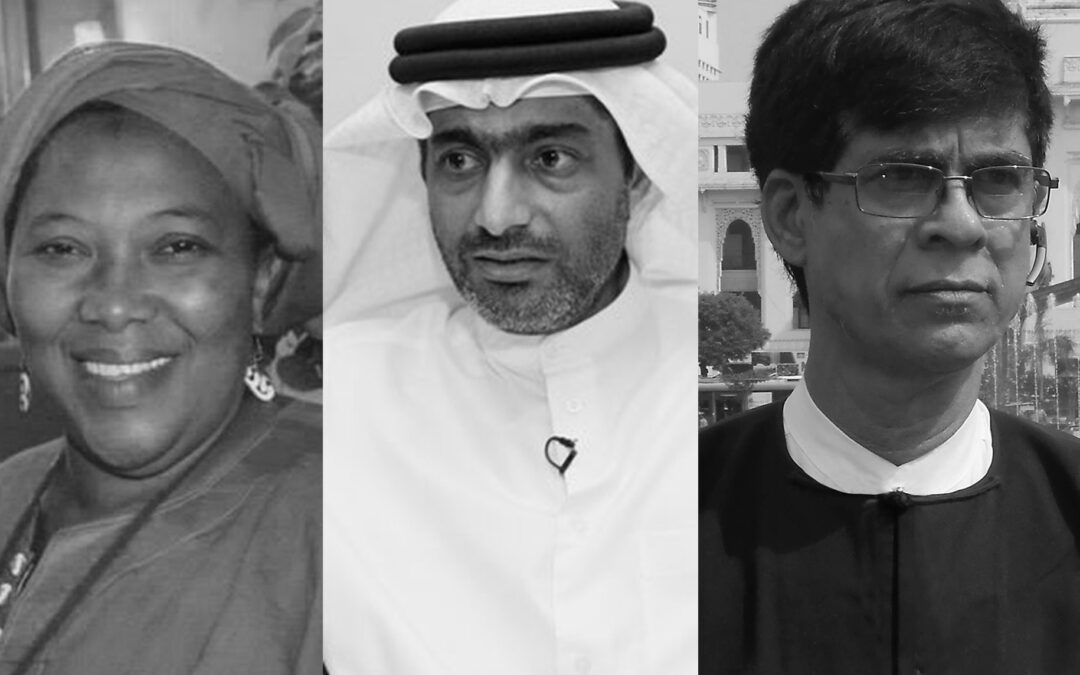
The three final human rights defenders who will compete for the award are Ahmed Mansoor (United Arab Emirates), Robert Sann Aung (Myanmar) and Asmaou Diallo (Guinea). The ICJ is member of the MEA Jury.
The Martin Ennals Award for Human Rights Defenders (MEA) is the main award of the human rights movement and as such can be labelled as the Nobel Price for human rights.
It is a unique collaboration among ten of the world’s leading human rights organizations to give protection to human rights defenders worldwide.
This award is selected by the International Human Rights Community (members of the jury are ICJ, Amnesty International, Human Rights Watch, Human Rights First, International Federation for Human Rights, World Organisation Against Torture, Front Line Defenders, EWDE Germany, International Service for Human Rights and HURIDOCS).
It is given to Human Rights Defenders who have shown deep commitment and face great personal risk. The aim of the award is to highlight their work and protect them through increased visibility.
The 2015 Award will be presented on Oct. 6th at a ceremony hosted by the City of Geneva.
Since 2006, Ahmed Mansoor (United Arab Emirates) has focussed on initiatives concerning freedom of expression, civil and political rights.
He successfully campaigned in 2006-2007 to support two people jailed for critical social comments. They were released and the charges dropped.
Shortly after, the Prime Minister of UAE issued an order not to jail journalists in relation to their work.
He is one of the few voices within the United Arab Emirates who provides a credible independent assessment of human rights developments.
He regularly raises concerns on arbitrary detention, torture, international standards for fair trials, non-independence of the judiciary, and domestic laws that violate international law.
He was jailed in 2011 and since then has been denied a passport and banned from travelling.
“I’m very pleased to be nominated for the Martin Ennals award,” he said. “This recognition indicates that we are not left alone in this part of the world and I hope it will shed further light on the human rights issues in the UAE. It is not just full of skyscrapers, big malls and an area attractive to businesses, but there are other struggles of different sorts beneath all of that.”
Since his first year of University in 1974, Robert Sann Aung (Myanmar) has courageously fought against human rights abuses.
He has been repeatedly imprisoned in harsh conditions, physically attacked as well as regularly threatened.
His education was interrupted numerous times and he was disbarred from 1993 – 2012.
In 2012, he managed to regain his license to practice law. Since then he has represented jailed child soldiers, those protesting at a contested copper mine, peaceful political protesters, those whose land has been confiscated by the military, as well as student activists.
Throughout his career he has provided legal services, or just advice, often pro bono, to those whose rights have been affected.
“I feel humble and extremely honored to be nominated for this prestigious award. This nomination conveys the message to activists, human rights defenders and promoters who fight for equality, justice and democracy in Myanmar that their efforts are not forgotten by the world,” he said.
Asmaou Diallo (Guinea)’s human rights work started following the events of 28 September 2009 when the Guinean military attacked peaceful demonstrators.
Over 150 were killed, including her son, and over 100 women raped. Hundreds more were injured.
She and l’Association des Parents et Amis des Victimes du 28 septembre 2009 (APIVA), which she founded, work to obtain justice for these crimes and to provide medical and vocational support to victims of sexual assault, many of whom cannot return to their homes.
She has worked to encourage witnesses to come forward and supported them as they provided information and testimony to court proceedings.
As a result, eleven people have been charged, including senior army officers.
“Being among the nominees for the Martin Ennals Foundation encourages me to continue my fight for the protection and promotion of human rights in Guinea. I trust that this award will have a positive effect on the legal cases concerning the events of the September 28, 2009, and will be a lever for all defenders of human rights in Guinea,” she said.
Contact:
Olivier van Bogaert, Director Media & Communications, ICJ representative in the MEA Jury, t: +41 22 979 38 08 ; e: olivier.vanbogaert(a)icj.org
Michael Khambatta, Director, Martin Ennals Foundation, t: +41 79 474 8208 ; e: khambatta(a)martinennalsaward.org
Universal-MEA Final Nominees 2015-News-Press Release-2015-ENG (Official press release in English)
Universal-MEA Final Nominees 2015-News-Press Release-2015-FRE (Official press release in French)
Universal-MEA Final Nominees 2015-News-Press Release-2015-ARA (Official press release in Arabic)
Universal-MEA Final Nominees 2015-News-Press Release-2015-BUR (Official press release in Burmese)
UAE-MEA 2015 Bio Ahmed Mansoor-2015-ENG (full bio in PDF)
Myanmar-MEA 2015 Bio Robert Sann Aung-2015-ENG (full bio in PDF)
Guinea-MEA 2015 Bio Asmaou Diallo-2015-ENG (full bio in PDF)

Apr 14, 2015
Today the ICJ published a briefing paper addressing harmful gender stereotypes and assumptions in law and practice and highlighting efforts in a number of countries to reform such law and practice.
The briefing paper is intended to assist legal practitioners and human rights defenders working to ensure effective criminal justice response to sexual violence against women.
“Around the world harmful stereotypes have the effect of denying many victims of sexual violence effective access to justice and redress for violations. This briefing paper demonstrates the onerous and unfair burdens placed upon victims arising from their gender when they seek to access justice,” said Ian Seiderman, ICJ Legal and Policy Director.
The paper highlights the importance of upholding a suspect’s right to a fair trial, including the presumption of evidence and rights to examine witnesses and challenge evidence while at the same time ensuring victims and witnesses also maintain equality before the law.
The publication addresses common assumptions that women are inherently untruthful; that credibility is premised on chastity; that women will fight back and therefore should demonstrate evidence of physical force or a struggle; that women’s passive sexuality opens up room for debate in defining consent; that women should obey their husbands; and that sexual violence is a matter of dishonor to the victims and their families.
In identifying these underlying harmful gender stereotypes and assumptions the paper also identifies a number of reform measures and examples of good legislative practice that can help states to enhance protection against sexual violence of women in accordance with their international obligations.
Download the report here:
Universal-GenderStereotypes-Publications-Thematic report-2015-ENG (full text in PDF)

Mar 26, 2015 | News
The UN Human Rights Council today adopted a landmark resolution on “the right to privacy in the digital age” that will establish for the first time a UN Special Rapporteur on the Right to Privacy.The resolution faced some challenges during negotiations, but was adopted without a vote (i.e. by consensus).
The Rapporteur will be appointed later this year. The Council has invited him or her to include in initial reports to the Council and UN General Assembly, a focus on the challenges to the right of privacy arising from developments in digital and communications technology in “the digital age”. However, the mandate is able to deal with all aspects of the right to privacy.
The initiative has been strongly supported by civil society organisations including the ICJ, including in the form of a joint open letter, and a joint oral statement on behalf of some 92 NGOs from around the world.
The draft resolution, as adopted, may be downloaded here: HRC28-Privacy-DraftRes-2015