Guatemala: CIJ considera que la Corte de Constitucionalidad puede rescatar el Estado de Derecho

Guatemala: CIJ considera que la Corte de Constitucionalidad puede rescatar el Estado de Derecho

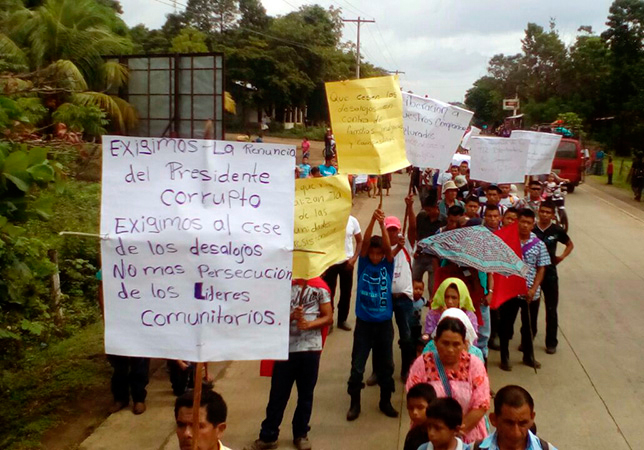
En el contexto actual de Guatemala, es notorio que el riesgo de abusos de poder y de violaciones a los derechos humanos, ha aumentado significativamente. Esta situación ha hecho surgir graves tensiones entre la Justicia Constitucional, a cargo de la Corte de Constitucionalidad y los poderes Ejecutivo y Legislativo.

Este tipo de tensiones y conflictos se han presentado recientemente, cuando el Tribunal Constitucional ha invalidado actos del Poder Ejecutivo por ser inconstitucionales.

Las y los magistrados de la Corte de Constitucionalidad han demostrado en dichos casos, que pueden emitir resoluciones, sin que se subordinen al Poder Ejecutivo o a otro poder fáctico y velando por la protección de los derechos humanos de todas las personas.

Ramón Cadena, Director de la Comisión Internacional de Juristas expresó que “es necesario reconocer que las y los Magistrados de la Corte de Constitucionalidad, desempeñan una función sumamente difícil, que requiere muy elevadas cualidades judiciales y éticas. Sin embargo, por difícil y compleja que sea su función, cuando el poder público se ejerce con abuso de autoridad y contraviniendo el Derecho Interno y el Derecho Internacional de los Derechos Humanos, la Corte de Constitucionalidad debe fijar los límites que el Derecho Constitucional e Internacional impone al ejercicio del poder.”
Special hearing of the Inter-American Commission of Human Rights (IACHR) on the role of the Guatemalan Commission against Corruption (CICIG)

Special hearing of the Inter-American Commission of Human Rights (IACHR) on the role of the Guatemalan Commission against Corruption (CICIG)

The Inter-American Commission of Human Rights (IACHR) held a special hearing on the role of the International Commission against Impunity in Guatemala (CICIG) in Boulder, Colarado.

Ramón Cadena, the ICJ Director stated “We regret that the Government of Guatemala requested the IACHR to hold the hearing behind closed doors since all the points discussed were of public interest. The discussions should have been open to the press and the general public. We urge the authorities to ensure there will be no retaliations against the work carried out by human rights organizations and human rights defenders.”

The ICJ welcomed the participation of many NGOs  at the event  and the frank dialogue that took place on this crucial issue for human rights in that country. The Guatemalan government delegation claimed that the Inter-American System of Human Rights was not competent to consider the matter. However, the IACHR maintained it was competent, according to the American Convention of Human Rights and other regional human rights legislation. As an “external observer”, the IACHR  stated it was “surprised” by the latest decisions taken by government authorities at the highest level not to extend the CICIG mandate nor allow the entry of Commissioner Iván Velásquez into the country. It considered these decisions were “excessive” and in no way strengthened the rule of law in Guatemala.

The government delegation further argued that the CICIG acted as a “parallel prosecutor” which affects the internal order of the country. The NGO delegation stated that on the contrary the CICIG acted as a “complementary prosecutor”. The delegation further noted that before the CICIG mandate was approved, the Constitutional Court, in an opinion published in the official gazette on 8 May 2007 (document no 791-2007), considered that the CICIG did not violate the constitutional order nor the rule of law in Guatemala.

The Constitutional Court referred to the CICIG as having “the function of supporting, assisting and strengthening the state institutions responsible for investigating crimes committed by  illegal and clandestine security forces .. and does not exclude the possibility of receiving  support from other institutions in the collection of evidence, provided that the participation has been established in a legal manner, as in the present case.”

The IACHR considered that the essential question  was whether the State of Guatemala already had the judicial independence and strong  institutions necessary to  fight against corruption in Guatemala without the support of the CICIG. The NGO delegation considered, based on different arguments, that the presence of the CICIG in Guatemala was still necessary.

The IACHR also informed the government delegation that it was in their interest to invite an in-situ visit of the IACHR as soon as possible so as to better understand the human rights situation.

The ICJ Director for Central America Ramón Cadena participated in the hearing at the request of the Central American Institute for Social Democracy  Studies (DEMOS), the Committee for Peasant Development (CODECA) and the Network of Community Defenders. The Indigenous Peoples Law Firm had been requested to attend by these organizations but was unable to do so at the last moment.

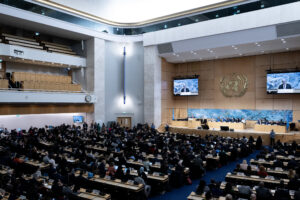
Comisión Interamericana de Derechos Humanos (CIDH) celebra audiencia sobre “Rol de la CICIG en la lucha contra la corrupción y su impacto en la situación de los derechos humanos en Guatemala”

Comisión Interamericana de Derechos Humanos (CIDH) celebra audiencia sobre “Rol de la CICIG en la lucha contra la corrupción y su impacto en la situación de los derechos humanos en Guatemala”

La CIJ celebra la participación de diferentes Organizaciones No Gubernamentales, en la audiencia que la Comisión Interamericana de Derechos Humanos (CIDH) convocara de oficio, la cual permitió escuchar la posición de ambas delegaciones y llevar a cabo un diálogo franco sobre un tema trascendental para la población guatemalteca y el respeto de los derechos humanos en el país.

La CIJ participó por medio de su Director para Centroamérica, abogado Ramón Cadena, participación solicitada por el Instituto Centroamericano de Estudios para la Democracia Social (DEMOS), del Comité de Desarrollo Campesino (CODECA) y de la Red de Defensores Comunitarios.

El Bufete para Pueblos Indígenas, si bien había sido solicitado por dichas organizaciones para asistir, no pudo hacerlo en un último momento.

Si bien la Delegación Gubernamental alegó falta de competencia por parte del Sistema Interamericano de Derechos Humanos, la Comisión Interamericana no sólo sostuvo que sí era competente, según la Declaración Americana de Derechos Humanos y la Convención Americana de Derechos Humanos y otra legislación regional de Derechos Humanos, sino que además, en su calidad de “observadora externa”, se sintió “sorprendida” por las últimas decisiones tomadas por las autoridades gubernamentales al más alto nivel y advirtió al Estado de Guatemala, que el mensaje que el Estado de Guatemala estaba dando con sus últimos actos y decisiones de no prorrogar el mandato de la CICIG, ni permitir el ingreso del comisionado Iván Velásquez al país, era “excesivo” y que en nada fortalecía al Estado de Derecho de Guatemala.

Otro argumento de la delegación gubernamental fue afirmar que la CICIG actuaba como “fiscalía paralela”, lo cual afectaba el ordenamiento interno.

Al respecto, la delegación de las organizaciones no gubernamentales explicaron a la ilustre Comisión Interamericana de Derechos Humanos, que no se trataba de una fiscalía paralela, sino que de la figura del “querellante adhesivo” y que incluso antes de la aprobación del mandato de la CICIG, la Corte de Constitucionalidad emitió una opinión consultiva el 8 de mayo de 2007 (Expediente 791-2007), debidamente publicada en el Diario Oficial, en la que consideró que la constitución de la CICIG no violaba el ordenamiento constitucional, ni legal del Estado de Guatemala.

Específicamente, la Corte de Constitucionalidad consideró al referirise a la función de la CICIG que “la función de apoyar, coadyuvar y fortalecer a las instituciones estatales encargadas de la investigación en los delitos cometidos con ocasión de la actividad de los cuerpos ilegales de seguridad y aparatos clandestinos de seguridad…no excluye la posibilidad de recibir el apoyo de otras instituciones en la recolección de evidencia, siempre que la participación se haya establecido de manera legal, como sucede en el presente caso.”

La ilustre Comisión Interamericana de Derechos Humanos (CIDH) consideró que la pregunta esencial que había que responder, era si el Estado de Guatemala contaba ya con la fortaleza institucional, con la independencia judicial y con funcionarios e instituciones sólidas, como para poder luchar contra la corrupción en Guatemala, sin el apoyo de la CICIG.

La delegación de las organizaciones no gubernamentales fundamentaron con diferentes argumentos, que aún no se contaba con dicha solidez y que la presencia de la CICIG en el país, seguía siendo necesaria.

La Comisión Interamericana celebró la participación nutrida de la Sociedad Civil de Guatemala y la presencia de representantes del gobierno guatemalteco y manifestó que el haber convocado de oficio a esta audiencia, demostraba el interés de la CIDH en Guatemala.

Informó a la delegación gubernamental, que era su interés realizar una visita “in loco” a la mayor brevedad posible, ya que de esa forma podría conocer en forma más profunda todas las situaciones de derechos humanos que se estaban presentando en el país, para lo cual solicitó el apoyo de la delegación gubernamental.

Ramón Cadena, Director de la CIJ para Centroamérica expresó: “Lamentamos que el Gobierno de Guatemala solicitara a la Comisión Interamericana de Derechos Humanos que la audiencia se llevara a cabo a “puertas cerradas”, ya que todos los puntos discutidos fueron del interés de la ciudadanía en general y de la prensa.

Por ello, en lugar de mantener las discusiones cerradas, deberían abrirse al conocimiento de la prensa y del público en general. Exigimos a las autoridades correspondientes, que no vaya a haber represalias en contra del trabajo que realizan las organizaciones de derechos humanos y las y los defensores de derechos humanos.”

ICJ Commissioner Reed Brody: “Twenty years later, Pinochet’s arrest remains an inspiration”

ICJ Commissioner Reed Brody: “Twenty years later, Pinochet’s arrest remains an inspiration”

On October 16, 1998, the former dictator of Chile Augusto Pinochet was arrested in London on a warrant from a Spanish judge. Reed Brody participated in the subsequent legal case.

Reed Brody went on to apply the “Pinochet precedent” in the landmark prosecution of the former dictator of Chad, Hissène Habré, who was convicted of crimes against humanity in Senegal in 2016.

He now works with victims of the former dictator of Gambia, Yahya Jammeh. The ICJ interviewed Brody about the Pinochet case and its legacy.

What was your role in the Pinochet case?

My role started when Pinochet was arrested in London. The case began long before that, of course, in the early years of Pinochet’s dictatorship when brave human rights activists documented each case of murder, and “disappearance.”

The ICJ worked with those advocates to produce a seminal 1974 report on those crimes, just six months after Pinochet’s coup. Shut out of Chile’s courts, even after the democratic transition of 1990, victims and their lawyers pursued a case against Pinochet in Spain under its “universal jurisdiction” law and when Pinochet traveled to London, Spanish Judge Baltasar Garzón requested and obtained his detention.

When Pinochet challenged his arrest in court claiming immunity as a former head of state, I went to London for Human Rights Watch, and we and Amnesty International were granted the right to intervene with teams of lawyers in the proceedings at the judicial committee of the House of Lords, then Britain’s highest court.

The Lords cited our research in rejecting Pinochet’s immunity.

You famously described the Lords’ Pinochet decision as a “wake-up call” to tyrants everywhere. Looking back, do you think it was?

Actually no, I think one would be hard pressed to discern a change in the behavior of dictators. Mugabe didn’t quake in his boots, Saddam didn’t clean up his act.

The more important and more lasting effect of the case was to give hope to other victims and activists. When the Lords ruled that Pinochet could be arrested anywhere in the world despite his status as a former head of state, the movement was in effervescence.

As a human rights lawyer, I was used to being legally and morally right, but still losing. In the Pinochet case, not only did we win, but we upheld the detention of one of the world’s most iconic dictators.

The Pinochet case inspired victims of abuse in country after country, particularly in Latin America, to challenge the transitional arrangements of the 1980s and 1990s, which allowed the perpetrators of atrocities to go unpunished and, often, to remain in power.

These temporary accommodations with the ancien régime didn’t extinguish the victims’ thirst to bring their former tormentors to justice.

How did you go from Pinochet to Habré?

With Pinochet, we saw that universal jurisdiction could be used as an instrument to bring to book people who seemed out of the reach of justice.

Together with groups like Amnesty, the FIDH, and the ICJ (which wrote an important report on the Pinochet case and its lessons), we had meetings on who could be the “next Pinochet.”

That’s when Delphine Djiraibe of the Chadian Association for Human Rights asked us to help Habre’s victims bring him to justice in his Senegalese exile.

I was excited at the prospect of persuading a country in the Global South, Senegal, to exercise universal jurisdiction, because there was a developing paradigm of European courts prosecuting defendants from formerly colonized countries.

It took us 17 years, but Habré became the first prosecution ever of a former head of state using universal jurisdiction, and indeed the first universal jurisdiction trial in Africa.

1998 was a high water mark for international justice with the adoption of the ICC Rome Statute and Pinochet’s arrest. Neither the ICC nor universal jurisdiction have quite lived up to their expectations. Why?

International justice doesn’t operate in a vacuum, it’s conditioned by the global power structure. Each case, whether at the ICC level or the transnational level, is a product of the political forces which must be mobilized, or fended off, to allow a prosecution to proceed.

Those forces, particularly since September 11, 2001, have been hostile to human rights enforcement in general and to justice in particular. Universal jurisdiction has been subject to the same double standards as the ICC.

The Belgian and Spanish universal jurisdiction laws, which were the broadest in the world, were both repealed when they were used to investigate superpower actions.

But many of the most successful cases have been those in which the victims and their activist supporters have been the driving forces, have compiled the evidence themselves, built an advocacy coalition which placed the victims and their stories at the center of the justice struggle and helped create the political will in the forum state.

I’m thinking not just of Habré, but the genocide prosecution in Guatemala of the former dictator Efraín Ríos Montt, the case in Haiti of “President for Life,” Jean-Claude “Baby Doc” Duvalier, the Liberian cases brought around the world by Civitas Maxima and its partners, the Swiss cases initiated by TRIAL International, and the Syria litigation by ECCHR and others.

These cases were brought before domestic courts either of the country in which the atrocities took place (Guatemala, Haiti) or of foreign countries based on universal jurisdiction, rather than before international courts.

Most of these cases took advantage of legal regimes which allowed victims directly to participate in the prosecutions as “parties civiles,” or “acusación particular” rather than play passive or secondary roles in cases prosecuted solely by state or international officials.

How do victim-driven prosecutions look different than institutional cases?

When it’s the victims and their allies who get the cases before a court, who gather the evidence, and who have formal standing as parties, the trials are more likely to live up to their expectations.

In the Rios Montt case, for instance, the Asociación Para la Justicia y Reconciliacion (AJR) and the Centro Para la Acción Legal en Derechos Humanos (CALDH) mobilized the victims, developed the evidence, defined the narrative and, essentially, determined the outlines of the case and chose the witnesses who would testify for the prosecution.

In the Habré case, we spent 13 years building the dossier, interviewing hundreds of victims and former officials and uncovering regime police files. The victims’ coalition always insisted that any trial include crimes committed against each of Chad’s victimized ethnic groups, and that is exactly was happened.

In contrast, a distant prosecutor, disconnected from national narratives and inherently not accountable to the victims or civil society, can be tempted to narrowly tailor prosecutions in the hopes of securing a conviction or avoiding political resistance.

This was the case with the ICC in the Democratic Republic of the Congo, for instance, where, as Pascal Kambale has persuasively argued, it betrayed the victims’ hopes.

Millions of civilians died in the DRC and Luis Moreno Ocampo only went after two local warlords. I think the current prosecutor is paying more attention to local realities.

The inspiration from victim-driven cases is also greater, and they are to some degree replicable. As Naomi Roht-Arriaza has written, these cases “stirred imaginations and opened possibilities precisely because they seemed decentralized, less controllable by state interests, more, if you will, acts of imagination.”

When I showed Chadian victims video clips of the Ríos Montt trial, they saw in those images exactly what they were trying to do.

Just as the Chadians came to us in the Habré case seeking to do what Pinochet’s victims had done, our hope in getting the Habré case to trial was that other survivors would be inspired by what Habre’s victims had done and say, “you see these people, they fought for justice and never gave up. We can do that too.”

And indeed, Liberian victims and Gambian victims have patterned their campaigns for justice on what Habre’s victims did. So, the Pinochet case continues to be an inspiration.


Reed Brody, commissaire à la CIJ: «Vingt ans après, l’arrestation de Pinochet reste une source d’inspiration»

Reed Brody, commissaire à la CIJ: «Vingt ans après, l’arrestation de Pinochet reste une source d’inspiration»

Le 16 octobre 1998, l’ancien dictateur chilien, Augusto Pinochet, a été arrêté à Londres sur mandat d’un juge espagnol. Reed Brody a participé à la procédure judiciaire ultérieure.

Reed Brody a ensuite appliqué le «précédent Pinochet» dans la poursuite marquante de l’ancien dictateur tchadien, Hissène Habré, reconnu coupable de crimes contre l’humanité au Sénégal en 2016.

Il travaille maintenant avec les victimes de l’ancien dictateur de Gambie, Yahya Jammeh. La CIJ a interrogé Brody sur l’affaire Pinochet et son héritage.

Quel a été votre rôle dans l’affaire Pinochet?

Mon rôle a commencé lorsque Pinochet a été arrêté à Londres. L’affaire a commencé bien avant, bien sûr, dans les premières années de la dictature de Pinochet, lorsque de courageux militants des droits de l’Homme ont documenté chaque cas de meurtre et de «disparition».

La CIJ a travaillé avec ces défenseurs pour produire un rapport crucial sur ces crimes en 1974, six mois seulement après le coup d’État de Pinochet. Exlus des tribunaux chiliens, même après la transition démocratique de 1990, les victimes et leurs avocats ont engagé une action en justice contre Pinochet en Espagne en vertu de la loi en matière de “compétence universelle”, et lorsque Pinochet s’est rendu à Londres, le juge espagnol Baltasar Garzón a demandé et obtenu sa détention.

Lorsque Pinochet a contesté son arrestation devant un tribunal, affirmant son immunité en tant qu’ancien chef d’État, je me suis rendu à Londres pour le compte d’Human Rights Watch, et avec Amnesty International nous avons obtenu le droit d’intervenir avec des équipes d’avocats dans les procédures auprès du comité judiciaire de la Chambre des lords, la plus haute cour de Grande-Bretagne.

Les Lords ont cité nos recherches pour rejeter l’immunité de Pinochet.

Vous avez décrit la décision des Lords concernant Pinochet comme un «signal d’alarme» pour des tyrans où qu’ils soient. En regardant en arrière, pensez-vous que c’était le cas?

En fait non, je pense qu’il serait difficile de discerner un changement de comportement des dictateurs. Mugabe n’a pas tremblé dans ses bottes, Saddam n’a pas mis de l’ordre dans ses affaires.

L’effet le plus important et le plus durable de l’affaire était de donner espoir à d’autres victimes et militants. Lorsque les Lords ont décidé que Pinochet pouvait être arrêté n’importe où dans le monde, malgré son statut d’ancien chef d’État, le mouvement était en effervescence.

En tant qu’avocat des droits de l’Homme, j’avais l’habitude d’avoir raison légalement et moralement, mais de perdre quand même. Dans l’affaire Pinochet, non seulement nous avons gagné, mais nous avons également confirmé la détention de l’un des dictateurs les plus emblématiques du monde.

L’affaire Pinochet a incité des victimes d’abus un pays après l’autre, notamment en Amérique latine, à contester les dispositions transitoires des années 80 et 90 qui permettaient aux auteurs d’atrocités de rester impunis et, souvent, de rester au pouvoir.

Ces arrangements temporaires avec l’ancien régime n’ont pas éteint la soif des victimes de traduire leurs anciens bourreaux en justice .

Comment êtes-vous passé de Pinochet à Habré?

Avec Pinochet, nous avons vu que la compétence universelle pouvait être utilisée comme un instrument permettant de traduire en justice des personnes qui semblaient hors de portée de la justice.

Ensemble avec des groupes comme Amnesty, la FIDH et la CIJ (qui a rédigé un important rapport sur l’affaire Pinochet et de ses leçons), nous avons eu des réunions  pour déterminer qui pourrait être le «prochain Pinochet».

C’est alors que Delphine Djiraibe de l’Association tchadienne des droits de l’Homme nous a demandé d’aider les victimes de Habré à le traduire en justice dans son exil sénégalais.

J’étais enthousiaste à la perspective de persuader un pays du Sud, le Sénégal, d’exercer une compétence universelle, car il existait un paradigme en développement dans lequel les tribunaux européens poursuivaient les accusés de pays anciennement colonisés.

Cela nous a pris 17 ans, mais Habré est devenu la première mise en accusation d’un ancien chef d’État grâce à la compétence universelle, et même le premier procès de compétence universelle en Afrique.

L’année 1998 a été un seuil important pour la justice internationale avec l’adoption du Statut de Rome de la CPI et l’arrestation de Pinochet. Ni la CPI ni les juridictions universelles n’ont été à la hauteur de leurs attentes. Pourquoi?

La justice internationale ne fonctionne pas dans le vide, elle est conditionnée par la structure du pouvoir mondial. Chaque cas, que ce soit au niveau de la CPI ou au niveau transnational, est le produit des forces politiques qui doivent être mobilisées ou repoussées pour permettre à une mise en accusation de progresser.

Ces forces, en particulier depuis le 11 septembre 2001, ont été hostiles à l’application des droits de l’homme en général et à la justice en particulier. La compétence universelle a été soumise aux mêmes doubles standards que la CPI.

Les lois en matière de juridiction universelle belge et espagnole, qui étaient les plus larges au monde, ont été abrogées lorsqu’elles ont été utilisées pour enquêter sur des actions de superpuissances.

Mais bon nombre des cas les plus réussis ont été ceux dans lesquels les victimes et leurs défenseurs militants ont été les forces motrices, ont rassemblé les preuves elles-mêmes, construit une coalition de plaidoyer plaçant les victimes et leurs récits au centre de la lutte pour la justice, et ont aidé à créer la volonté politique dans l’État du for.

Je ne pense pas seulement à Habré, mais aux poursuites pour génocide au Guatemala de l’ancien dictateur Efraín  Ríos Montt, l’affaire haïtienne du «président à vie», Jean-Claude «Baby Doc» Duvalier, les affaires libériennes  portées à travers le monde par Civitas Maxima et ses partenaires, les affaires suisses initiées par TRIAL International et le litige sur la Syrie par ECCHR et d’autres.

Ces affaires ont été portées devant les tribunaux nationaux du pays dans lequel les atrocités ont été commises (Guatemala, Haïti) ou de pays étrangers fondés sur une compétence universelle plutôt que devant des tribunaux internationaux.

La plupart de ces affaires ont tiré parti de régimes juridiques autorisant les victimes à participer directement aux poursuites en tant que «parties civiles» ou «acusación particular» plutôt que de jouer des rôles passifs ou secondaires dans des affaires uniquement intentées par des responsables nationaux ou internationaux.

Comment les poursuites engagées par les victimes sont-elles différentes des affaires institutionnelles?

Quand ce sont les victimes et leurs alliés qui amènent les cas devant un tribunal, qui recueillent les preuves et qui ont qualité pour agir, les procès ont plus de chances de répondre à leurs attentes.

Dans l’affaire Rios Montt, par exemple, l’Asociación Para la Justicia y Reconciliacion (AJR) et le Centro Para la Acción Legal and Derechos Humanos (CALDH) ont mobilisé les victimes, développé les éléments de preuve, défini le récit et, pour l’essentiel, déterminé les contours du dossier et choisi les témoins qui témoigneraient pour l’accusation.

Dans l’affaire Habré, nous avons passé 13 ans à construire le dossier, à interroger des centaines de victimes et d’anciens responsables et à mettre à jour les dossiers de la police du régime. La coalition des victimes a toujours insisté pour que tous les procès incluent des crimes commis contre chacun des groupes ethniques victimes au Tchad, et c’est exactement ce qui s’est passé.

En revanche, un procureur éloigné, déconnecté des discours nationaux et, par nature, pas redevable face aux victimes et à la société civile, peut être tenté de restreindre à sa guise les poursuites en justice dans l’espoir d’obtenir une condamnation ou d’éviter une résistance politique.

C’est le cas de la CPI en République démocratique du Congo, par exemple, où, comme le soutient Pascal Kambale, elle a trahi les espoirs des victimes.

Des millions de civils sont morts en RDC et Luis Moreno Ocampo ne s’en est pris qu’à deux chefs de guerre locaux. Je pense que l’actuel procureur accorde plus d’attention aux réalités locales.

L’inspiration tirée des cas menés par les victimes est également plus grande et peuvent, dans une certaine mesure, être reproduits. Comme Naomi Roht-Arriaza l’a écrit, ces affaires ont «suscité l’imagination et ouvert des possibilités, précisément parce qu’elles semblaient décentralisées, moins contrôlables par les intérêts de l’État et davantage, si vous voulez, d’actions imaginables ».

Quand j’ai montré aux victimes tchadiennes des clips vidéo du procès Ríos Montt, elles ont vu dans ces images exactement ce qu’elles essayaient de faire.

Tout comme les Tchadiens sont venus nous voir dans l’affaire Habré pour tenter de faire ce que les victimes de Pinochet avaient fait, notre espoir en portant l’affaire Habré devant les tribunaux était que d’autres survivants s’inspirent de ce que les victimes de Habré ont fait et disent: «Vous voyez ces personnes , ils se sont battus pour la justice et n’ont jamais abandonné. Nous pouvons le faire également.”

Et en effet, les victimes libériennes et gambiennes ont structuré leurs campagnes en faveur de la justice sur ce que les victimes de Habré ont fait. Ainsi, l’affaire Pinochet continue d’être une source d’inspiration.

Translate »