Mar 10, 2021 | Advocacy, Non-legal submissions
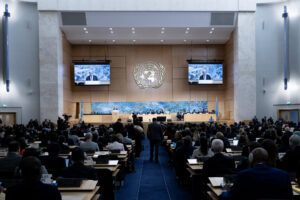
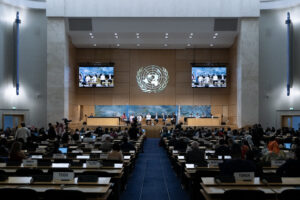
The ICJ delivered a statement today on the occasion of the interactive dialogue on the oral update by the Independent International Fact-Finding Mission on the situation in Venezuela calling for attention to the persistence of widespread serious human rights violations in the country.
The statements reads as follows:
“Madame President,
The International Commission of Jurists (ICJ) welcomes the Independent International Fact-Finding Mission’s oral update on the situation in Venezuela.
The ICJ calls attention to the persistence of widespread serious human rights violations, as reported by the FFM in its 2020’s report, including extrajudicial killings.
Venezuelan authorities have wholly failed to comply with the Mission’s recommendations, including the need for “prompt, effective, thorough, independent, impartial and transparent investigations into the human rights violations and crimes”.
This underscores the deficits in judicial and prosecutorial independence that has undermined fair trial rights.
The ICJ is extremely concerned about attacks on human rights defenders and civil society organizations in Venezuela by the authorities, which include the criminalization of the defence of human rights protected under international human rights law.
Civil society organizations that were targeted in 2020 include “Acción Solidaria”, “Provea”, “Alimenta la Solidaridad” and “CONVITE”, and early this year five members of “Azul Positivo” were arbitrarily detained and continue to be harassed.
The ICJ urges that the Venezuelan authorities ensure their full cooperation with the FFM and immediately cease the attacks on human rights defenders; conduct independent investigations and bring to justice those responsible for serious human violations; and remove obstacles to access to justice for victims.
Thank you.”
Contact:
Massimo Frigo, ICJ UN Representative, e: massimo.frigo(a)icj.org, t: +41797499949
Jan 14, 2021 | News
The ICJ today deplored the comprehensive failure of the Sri Lankan authorities to ensure accountability for conflict-era crimes, marked by the dropping of charges and release of all five accused in the Joseph Pararajasingham murder trial.
Parliamentarian Joseph Pararajasingham was killed by unidentified gunmen on 25 December 2005 while he attended Christmas mass at the Batticaloa St. Mary’s Cathedral, in the Eastern Province of Sri Lanka. Eight other people, including his wife, were injured during the firing.
Yesterday, the Batticaloa High Court acquitted and ordered the released of all five accused, including former-LTTE cadre and now-Member of Parliament, Sivanesathurai Chandrakanthan alias ‘Pillaiyaan’, in the trial of Pararajasingham, a former Tamil National Alliance Parliamentarian. The judgment was delivered after the Attorney General’s Department (AG) informed the Court that it would not proceed with the prosecution. The AG provided no reason publicly for this decision.
“The shelving of this case five years after it began, is a blow to the victims of this serious human rights atrocity.” said Ian Seiderman, ICJ’s Legal and Policy Director.
“This constitutes yet another marker of Sri Lanka’s consistent failure to hold accountable perpetrators of serious conflict-era crimes,” he added.
In November 2020, the AG had informed the Batticaloa High Court that he intended to proceed with the case, notwithstanding the Court of Appeal deemed inadmissible important evidence of the prosecution’s case.
The UN Office of the High Commissioner on Human Rights Investigation on Sri Lanka (2015) had already concluded that “there are reasonable grounds to believe that the Karuna Group (of which Chandrakanthan was a member) killed Joseph Pararajasingham, and that it was aided and abetted by security and army personnel.”
The acquittal in Pararajasingham’s murder case follows that of another Tamil Parliamentarian Nadarajah Raviraj, where an all-Sinhalese jury acquitted five persons including three Navy intelligence officers in December 2016, a decade after his murder.
The UN High Commissioner for Human Rights identified both these cases, in which no progress had been made, emblematic of Sri Lanka’s dismal record on accountability.
The ICJ called on the Attorney General’s Department to reopen fresh investigations into the murder of the deceased legislator so as to ensure justice and justice for the victims of this atrocity.
The ICJ notes that the Attorney General maintains the dual role of public prosecutor and as attorney for the State, positions which are prone to come into tension. The former UN Special Rapporteur on the Independence of Judges and Lawyers, Monica Pinto, following her mission to Sri Lanka in 2016 observed that “there is a general perception that, first and foremost, the [Attorney General’s] department defends the interests of the government and not the public’s interest.”
Background
Sivanesathurai Chandrakanthan who broke away from the Liberation Tigers of Tamil Eelam (LTTE) in 2004, functioned as a paramilitary, in support of the then-Rajapaksa Government. He is presently the leader of Tamil Makkal Viduthalai Pulikal (TMVP), a political party aligned to the Government and was voted into Parliament at the 2020 General Elections.
Investigation into the killing only began in 2015, after a new government was formed following elections which saw the defeat of Rajapaksa. Chandrakanthan was taken into remand custody on 11 October 2015 when he arrived at the Criminal Investigation Department to record a statement in relation to the assassination of the late Tamil politician. The Attorney General indicted that Chandrakanthan (who was 3rd accused) in the High Court of Batticaloa for offences committed under the Penal Code and the Prevention of Terrorism Act. He was granted bail for the first time in November 2020 after the primary evidence against the accused was deemed inadmissible by the Court of Appeal. The case was fixed for January 11 only after the AG informed courts he intended proceeding with the case notwithstanding the Appeal Court ruling.
Contact
Osama Motiwala, ICJ Communications Officer, Asia & Pacific programme, e: osama.motiwala(a)icj.org
May 13, 2019 | Human Rights Council, News, Work with the UN
The ICJ has joined with more than 35 other international and African NGOs, calling on states to address the ongoing deterioration of the human rights situation in Tanzania, at the upcoming session of the UN Human Rights Council in June.
Read the letter here.
Oct 5, 2017 | News
The ICJ calls for Venezuela to accept long-standing requests for country visits by UN Special Procedures whose mandates are most relevant to the rule of law and human rights crisis in the country.
The ICJ takes note of the announcement by the Venezuelan Government that it is inviting the UN Independent Expert on the promotion of a democratic and equitable international order, Mr. Alfred de Zayas, to visit the country.
This announcement, together with a recent invitation to the Special Rapporteur on the right to development is significant. For more than a decade, the Venezuelan Government has denied or left unanswered requests for visits to the country by numerous other of the independent experts (known as “Special Procedures”) of the United Nations. The last mission to Venezuela by a special procedure was the Special Rapporteur on Torture in 1996.
However, the breakdown of the rule of law and the extremely serious human rights situation in Venezuela make visits by other United Nations Special Procedures of urgent relevance.
“In the course of this year, extrajudicial and arbitrary executions, torture and ill-treatment of detainees, arbitrary detention, trial of civilians by military tribunals, and persecutions and attacks against opponents, dissidents and human rights defenders have become systematic and generalized practices in Venezuela, said Federico Andreu Guzman, ICJ South America Representative.
“It is therefore difficult to see why the Government of Venezuela would not respond to long-standing requests from Special Procedure mandates relevant to these violations in favour of proactively inviting other UN experts”, Andreu Guzman added.
The ICJ therefore calls on the Government of Venezuela to invite to visit the country the Working Group on Arbitrary Detention and the Special Rapporteurs on extrajudicial, summary or arbitrary executions; the independence of judges and lawyers; torture and other cruel, inhuman or degrading treatment or punishment; the rights to freedom of peaceful assembly and association; the promotion and protection of the right to freedom of opinion and expression; and on the situation of human rights defenders. All of these UN experts have long-standing requests to visit Venezuela, some for many years, which the Venezuelan Government has failed so far to accept.
“Under the Charter of the United Nations, Member States have the obligation to cooperate with the UN Special Procedures on human rights. This duty is of particular importance when the State is a member of the Human Rights Council, as is the case with Venezuela”, said Andreu Guzman.
The ICJ also calls on the Government of Venezuela to accept the request for a visit to the country that, since 2004, has been repeatedly issued by the Inter-American Commission on Human Rights.
Background
For several years, the following Special Procedures of the UN Human Rights Council have made requests to visit Venezuela: the Special Rapporteur on extrajudicial, summary or arbitrary executions; the Special Rapporteur on the situation of human rights defenders; the Working Group on Arbitrary Detention; the Special Rapporteur on the independence of judges and lawyers; the Special Rapporteur on the rights to freedom of peaceful assembly and association; the Special Rapporteur on violence against women, its causes and consequences; the Special Rapporteur on torture and other cruel, inhuman or degrading punishment; the Special Rapporteur on the promotion and protection of the right to freedom of opinion and expression; the Working Group on the issue of human rights and transnational corporations and other business enterprises; the Special Rapporteur on adequate housing as a component of the right to an adequate standard of living; and the Special Rapporteur on the right to food.
At the regional level, although it denounced the American Convention on Human Rights in September 2012, Venezuela is still a State party to three Inter-American human rights treaties (Inter-American Convention to Prevent and Punish Torture; Inter-American Convention on Forced Disappearance of Persons; and Inter-American Convention on the Prevention, Punishment and Eradication of Violence Against Women). However, Venezuela has systematically ignored recommendations of the Inter-American Commission on Human Rights (IACHR) and has also denied IACHR requests to visit the country, made since 2004.
Contacts
Federico Andreu-Guzmán, ICJ South America Representative, tel: +57 311 481 8094; email: federico.andreu(a)icj.org
Carlos Ayala Corao, ICJ Commissioner (Venezuela), tel: +57 414 243 4872; email: cayala(a)cjlegal.net
Alex Conte, ICJ Global Redress and Accountability Initiative, tel: +22 979 3802; email: alex.conte(a)icj.org
Oct 5, 2017 | Comunicados de prensa
La CIJ hace un llamado a Venezuela a que acepte las solicitudes de visitas al país que han formulado, desde hace varios años, los Procedimientos especiales de las Naciones Unidas, cuyos mandatos son más relevantes para el Estado de Derecho y la crisis de derechos humanos.
La CIJ toma nota del anuncio del Gobierno de Venezuela de invitar al país al Experto independiente sobre la promoción de un orden internacional democrático y equitativo de las Naciones Unidas, Sr. Alfred de Zayas.
Este anuncio, así como él de invitar al país al Relator Especial sobre el derecho al desarrollo, resulta significativo. Por más de una década, el Gobierno venezolano ha denegado o dejado sin respuesta las solicitudes de visita al país de numerosos Expertos de las Naciones Unidas (conocidos como “Procedimientos especiales”). La última misión realizada a Venezuela por un Procedimiento especial, fue la del Relator Especial sobre la Tortura en 1996.
Sin embargo, dada la ruptura del Estado de Derecho y la gravísima situación de derechos humanos en Venezuela, se requiere urgentemente que otros Procedimientos especiales de Naciones Unidas, con un mandato relevante, realicen misiones en el país.
“En el curso de este año las ejecuciones extrajudiciales y arbitrarias, la tortura y malos tratos a detenidos, la detención arbitraria, el juzgamiento de civiles por tribunales militares y las persecuciones y ataques contra opositores, disidentes y defensores de derechos humanos se han convertido en prácticas sistemáticas y generalizadas en Venezuela”, declaró Federico Andreu-Guzmán, Representante para Suramérica de la CIJ.
“Por lo tanto, es difícil entender por qué el Gobierno de Venezuela no responde a las solicitudes formuladas desde larga data por los Procedimientos especiales con mandatos sobre estas violaciones, mientras invita de forma proactiva a otros Expertos de las Naciones Unidas”, agregó Andreu-Guzmán.
La CIJ hace, por lo tanto, un llamado al Gobierno de Venezuela a que invite a visitar el país al Grupo de Trabajo sobre la Detención Arbitraria y a los Relatores Especiales sobre ejecuciones extrajudiciales, sumarias o arbitrarias; la independencia de los magistrados y abogados; la tortura y otros tratos o penas crueles, inhumanos o degradantes; los derechos a la libertad de reunión pacífica y de asociación; la promoción y protección del derecho a la libertad de opinión y de expresión; y sobre la situación de los defensores de derechos humanos. Todos estos Expertos de las Naciones Unidas han solicitado visitar Venezuela desde tiempo atrás, incluso algunos desde hace varios años, sin que el Gobierno venezolano haya aceptado estas solicitudes hasta ahora.
“Los Estados miembros de las Naciones Unidas tienen, bajo la Carta de las Naciones Unidas, la obligación de cooperar con los Procedimientos especiales de derechos humanos de esta organización. Esta obligación cobra particular importancia cuando el Estado es miembro del Consejo de Derechos Humanos, como es el caso de Venezuela”, declaró Andreu-Guzmán.
Asimismo, la CIJ hace un llamado al Gobierno de Venezuela para que acepte la solicitud de visita al país que, desde el año 2004, ha reiterativamente formulado la Comisión Interamericana de Derechos Humanos.
Información complementaria
Desde hace varios años, los siguientes Procedimientos especiales del Consejo de Derechos Humanos de las Naciones Unidas han solicitado visitar a Venezuela: el Relator Especial sobre ejecuciones extrajudiciales, sumarias o arbitrarias; el Relator Especial sobre la situación de los defensores de derechos humanos; el Grupo de Trabajo sobre la Detención Arbitraria; el Relator Especial sobre la independencia de los magistrados y abogados; la Relatora Especial sobre los derechos a la libertad de reunión pacífica y de asociación; la Relatora Especial sobre la violencia contra la mujer, sus causas y consecuencias; el Relator Especial sobre la tortura y otros tratos o penas crueles, inhumanos o degradantes; el Relator Especial sobre la promoción y protección del derecho a la libertad de opinión y de expresión; el Grupo de Trabajo sobre la cuestión de los derechos humanos y las empresas transnacionales y otras empresas; la Relatora Especial sobre una vivienda adecuada como elemento integrante del derecho a un nivel de vida adecuado; y la Relatora Especial sobre el derecho a la alimentación.
En el ámbito regional, aunque denunció la Convención Americana sobre Derechos Humanos en septiembre de 2012, Venezuela sigue siendo Estado parte de tres tratados interamericanos de derechos humanos (La Convención Interamericana para Prevenir y Sancionar la Tortura; la Convención Interamericana sobre Desaparición Forzada de Personas; y la Convención Interamericana para Prevenir, Sancionar y Erradicar la Violencia Contra la Mujer). Sin embargo, las recomendaciones de la Comisión Interamericana de Derechos Humanos han sido sistemáticamente ignoradas por el Estado venezolano, el cual además ha denegado las solicitudes de visita al país que este órgano ha formulado desde el año 2004.
Contactos
Federico Andreu-Guzmán, Representante para Suramérica de la CIJ, tel: +57 311 481 8094; correo electrónico federico.andreu@icj.org
Carlos Ayala Corao, Comisionado de la CIJ (Venezuela), tel: +57 414 243 4872; correo electrónico cayala@cjlegal.net
Alex Conte, Iniciativa Global de la CIJ sobre Reparación y Rendición de Cuentas, tel: +22 979 3802; email: alex.conte@icj.org