Mar 7, 2019 | Advocacy, News
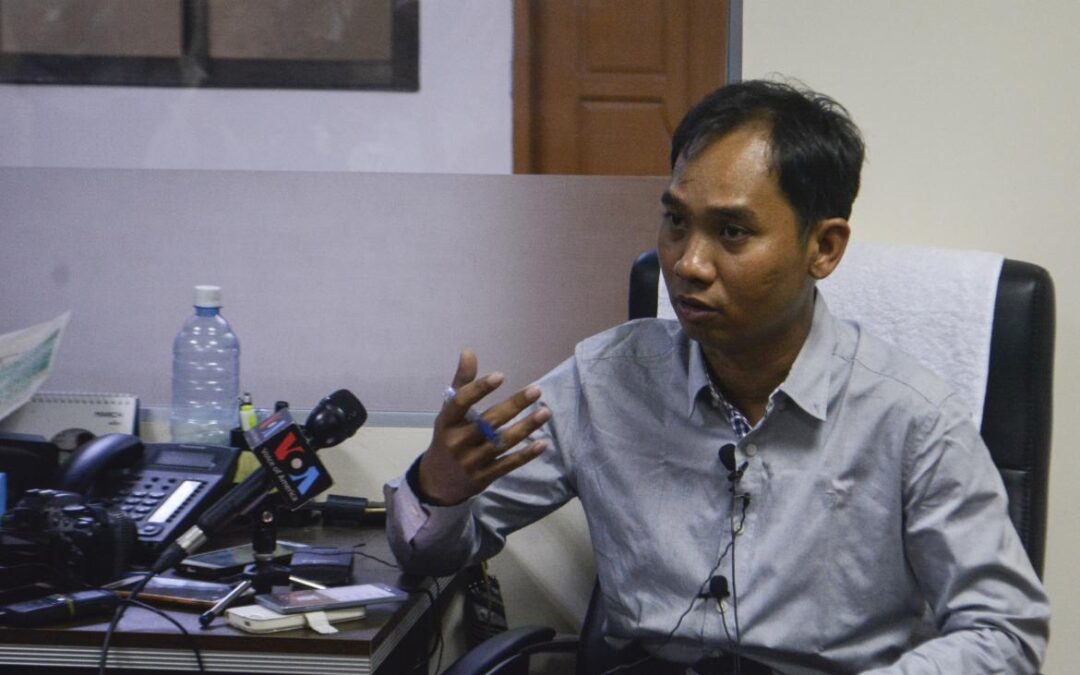
The ICJ joined a list of 77 civil society organizations to call on relevant authorities in Myanmar to drop spurious charges against journalist Ko Swe Win, to decriminalize defamation, and to release human rights defenders currently imprisoned under repressive criminal defamation laws.
The statement reads:
On the second anniversary of the defamation charges brought upon Ko Swe Win, editor at online newspaper Myanmar Now, we, the undersigned 77 civil society organisations, call on the relevant authorities to drop the case against him. Spurious defamation charges under Article 66(d) of the Telecommunications Law were filed against him on 7 March 2017 by ultranationalists intent on suppressing free speech. The Government of Myanmar must take concrete steps in parliament to decriminalise defamation, repeal Article 66(d) of the Telecommunications Law and drop the charges and release all activists and human rights defenders currently in prison and being charged under this repressive legislation.
Article 66(d) of the Telecommunications Law of 2013 was amended in 2017, but notably, defamation is still criminalised and carries a punishment of up to two years of imprisonment or a fine of up to one million kyat or both. The law is still frequently used to stifle free speech in Myanmar and silence critics. To date, a reported 173 cases have been filed under Article 66(d) since its enactment.
The UN Human Rights Committee has called on all states to decriminalise defamation, indicating that imprisonment for defamation is a penalty that can never be appropriate or compatible with the right to freedom of expression. In addition, the Special Rapporteur on the promotion and protection of the right to freedom of opinion and expression has stated that defamation should be treated as a matter of civil rather than criminal law, stressing that criminal prosecution for defamation inevitably becomes a mechanism of political censorship, which contradicts freedom of expression and of the press. In the case of Article 66(d), Myanmar law allows for agents of the offended party to file charges for defamation and initiate criminal proceedings on their behalf. In effect, this means that powerful organisations and individuals can operate via proxies to target those that they consider disturbing, a form of judicial harassment with severe implications for the individuals who are accused.
Ko Swe Win was charged with defamation under Article 66(d) of the Telecommunications Law for sharing a story by Myanmar Now on Facebook. The story quoted a senior monk who said that well-known ultranationalist monk U Wirathu’s actions could be cause for him to be expelled from the monkhood as they violated the tenets of Buddhism. U Wirathu, notorious for using Facebook to agitate against Muslims, had previously expressed support for and thanked U Kyi Lin – the recently convicted gunman who shot and killed prominent lawyer U Ko Ni in January 2017. U Ko Ni was an expert on constitutional law and was working to change the military-drafted 2008 Constitution. The plaintiff, a follower of U Wirathu, brought the charges in March 2017 and the court proceedings started in July 2017.
Since then, Ko Swe Win has had to travel regularly to the courthouse in Mandalay, where the charge was filed, from his home in Yangon and back – a distance of over 1,200 kilometres. The court hearings, now totaling 55, have been ongoing for almost two years, but the court has still only heard the plaintiff’s side, which has consistently been stalling the process. On some occasions, Ko Swe Win has travelled from Yangon only to find that the plaintiff or witnesses have failed to appear in court and that the proceedings have been postponed. The plaintiff himself was arrested in August 2017 and has since been detained, which has caused significant delays to the process.
U Wirathu has been summoned twice but failed to appear. On the first occasion, his lawyer informed the court that U Wirathu could not make the hearing because he was attending a donation ceremony. On the second occasion, U Wirathu’s lawyer requested that the hearing be held at his monastery compound. That request was denied by the township court, but U Wirathu appealed to the higher district court, which also denied the request. While the district court considered the request, no hearings could be held in the township court. Ko Swe Win however, was still required to make an appearance every two weeks before the township court judge just to be informed of the next date he was due to appear in court. This procedure, which required him to travel from Yangon to Mandalay, was typically over in a matter of minutes.
The many irregularities of this case highlight the lack of independence of the Myanmar judiciary. It appears that the authorities are determined to target those that are working to expose troubling truths and terrible crimes, rather than those who commit them. Those responsible for spreading dangerous speech and inciting violence face no consequences, while those who criticise such dangerous actions continue to be prosecuted. In a recent parallel case, also fraught with controversies, two Reuters reporters – Wa Lone and Kyaw Soe Oo – were convicted to seven years in prison for exposing a mass killing of Rohingya men and boys carried out by the Myanmar military in northern Rakhine State.
In Myanmar, high-ranking military commanders, some of whom are accused by UN investigators for war crimes, crimes against humanity, and even genocide, remain at large, while journalists who expose the truth and report on human rights violations in the country are charged under repressive laws. This inverted idea of justice needs to come to an end if Myanmar is to continue its path towards democracy.
As long as Article 66(d) remains, people in Myanmar, especially those who criticise powerful individuals, officials and government policies online, will be at risk of being imprisoned for their peaceful exercise of the right to freedom of expression.
In light of the above, we call on the Government of Myanmar and its relevant authorities to:
- Drop the defamation charges under Article 66(d) of the Telecommunications Law against Ko Swe Win and other activists and human rights defenders and release those currently imprisoned under this repressive legislation;
- Repeal Article 66(d) of the Telecommunications Law, or at a very minimum, amend it to ensure that:
- defamation is no longer criminalised by deleting references to “defamation” as well as vague language such as “disturbing”;
- only a government prosecutor can file a criminal complaint under Article 66(d);
- where recognisably criminal acts such as “extortion” and “threats” occur in the law they are clearly and narrowly defined in line with international human rights law, to ensure it is not used to criminalise the peaceful expression of views.
Download
Myanmar-statement on defamation-Advocacy-2019-ENG (full statement in English, PDF)
Myanmar-statement on defamation-Advocacy-2019-BUR (full statement in Burmese, PDF)
Mar 5, 2019 | News
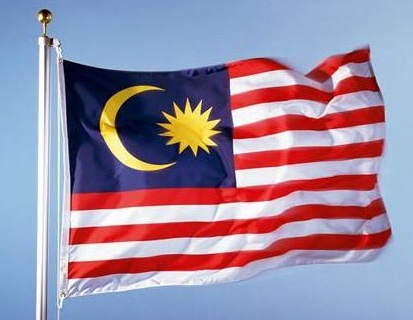
On 4 March 2019, Malaysia acceded to the Rome Statute of the International Criminal Court (ICC), making it the 124th State Party to the ICC.
“The decision by Malaysia’s government to become party to the Rome statute should be commended as a positive sign of its commitment to the rule of law and acceptance to work with the global community to end impunity and ensure accountability for some of the gravest crimes under international law,” said Frederick Rawski, the ICJ’s Asia-Pacific Director.
The ICJ considers the establishment of the ICC as a watershed achievement in the development of international law and the will and capacity of States to act in concert to address atrocities around the world that carry devastating consequences for the victims.
The aim to end impunity on a global scale requires that the Rome Statute be ratified universally.
The ICC was established in 2002 as a permanent international criminal court to investigate and, where warranted, put on trial individuals charged with the some of the most serious crimes of international concern, particularly the crime of genocide, crimes against humanity, war crimes and the crime of aggression.
The Rome Statute operates on the principle of complementarity, meaning that the ICC can only become engaged when the responsible States are unable or unwilling to investigate and prosecute allegations at the national level.
“Malaysia’s accession serves as an example for the entire Asian region, which has been significantly underrepresented at the ICC,” said Rawski.
“It sends a timely message of support for international accountability, at a moment when the actions of two of Malaysia’s neighboring countries – Myanmar and the Philippines – are the focus of preliminary investigations by the ICC, and after Philippines announced its intent to withdraw from the Statute last year,” he added.
In March 2018, the ICC was formally notified by Philippines of its intention to withdraw from the Rome Statute after the court initiated a preliminary examination into allegations of crimes committed in the context of the Philippines’ government’s “war on drugs” campaign since July 2016. The ICJ condemned this move as a blow to international justice.
In September 2018, the ICC launched a preliminary examination into allegations of forced deportations of Rohingya Muslims from Myanmar into Bangladesh, on the basis that the court had jurisdiction because Bangladesh is a State Party and the deportations occurred in part on Bangladeshi territory. The ICJ submitted an amicus curiae in support of such jurisdiction.
Contact
Frederick Rawski, ICJ Asia and Pacific Regional Director, e: frederick.rawski(a)icj.org
See also
Philippines: the Government should reconsider withdrawal from ICC
ICJ submits Amicus Curiae Brief to International Criminal Court
Feb 12, 2019 | News
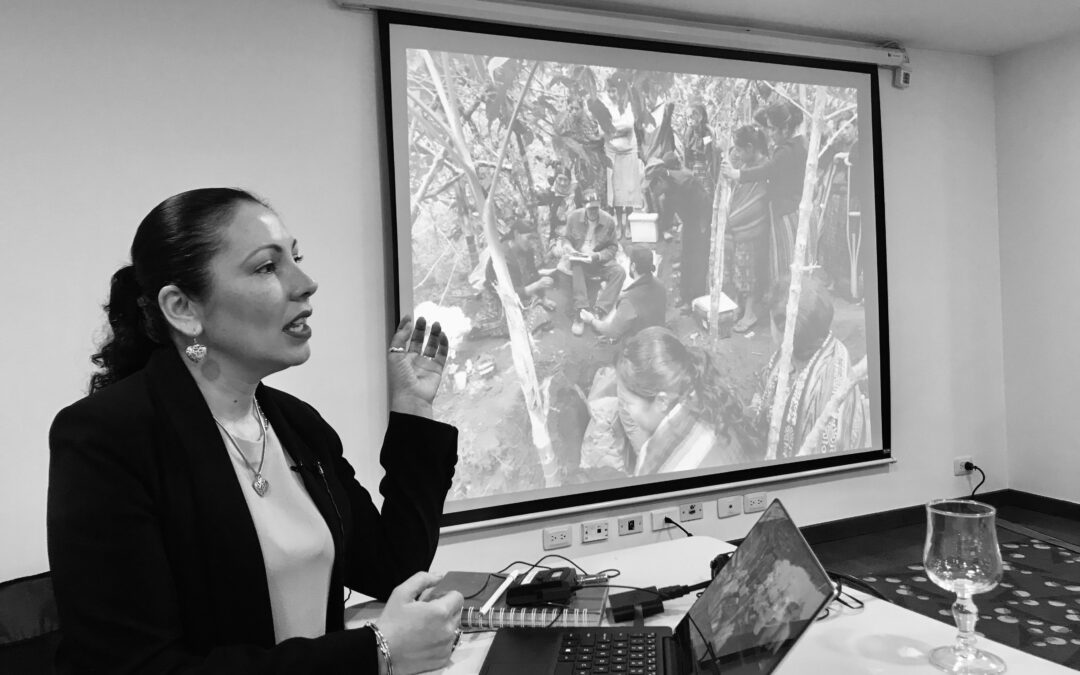
Today in Bogotá, Colombia, ICJ and its partners launched a new 30-month project under the ICJ’s Global Accountability Initiative entitled, Promoting justice for extrajudicial killings and enforced disappearances in Colombia, Guatemala and Peru.
The aim of the project is to promote the accountability of perpetrators and access to effective remedies and reparation for victims and their families in cases of extrajudicial killings and enforced disappearances in Colombia, Guatemala and Peru – and Latin America more broadly – through effective, accountable and inclusive laws, institutions and practices that also reduce the risk of future violations
The ICJ’s partners include the Asociacion de Familiares de Detenidos-Desaparecidos de Guatemala (FAMDEGUA), Asociación Red de defensores y defensoras de derechos humanos (dhColombia), Equipo Argentino de Antropología Forense (EAAF), Equipo Peruano de Antropología Forense (EPAF), Fundación de Antropología Forense de Guatemala (FAFG), and the Instituto de Defensa Legal (IDL).
Christof Heyns, Director of the Institute for International and Comparative Law in Africa and Professor of Human Rights Law at the University of Pretoria – and a former Special Rapporteur on extrajudicial, summary or arbitrary executions – also joins the project as special adviser.
In carrying out the project the ICJ will conduct general studies on obstacles to impunity in Colombia, Guatemala and Peru, as well as specific documentation of emblematic cases of serious human rights violations. The ICJ will also produce a practitioners’ guide for use by civil society, victims and their representatives on the investigation and prosecution of potentially unlawful death, and a regional guide for forensic experts on the investigation and prosecution of potentially unlawful death. In connection with the project the IJC intends to conduct strategic litigation, trial observations and capacity building activities involving judges, prosecutors, investigators, lawyers, civil society, victim groups and forensic experts.
The project is supported by the EU European Instrument for Democracy and Human Rights (EIDHR).
Contacts:
Kingsley Abbott, Senior Legal Adviser & Coordinator of the ICJ’s Global Accountability Initiative, email: kingsley.abbott(a)icj.org
Rocío Quintero, Legal Adviser, Latin America, email: rocio.quintero(a)icj.org
Feb 11, 2019 | News
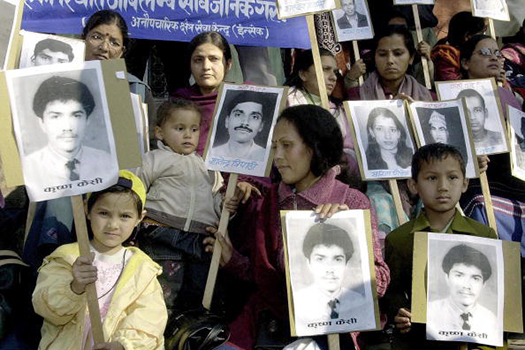
The ICJ, Amnesty International and TRIAL International today called for the Government of Nepal to commit to a transparent and consultative transitional justice process that complies with international law and the judgments of the Supreme Court of Nepal.
On 6 February, the Government of Nepal extended the mandates of the Truth and Reconciliation Commission (TRC) and the Commission on the Investigation of Enforced Disappearance of Persons (CIEDP) for an additional year and committed to the selection of new commissioners by April 2019.
Following the announcement, the ICJ, Amnesty International and TRIAL International voiced concerns about past approach to transitional justice and urged the Government to ensure that the next two months are used to get the flawed process on track.
The organizations warned that this should not become another missed opportunity to ensure that victims are provided the justice, truth and reparation that they so desperately seek.
“A further one-year extension will be meaningless if measures are not taken to secure the independence and impartiality of the commissions,” said Frederick Rawski, ICJ Asia Pacific Director.
“This can only be achieved through a transparent selection process driven by a genuine will to combat impunity – not just for conflict victims, but for future generations,” he added.
The three organizations reiterated their view that the process to date has failed to deliver justice, truth or reparation for victims of crimes under international law and gross human rights violations or establish laws and institutional safeguards to ensure that such crimes are never repeated.
The organizations underscored the need for independent, competent and impartial commissions, compliance with international law, and the meaningful participation of conflict victims, civil society and National Human Rights Commission in the design and implementation of the process.
“This is a great opportunity for Nepal to learn from its past, as well as experiences from other post-conflict societies, that the credibility of transitional justice process ultimately lies on the integrity, competence, independence and expertise of the commissioners. The independence of the Commission, together with a legal framework in accordance with international law, will make or break the success of the commitment to guarantee justice, truth and reparation,” said Biraj Patnaik, South Asia Director of Amnesty International. “The process for appointing new commissioners must be transparent and open to public scrutiny. Victims and civil society must have a robust opportunity to propose and vet candidates.”
The organizations also noted with disappointment that substantive legal concerns raised repeatedly by victims, civil society and the international human rights community have gone unanswered.
The government has not given a clear indication as to whether or how these concerns will be addressed.
“In addition to its obligation to ensure that conflict victims have access to an effective remedy and reparation, the authorities have a separate and independent obligation to investigate and if there is sufficient admissible evidence, prosecute those suspected of criminal responsibility in fair trials before ordinary civilian courts – and, if found guilty, punish them with appropriate penalties which take into account the grave nature of the crimes,” said Helena Rodríguez-Bronchú, Head of TRIAL International’s program in Nepal.
“These obligations are clearly established in international law, as well affirmed in ruling after ruling by the Supreme Court. It is about time that the Government stopped proposing measures that are clearly inconsistent with the letter and spirit of those judgements,” she added.
Concerns raised about existing, and proposed, legislation include: disparities between the definitions of specific crimes under international law and human rights obligations and violations under national, and international law; inadequate provisions to ensure that serious crimes under international law are subject to criminal accountability (including punishment proportionate to the seriousness of the crimes); and a reliance on compensation at the expense of other forms of reparation and remedy for conflict survivors and their families
The ICJ, Amnesty International and TRIAL International had previously submitted a legal analysis of draft transitional justice legislation circulated in 2018, including recommendations on how to ensure compliance with international law and good practices.

Feb 7, 2019 | Advocacy, Non-legal submissions
The ICJ has submitted a written statement on Sri Lanka to the Human Rights Council ahead of its 40th Session in Geneva.
Almost ten years after Sri Lanka emerged from a period of conflict and massive human rights violations, the Government of Sri Lanka still has largely failed to implement its human rights obligations and commitments as reflected in Resolution 30/1.
The ICJ statement focuses on two of four transitional justice mechanisms which the Government committed to establish under the Resolution: (a) the judicial mechanism with special counsel to investigate violations of human rights and international humanitarian law; and (b) the office of missing persons. It highlights how female victims of war are uniquely impacted by the Government’s failure to implement the commitments made before the UNHRC and underscores the importance of holistically including women when such measures are implemented.
Recommendations:
The ICJ considers that the gravity and character of the crimes under international law committed in Sri Lanka, and the failure of the Government of Sri Lanka to meet its obligations and commitments to ensure justice for such crimes including as provided for in resolution 30/1, means that referral to the International Criminal Court or the creation of another international mechanism to facilitate criminal accountability would be fully warranted. If however the Council does not choose to pursue these options at this stage, the ICJ urges the Council at minimum to:
- Continue the monitoring of Sri Lanka through the adoption of a new resolution to ensure that the Government complies with all its obligations and commitments as reflected in resolution 30/1.
- Provide for OHCHR to develop, with the Sri Lankan Government, an implementation strategy with definitive timelines to ensure that the time afforded under the new resolution is utilised to expedite the implementation of measures assured under Resolution 30/1.
- Encourage Member States to exercise universal jurisdiction in order to bring perpetrators to justice.
The ICJ urges the Government of Sri Lanka to:
- Take immediate measures to establish the judicial mechanism with international involvement as contemplated under operative paragraph 6 of Resolution 30/1. The mechanism should ensure gender parity, be accessible for women in civil society, and allow female victims to fully participate in the process.
- Spread awareness regarding the importance of certificates of absence and confirm to the community that issuance of a certificate will not result in the end of efforts to find the person.
- Ensure an overall gender strategy is integrated in all other transitional justice mechanisms that are yet to be established so that structural injustices against women, especially in terms of discrimination and lack of participation, are addressed.
(full text of submission, in PDF: UN-HRC40-SriLanka-WrittenStatement-2019-EN)