Sep 21, 2017 | Events, News
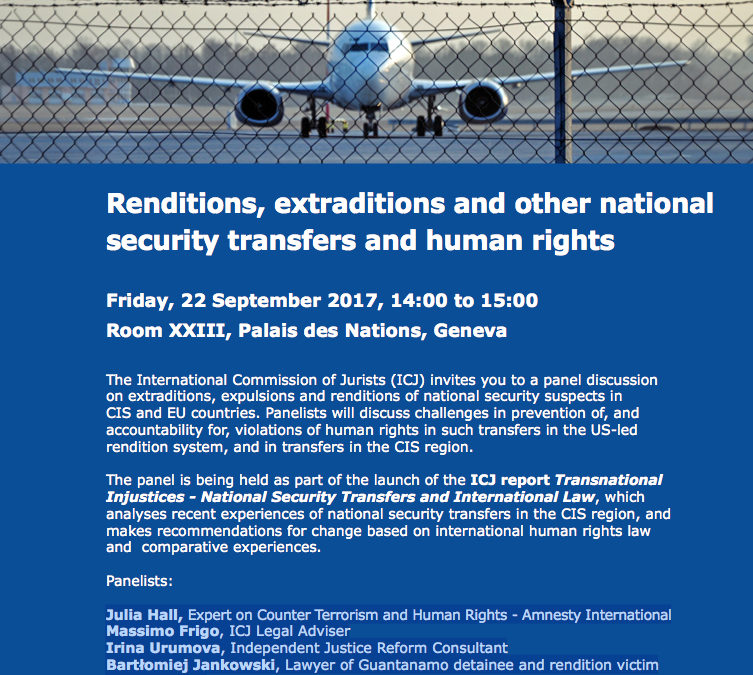
At a side event to the UN Human Rights Council on 22 September, the ICJ will discuss challenges in prevention of, and accountability for, violations of human rights in the US-led rendition system, and in the CIS region.
The event will address as well the challenges of extraditions, expulsions and renditions of national security suspects in CIS and EU countries.
The panel discussion is being held as part of the launch of the ICJ report Transnational Injustices – National Security Transfers and International Law, which analyses recent experiences of national security transfers in the CIS region, and makes recommendations for change based on international human rights law and comparative experiences.
The event will take place at the UN Human Rights Council in Geneva on Friday 22 September at 14:00 – 15:00 at Room no. XXIII.
Panelists:
- Julia Hall, Expert on Counter Terrorism and Human Rights – Amnesty International
- Bartłomiej Jankowski, Lawyer of Guantanamo detainee and rendition victim Abu Zubaydah
- Massimo Frigo, ICJ Legal Adviser
- Irina Urumova, Independent Justice Reform Consultant
Copies of the report in English will be available for the persons attending the meeting.
A flyer for this event is available in PDF format by clicking here.
For more information, contact massimo.frigo(a)icj.org and/or un(a)icj.org

Aug 29, 2017 | News, Publications, Reports, Thematic reports
South Asian states can only address the tens of thousands of cases of enforced disappearances by recognizing enforced disappearance as a serious crime in domestic law, said the ICJ today.
On the eve of the International Day of the Victims of Enforced Disappearances, the ICJ 58-page report No more ‘missing persons’: the criminalization of enforced disappearance in South Asia analyzes States’ obligations to ensure that enforced disappearance constitutes a distinct, autonomous crime under national law.
It also provides an overview of the practice of enforced disappearance, focusing specifically on the status of the criminalization of the practice, in five South Asian countries: India, Pakistan, Bangladesh, Sri Lanka and Nepal.
For each State, the report briefly examines the national context in which enforced disappearances are reported, the existing legal framework, the role of the courts; and the international commitments and responses to recommendations concerning criminalization.
“It is alarming that despite the region having some of the highest numbers of reported cases of disappearances in the world, enforced disappearance is not presently a distinct crime in any South Asian country,” said Frederick Rawski, ICJ’s Asia Director.
“This shows the lack of political will to hold perpetrators to account and complete apathy towards victims and their right to truth, justice and reparation,” he added.
In Nepal and Sri Lanka, draft legislation to criminalize enforced disappearance is under consideration.
Though the initiatives are welcome, the draft bills in both countries are flawed and require substantial improvements to meet international standards.
In the absence of a clear national legal framework specifically criminalizing enforced disappearance, unacknowledged detentions by law enforcement agencies are often treated by national authorities as “missing persons” cases.
On the rare occasions where criminal complaints are registered against alleged perpetrators, complainants are forced to categorize the crime as “abduction”, “kidnapping” or “unlawful confinement”.
These categories do not recognize the complexity and the particularly serious nature of enforced disappearance, and often do not provide for penalties commensurate to the gravity of the crime.
They also fail to recognize as victims relatives of the “disappeared” person and others suffering harm as a result of the enforced disappearance, as required under international law.
“Like torture and extrajudicial execution, enforced disappearance is a gross human rights violation and a crime under international law,” said Rawski.
“South Asian States must recognize that they have an obligation to criminalize the practice with penalties commensurate with the seriousness of the crime–filing “missing” person” complaints in cases of disappearance is not enough, and in fact, it trivializes the gravity of the crime,” he added.
Other barriers to bringing perpetrators to account are also similar across South Asian countries: military and intelligence agencies have extensive and unaccountable powers, including for arrest and detention, often in the name of “national security”; members of law enforcement and security forces enjoy broad legal immunities, shielding them from prosecution; and military courts have jurisdiction over crimes committed by members of the military, even where these crimes are human rights violations, and proceedings before such courts are compromised by their lack of independence and impartiality.
Victims’ groups, lawyers, and activists who work on enforced disappearance also face security risks including attacks, harassment, surveillance, and intimidation.
A comprehensive set of reforms, both in law and policy, is required to end the entrenched impunity for enforced disappearances in the region – criminalizing the practice would be a significant first step, said the ICJ.
Contacts:
Frederick Rawski (Bangkok), ICJ Asia Pacific Regional Director, e: frederick.rawski(a)icj.org
Reema Omer, ICJ International Legal Advisor (South Asia) t: +923214968434; e: reema.omer(a)icj.org
Thyagi Ruwanpathirana, ICJ National Legal Advisor (Sri Lanka), e: thyagi.ruwanpathirana(a)icj.org
Background
Under international law, an enforced disappearance is the arrest, abduction or detention by State agents, or by people acting with the authorization, support or acquiescence of the State, followed by a refusal to acknowledge the detention or by concealing the fate or whereabouts of the “disappeared” person which places the person outside the protection of the law.
The UN General Assembly has repeatedly described enforced disappearance as “an offence to human dignity”.
South Asia-Enforced Disappearance-Publications-Reports-Thematic Reports-2017-ENG (full report in PDF)
Aug 22, 2017 | News, Publications, Reports, Thematic reports, Video clips
The institutional political crisis in Venezuela has brought the rule of law to near collapse and severely obstructed accountability for those responsible for gross human rights violations, the ICJ concluded in a report released today.
The ICJ’s report Achieving Justice for Gross Human Rights Violations in Venezuela found that the authorities led by President Nicolás Maduro have undertaken a sustained campaign to take control of the Supreme Court of Justice and, with the Supreme Court’s support, suspend the constitutional powers of the former National Assembly and subvert efforts to hold the executive to account within a rule of law framework.
“Rule of law in Venezuela has been replaced by rule of arbitrary executive power,” said Alex Conte, ICJ’s Global Accountability coordinator.
“The Constitution is disregarded, the judiciary cannot exercise its independent function, and the separation of powers is non-existent,” he added.
The ICJ’s report concludes that the human rights situation in Venezuela has deteriorated rapidly in recent years, particularly since 2014.
Extrajudicial and arbitrary executions, the practices of torture and ill-treatment, arbitrary detention, the trial of civilians by military courts and the criminalization and prosecution of political and social dissent have only increased.
“The political context of extreme polarization and the breakdown of the rule of law, along with the judiciary’s lack of independence, have severely obstructed accountability for those responsible for gross human rights violations,” said Conte.
“Victims and their families are left without justice.”
This situation has been further exacerbated by the recent dismissal of Venezuela’s Attorney General, described by the ICJ as a politically motivated act that violates international standards and removes one of the last institutional checks on executive authority and destroys one of the few glimmers of hope for an end to impunity for human rights violations.
Also troubling is the establishment by the new Consituent National Assembly of a ‘Truth Commission’, which the ICJ fears will be a politically manipulated instrument aimed at entrenching impunity for the executive and, when combined with President Maduro’s declaration that legal immunity will be stripped from National Assembly members that have opposed him, a tool to silence Government opposition, rather than to help discharge Venezuela’s duty to promptly, independently and effectively investigate allegations of gross human rights violations.
“Venezuela’s situation of entrenched impunity cannot be resolved without the establishment of an independent judicial authority that can address human rights violations, deter further violations and help bring back the rule of law,” Conte added.
Contact:
Alex Conte, ICJ Global Redress and Accountability Initiative, t: +41 79 957 27 33; e: alex.conte(a)icj.org
Federico Andreu Guzman, ICJ Senior Legal Adviser, Americas, e: Federico.andreu(a)icj.org
Venezuela-GRA Baseline Study-Publications-Reports-Thematic reports-2017-ENG (full report, PDF)
Read also:
ICJ Position Paper on the Dismissal of the Attorney General of Venezuela (August 2017)
ICJ Report, Venezuela: The Sunset of the Rule of Law (October 2015)
ICJ Report, Strengthening the Rule of Law in Venezuela (November 2014)
Jun 22, 2017 | News
Pakistani authorities need to ensure a prompt, impartial and effective investigation into a barrage of assaults and threats against lawyers in the premises of the Lahore High Court, the ICJ, Human Rights Watch and Amnesty International said today.
The Government needs to defend the rule of law and prosecute those responsible for any criminal conduct.
On 20 June, during proceedings of a case involving the alleged abduction and subsequent “disappearance” of a 26-year old woman and her two-year old son, supporters of the accused, a prominent lawyer, physically assaulted the complainant’s counsel Shabbir Hussain and Usama Malik, and made abusive remarks and threats against another member of the complainant’s legal team, Noor Ejaz Chaudhry.
The attackers were mostly lawyers and members of the local bar association.
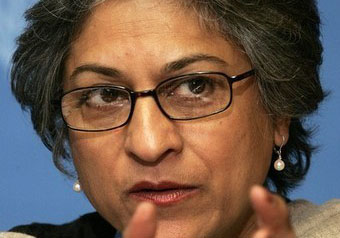
The attackers also made abusive and threatening remarks against Asma Jahangir (photo), a notable human rights lawyer, Honorary Commissioner of the ICJ, and former President of the Supreme Court Bar Association.
Asma Jahangir was not present in the court but was represented by her legal team comprising of Shabbir Hussain, Usama Malik, Mian Liaquat Ali and Noor Ejaz Chaudhry.
“The legal profession is one of the pillars of the administration of justice. It is deeply worrying that instead of discharging their responsibility to uphold the rule of law, certain lawyers would resort to threats and violence in a clear attempt to obstruct justice,” said Ian Seiderman, ICJ’s Legal and Policy Director.
Under international standards, including the UN Basic Principles on the Role of Lawyers, Pakistan has an obligation to ensure that lawyers are able to perform all of their professional functions without intimidation, hindrance, harassment or improper interference.
Where lawyers are threatened as a result of discharging their functions, authorities must ensure they are adequately safeguarded.
“Lawyers must be able to go to court without fearing violent assaults and abuse,” Brad Adams, Asia director at Human Rights Watch said. “That such assaults take place with increasing frequency in Pakistan and without accountability represents a serious failure of the Pakistani authorities to ensure rule of law.”
It is the responsibility of the bar councils and associations to ensure that allegations of professional misconduct against their members are promptly, independently and impartially investigated, and if lawyers are found in breach of their codes of conduct after a fair hearing, disciplinary action is taken against them.
Any disciplinary action must be subject to an independent judicial review.
Threatening and assaulting opposing counsel is not just against the law, but also in breach of lawyers’ professional code of ethics,” said David Griffiths, Amnesty International’s Senior Adviser on South Asia. “The respective Bar Councils must take notice of the allegations, and use this condemnable incident as an opportunity to tackle the culture of impunity which impacts even the legal profession in Pakistan.”
Background
In May 2017, Bilquis Zareena filed a habeas corpus petition in the Lahore High Court for the recovery of her daughter Ayesha and grandson Alyan Ali, who have allegedly been missing since November 2016.
According to Bilquis Zareena, her daughter had secretly been married to Maqsood Buttar, a prominent lawyer and member of the Pakistan Bar Council, the highest regulatory body for lawyers in the country.
Bilquis Zareena claims her daughter and grandson’s lives could be in danger as Maqsood Buttar had previously threatened and even attempted to kill Ayesha.
The next hearing in the case is on Friday, 23 June 2017.
Contact:
Ian Seiderman, ICJ Legal and Policy Director, e: ian.seiderman(a)icj.org
Reema Omer, ICJ International Legal Adviser (South Asia), e: reema.omer(a)icj.org
Jun 16, 2017 | Advocacy, Non-legal submissions
The International Commission of Jurists today drew to the attention of the Human Rights Council the failure of responsible States to ensure accountability for renditions and secret detention in several countries across the world.
The issue was highlighted by an oral statement in the General Debate on human rights situations that require the Council’s attention.
The ICJ statement continued as follows:
The US-administered rendition and secret detention programme of the last decade led to the commission of egregious violations of human rights and crimes under international law on a global scale with the complicity of several States, including in Europe.
Similar practices have been adopted in the Russian Federation where abductions of “terrorism” or “extremism” suspects and transfer to Central Asian States continue, in disregard of the principle of non-refoulement.
None of the States involved in the US-led renditions programme, or in abduction and transfer practices occurring in the Russian Federation, have ensured full accountability of those responsible and full redress for victims.
The ICJ calls on this Council to issue a strong call to all UN Member States to provide full accountability and redress for victims for the human rights violations that occurred during these operations.