Mar 9, 2017 | News
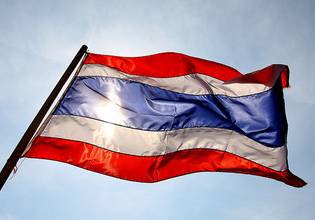
Amnesty International and the ICJ regret the decision of Thailand’s National Legislative Assembly (NLA) to further delay the passage of essential legislation criminalizing torture and enforced disappearances.
Our organizations call on the Thai government to cease its stalling measures and instead prioritize the amendment of the Draft Prevention and Suppression of Torture and Enforced Disappearance Act (Draft Act) in order to bring it into line with international law. The government should then ensure its passage into law without undue delay.
On 28 February, the Office of the High Commissioner for Human Rights announced that it had been informed that the NLA would not enact the Draft Act. The following day, an NLA official speaking to BBC Thai confirmed that the draft would be “returned [to the Thai Cabinet] for more consultations… with Interior officials, police authorities, the national security sector, military authorities and prosecutors.”
The Draft Act is the result of years of effort by government authorities, including by Ministry of Justice officials who consulted with our organizations and took account of many of our recommendations in elaborating it. The draft was approved by Thailand’s Cabinet in May 2016.
The recent decision by the NLA has indefinitely delayed the enactment of this important piece of legislation, which would represent a significant step towards preventing torture and enforced disappearances in Thailand.
The slow-tracking of this law in the face of all the commitments Thailand has made over the years right up to last year is extremely disappointing, especially for the victims of torture and enforced disappearances who have struggled to obtain justice in the absence of a clear legal framework.
The most recent version of the Draft Act addresses many existing gaps in Thailand’s current legal framework and could support Thailand’s compliance with its obligations under international human rights law. However, further amendments are needed to address significant shortcomings in the Draft Act.
In particular, the Draft Act omits key elements from the definitions of torture and enforced disappearances, does not criminalize acts of cruel, inhuman or degrading treatment, and fails to define enforced disappearance as a continuing crime. Additionally, the Draft Act does not extend criminal liability beyond the direct commission of the act and fails to unequivocally bar the use as evidence in court proceedings of statements obtained by torture.
Thailand should make it a top priority to address these and other concerns and to enact the law as soon as possible. The urgent need to amend and enact the Draft Act is underscored by recent reports alleging the use of torture and other ill-treatment by state security forces and the continued failure to hold accountable perpetrators of torture, other ill-treatment and enforced disappearances.
Our organizations remain committed to providing any necessary assistance to the Thai government in amending the Draft Act or otherwise acting to prevent torture and enforced disappearances in Thailand.
Background
Thailand is a state party to the International Covenant on Civil and Political Rights (ICCPR), the Convention against Torture and other Cruel, Inhuman or Degrading Treatment or Punishment (CAT), and has signed, but not ratified, the International Convention for the Protection of All Persons from Enforced Disappearance (ICPPED).
The expert UN bodies overseeing the implementation of these treaties have consistently called upon states parties to criminalise torture and enforced disappearance as specific crimes.
On 13 and 14 March 2017, the UN Human Rights Committee will review Thailand’s compliance with the ICCPR.
In Thailand’s 15 November 2016 reply to the Committee’s List of Issues,[1] it noted that it was in the process of passing the Draft Law which would “provide clear definition and set up specific offence on torture to be in line with the terms set forth under CAT” and “serve as an implementing legislation for ICPPED.”
It also noted that the Draft Act “aims to strengthen the prevention, suppression, and prosecution mechanism and to ensure remedy for victims as well as address the problem of misuse, and abuses of power by government authorities with regard to torture and enforced disappearances.”
It concluded by noting that “[o]n 24 May 2016, the Cabinet approved the draft Act in principle. The draft has been reviewed by the Council of State and is currently waiting to be submitted to the legislative branch for consideration.”
[1] Human Rights Committee, “Replies of Thailand to the List of Issues,” U.N. Doc. CCPR/C/THA/Q/2/Add.1, para 51.
Thailand-Joint Statement-Torture Legislation-News-2017-ENG (Press release in PDF)
Contact
Kingsley Abbott, Senior International Legal Adviser for Southeast Asia, Tel: +66 94 470 1345, E-mail: Kingsley.abbott(a)icj.org

Mar 8, 2017 | Advocacy, Analysis briefs, News
Today the ICJ submitted a brief opposing the current efforts by South Africa to withdraw from the Rome Statute of the International Court.
The brief was submitted in collaboration with a number of South Africa’s leading jurists to the South African Parliamentary Portfolio Committee on Justice and Correctional Services.
The brief was signed by Retired South African Constitutional Court Justices Laurie Ackermann; Richard Goldstone; Johann Kriegler; Yvonne Mokgoro, Kate O’Regan, Zak Yacoob. It was co-signed by Navi Pillay, former United Nations High Commissioner for Human Rights, former judge of the ICC and former President of the International Criminal Tribunal for Rwanda (ICTR). Wilder Tayler, Secretary General, signed on behalf of the ICJ
The ICJ and leading South Africa jurists call on South African Parliamentarians not to pass The Implementation of the Rome Statute of the International Criminal Court Act Repeal Bill [B23-2016].
They also urge South Africa to remain a party to the Rome Statute of the ICC and engage, where appropriate with other African States, in actively pursuing appropriate reforms within the Assembly of State Parties, with a view to making the ICC more effective in advancing the objectives of international justice.
“South Africa should actively encourage other African states to put in place legislation required to empower domestic courts with the ability to try genocide, war crimes and crimes against humanity. South Africa should continue to work constructively with civil society on the advancement of international criminal justice,” the report stated.
“Pursuit of justice and pursuit of peace are complementary and mutually reinforcing objectives that South Africa will best achieve by remaining party to the Rome Statute of the ICC. Its not an either or situation. Protecting heads of States from justice whatever they do compromises peace too much,” said Retired Justice Zak Yacoob.
The report also underscored the danger of an impunity gap if South Africa pulls out of the ICC, as there would be no other effective regional or international forum in which to prosecute the most serious crimes under international law.
“Given the devastating impact of impunity on the rule of law, on development efforts and on society at large, it is vital that South Africa projects itself as a leader in anti-impunity efforts in the region. Pulling out of the Rome Statute of the ICC would crush the best chances that Africa has today to tackle the pervasive impunity that affects the region and would be a most unfortunate move for South Africa and the wider international community,” said Wilder Tayler, Secretary General of the ICJ.
Background
South Africa is one of the earliest parties to the Rome Statute of the ICC. It signed the Rome Statute on the day it was adopted, 17 July 1998, and ratified it on 27 November, 2000. Both during the negotiations preceding the Rome Conference that established the Court in 1998, and at the Conference itself, South Africa played a leading role.
However, the events of June 2015 surrounding the arrival of President Omar al Bashir of Sudan in South Africa appears to have engendered a shift in South Africa’s posture, leading many observers to call into question the country’s commitment to international justice.
The failure by South African authorities to arrest and surrender President al Bashir to the ICC, although he had been indicted by the ICC for war crimes, crimes against humanity and genocide, led to the Southern Africa Litigation Centre (SALC) taking the government to court to compel it to fulfil its obligations both under the Rome Statute and the Implementation of the International Criminal Court Act 27 of 2002 (Implementation Act).
On 19 October 2016, the Minister of International Relations and Co-operation gave notice of South Africa’s intention to withdraw from the Rome Statute.
The Portfolio Committee on Justice and Correctional Services put out a call for submissions to be made to the Parliamentary Portfolio Committee on Justice and Correctional Services on the Implementation of the Rome Statute of the International Criminal Court Act Repeal Bill [B23-2016] to be made by 8th March 2017. The ICJ Brief was filed pursuant to that call.
Contact
Arnold Tsunga, Director of the ICJ Africa Programme, arnold.tsunga@icj.org and +277 164 059 26
RSA-ICC Withdrawal-Advocacy-Analysis Brief-2017 (Analysis brief in PDF)
Mar 7, 2017 | Advocacy, Non-legal submissions
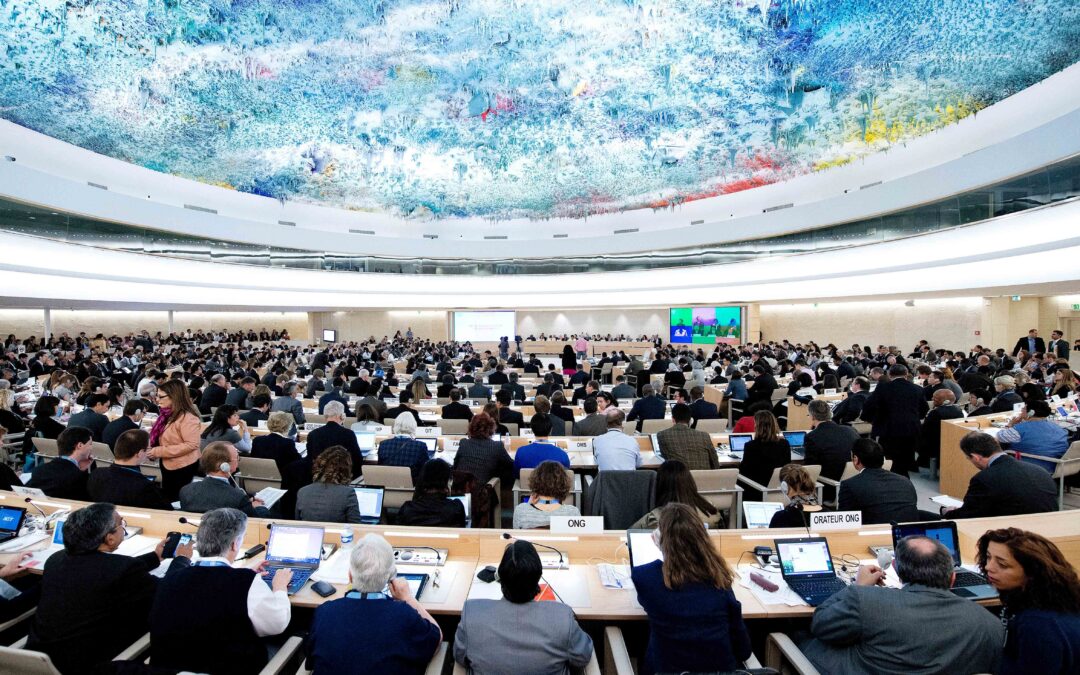
Today at the UN Human Rights Council the ICJ expressed concerns about violence and other wrongs against children in times of armed conflict and peacetime.
The ICJ statement was delivered during an interactive dialogue with the Special Representatives of the Secretary General on Violence against Children and for Children and Armed Conflict.
The ICJ thanked the Special Representatives for their annual reports (Violence against Children UN doc.A/HRC/34/45-ENG and Children and Armed Conflict UN doc.A/HRC/34/44-ENG) and then continued as follows:
We welcome the renewed commitment of States, via the Sustainable Development Goals (in particular SDG 5.2 and 5.3 and SDG 16.2 and 16.3), to eliminating violence against children and ensuring access to justice for everyone by 2030.
However, as the Special Representative for Violence against Children’s report noted, we must ensure that protecting children from violence is not simply an ideal but is realized in practice.
The ICJ is concerned about systemic problems where States agree in principle to protect children from violence but disagree on fundamental definitions of ‘children’ and ‘violence’.
We agree with the Special Representative for Children and Armed Conflict’s assessment that States must close any legal lacunae that fail to implement the almost universally accepted definition of ‘child’ as everyone below the age of 18.
We ask that all forms of violence against children be condemned even where some violent practices, such as child marriage or female genital mutilation, were once considered culturally acceptable.
We welcome efforts undertaken to prevent violence against children and protect children in armed conflict to ensure their human rights are protected.
However, rights protections are meaningless without accountability and so we would like to ask which measures should be put in place to eradicate impunity and ensure access to justice for children who have suffered violence and other wrongs in times of armed conflict and otherwise?
The statement can be downloaded in PDF format here: HRC34-OralStatement-violence against children+children armed conflict-Advocacy-2017

Feb 27, 2017 | News, Publications, Reports, Thematic reports
The Government of Myanmar should impose a moratorium on the development of Special Economic Zones (SEZs) until it can ensure SEZs can be developed inline with international human rights laws and standards, said the ICJ at a report launch held today in Yangon.
The 88-page report, entitled Special Economic Zones in Myanmar and the State Duty to Protect Human rights, assesses the laws governing Myanmar’s SEZs and finds that the legal framework is not consistent with the State’s duty to protect human rights.
For example, a case study examining the Kyauk Phyu SEZ in Rakhine State shows that the land acquisition process initiated in early 2016 lacks transparency, does not comply with national laws on land acquisition, and risks violating the rights of 20,000 residents facing displacement.
“The SEZ Law undermines the protection of human rights, and critical legal procedures are often poorly implemented, so the Kyauk Phyu project risks repeating the rights violations that have been associated with SEZs in the past,” said Sam Zarifi, the ICJ’s Asia Director.
“The NLD-led Government can make a break from the past by ensuring economic development projects benefit Myanmar’s people, rather than rushing to facilitate projects which result in human rights violations and ultimately undermine sustainable development,” he added.
Myanmar’s legal framework for SEZs is based on the 2014 SEZ Law and incorporating national laws governing land, labour and the environment.
The report shows that while national laws require Environmental Impact Assessments and the application of international standards on involuntary resettlement, the SEZ Law does not establish clear accountabilities for the implementation of these procedures.
This has contributed to human rights violations and abuses in each of Myanmar’s three SEZs, the report says.
“It has been encouraging that government officials have emphasized their commitment to protecting human rights in SEZs in line with the rule of law,” said Sean Bain, the ICJ’s Legal Consultant in Myanmar and lead author of the report.
“The legal reforms recommended in this report will be critical to meet these commitments while fulfilling the State’s duty to protect human rights in SEZs. We also suggest that investors take heightened due diligence measures to ensure they are not complicit in rights violations,” he added.
The report was based on extensive legal research as well as interviews with over 100 people, from affected communities to investors and government officials, during 2016.
Key recommendations to the Government of Myanmar
- Protect human rights in Myanmar’s SEZs by amending the SEZ Law, through meaningful public consultation in accordance with international standards.
- Order a moratorium on the development of SEZs, and on entering related investment agreements, until the SEZ Law has been amended to ensure conformity with international human rights law and standards.
- Commission a Strategic Environmental Assessment for the Kyauk Phyu SEZ, in line with Myanmar’s environmental conservation laws. This would involve consultation to inform decision-making on the Kyauk Phyu SEZ and related projects, by identifying cumulative environmental and social impacts of all the developments in Kyauk Phyu, while considering conflict dynamics and economic development in Rakhine State.
- Suspend land acquisition in Kyauk Phyu until after the completion of a resettlement plan that is in line with international standards, as required in the EIA Procedure.
Contact
Sean Bain, ICJ Legal Consultant in Myanmar, t: +95 9263533230 ; e: sean.bain(a)icj.org
Myanmar-SEZ assessment-Publications-Reports-Thematic reports-2017-ENG (full report, in PDF)
Myanmar-SEZ assessment SUMMARY-Publications-Reports-Thematic reports-2017-ENG (executive summary of the report, in PDF)
Myanmar-SEZ assessment full-Publications-Reports-Thematic reports-2017-BUR (Burmese version of full report, in PDF)
Myanmar-SEZ assessment-Publications-Reports-Thematic reports-2017-BUR (Burmese version of the executive summary, in PDF)
Feb 13, 2017 | News
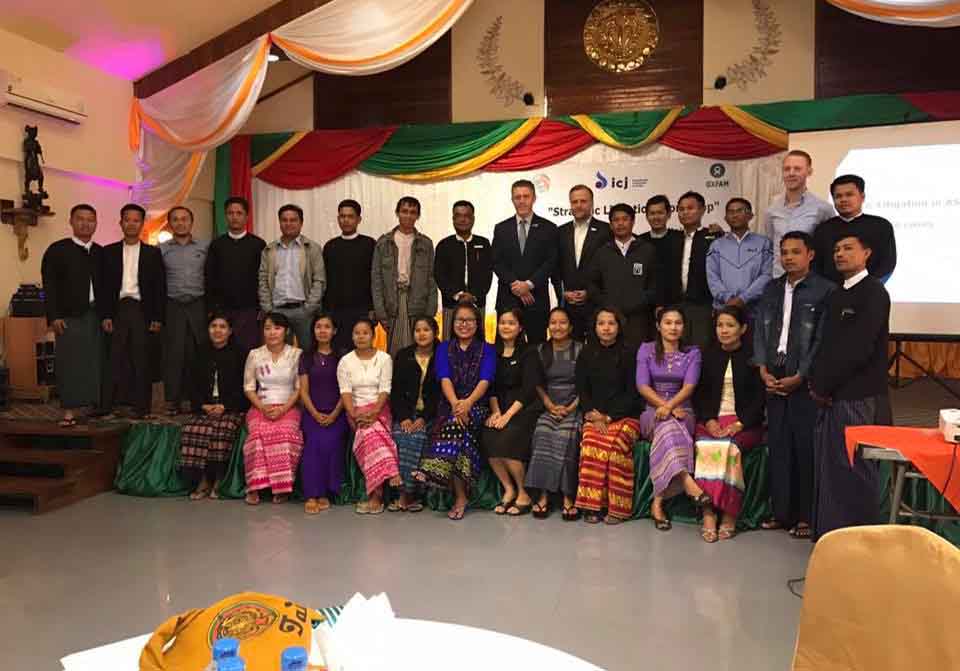
The workshop, held from 11-12 February in Sittwe, brought lawyers and civil society together to discuss of experiences of strategic litigation elsewhere in Myanmar and the region, and consider potential public purpose litigation cases in Rakhine State.
Dr Daniel Aguirre, the ICJ’s International Legal Adviser in Myanmar, provided an introduction to strategic litigation as a method for promoting accountability in a time of transition in governance.
He noted the critical role of independent lawyers in protecting human rights, by representing clients from all communities in Rakhine State.
And he emphasized the importance of strategic litigation as a means to prevent violations and abuses of human rights, or to seek reparations where violations and abuses have occurred.
Kingsley Abbot and Jintana Sakulborirak, from the ICJ’s Asia Regional Office in Thailand, discussed strategic litigation cases from the region, including in northern Thailand where community members have launched an action to appeal the legality of land acquisition for a planned SEZ in Tak Province.
The cases highlighted how media engagement is a critical part of strategic litigation, to raise public attention on human rights issues and demands for accountability in the implementation of investment projects.
Daw Aye Mon Thu, advocate from Dawei Pro Bono Lawyers Network presented the experiences of Heinda Mine cases from Dawei Region, Southern Myanmar, emphasizing the importance of trust-building and cooperation with local community as stake-holder. Such a strategic litigation cases are extremely rare in Myanmar.
Discussions followed about potential cases for strategic litigation from Kyauk Phyu and Sittwe, including issues related to land acquisition for railways construction and an SEZ appear to have been carried out unlawfully in violation of human rights.
Participants discussed the principle of undertaking litigation for broader advocacy objectives rather than solely focusing on actually winning the case in the court.
They also reflected on the challenges and limitations for Myanmar lawyers to undertake strategic litigation.
Highlighting the vital role of lawyers, speakers encouraged participants to consider strategic litigation as a means to challenge unlawful acts that violate or abuse human rights, particularly accompanying business enterprises.
Rakhine State is among Myanmar’s poorest and most isolated provinces, where lawyers and CSOs have had limited exposure to concepts of human rights and international laws.
This workshop, the first of its kind to be held in Rakhine State, is part of efforts to address this gap by building legal literacy on international human rights law and lawyers to consider litigation as a strategy to protect human rights.