Jul 29, 2015 | News
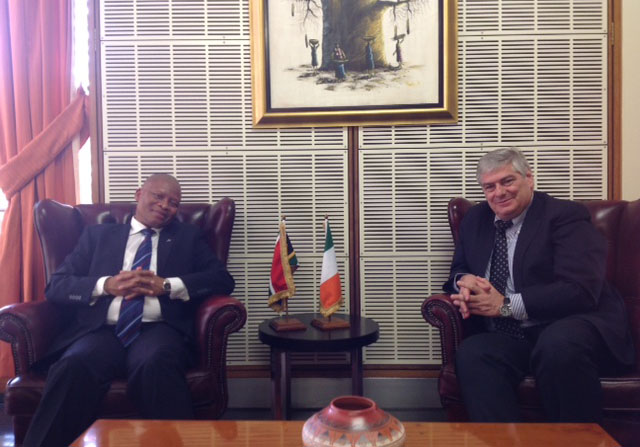
They held bilateral talks at the Constitutional Hill in Johannesburg, discussing matters of mutual interest including possible collaboration in the building of strong, independent, impartial and accountable judicial institutions on the African continent.
They also agreed in principle on the importance of establishing a platform of systematic and sustained dialogue by judicial leaders in Africa on challenges that emerge from time to time that pose threats to judicial independence.
A few country specific situations on threats to judicial independence were discussed as well.
The ICJ Secretary General is in Southern Africa where he has met several judicial leaders including Chief Justice Godfrey Chidyausiku of Zimbabwe, Justice Rita Makarau the Secretary of the Judicial Service Commission in Zimbabwe and Justice Azhar Cachalia of the Supreme Court of Appeal of South Africa who is also the Chair of the Executive Committee of the ICJ.
He will be in Swaziland on Thursday and Friday before winding up his visit to the region on the 2nd August 2015.
Jul 22, 2015 | News
Ante los procesos penales que ha iniciado la Comisión internacional contra la Impunidad en Guatemala (CICIG) en el país, la CIJ expresa su absoluto apoyo al Comisionado de la CICIG Iván Velásquez por la batalla que está librando por la depuración del Estado de Guatemala y contra la corrupción.
Todos los casos develados por la CICIG están demostrando los niveles de impunidad existentes, debido a la persistencia de diferentes estructurales criminales, que cuentan con participación de altos funcionarios de Gobierno.
La CIJ lamenta que un partido político esté promoviendo acciones en contra de la CICIG y manifestaciones de diversa índole, para desestabilizar al país y evitar que sus miembros y candidatos sean investigados.
La CIJ se permite recordar que los actos de corrupción afectan seriamente la vida de toda la población guatemalteca, el uso adecuado de los recursos públicos en beneficio de las mayorías y corroe los cimientos básicos del Estado de derecho.
Ramón Cadena, Director de la CIJ para Centro América, declaró: “Hacemos un llamado a todos los partidos políticos, para que apoyen la gestión de la CICIG y faciliten toda la información que coadyuve a las investigaciones que la CICIG está llevando a cabo para erradicar la corrupción en el país.”
Jul 22, 2015 | News
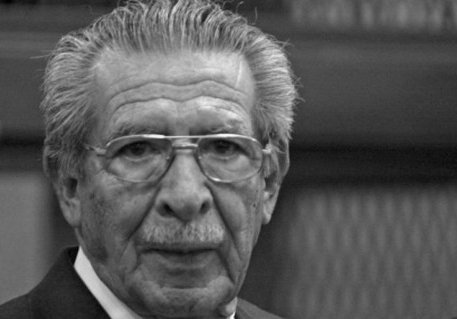
El genocidio perpetrado contra población Ixil de Guatemala será debatido en el segundo juicio seguido en contra del ex Presidente de facto Efraín Ríos Montt y el ex Director de inteligencia José Mauricio Rodríguez Sánchez.
El juicio está por reiniciarse el 23 de julio. Lamentablemente, este segundo juicio ya se ha visto afectado por diferentes hechos, que a continuación describimos.
La recusación de la jueza Presidenta del Tribunal B de Mayor Riesgo, debido a la redacción de su tesis doctoral sobre el delito de Genocidio, no debió de haber sido aceptada por no existir una causa razonable, ya que dicho trabajo de tesis se relaciona con su formación académica especializada en justicia de transición.
Posteriormente, la jueza fue sustituida por un juez que ha evidenciado relaciones de amistad a través de las redes sociales con uno de los abogados defensores del acusado Ríos Montt (photo).
Nuevamente la defensa busca que por lo menos un juez “amigo” integre el tribunal. A ello se suma el hecho de que recientemente el Instituto Nacional de Ciencias Forenses (INACIF) emitió un informe que hace referencia al supuesto problema de salud física y mental del acusado Ríos Montt.
La CIJ de la manera más enérgica expresa que estos actos son parte de una estrategia que tiene como propósito eludir la acción de la justicia.
La CIJ considera que ello constituye una violación al derecho de las víctimas al acceso a la justicia y contra el derecho a un juicio justo, libre de intromisiones de todo actor externo.
La CIJ se permite recordar al Poder Judicial que el combate a la impunidad de acuerdo con los estándares internacionales la justicia debe obedecer a tres imperativos: juzgar y sancionar a los responsables de graves crímenes, como el genocidio; satisfacer el derecho de las víctimas a conocer lo sucedido y obtener reparación integral; y fortalecer la independencia de las autoridades judiciales.
El supuesto problema de salud física y mental del acusado Ríos Montt podría ser solo una simulación, para evitar que sea nuevamente llevado a juicio.
Al respecto, la CIJ denuncia las acciones violatorias del debido proceso realizadas una vez más, por la jueza Carol Patricia Flores, quien ordenó se le practicasen exámenes médicos a Ríos Montt, para averiguar acerca de su estado de salud físico y mental.
Esta orden de la jueza Flores es ilegal, debido a que el proceso ya se encontraba a cargo del tribunal de Sentencia Penal B de Mayor Riesgo y ella carecía de competencia para ordenar tal medida.
La CIJ insta a los jueces a ejercer su poder de contralores del proceso penal, rechazando todos los actos de litigio de mala fe que sean promovidos por la defensa de los procesados.
Se requiere que los jueces a cargo del juicio se encuentren libres de toda presión externa que pueda intimidarlos en su función.
Para garantizar su independencia deben contar con el apoyo de la Corte Suprema de Justicia, quien debe velar por su seguridad y por el desarrollo del proceso en un marco de respeto.
Ramón Cadena, Director de la CIJ para Centro América, expresó: “Otra vez estamos ante una serie de medidas dilatorias, que demuestran que existen jueces que se prestan a promover la impunidad de graves violaciones a los derechos humanos.”
Jul 8, 2015 | News
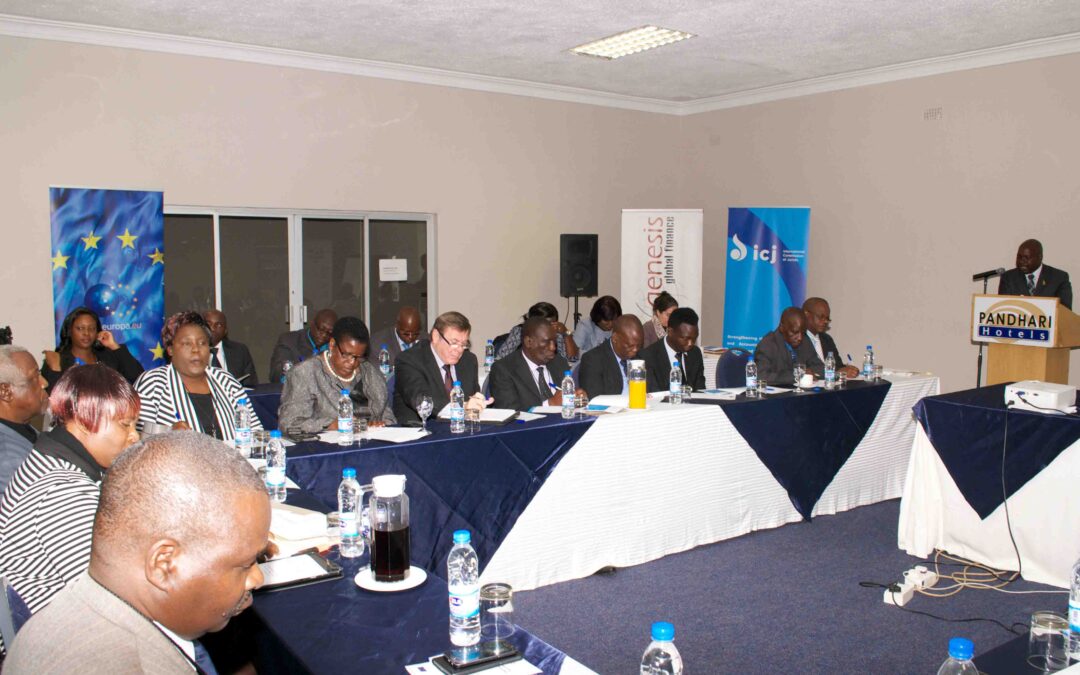
The National Prosecuting Authority (NPA) of Zimbabwe convened its first strategic planning workshop with technical support from the ICJ, under recently launched European Union (EU) funded project to contribute to an improvement in administration of justice in Zimbabwe.
The strategic planning workshop took place in Harare from 6 to 8 July 2015.
The NPA is established under section 259 of the 2013 Constitution as a separate, independent and accountable institution responsible for instituting and undertaking criminal prosecutions on behalf of the State, promoting a just and fair system for all persons approaching the courts and protecting the rights of the arrested and detained persons as provided for by the Constitution.
The strategic plan will allow the NPA to set its vision, objectives and including stakeholders’ expectations as guided by the Constitution and the National Prosecuting Authority Act for the next 5 years.
The NPA held this strategic plan as its first ever strategic stakeholder’s engagement since its establishment under the Constitution in May 2013.
To validate and ground the strategic plan and outputs, the NPA invited civil society organizations, law based institutions, human rights advocates, women lawyers associations, legal aid institutions, the Parliament Thematic and Standing Committee representatives, law enforcement agencies, and law professors, among others.
The Judicial Service Commission and Law Society of Zimbabwe, ICJ’s partners in EU funded project on improvement in the administration of justice, also attended the NPA strategic planning session.
The strategic plan will inform further interventions and activities for strengthening the observance of the rule of law, fair trial and access to justice by the NPA with support from ICJ’s EU funded project.
Once developed and adopted, the strategic plan will further open opportunities for other technical partnerships and funding opportunities for the NPA.
Contact:
Arnold Tsunga, ICJ Regional Director for Africa, t: +27 73 131 8411, e: arnold.tsunga(a)icj.org
Jun 29, 2015 | News
The ICJ calls on the UN Human Rights Council and the Security Council to respond to the findings of the Independent Commission of Inquiry on the 2014 Gaza Conflict, and fully implement all its recommendations.
This should be done with a view to ensuring accountability, including effective remedy and reparation, for all violations of international humanitarian law and human rights abuses committed by the Israeli Defence Forces (IDF) and by Palestinian armed groups, the ICJ says.
The ICJ further calls on the Human Rights Council to establish an independent mechanism to monitor the implementation of the Commission’s recommendations by both parties.
“Israeli and Palestinian authorities must break the chronic cycle of impunity in the Israeli-Palestinian conflict. All credible evidence of war crimes, such as the Commission of Inquiry has highlighted, must be properly investigated,” said Said Benarbia, Director of the ICJ MENA Programme.
“No one who is responsible, whether military or civilian and regardless how high their office, can be allowed to escape justice,” he added.
The Report published last week, and discussed today at the Human Rights Council, documents serious violations of international law and human rights abuses committed during the conflict, such as indiscriminate attacks, including disproportionate attacks, and direct attacks against civilians and against civilian objects that are not justified under the International Humanitarian Law.
The Commission found that artillery and other explosive weapons had been used in densely populated areas, that entire neighborhoods in Gaza had been destroyed, and that unguided rockets had been used.
As indicated by the Commission, some of those acts may constitute war crimes.
To date, both Israeli and Palestinian authorities have failed to meet their obligations under international law to effectively investigate the violations and to prosecute anyone criminally responsible.
Investigations and criminal proceedings initiated by the IDF’s Military Advocate General (MAG), which is also involved in the planning and execution of the IDF’s military operations, fall short of international standards including in relation to independence and impartiality.
No criminal investigations into violations and abuses committed by Palestinian armed groups appear to have been initiated by the Gaza authorities.
The ICJ calls on both authorities to provide for effective, independent and impartial investigation mechanisms in line with international standards.
Absent such reforms, international justice mechanisms can and should fill accountability and remediation gaps where domestic authorities are unwilling or unable to effectively administer justice.
“Israeli and Palestinian authorities must reform the framework for their current investigations and prosecutions. They must also fully cooperate with international accountability mechanisms, including the preliminary examination initiated by the International Criminal Court,” Benarbia said. “The aim throughout must be to make known the truth about the violations, to identify and hold those responsible to account, to ensure victims’ rights, and to prevent any recurrence.”
Contact:
Theo Boutruche, Legal Adviser of the ICJ Middle East and North Africa Programme, tel: +33 670735747, e-mail: theo.boutruche(a)icj.org
POT-UN Report Gaza -News-Press release-2015-ARA