Sep 16, 2015 | News
Myanmar’s government must end the practice of appointing newly retired military officials as judicial officers to its courts and ensure that the judiciary carries out its functions as a separate branch and independent of the Executive, said the ICJ today.
At least 20 former military officers who have just recently resigned from the military were reportedly appointed as vice director generals to the country’s Supreme Court this month.
They will be performing administrative functions but according to section 310 of the Myanmar Constitution will be in line for senior judicial appointments at the state or regional level after 5 years or sooner if the President considers them to be ‘eminent jurists’.
“One of the fundamental aspects of an independent, impartial and accountable judiciary is the appointment of judges, through proper procedures, on the basis of their legal competencies,” said Sam Zarifi, ICJ’s Asia Director. “The process for appointing and promoting judges must be transparent and ensure judicial independence and impartiality.”
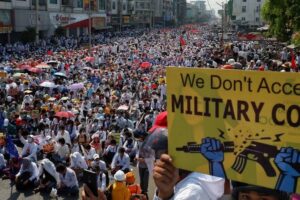
A group of leading members of the Myanmar bar launched a “yellow ribbon” campaign last Friday in Yangon to protest the practice of assigning military officers to serve as judicial officers.
“The process of selecting these officers and assessing their legal qualifications is totally opaque,” Zarifi added. “The lawyers wearing yellow ribbons are emphasizing the belief of people in Myanmar that strengthening the rule of law is essential to guaranteeing justice and the country’s political and economic development, so it’s important to improve the judiciary’s qualifications and increase public trust.”
The Supreme Court of Myanmar launched its Strategic Plan 2015-2016, citing “judicial independence and accountability” as one of its key strategy areas.
The UN Basic Principles on the Independence of the Judiciary provide that that “Persons selected for judicial office shall be individuals of integrity and ability with appropriate training or qualifications in law.”
“The Myanmar judiciary is trying to shake off decades of interference from the Executive branch in order to assert its proper role as defender of the rights of people in Myanmar, and it can’t do so without a clear and transparent appointment and promotion process,” Zarifi said.
An exposition and analysis of international law and standards are available in English and Myanmar language in the ICJ’s authoritative Practitioners’ Guide on the Independence and Accountability of Judges, Lawyers and Prosecutors.
Contact:
Sam Zarifi, ICJ Regional Director for Asia and the Pacific, t: +66 807819002; e: sam.zarifi(a)icj.org
Vani Sathisan, ICJ International Legal Adviser for Myanmar, t: +95 9250800301; e: vani.sathisan(a)icj.org
Aug 2, 2015 | News
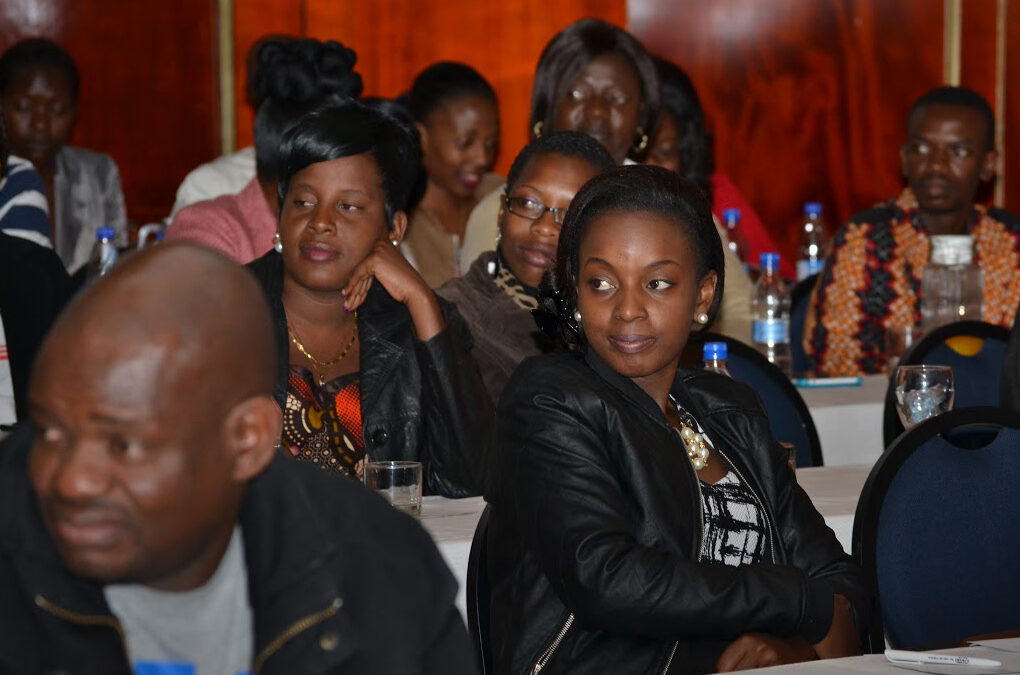
From 31 July to 2 August 2015 the ICJ supported a training and induction workshop for the Zimbabwe National Prosecuting Authority (NPA) in Harare, with over 200 participants.
The public prosecutors came from the Eastern Division comprising of Midlands, Manicaland and Masvingo provinces.
The objective of the training and induction workshop was to appraise the prosecutors of the changes brought about by the Constitution, international and regional standards in the conducting of prosecutorial duties, their independence and accountability.
The presentations also focused on the Criminal Procedure and Evidence Act as the main guiding framework for public prosecutors which has been significantly altered with the assumption of a new Constitution in respect of fair trial rights.
The NPA and the public prosecutors required a platform to collectively familiarize themselves with the changes and conducting of their duties guided by national, international and regional standards.
For purposes of infusing best regional and international practices, presentations included international principles and standards for prosecutors under United Nations Basic Principles on the Role of Prosecutors; the Principles and Guidelines on the Right to Fair Trial and Legal Assistance in Africa; the relationship of the NPA and other arms such as the Judicial Service Commission and the Police.
An array of resources persons were invited and included Justice Chinembiri Bhunu, from the Judicial Service Commission, Virginia Mabiza, Permanent Secretary Ministry of Justice Legal and Parliamentary Affairs, Andrew Chigovera, former Attorney General of Zimbabwe, former Commissioner on the African Commission on Human and Peoples Rights and Dr. Tarisai Mutangi, law lecturer Midlands State University.
As a new establishment under the Constitution, the NPA explored the available and needed continuous professional development for prosecutors to fully equip them for their mandate.
The Principal of the Judicial College of Zimbabwe (a partner of the ICJ), Mr. Shana, presented on the opportunities for continuous professional development for prosecutors for acquaintance with new legal developments.
The training follows additional support that ICJ made to the National Prosecuting Authority (NPA) under a European Union (EU) funded agreement to develop a strategic plan for the NPA in respect of which a strategic planning workshop was held from 6 to 8 July 2015,
Contact:
Arnold Tsunga, ICJ Regional Director for Africa, t: +27 73 131 8411, e: arnold.tsunga(a)icj.org
Jul 29, 2015 | News
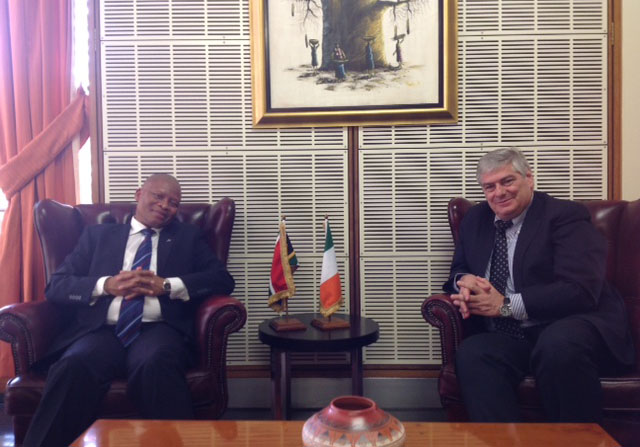
They held bilateral talks at the Constitutional Hill in Johannesburg, discussing matters of mutual interest including possible collaboration in the building of strong, independent, impartial and accountable judicial institutions on the African continent.
They also agreed in principle on the importance of establishing a platform of systematic and sustained dialogue by judicial leaders in Africa on challenges that emerge from time to time that pose threats to judicial independence.
A few country specific situations on threats to judicial independence were discussed as well.
The ICJ Secretary General is in Southern Africa where he has met several judicial leaders including Chief Justice Godfrey Chidyausiku of Zimbabwe, Justice Rita Makarau the Secretary of the Judicial Service Commission in Zimbabwe and Justice Azhar Cachalia of the Supreme Court of Appeal of South Africa who is also the Chair of the Executive Committee of the ICJ.
He will be in Swaziland on Thursday and Friday before winding up his visit to the region on the 2nd August 2015.
Jul 22, 2015 | News
Ante los procesos penales que ha iniciado la Comisión internacional contra la Impunidad en Guatemala (CICIG) en el país, la CIJ expresa su absoluto apoyo al Comisionado de la CICIG Iván Velásquez por la batalla que está librando por la depuración del Estado de Guatemala y contra la corrupción.
Todos los casos develados por la CICIG están demostrando los niveles de impunidad existentes, debido a la persistencia de diferentes estructurales criminales, que cuentan con participación de altos funcionarios de Gobierno.
La CIJ lamenta que un partido político esté promoviendo acciones en contra de la CICIG y manifestaciones de diversa índole, para desestabilizar al país y evitar que sus miembros y candidatos sean investigados.
La CIJ se permite recordar que los actos de corrupción afectan seriamente la vida de toda la población guatemalteca, el uso adecuado de los recursos públicos en beneficio de las mayorías y corroe los cimientos básicos del Estado de derecho.
Ramón Cadena, Director de la CIJ para Centro América, declaró: “Hacemos un llamado a todos los partidos políticos, para que apoyen la gestión de la CICIG y faciliten toda la información que coadyuve a las investigaciones que la CICIG está llevando a cabo para erradicar la corrupción en el país.”
Jul 22, 2015 | News
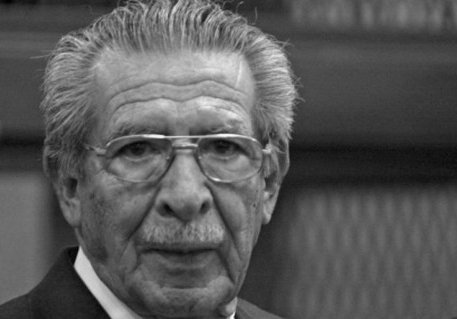
El genocidio perpetrado contra población Ixil de Guatemala será debatido en el segundo juicio seguido en contra del ex Presidente de facto Efraín Ríos Montt y el ex Director de inteligencia José Mauricio Rodríguez Sánchez.
El juicio está por reiniciarse el 23 de julio. Lamentablemente, este segundo juicio ya se ha visto afectado por diferentes hechos, que a continuación describimos.
La recusación de la jueza Presidenta del Tribunal B de Mayor Riesgo, debido a la redacción de su tesis doctoral sobre el delito de Genocidio, no debió de haber sido aceptada por no existir una causa razonable, ya que dicho trabajo de tesis se relaciona con su formación académica especializada en justicia de transición.
Posteriormente, la jueza fue sustituida por un juez que ha evidenciado relaciones de amistad a través de las redes sociales con uno de los abogados defensores del acusado Ríos Montt (photo).
Nuevamente la defensa busca que por lo menos un juez “amigo” integre el tribunal. A ello se suma el hecho de que recientemente el Instituto Nacional de Ciencias Forenses (INACIF) emitió un informe que hace referencia al supuesto problema de salud física y mental del acusado Ríos Montt.
La CIJ de la manera más enérgica expresa que estos actos son parte de una estrategia que tiene como propósito eludir la acción de la justicia.
La CIJ considera que ello constituye una violación al derecho de las víctimas al acceso a la justicia y contra el derecho a un juicio justo, libre de intromisiones de todo actor externo.
La CIJ se permite recordar al Poder Judicial que el combate a la impunidad de acuerdo con los estándares internacionales la justicia debe obedecer a tres imperativos: juzgar y sancionar a los responsables de graves crímenes, como el genocidio; satisfacer el derecho de las víctimas a conocer lo sucedido y obtener reparación integral; y fortalecer la independencia de las autoridades judiciales.
El supuesto problema de salud física y mental del acusado Ríos Montt podría ser solo una simulación, para evitar que sea nuevamente llevado a juicio.
Al respecto, la CIJ denuncia las acciones violatorias del debido proceso realizadas una vez más, por la jueza Carol Patricia Flores, quien ordenó se le practicasen exámenes médicos a Ríos Montt, para averiguar acerca de su estado de salud físico y mental.
Esta orden de la jueza Flores es ilegal, debido a que el proceso ya se encontraba a cargo del tribunal de Sentencia Penal B de Mayor Riesgo y ella carecía de competencia para ordenar tal medida.
La CIJ insta a los jueces a ejercer su poder de contralores del proceso penal, rechazando todos los actos de litigio de mala fe que sean promovidos por la defensa de los procesados.
Se requiere que los jueces a cargo del juicio se encuentren libres de toda presión externa que pueda intimidarlos en su función.
Para garantizar su independencia deben contar con el apoyo de la Corte Suprema de Justicia, quien debe velar por su seguridad y por el desarrollo del proceso en un marco de respeto.
Ramón Cadena, Director de la CIJ para Centro América, expresó: “Otra vez estamos ante una serie de medidas dilatorias, que demuestran que existen jueces que se prestan a promover la impunidad de graves violaciones a los derechos humanos.”