Mar 12, 2021 | News
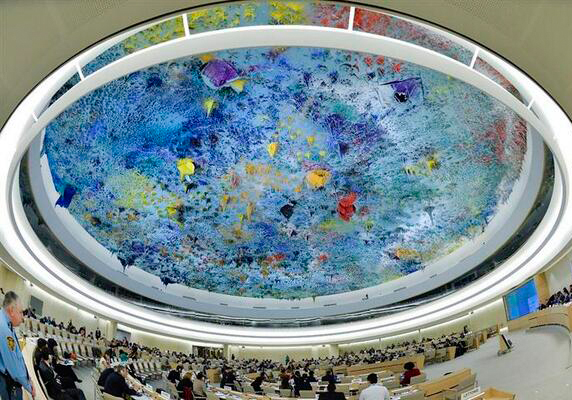
Non-governmental organizations (NGOs) from around the world expressed their strong support today for a joint declaration by UN member states condemning the human rights situation in Egypt which was delivered at the UN Human Rights Council.
In the declaration governments expressed “deep concern” for widespread human rights violations committed with impunity by the Egyptian authorities.
The joint declaration, signed by 31 states and delivered by Finland at the Council’s 46th session highlighted “restrictions on freedom of expression and the right to peaceful assembly, the constrained space for civil society and political opposition.” It also condemned the use of counter-terrorism laws to punish peaceful critics.
“The March 12 declaration ends years of a lack of collective action at the UN Human Rights Council on Egypt, despite the sharply deteriorating human rights situation in the country,” said Bahey Hassan, Director of the Cairo Institute for Human Rights Studies. “Countries should continue to make it clear to the Egyptian government that it will no longer have a carte blanche to arbitrarily imprison, torture or violate the right to life or unlawfully kill people.”
More than 100 NGOs from around the world wrote to UN member states in early 2021, warning that the Egyptian government is attempting to “annihilate” human rights organizations and eradicate the human rights movement in the country through sustained, widespread, and systematic attacks.
The organizations had asked UN member states to adopt a resolution establishing a monitoring and reporting mechanism on Egypt. The declaration delivered on March 12 is a significant step and should be followed up by concrete action toward achieving this goal, the organizations said. The declaration was on the Council’s agenda under Item 4, which provides a space to raise concerns about grave and systematic human rights violations, including country-specific situations.
The last joint declaration on the human rights situation in Egypt at the Human Rights Council was delivered by Iceland and co-signed by 26 countries in March 2014.
Since that time the human rights situation in Egypt has deteriorated dramatically. The Egyptian authorities have virtually obliterated almost all space for free expression, peaceful assembly, and association. Under President Abdel Fattah al-Sisi’s rule security forces, with the complicity of prosecutors and judges, have arrested, detained or prosecuted thousands, including hundreds of human rights defenders, religious minorities’ rights activists, peaceful protesters, journalists, academics, artists, politicians and lawyers.
Many have been forcibly disappeared, tortured or otherwise ill-treated, and detained for months or years in inhumane conditions without trial. Those detained are regularly held on the basis of unfounded terrorism-related charges. If referred to trial individuals are often convicted in grossly unfair proceedings before military courts and through mass trials. Many have been sentenced to death and executed after unfair trials that have relied on statements likely obtained through torture. The authorities have also used morality and debauchery laws to arrest and detain women influencers, sexual violence survivors and witnesses, and LGBTI individuals and activists.
The UN Working Group on Arbitrary Detention has found that arbitrary detention is a systematic problem in Egypt. The UN Committee against Torture said in 2017 following an inquiry on Egypt that the facts gathered by the committee “lead to the inescapable conclusion that torture is a systematic practice in Egypt.”
“Today’s declaration sends a clear message to the Egyptian authorities that the world will no longer turn a blind eye to their relentless campaign to crush peaceful dissent. The authorities must take urgent action to comply with their obligations under international law, starting by releasing the thousands of men and women arbitrarily detained, protecting those in custody from torture and other ill-treatment, and ending the crackdown on peaceful activism, ” said Kevin Whelan, Amnesty International representative to the UN in Geneva.
In the March 12 joint declaration governments called for “accountability and an immediate end of impunity” for abuses. Governments also called on Egypt to cease “abuses of due process,” the excessive use of “extended pre-trial detention,” and “the practice of adding detainees to new cases with similar charges after the legal limit for pre-trial detention has expired.”
Governments that have joined the declaration, led by Finland, include: Australia, Austria, Belgium, Bosnia and Herzegovina, Bulgaria, Canada, Costa Rica, Czech Republic, Denmark, Estonia, France, Germany, Iceland, Ireland, Italy, Latvia, Liechtenstein, Lithuania, Luxembourg, Montenegro, the Netherlands, New Zealand, North Macedonia, Norway, Slovenia, Spain, Sweden, Switzerland, the United Kingdom, and the United States of America. Other governments can join the declaration until two weeks after the end of the current Human Rights Council session.
“Bringing the human rights situation in Egypt to the attention of the Human Rights Council and properly addressing these abuses is of fundamental importance to ensure Egypt’s long-term stability and the dignity of its people,” said John Fisher, Geneva Director at Human Rights Watch.
The Co-signing organizations to this statement include:
Amnesty International, Arab Network for Knowledge and Human Rights (ANKH), Artists at Risk (AR), Association of juridical studies on Immigration (ASGI), The Cairo Institute for Human Rights Studies (CIHRS), le Comité de Vigilance pour la Démocratie en Tunisie, Committee for Justice, Democracy for the Arab World Now (DAWN), DIGNITY – Danish Institute Against Torture, The Egyptian Front for Human Rights, Egyptian Human Rights Forum, EuroMed Rights, The Freedom Initiative, Freedom House, Human Rights Watch (HRW), humanrights.ch, International Federation for Human Rights (FIDH), The International Commission of Jurists (ICJ), International Service for Human Rights (ISHR), MENA Rights Group, Minority Rights Group International, MTÜ Andalus Institute for Tolerance and anti-Violence Studies, The Project on Middle East Democracy (POMED), Réseau des Organisations de la Société Civile pour l’Observation et le Suivi des Elections en Guinée, PEN International, People in Need, Robert F. Kennedy Human Rights, Tunisian Coalition to Abolish the Death Penalty
Download
Press release in English and Arabic.
Q&A in English.
Contact
Said Benarbia, International Commission of Jurists (Geneva) – said.benarbia@icj.org
Jeremie Smith, Cairo Institute for Human Rights Studies (Geneva) – jsmith@cihrs.org
Neil Hicks, Cairo Institute for Human Rights Studies (New York) – nhicks@cihrs.org
John Fisher, Human Rights Watch (Geneva) – fisherj@hrw.org
Amr Magdi, Human Rights Watch (Berlin) – magdia@hrw.org
Kevin Whelan, Amnesty International (Geneva) – kevin.whelan@amnesty.org
Sara Hashash, Amnesty International (London) – Sara.Hashash@amnesty.org
Rasmus Grue, Christensen, DIGNITY – Danish Institute Against Torture – rgc@dignity.dk
Antoine Madelin, International Federation for Human Rights (Paris), amadelin@fidh.org
Mohammed Soltan, The Freedom Initiative – Soltan@thefreedomi.org
Feb 8, 2021 | News
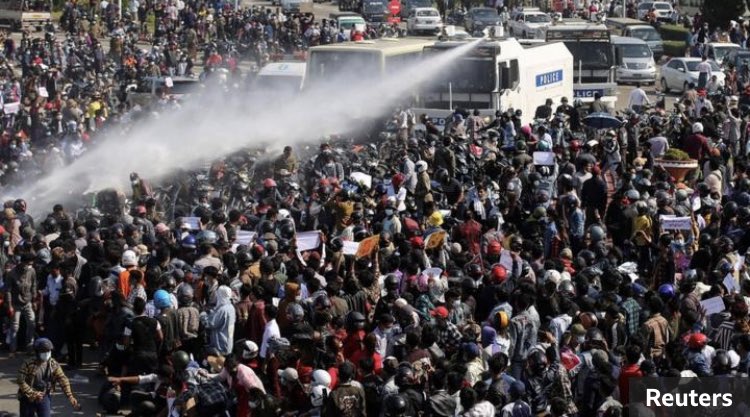
The Myanmar military’s coup d’etat of 1 February is unconstitutional and fails to comply with basic rule of law principles, said the ICJ today.
“The Myanmar military’s actions violate even the flawed Constitution that the military itself imposed in 2008,” said Sam Zarifi, ICJ’s Secretary General. “The irregularities alleged by the military in the recent elections do not justify declaring a state of emergency and shattering the already weak rule of law in the country.”
The coup d’etat does not comply with the Constitution of the Republic of the Union of Myanmar 2008, which suffers from multiple shortcomings in basic respect for the rule of law and international human rights standards.
Article 417 of the Constitution requires the President to declare a state of emergency when there is a risk to the sovereignty of the country.
Article 418 requires the President to hand over all power to the Commander-in-Chief of the Army. Contrary to this provision, the state of emergency was declared by the Vice-President, after the military detained President Win Myint.
“The accountability of the military to the civilian authorities is a core rule of law principle”, said Sam Zarifi “Myanmar’s military leaders have turned this principle on its head by usurping total authority again.”
The ICJ is concerned that Myanmar’s Constitution provides for the possibility of suspending protections for a number of human rights, such as freedom of expression and association and the right to habeas corpus. Under international human rights law, derogations from certain rights are permissible only when strictly necessary to meet a specific threat to the life of the nation, conditions not met under the current emergency.
The right to habeas corpus is among those rights that may never be suspended. The writ of habeas corpus allows any person detained by any State agent, including during emergencies, to challenge the lawfulness of the detention.
“The right to test the lawfulness of any detention needs to be restored and the judiciary must be able to independently examine the legality of any arrests and detentions and order to release of those it finds are detained illegally” said Sam Zarifi.
Of particular concern to the ICJ is the near-total impunity provided to the military after the declaration of the State of Emergency, and the proliferation of arbitrary detention without recourse to legal review.
Article 432 of the Constitution effectively shields the military and security forces from any review of ’legitimate measures’ pursuant to the declaration of a state of emergency, which the ICJ notes also flies in the face of the rule of law.
“After the shock of the coup d’etat, we are now seeing brave lawyers and civil society activists trying to use peaceful means at their disposal to demand their rights,” Zarifi said. “This movement is not focused around an icon or even one party, but on the notion that the people of Myanmar should be able to government themselves and decide their future.”
Contact
Sam Zarifi, ICJ’s Secretary General, sam.zarifi(a)icj.org
Nov 3, 2020 | Advocacy, Non-legal submissions
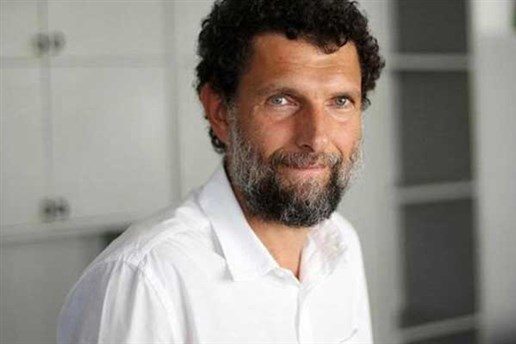
Today, the ICJ, jointly with Human Rights Watch and the Turkey Human Rights Litigation Support Project presented a submission to the Council of Europe’s Committee of Ministers on the Execution of the judgment Kavala v. Turkey by the European Court of Human Rights.
The ICJ, Human Rights Watch and the Turkey Human Rights Litigation Support Project have reported to the Committee of Ministers that new charges against Osman Kavala lack concrete evidence and have been brought in disregard of the ECtHR’s judgment whose execution the Committee is supervising.
The three NGOs have invited the Committee of Ministers to:
- consider adopting the relevant recommendations formulated in their submission of 29 May 2020;
- take further steps to end immediately Mr. Kavala’s ongoing detention, which has now exceeded three years;
- recognise at its 1390th 1-3 December 2020 meeting that the continuing detention of Osman Kavala violates Article 46 of the Convention concerning the binding nature of final judgments of the ECtHR and may trigger Article 46(4) infringement proceedings against Turkey; and
- take the necessary general measures identified in the NGOs submission of 29 May 2020 to implement the ECtHR’s ruling concerning Article 5 and 18 of the Convention in Kavala v. Turkey and its findings in relation to human rights defenders.
In their initial submission dated 29 May 2020, the NGOs underlined that decisions taken to prolong Mr. Kavala’s detention had been guided by political expediency and there had been a concerted political effort by the Turkish authorities to prevent Mr. Kavala’s release. These bases for their action are evident in the sequence of court orders prolonging Mr. Kavala’s detention, the actions of the executive and prosecutors in relation to the judicial procedures against him, and the lack of due consideration of the ECtHR’s findings and objective deliberation as to the legality of any deprivation of liberty. The NGOs made several recommendations to the Committee of Ministers, on the issues of the general and individual measures, to ensure full implementation of the ECtHR’s judgment and Mr. Kavala’s immediate release on the ground that the Court’s judgment clearly applies to his ongoing detention.
In its judgment on Kavala v. Turkey, the EUropean Court of Human Rights, on 10 December 2019, found violations of Article 5(1) (right to liberty and security), Article 5(4) (right to a speedy decision on the lawfulness of detention) and Article 18 (limitation on use of restrictions on rights) of the European Convention on Human Rights taken together with Article 5(1). The Court required the Government of Turkey to take measures to end the detention of human rights defender Osman Kavala and to secure his immediate release. The Court stated that any continuation of Mr. Kavala’s detention would prolong the violations and breach the obligation to abide by the Court’s judgment in accordance with Article 46(1) of the Convention. The judgment became final on 11 May 2020.
Despite the Court’s clear findings and mandatory order, Mr. Kavala remains in detention as of the date of this submission.
Turkey-Kavala_v_TurkeyExecution-JointSubmission2-HRWICJTHRLP-2020-ENG
Sep 28, 2020 | Events, News
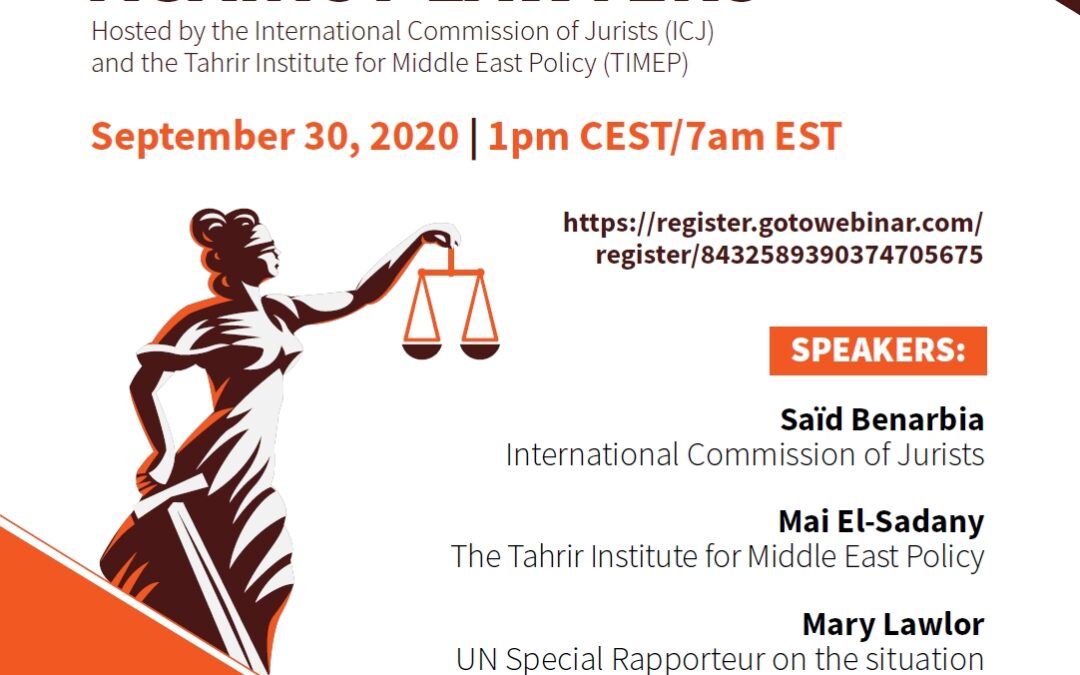
Join this panel discussion with ICJ, the Tahrir Institute, and the UN Special Rapporteur on human rights defenders, Wednesday 30 September 2020, 13:00.
Targeting the Last Line of Defense:
Egypt’s attacks against lawyers
A Virtual Side Event to the Human Rights Council 45th Session
Wednesday 30 September 2020, 13:00 – 14:30 (Geneva time)
The International Commission of Jurists (ICJ) and the Tahrir Institute for Middle East Policy (TIMEP) cordially invite you to join this online side event, including the UN Special Rapporteur on human rights defenders, this coming Wednesday.
The ICJ and TIMEP will present their joint report Targeting the last line of defense: Egypt’s attacks against lawyers. The report documents systematic targeting of lawyers through arbitrary arrests and detention, physical assaults, torture and enforced disappearances, as well as politicized criminal proceedings under counter-terrorism and other overbroad laws.
In the report, the ICJ and TIMEP call on the Egyptian authorities to immediately end their crackdown on lawyers and to unconditionally release all lawyers who are detained or convicted solely on the basis of the peaceful exercise of their human rights and/or the legitimate discharge of their professional duties.
Speakers:
- Mary Lawlor, UN Special Rapporteur on the situation of human rights defenders
- Saïd Benarbia, International Commission of Jurists
- Mai El-Sadany, The Tahrir Institute for Middle East Policy
Register for the event here:
https://attendee.gotowebinar.com/register/8432589390374705675.
For more information contact: un(a)icj.org
Sep 25, 2020 | Advocacy, Non-legal submissions
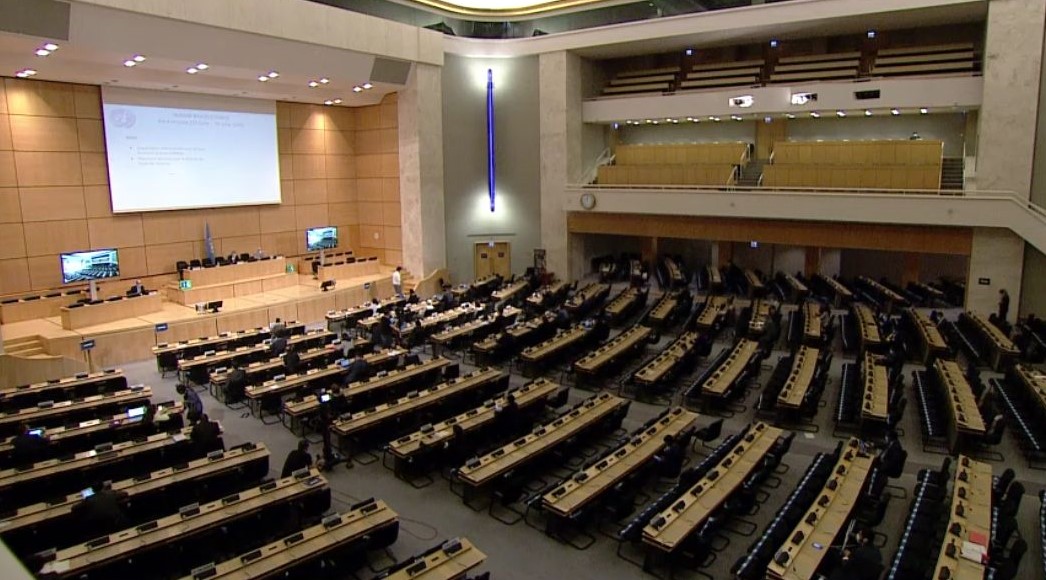
At the UN Human Rights Council, the ICJ and other NGOs have highlighted the joint civil society call for an international human rights monitoring mechanism on China.
The oral statement was delivered on behalf of the group of NGOs by Human Rights Watch, during the general debate on country situations. The statement builds on a joint open letter by more than 300 civil society organizations, including the ICJ, issued earlier this month.
The statement to the Human Rights Council read as follows:
“We join together to call for an international mechanism to address the Chinese government’s human rights violations, and urge the Human Rights Council to take decisive action to achieve this goal.
On 26 June 2020, an unprecedented 50 United Nations experts called for ‘decisive measures to protect fundamental freedoms in China.’ They highlighted China’s mass human rights violations in Hong Kong, Tibet, and Xinjiang, suppression of information in the context of the Covid-19 pandemic, and attacks on rights defenders, journalists, lawyers and critics of the government across the country.
Our organizations are also concerned about the impact of China’s rights violations world-wide. China has targeted human rights defenders abroad, suppressed academic freedom in countries around the world, and engaged in internet censorship and digital surveillance. We deplore China’s promotion of rights-free development and the ensuing environmental degradation at the hands of government-backed extractive industries, as well as the racist treatment of people in China, or by Chinese state actors in other parts of the world.
We are dismayed at China’s efforts to distort the mandate of the UN Human Rights Council by promoting ‘cooperation’ over accountability, and opposing initiatives to bring scrutiny of serious rights violations and international crimes in countries around the world. It has used its seat on the UN’s NGO Committee to baselessly deny accreditation to nongovernmental organizations (NGOs), while accrediting government-organized NGOs (GoNGOs). It has sought to deny access to human rights defenders to UN premises, denounced speakers on NGO side events as ‘terrorists,’ and threatened delegates to deter them from attending UN side events on rights violations, including abuses in Xinjiang.
When the UN High Commissioner for Human Rights, Special Procedures, and dozens of states urged China to comply with international human rights standards, China contended that they were ‘improper remarks’ that ‘grossly interfered’ with China’s sovereignty.
A state that tries to hold itself above any kind of scrutiny presents a fundamental threat to human rights. That China—a state with extraordinary global power—expects such treatment affects us all.
We therefore endorse the call by UN experts for a Special Session or Urgent Debate at the Human Rights Council to evaluate the range of violations by China’s government, and to establish an impartial and independent UN mechanism to closely monitor, analyze, and report annually on that topic. We urge the UN Secretary-General to appoint a Special Envoy, consistent with his Call to Action on Human Rights, and we call on the High Commissioner for Human Rights to fulfil her independent mandate to monitor and publicly report on China’s sweeping rights violations. We support the call that UN member states and UN agencies use all interactions with Chinese authorities to insist that the government comply with its international human rights obligations.
In the spirit of global solidarity and partnership, we urge the Council swiftly to counter and remediate grave human rights violations committed by Chinese authorities. No state should be above the law.”