Dec 5, 2017 | Advocacy, Non-legal submissions
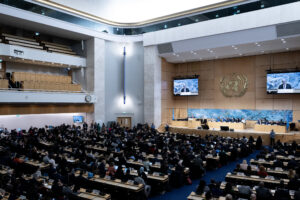
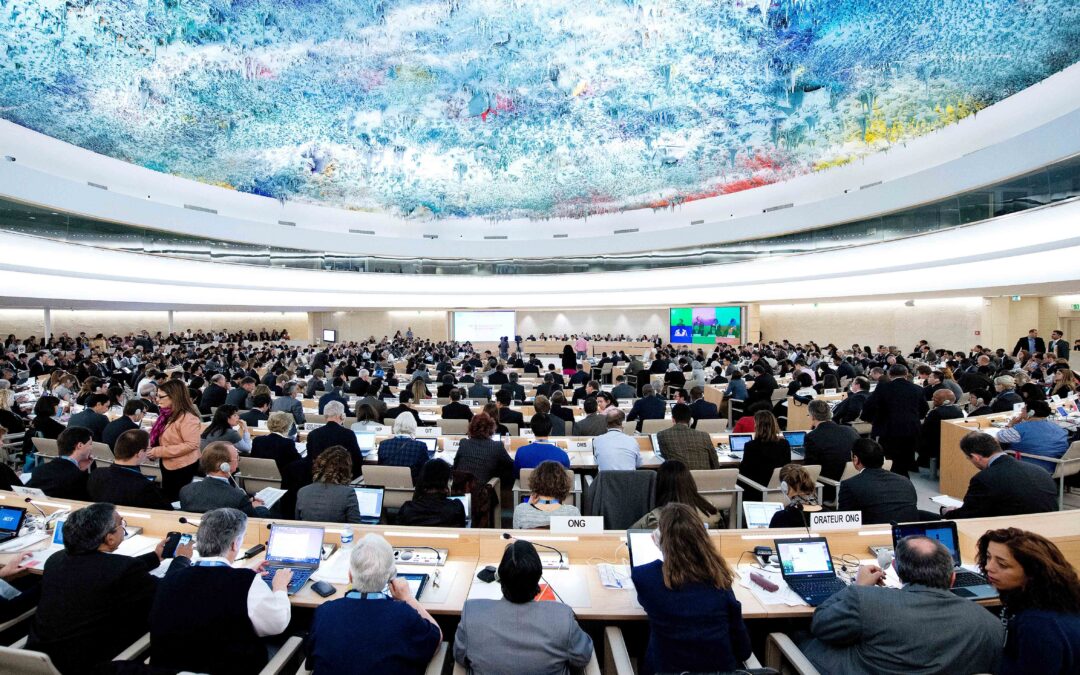
The ICJ today addressed an emergency Special Session of the UN Human Rights Council on Myanmar, outlining key requirements for the protection of the Rohingya minority, including safe and voluntary return of refugees.The Special Session is expected to adopt a resolution to address “The human rights situation of the minority Rohingya Muslim population and other minorities in the Rakhine State of Myanmar.”
The ICJ statement read as follows:
“It is encouraging that the Governments of Bangladesh and Myanmar have recognized the right of displaced Rohingya to return to their places of residence.
However, any provisions for return must comply with international law, including as regards non-refoulement. Effective guarantees that all displaced persons will be able to return to their place of prior residence in a safe, dignified, voluntary and sustainable manner, without discrimination, are essential.
Rohingya refugees must also be provided with alternatives to return, including the option of seeking international protection. Anything short of this would amount to their forcible return and thus violate the non-refoulement principle.
It is of the utmost urgency that the gross and systematic violations that have given rise to the forced displacement are immediately brought to an end and that measures are taken to prevent their recurrence, including by holding perpetrators responsible.
No-one may be forcibly returned to the current circumstances that prevail in Rakhine State, and voluntary returns will only ultimately take place if and when refugees are satisfied they are not returning to further violations in Myanmar.
Any provisions for restrictions on freedom of movement upon return are also of concern, particularly given past experience, with internment camps housing tens of thousands of Muslims displaced in 2012 still in place. Such restrictions elsewhere in Rakhine State contribute to violations of, among other things, the human rights to life, to health, to food, to education and to livelihoods.
To ensure that the rights of refugees are respected and protected, Bangladesh and Myanmar should immediately seek to ensure that UNHCR is involved, and its guidance followed, in any discussion of repatriation processes.
The Government of Myanmar must cooperate with the UN-mandated Fact Finding Mission to independently establish facts and provide a proper foundation for effective responses to human rights violations and humanitarian crises in Rakhine State, as well as in Shan and Kachin States, whose populations also face related patterns of human rights violations by military and security forces.”
The Council adopted a resolution at the end of the session, which reflects many of the concerns raised by the ICJ and others: A_HRC_S_27_L1
Jul 6, 2017 | News
The ICJ welcomed today’s judgment by the International Criminal Court (ICC) that South Africa had violated its legal obligations by failing to arrest Sudanese President Omar al-Bashir during his visit to the country in June 2015.
The ICC said the South Africa should have surrendered him to the ICC for prosecution.
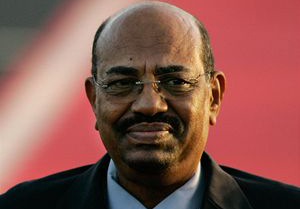
President al-Bashir (photo) had been indicted by the ICC for genocide, crimes against humanity and war crimes in connection with attacks against civilians in the Darfur region of the country.
“The judgment is a victory for international justice. It is an extremely important step toward tackling impunity in Sudan and worldwide,” said Arnold Tsunga, the ICJ Africa Regional Director.
The court said unequivocally that South Africa had a duty to arrest and surrender president Bashir to the ICC for prosecution.
It said that South Africa had a duty to recognize that head of state immunity did not apply to al Bahsir under the terms of the Rome Statute, and that leaving the question of immunity to South Africa’s voluntary discretion would have created “an insurmountable obstacle for the court to exercise its jurisdiction.”
The Court also said that Sudan itself had an obligation to remove and immunities for al-Bashir in respect to matters for which he was under indictment.
“The ICJ calls upon the Governments of South Africa and Sudan to respect the judgment of the Court, and urges all States to cooperate with the Court to bring President al-Bashir, and others indicted to justice,” Tsunga added.
The ICC also called on the UN Security and the Assembly of States Parties of the ICC to take appropriate measures to address the non-compliance by South Africa and Sudan.
Background
South Africa has been a party to the Rome Statute of the International Criminal Court since 27 November 2000.
States parties to the Rome Statute are obliged to cooperate with ICC, including by arresting and surrendering persons under indictment by the ICC who may be on their territory.
South Africa took measures to cooperate with the ICC by enacting the Implementation of the Rome Statute of the International Criminal Court Act, 2002.
Accordingly, South Africa had a duty to arrest President al-Bashir when he visited South Africa in 2015
President al-Bashir stands accused of serious crimes, with two warrants of arrest issued by the pre-trial chamber of the ICC.
They all are for war crimes, crimes against humanity and genocide, related to events in the Darfur region of Sudan.
Among the acts are widespread murder, rape and torture.
Read also:
South Africa appears before ICC for failure to arrest Sudanese President Bashir – The ICJ observes the hearing
Contact
Arnold Tsunga, ICJ Director for Africa, t +27716405926 ;
Thulani Maseko, ICJ Legal consultant, t: +268 7602 5165
Ian Seiderman, ICJ Legal & Policy Director, t: +41 22 979 3837
Apr 27, 2017 | News
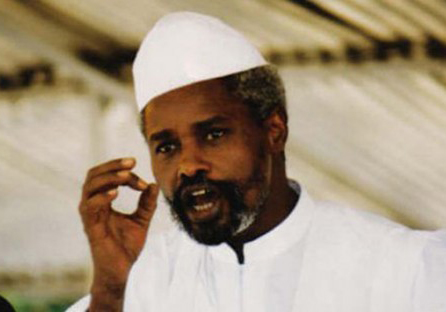
An appeals court’s confirmation of the conviction for crimes against humanity, war crimes and torture of Hissène Habré, the former president of Chad, is a vindication of the decades-long campaign waged by his survivors, the ICJ and two human rights groups supporting the victims said today.
Habré’s May 2016 conviction was upheld by the appeals chamber of the Extraordinary African Chambers in the Senegalese court system on April 27, 2017.
The appeals court also confirmed the life sentence handed down by the trial court and ordered Habré to pay over 82 billion CFA francs (approximately 123 million euros) to his victims.
“This is a crowning victory for Hissène Habré’s victims, who for 26 years never gave up fighting to bring him to justice” said the ICJ Commissioner Reed Brody, who has worked with the survivors since 1999.
“His life sentence is a wake-up call to tyrants everywhere that if they engage in atrocities they will never be out of the reach of their victims,” he added.
The appeals court also upheld the decision to order compensation to Habré’s victims and said that a trust fund created by the African Union (AU) should be tasked with searching for and recovering Habré’s assets.
A summary of the decision was read out in court by chief judge Ougadeye Wafi, a judge of the Supreme court of Mail, who shared the bench with two senior Senegalese judges.
Habré, who ruled Chad from 1982 to 1990, was not in court for the judgment. He did not recognize the chambers’ authority and sat silently throughout the trial.
His court-appointed lawyers filed the appeal on his behalf.
Hissène Habré fled to Senegal in 1990 after being deposed by the current Chadian president, Idriss Déby Itno. Although Habré was first arrested and indicted in Senegal in 2000, it took a long campaign by his victims before the Extraordinary African Chambers were inaugurated by Senegal and the AU in February 2013 to prosecute crimes under international law committed in Chad during Habré’s rule.
“I have been fighting for this day since I walked out of prison more than 26 years ago,” said Souleymane Guengueng, who nearly died of mistreatment and disease in Habré’s prisons, and later founded the Association of Victims of Crimes of the Regime of Hissène Habré (AVCRHH). “Today I finally feel free.”
Habré’s trial was the first in the world in which the courts of one country prosecuted the former ruler of another for alleged human rights atrocities.
“At long last, after so many years of fighting, so many years of setbacks, we have achieved what we set out to do,” said Jacqueline Moudeina of Chad, the victims’ chief lawyer and president of the Chadian Association for the Promotion of Human Rights (ATPDH).
The appeals court said that while it accepted the credibility of the witness Khadidja Hassan Zidane who stated that Habré personally raped her on four occasions, it could not convict Habré of personal having committed rape because the charge was not included in the individual indictment.
In the ruling upheld today, the trial court awarded each survivor of rape and sexual slavery 20 million CFA francs (approximately 30,489 Euros, US$32,702), each survivor of torture and arbitrary detention and each mistreated former prisoner of war 15 million CFA francs (22,867 Euros, US$24,526), and family members of victims 10 million CFA francs (15,244 Euros, US$16,350).
It said that 7,396 victims were eligible for reparations and that 3,489 others who had not produced sufficient proof could apply to the trust fund.
The court has already frozen some assets belonging to Habré including a house in an upscale Dakar neighborhood believed to be worth about 680,000 Euros as well as some small bank accounts. Habré is thought to have much more extensive assets.
“Money will never bring back my friends,” said Clément Abaïfouta, who as a prisoner was forced to bury other detainees in mass graves, and is now president of the AVRCHH. “But money is important to heal the wounds, to take victims out of poverty, and to show that we have rights that must be recognized.”
“With this verdict, we can now try to locate and seize Habré’s assets and make sure the victims are compensated,” said lawyer Moudeina.
Contact
Reed Brody, ICJ Commissioner, t: +221-76-618-79-10 (in Dakar) or +1-917-388-6745 ; e: reedbrody(a)gmail.com
The full text of the press release can be downloaded in English and in French below:
Chad-HisseneHabre Conviction Upheld-News-Press Releases-2017-ENG (English, PDF)
Tchad-Hissene Habre peine confirmee-News-Press Releases-2017-FRE (Français, PDF)
Feb 23, 2017 | Advocacy, Open letters
The ICJ joins South Sudanese, regional and other international non-governmental organizations in a joint letter urging the Human Rights Council to renew and strengthen the mandate and capacity of the UN Commission on Human Rights in South Sudan.
Action is needed to address the continued lack of accountability for severe, widespread and on-going crimes under international law and human rights violations and abuses, many of which amount to war crimes and crimes against humanity, during the upcoming 34th session of the UN Human Rights Council (UN HRC).
South Sudan-letter HRC34-Advocacy-Open letters-2017-ENG (full text in PDF)
Oct 22, 2016 | Advocacy
South Africa’s announced withdrawal from the International Criminal Court (ICC) is a slap in the face for victims of the most serious crimes and should be reconsidered, African groups and international organizations with a presence in Africa said today.
The groups urged other African countries to affirm their commitment to the ICC, the only court of last resort to which victims seeking justice for mass atrocities can turn.
“South Africa’s intended withdrawal from the ICC represents a devastating blow for victims of international crimes across Africa,” said Mossaad Mohamed Ali of the African Center for Justice and Peace Studies. “As South Africa is one of the founding members of the court, its announcement sends the wrong message to victims that Africa’s leaders do not support their quest for justice.”
South Africa publicly announced on October 21, 2016, that it has notified the United Nations secretary-general of its intent to withdraw from the ICC.
However, there are significant questions as to whether South Africa abided by its domestic law in withdrawing without approval of its own parliament, the groups said.
“Modern day South Africa is testament to the importance of struggle for international justice, given the history of people of South Africa supported by the international community in defeating the scourge of apartheid and systematic racism. It is inconceivable that this country is now at the forefront of efforts aimed at undermining the international framework to tackle impunity,” said Arnold Tsunga, Director of ICJ’s Africa Regional Programme.
“We call on the government of South Africa to reconsider taking this enormous backwards step in the struggle for justice and to restore its place as a leader in promoting accountability for the most serious crimes and human rights abuses,” he added.
“South Africa’s purported withdrawal – without parliamentary approval or public debate – is a direct affront to decades of progress in the global fight against impunity,” said Stella Ndirangu, from the Kenyan section of the International Commission of Jurists.
“We call on the South African government to reconsider its rash action and for other states in Africa and around the world to affirm their support for the ICC.”
“We do not believe that this attempt to withdraw from the ICC is constitutional and it is a digression from the gains made by South Africa in promoting human rights on the continent,” said Jemima Njeri of the Institute for Security Studies’ International Crime in Africa Program.
“The South African government is sending a signal that it is oblivious to victims of gross crimes globally.”
South Africa’s announcement that it will withdraw from the ICC comes after the country’s court of appeal concluded the government violated its international and domestic legal obligations in not arresting ICC fugitive Sudanese President Omar al-Bashir in June 2015, when he visited South Africa.
A government appeal was pending, but on October 21, 2016, the government indicated that it has withdrawn the appeal.
“The decision by Pretoria to withdraw from the Rome Statute is a response to a domestic political situation,” said George Kegoro of the Kenya Human Rights Commission.
“Impervious to the country’s political history and the significance of the ICC to African victims and general citizenry, the South African leadership is marching the country to a legal wilderness, where South Africa will be accountable for nothing.”
South Africa is the first country to notify the UN secretary-general of withdrawal from the ICC.
Contact:
Arnold Tsunga, Director of ICJ’s Africa Regional Programme, t: +27-716-405-926 ; e: arnold.tsunga@icj.org
south-africa-withdrawal-of-icc-advocacy-2016-eng (full text in PDF)