Mar 7, 2014 | News
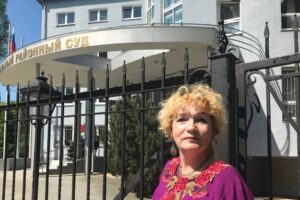
The ICJ expressed concern at the arrest and detention, on 28 February, of lawyer Taisiya Baskayeva, who represents a significant number of victims of human rights violations before the European Court of Human Rights.
Taisiya Baskayeava was arrested on charges of large-scale fraud under article 159.3 of the Russian Criminal Code, based on allegations by investigators that she misappropriated reparations awarded to victims she represented in the case of Salkazanov and others v. Russia before the European Court.
The arrest followed repeated attempts by the investigator to place her in detention in connection with the case.
A previous request to the Court by the investigator for her arrest, on 14 February, had been based partly on the allegation that she was in hiding in the United Arab Emirates and the fact that she had been “put on an international missing list.”
However the Court on that occasion denied the request, saying that it “received no reliable information that Baskayeva T.S. had left the territory of Russia” and that she had sent an urgent telegram from the Moscow region to prove her presence in the territory of Russia.
Taisiya Baskayeva was detained in Moscow region while undergoing a medical check and driven some 1200 km in a car to North Osetia.
At a hearing on 4 March 2014 the Soviet District Court of Vladikavkaz decided to grant the motion to detain the lawyer for two months pending trial. The Court ruled out other less restrictive measures.
The ICJ has received information indicating that the investigation presented no evidence that Taisiya Baskayeva had left Russia, except for an allegation made by the investigator in the motion for her arrest.
The ICJ is unaware of the reasons for declaring the lawyer missing, since her whereabouts were clearly known.
Moreover, the fact that she was detained while undergoing a medical check, of which the investigative authorities were duly informed by the Central City Hospital, contradicts her inclusion on a “international missing list”.
According to the official letter of the Deputy Head Physician at the disposal of the ICJ, the schedule of her visits was also made known to the investigative authorities.
The ICJ is concerned at that the detention may be arbitrary, and may have been ordered for the improper motive of subjecting Taisiya Baskayeva to persecution, harassment or intimidation in regard to her representation of her clients before the European Court of Human Rights.
If so, the Russian Federation would be in breach of obligations in respect of the right to liberty under article 9 of the International Covenant on Civil and Political Rights and article 5 of the European Convention on Human Rights.
The ICJ recalls that for lawyers to be able to fulfill their role and duties effectively, and independently, the State authorities must ensure that they are able to discharge their functions without any intimidation, harassment or improper interference.
According to the UN Basic Principles on the Role of Lawyers, lawyers must not be threatened with prosecution or any other form of sanctions for any action taken in accordance with professional duties or standards and ethics (Principle 16).
Under these principles when lawyers are threatened as a result of discharging their functions, the state authorities must take adequate steps to protect them (Principle 17).
The ICJ is concerned that the detention may constitute a form of a reprisal for an effective representation of the interests of a significant group of victims before the European Court of Human Rights.
Any such reprisal would be incompatible with Russia’s obligations under article 34 of the European Convention for Human Rights guaranteeing an effective exercise of the right to bring lodge applications claiming violations under the ECHR.
Approximately 200 other cases submitted by Ms. Baskayeva are currently pending before the European Court of Human Rights.
The ICJ will continue to monitor the criminal prosecution of lawyer Taisiya Baskayeva.
Contacts:
Róisin Pillay, Director, Europe Programme, t + 32 273 48 46, roisin.pillay(a)icj.org
Temur Shakirov, Legal Adviser, Europe Programme, t + 41 22 979 38 32, temur.shakirov(a)icj.org
Russia-Concerns over Baskayeva-news-web story-2014-rus (full text in pdf)
Feb 18, 2014 | Advocacy, News, Non-legal submissions
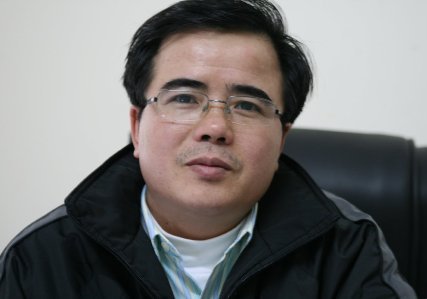
The ICJ condemned the decision by the Court of Appeal of the Supreme People’s Court in Hanoi to uphold the conviction and sentencing of lawyer and human rights defender Le Quoc Quan to 30 months imprisonment.
The ICJ called on Viet Nam authorities to release him immediately.
“The decision of the Court of Appeal is regrettable but not unexpected,” said Sam Zarifi, ICJ’s Regional Director for Asia and the Pacific. “The ICJ has repeatedly criticized the lack of independence of the courts in Viet Nam. This is a political case and the government of Viet Nam has again used the courts to punish a significant critical voice.”
Today’s appellate hearing lasted for four hours. Thirty minutes after the hearing ended, the court released its decision upholding Le Quoc Quan’s conviction.
Le Quoc Quan, a lawyer who was illegitimately barred from practice for challenging government human rights violations, was convicted on 2 October 2013 of tax evasion under section 161 of the Vietnamese Penal Code. The ICJ had criticized Le Quoc Quan’s conviction, pointing out that he did not receive a fair trial.
The Court of Appeal upheld Le Quoc Quon’s sentence with time served since his arrest on 27 December 2012 to be taken into account.
The Court of Appeal also upheld the earlier order made by the People’s Court of Hanoi for Le Quoc Quan’s company to pay 645 million VND (approximately USD30,000) and a fine of 1.3 billion VND (approximately USD60,000), for alleged unpaid taxes.
Le Quoc Quan has been on a hunger strike protesting his conviction since 1 February 2014. He was so weak that it was difficult for him to stand up during the hearing.
“Le Quoc Quan’s faulty trial violated right to an independent, impartial tribunal, and the appeal process also fell short of international fair trial standards, including under the International Covenant on Political and Civil Rights, to which Vietnam is a party,” Zarifi said.
The public was barred from entering the courtroom during today’s hearing and only Le Quoc Quan’s wife, mother, and lawyers were allowed inside.
Le Quoc Quan was also not allowed to meet with his lawyers in the last few days leading up to the appeal hearing.
His lawyers tried to visit him in prison at least twice last week, but they were barred from seeing him.
Le Quoc Quan’s lawyers also confirmed to ICJ that Le Quoc Quan was not allowed to meet and communicate with his lawyers immediately after his conviction by the People’s Court of Hanoi and had to file an appeal on his own.
In drafting his appeal, all legal documents and files pertaining to his case were withheld from him.
The UN Human Rights Committee has emphasized that all convicted persons like Le Quoc Quan must be given copies of a duly reasoned, written judgment of the trial court, as well as other documents such as transcripts, so that they may be able to effectively enjoy their right to appeal.
Under Viet Nam’s laws, lawyers of convicted persons cannot file an appeal on behalf of their clients.
It is only after the appeal has been filed and accepted by the appellate court that the convicted person may identify the lawyer of his choice.
The chosen lawyers are recognized and allowed to participate in the case only after the court approves their application for a “defence counsel’s certificate” or “advocacy certificate”.
The UN Basic Principles on the Role of Lawyers provide that no court shall refuse to recognize the right of a lawyer to appear before it on behalf of his client, unless the lawyer has been disqualified in accordance with domestic law.
“Viet Nam’s courts operate in violation of international standards that clarify that lawyers must be allowed to assist their clients in filing an appeal,” Zarifi said.
Le Quoc Quan cannot appeal the decision of the Court of Appeal under the article 248(3) of the Criminal Procedure Code of Vietnam, which states that decisions of the Court of Appeal are final and legally binding from the date of their pronouncement.
The lawyers of Le Quoc Quan, however, are said to be considering filing a petition on procedural issues on this case.
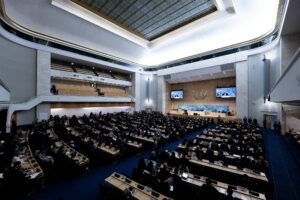
On 14 February, the ICJ submitted a written statement to the Human Rights Council (see below) under the title “Violations of the right to counsel of Viet Nam human rights defender Le Quoc Quan”.
In the statement, the ICJ called on the UN Special Rapporteur on the Independance of Judges and Lawyers to reiterate her request to the Government of Viet Nam to extend an invitation to her mandate to undertake a mission to the country.
The ICJ also called on Viet Nam to amend its laws expressly to ensure that anyone deprived of liberty, including human rights defenders, are given access to counsel from the moment of deprivation of liberty or at latest within 24 hours of detention.
Viet Nam should also consider including in its laws penalties for law enforcement authorities who do not honour such provisions.
Contact:
Emerlynne Gil, ICJ International Legal Adviser for Southeast Asia, t +66 2 619 8477; email: emerlynne.gil(a)icj.org
Craig Knowles, ICJ Media Consultant, t +66 81 9077653; email: craig.knowles(a)icj.org
Viet Nam-Human Rights Council-ICJWrittenStatement-advocacy-2014 (full text in pdf)

Dec 3, 2013 | News
Today, the ICJ observed a hearing in a case concerning Zinaida Mukhortova, a lawyer detained until recently in a psychiatric facility, allegedly for carrying out her professional duties, but released on 1 November.
At the hearing on 2 December, the Karaganda Regional Court confirmed the lawfulness of her detention, upholding the earlier decision of the Balkhash City Court of 20 August 2013, to grant the motion of the Prosecutor’s Office to detain the lawyer.
“The likelihood of her repeated detention for the lawful exercise of her profession has risen following this decision,” Almaza Osmanova, an ICJ observer present at the hearing, commented.
The deputy Head of the Medical Facility in which Zinaida Mukhortova (photo) was detained, Doctor R.R. Iskahakov was present at the hearing and insisted on the lawfulness of her detention.
The ICJ previously reported Doctor Iskahakov’s refusal to release lawyer Mukhortova until all the court proceedings had been completed.
The ICJ trial observation mission consisted of two observers: Almaza Osmanova, a practicing lawyer from Kyrgyzstan and Kayum Yusufov, a practicing lawyer from Tajikistan.
The ICJ has previously made statements following lawyer Mukhortova’s detention and subsequent release from the psychiatric facility:
Kazakhstan: ICJ welcomes release of a lawyer from psychiatric detention
Kazakhstan: psychiatric detention of lawyer must be ended
Contact:
Róisín Pillay, Director, ICJ Europe Programme, roisin.pillay(a)icj.org
Temur Shakirov, LegalAdviser, ICJ Europe Programme, temur.shakirov(a)icj.org

Nov 29, 2013 | Advocacy, Non-legal submissions
The ICJ’s Director of the International Law and Protection Programmes, Alex Conte, today delivered the keynote address at the launch of the OSCE manual on Human Rights in Counter-Terrorism Investigations.
Responding to the challenges faced by some OSCE participating States in operationalizing human rights when conducting counter-terrorism investigations, the OSCE Office for Democratic Institutions and Human Rights (ODIHR) and the OSCE Secretariat’s Transnational Threats Department / Strategic Police Matters Unit jointly developed a manual on Human Rights in Counter-Terrorism Investigations. The manual adopts an operational approach to different phases of counter-terrorism investigations and linking them to relevant human rights standards.
The keynote address focussed on the link between human rights protection and effective counter-terrorism practices; and on how human rights are themselves useful tools to successfully prevent and counter terrorism. It identified five law, policy and practical reasons that human rights compliance is required and/or contributes to the prevention and countering of terrorism:
- Human rights compliance while countering terrorism is an international obligation, recalling that States’ right and duty to combat terrorism is part of international and regional human rights law stemming from the duty of States to protect individuals under their jurisdiction from interference with their enjoyment of human rights, including the rights to life and security;
- Human rights compliance at the investigative stage of counter-terrorism cases means that there will be an exponentially greater chance that the precious resources dedicated to terrorist investigations will result in the admissibility of evidence;
- Human rights compliance at the investigative and pre-trial stages of counter-terrorism cases (considering the impact of prolonged detention without trial or without charge) gives rise to a greater prospect of achieving a sound conviction;
- Bringing perpetrators of terrorist acts to justice through effective (i.e. human rights-compliant) investigation and prosecution contributes to the realisation for victims of terrorism of their rights to truth and reparation; and
- Human rights compliance not only assists the short-term objectives of effective counter-terrorism investigations and prosecutions, but is also the essential basis for a sustainable, long-term approach to the countering of terrorism by avoiding further conditions conducive to the spread of terrorism.
ICJ-OSCE-ManualOnHumanRightsInCounterTerrorismInvestigations-LaunchEvent-KeynoteAddress-NonlegalSubmission-2013 (download keynote address in PDF)
OSCE_HRCT_Manual (download manual on Human Rights in Counter-Terrorism Investigations in PDF)
Nov 6, 2013 | News
The ICJ is calling on the Bangladeshi authorities to immediately and unconditionally release Nasiruddin Elan, Director of the human rights group Odhikar.
Odhikar is an affiliate organization of the ICJ.
On 6 November 2013, a Dhaka cyber crimes tribunal rejected Nasiruddin Elan’s bail application and ordered his detention in Dhaka Central Jail.
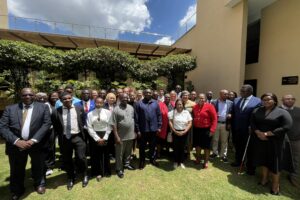
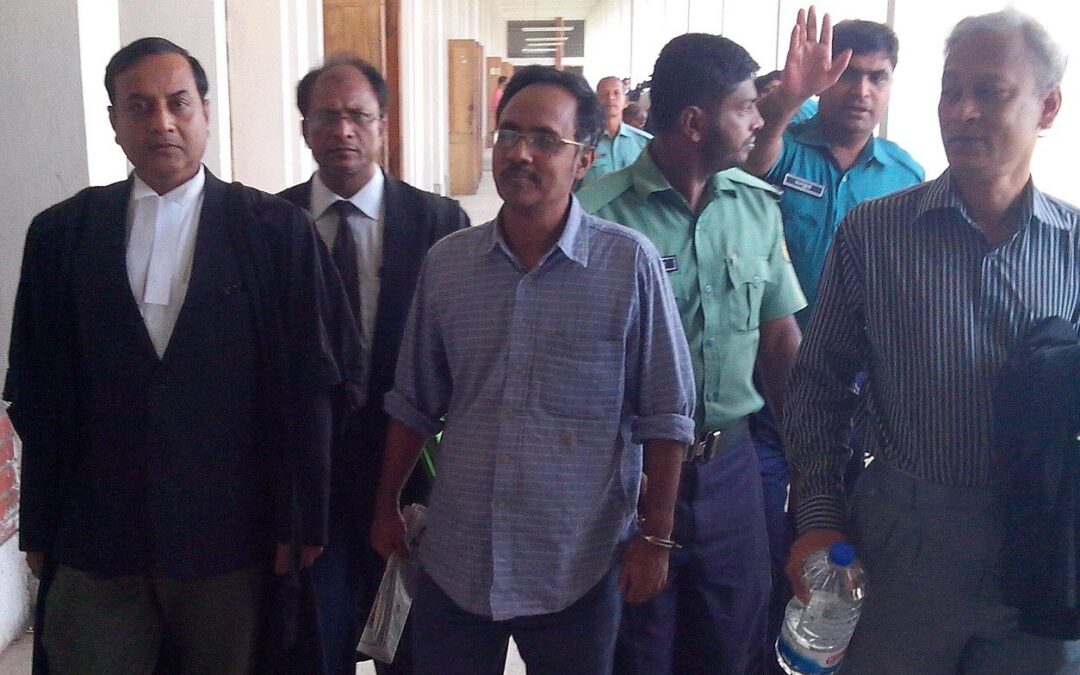
Nasiruddin Elan (in the middle on the picture) has been accused of distorting information, presenting false evidence and manipulating photographs of a Government crackdown on a rally by Hefazat-e-Islam, an Islamist political organization, in May this year.
The action reportedly resulted in multiple deaths and injuries. Odhikar had reported that 61 protestors were killed by the Rapid Action Battalion (RAB) and the police. The Government contests the number of casualties.
“What we are seeing is a continuing unlawful attack on Odhikar and voices critical of the Government,” said Ben Schonveld, ICJ’s South Asia Director. “Nasiruddin Elan is being arbitrarily detained for the lawful exercise of the right to freedom of expression and his legitimate work as a human rights defender.”
“The Government should immediately drop its opposition to Nasiruddin Elan’s bail application,” he added. “We are concerned that he will be one of the many detainees who faces torture and ill-treatment during detention, as documented by Odhikar and other human rights organizations.”
Bangladesh-Elan arrest statement-news-web story-2013 (full text in pdf)