Oct 27, 2017 | News
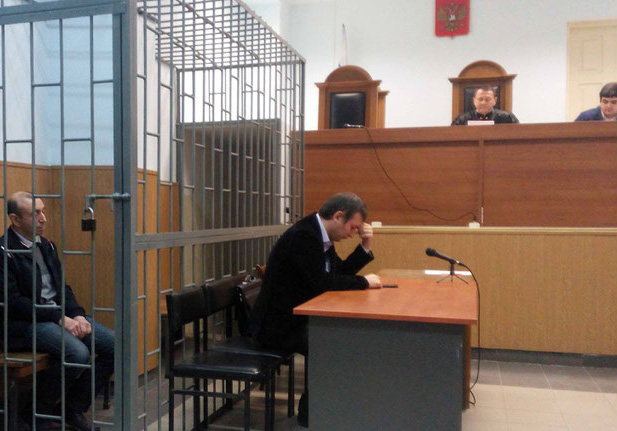
Today, the ICJ expressed concern at the allegations of harassment of lawyer Shamil Magomedov following an acquittal of his client Sulntankhan Ibragimov, who had been accused of murder.
The allegations should be investigated and authorities must make clear to law enforcement officials that such intimidation and harassment is prohibited, the ICJ said.
Yesterday, the lawyer alleged that on 19 October, while he was in Moscow, a law enforcement officer visited his home in Dagestan and questioned his family members about his whereabouts and “why he complained so much to law enforcement bodies”.
The lawyer believes this is related to the acquittal of his client, Sulntankhan Ibragimov, in whose case a decision had been delivered three days before.
When the matter was raised in court, Prosecutor Magomed Aliyev claimed the law enforcement officer’s visit was routine.
The ICJ considers that in the circumstances, the visit to and questioning by a law enforcement officer of a lawyer’s family about his professional activities could only reasonably be understood as a form of intimidation or harassment.
International standards, such as the UN Basic Principles on the Role of Lawyers, provide that governments must ensure that lawyers “are able to perform all of their professional functions without intimidation, hindrance, harassment or improper interference” and “shall not suffer, or be threatened with, prosecution or administrative, economic or other sanctions for any action taken in accordance with recognized professional duties, standards and ethics.”
The ICJ calls on the relevant prosecutorial and law enforcement authorities to make clear to all their officials that all intimidation and harassment of lawyers, including by visiting and questioning a lawyer’s family about the lawyer’s protected professional activities, is prohibited.
Background
Shamil Magomedov, a lawyer from Dagestan, defended Sultankhan Ibragimov in a case where he was charged with the muder of Alisultan Omarov, a Greco-Roman wrestling coach, in 2015 and the murder in 2016 of Nazim Gadjiev, the leader of the “Sadval” movement.
On 16 October, the jury trial found Sultankhan Ibragimov not guilty on all accounts.
Russia-Shamil Magomedov statement-News-web stories-2017-RUS (story in Russian, PDF)
Aug 15, 2017 | Advocacy
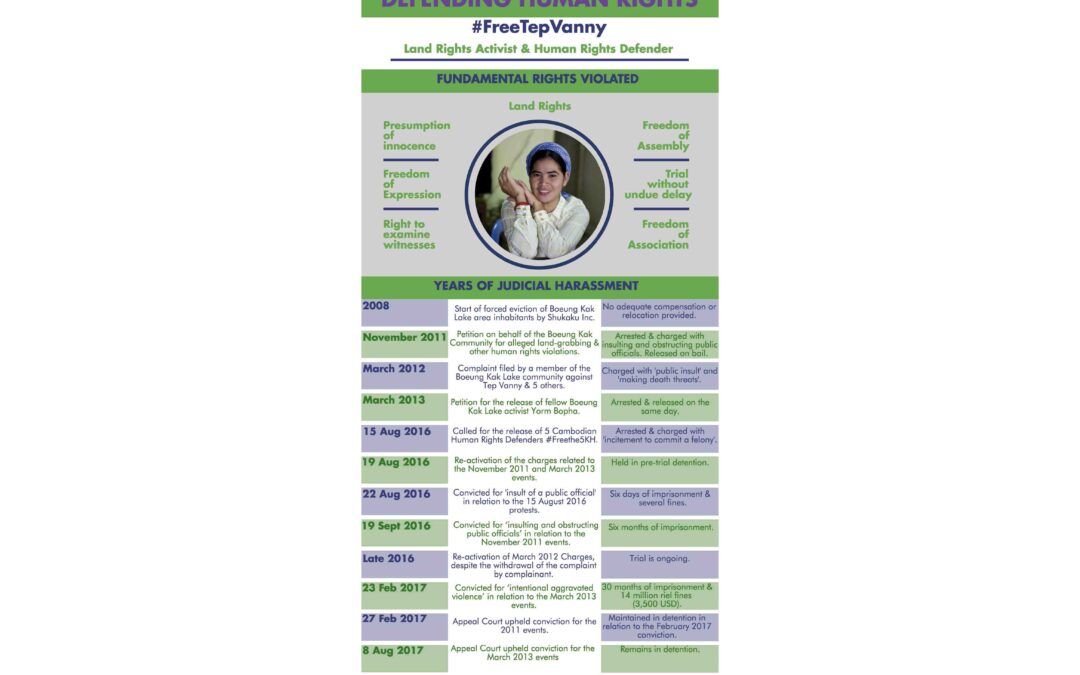
Tep Vanny, one of Cambodia’s most prominent land activists and human rights defenders, will have spent one year in prison on 15 August for defending her community and exercising her human rights.
The ICJ and other human rights organizations condemn her arbitrary imprisonment and call for her convictions to be overturned, for all ongoing politically motivated and unsubstantiated charges against her to be dropped, and for her immediate release from prison.
Tep Vanny has fought tirelessly to protect the rights of members of the Boeung Kak Lake community, following their forced eviction from their homes in Phnom Penh.
More recently, she played a leading role in the so-called ‘Black Monday” campaign, challenging the arbitrary pre-trial detention of five human rights defenders, Lim Mony, Ny Sokha, Yi Soksan, Nay Vanda, and Ny Chakrya (the “Freethe5KH” detainees).
On 22 August 2016, following her arrest at a protest calling for the release of the five, she was convicted of ‘insulting of a public official’, and sentenced to six days in prison.
However, instead of releasing her based on time served, the authorities reactivated dormant charges dating back to a 2013 protest and kept her in detention.
“It is clear that the authorities are using the courts to lock me up, silence my freedom of expression and break my spirit,” said Tep Vanny. “They want to stop me from advocating and seeking a solution for the remaining people from Boeung Kak Lake as well as other campaigns to demand justice in our society.”
On 19 September 2016, Tep Vanny was sentenced, along with three other Boeung Kak Lake community activists, to six months imprisonment for “insulting and obstructing public officials” in a reactivated case related to a 2011 peaceful protest calling for a resolution to the Boeung Kak Lake land dispute, despite the absence of credible inculpatory evidence.
This conviction has since been upheld by the Court of Appeal on 27 February 2017.
On 23 February 2017, following proceedings which fell short of fair trial standards, Tep Vanny was convicted of “intentional violence with aggravating circumstances”, sentenced to a further 30 months in prison and fined more than 14 million riel (about US $3,500 – or twice the annual minimum wage in Cambodia) for having peacefully participated in protests calling for the release of her fellow activist Yorm Bopha, back in 2013.
While the #FreeThe5KH human rights defenders were released on bail on 29 June 2017, after having spent 427 days in arbitrary detention, Tep Vanny remains in prison.
She is currently on trial in a third reactivated case, facing charges of “public insult” and “death threats” brought by another member of the Boeung Kak Lake community, despite the complaint having been dropped by the community member.
On 8 August 2017, the Court of Appeal upheld her February 2017 conviction.
Cambodia-Joint Statement Tep Vanny-Advocacy-2017-ENG (full statement in English, PDF)
Cambodia-Joint Statement Tep Vanny-Advocacy-2017-KHM (full statement in Khmer, PDF)
Cambodia-Infographic TV Case Overview-Advocacy-2017-KHM (Infographic in Khmer, PDF)

Jul 13, 2017 | News
The ICJ today mourns the passing of Chinese human rights defender and Nobel Peace Prize winner, Liu Xiaobo. Liu Xiaobo was awarded the Nobel Peace Prize in 2010 and was described as the “foremost symbol of the struggle for human rights in China.”
He passed away today at the First Hospital of China Medical University, while still in the custody of Chinese authorities.
He has been imprisoned since 2009, after being found guilty for “subverting state power”, for calling for a new constitution in China. His wife, poet Liu Xia, remains under house arrest in Beijing.
In May 2017 authorities announced that he had been diagnosed with late-stage liver cancer.
Chinese authorities refused calls that he be allowed to travel to receive medical treatment abroad.
The ICJ honors Liu Xiaobo for his peaceful and unrelenting pursuit for human rights in China, and calls on the government to end the house arrest, and guarantee the freedom of movement, of Liu Xia.
Sam Zarifi, ICJ’s Secretary General said: “Liu Xiaobo will continue to serve as an inspiration not only for those fighting for human rights in China, but also for all human rights defenders working to promote and protect human rights all over the world.”
The ICJ believes that the death of Liu Xiaobo should serve as a wake up call to the Government of China that they cannot simply and brutally silence dissenting voices.
Liu Xiaobo’s death only serves to amplify his call for human rights and upholding the rule of law in China.
The ICJ has consistently called upon the Chinese government to end the harrassment and unlawful detention of lawyers and human rights defenders.
Jul 6, 2017 | News
The Turkish government should immediately release 11 people, including eight Turkish human rights defenders, who were detained yesterday in Istanbul, said the ICJ today.
The human rights defenders were arrested on unknown charges while attending a training in Istanbul on digital security and information management; also reported arrested were two trainers (reportedly a German and a Swedish national) and the owner of the training venue.
Amnesty International has reported that they were denied access to family members and lawyers, contrary to existing regulations.
“These arrests are an alarming setback to efforts to restore the rule of law in Turkey,” said ICJ Secretary General Sam Zarifi.
“Arrest and harassment of human rights defenders violates Turkey’s international legal obligations. Turkish authorities should be protecting human rights and supporting the important work of human rights defenders, but instead we have witnessed a continuing pattern of arrests on human rights defenders in the country,” he added.
On 6 June, Taner Kiliç, the President of Amnesty International Turkey was arrested.
He is currently detained on remand in what several international observers have qualified as baseless charges.
Turkey is currently under a State of Emergency enacted after the attempted coup d’etat of 15 July 2016.
While recognizing the serious attack suffered by Turkish institutions, the ICJ has repeatedly called for an end to this year-long state of emergency under which sweeping measures have been enacted that continue to erode human rights, including rights of fair trial, the right to liberty, and freedoms of expression and association.
“It is time to turn the page of the emergency and return to the rule of law,” said Sam Zarifi. “The work of human rights defenders, judges and lawyers is essential to a democratic society that upholds human rights.”
Background
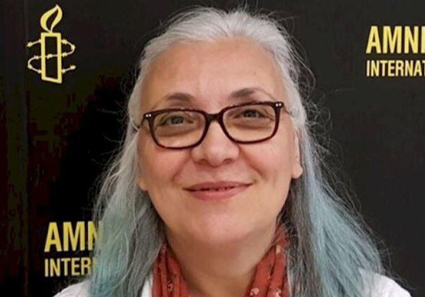
The human rights defenders arrested are Idil Eser (current Director of Amnesty International Turkey, photo), İlknur Üstün (Women’s Coalition), Günal Kurşun (Human Rights Agenda Association), Nalan Erkem (Citizens Assembly), Nejat Taştan (Equal Rights Watch Association) , Özlem Dalkıran (Citizens’ Assembly), Şeyhmuz Özbekli, and Veli Acu (Human Rights Agenda Association).
Contact
Olivier van Bogaert, ICJ Director of Media & Communications, t: +41 22 979 3808 ; e: olivier.vanbogaert(a)icj.org

Jun 30, 2017 | Multimedia items, News, Video clips
ICJ Commissioner Karinna Moskalenko talks about the vulnerabilities of human rights defenders in Russia, as part of the ICJ’s ongoing women profiles series.
Ms Moskalenko is a Russian lawyer who has been a Commissioner of the ICJ since 2003. In the early 1990s she founded, and was the former Director of, the International Protection Centre based in Moscow.
The Centre was founded after Russia had ratified the Human Rights Committee Mechanism with the Optional Protocol to the International Covenant on Civil and Political Rights. This provided an opportunity to be able to use international mechanisms to appeal against injustices.
Once Russia had ratified the European Convention it was also possible to use the European Court of Human Rights as another means to challenge incidences where domestic remedies were failing to protect the rights of people in Russia.
The Centre pursued many cases successfully and the credibility of the organization grew, which also increased demands for help. Karinna said that women have a strong role to play in human rights defence work in Russia and form the majority of the human rights community where they are well respected.
However, this is not reflected elsewhere in Russian society where, although women are visible in senior roles within the judiciary and the executive, they do not often play an important role in leadership positions or decision-making.
“Women in Russia are sometimes much more vulnerable than other groups of the population,” said Karinna. She identified the particular problem of domestic violence as one where women are unable to obtain legal protections because police are not very interested in the problem. In addition many people within society think that women already have enough protections so there is little public opposition for reducing protections and no support for enhancing these.
Karinna felt compelled to work as a human rights defender to protect the most vulnerable people but commented that many lawyers are not interested in this field of law. Instead, they prefer to build careers within official bodies of the judiciary or the government. Human rights activities are no longer very popular, she said.
Members of non-governmental organizations are often accused of being ‘foreign agents’ or ‘enemies of the State’. As many people do not understand the nature of human rights defence work, Ms Moskalenko said it can be frustrating and hurtful to have to defend yourself against these accusations. However, Karinna thinks that those working in human rights are the most patriotic people she knows because they care about the rights of each and every member of society.
Fortunately, the International Protection Centre has won so many cases for ordinary people that they have a very good reputation in society, but they do not have enough funding for their activities. They cannot accept international funds and domestically no funding is available. Many lawyers take on unpaid cases, but not everyone can afford to do so. The defence of human rights is a very difficult career.
“I cannot say that there is no fear. There is, of course. Some of my friends were killed because of their human rights activity.”
Ms Moskalenko said that human rights defence work is very important but in Russia defenders are not protected financially, legally, morally or physically. They are frequently threatened, persecuted and even killed.
However, although working as a human rights defender is difficult, Karinna says that “when you somehow help people, you want to continue that, you think that you believe that you must do that, you cannot stop and people come to you, how can you refuse?”
Watch the interview:
The series of profiles introducing the work of ICJ Commissioners and Honorary Members on women’s rights was launched on 25 November 2016 to coincide with the International Day to Eliminate Violence against Women and the first day of the 16 Days of Activism Against Gender-Based Violence Campaign.