Apr 2, 2014 | News
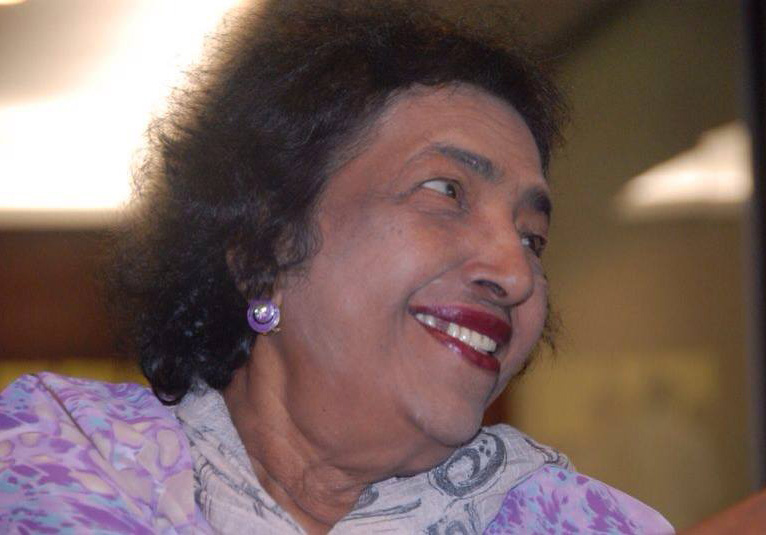
The ICJ mourns the loss of Irene Fernandez, a Malaysian human rights defender who was at the frontline of promoting and protecting human rights, especially the rights of women and migrant workers.

Mar 27, 2014 | Events, News, Publications, Reports, Seminar and conference reports
The ICJ hosted over 40 human rights defenders (HRDs) from Southern, Eastern and Western Africa to deliberate on strategies for enhancing the protection of human rights and human rights defenders.
The event took place on 27-28 March 2014 in Tswane, Pretoria.
Several African dignitaries attended the strategy session, including various independent experts from the African Union and United Nations focusing on protection and promotion of the work of human rights defenders.
This reflection session came in the wake of the increased sophistication of acts that undermine the independent, safe and secure operation of human rights defenders in Africa.
These acts include restrictive and punitive legislative enactments, in countries such as Uganda, Ethiopia and Kenya, and extra judicial killings and enforced disappearances in countries such as the Democratic Republic of Congo, Sudan, and South Sudan.
Other acts undermining the work and security of human rights defenders include the prohibition of access to funding; defamatory labeling of HRDs as “spies”, “unpatriotic”, “traitors”, and “foreign agents”; and the passing of laws criminalizing homosexuality.
The Universally acclaimed Declaration on Human Rights Defenders has recorded a greater number of breaches in recent times than before.
There is an increasing need for defenders to identify and reflect on opportunities to strengthen their collective responses and to provide rapid in-country and regional support and solidarity that nurtures a spirit of resilience, collectiveness and camaraderie within universally accepted norms of the defence of human rights.
Contact
Arnold Tsunga, Director, ICJ Africa Regional Programme, Arnold.tsunga(a)icj.org, +27731318411, or
Martin Okumu-Masiga, Deputy Director, ICJ Afria Regional Programme, Martin.okumu-masiga(a)icj.org, +27110248268 (full text in PDF)
Southern Africa-Strategic Session rapide response-Publications-Workshop report-2015-ENG (full text in PDF)

Mar 20, 2014 | News
Thailand’s caretaker government must remove emergency measures throughout the country following the lifting of the Emergency Decree in the capital Bangkok and its surrounding provinces this week, the ICJ said today.
On 18 March, the caretaker government voted to lift the Emergency Decree (effective 19 March) that had been in place in Bangkok and surrounding provinces since 21 January 2014 in response to protests led by the People’s Democratic Reform Committee (PDRC).
At least 20 people have died in protest-related violence and hundreds have been injured.
The Emergency Decree was replaced by the Internal Security Act (ISA), which also does not fully comply with international standards, but provides better remedies for victims of human rights violations than the Decree.
“The imposition of the Emergency Decree creates an environment conducive to abuse of power and human rights violations such as arbitrary arrest and detention, torture and enforced disappearance,” said Sam Zarifi, ICJ’s Regional Director for Asia and the Pacific. “Lifting the Emergency Decree in Bangkok is a positive step, but it is crucial that the authorities remove the Emergency Decree and other measures of emergency rule, including martial law, that are in force in all or parts of at least 30 of Thailand’s 77 provinces.”
These measures should be replaced by law and action that are consistent with international human rights standards, Zarifi said, adding that martial law should not be used as a political tool.
The caretaker government must respond to demonstrations, unrest and emergencies in a manner which complies with its obligations under the International Covenant on Civil and Political Rights (ICCPR), and other international standards, including the Code of Conduct for Law Enforcement Officials, adopted by the UN General Assembly in 1979, and the Basic Principles on the Use of Force and Firearms by Law Enforcement Officials, adopted by the UN Congress on the Prevention of Crime and Treatment of Offenders in 1990.
These standards set out the circumstances in which resort to necessary and proportional force may be lawfully exercised. Article 8 of the Basic Principles on the Use of Force and Firearms states that “exceptional circumstances such as internal political instability or any other public emergency may not be invoked to justify any departure from these basic principles.”
In order to safeguard the rule of law and enhance the protection of human rights in Thailand, the ICJ calls on the caretaker government to repeal the Emergency Decree and other emergency measures including martial law, and to ensure accountability for violent acts through the thorough and effective investigation of criminal acts and prosecution of those reasonably suspected of committing them, in the course of fair, human rights-compliant criminal proceedings.
CONTACT: Sam Zarifi, ICJ Asia-Pacific Regional Director, (Bangkok), t:+66 807819002, e-mail: sam.zarifi(a)icj.org
Craig Knowles, ICJ Media & Communications, (Bangkok), t:+66 819077653, e-mail: craig.knowles(a)icj.org
For further reading on ICJ’s work on emergency laws in Thailand see: Thailand’s Internal Security Act, Risking the Rule of Law? (2010) https://www.icj.org/thailands-internal-security-act-risking-the-rule-of-law/ Implementation of Thailand’s Emergency Decree (2007) https://www.icj.org/thailand-implementation-of-thailand%C2%B4s-emergency-decree/ More Power, Less Accountability: Thailand’s New Emergency Decree (2005) https://www.icj.org/more-power-less-accountability/

Mar 18, 2014 | News
The arbitrary arrest and detention of prominent human rights defenders is an attempt to silence criticism and divert the spotlight from ongoing abuses, leading global and Asian human rights monitors said today in a joint statement.
The statement was issued by Amnesty International, Forum Asia, Human Rights Watch, the International Crisis Group, and the International Commission of Jurists.
Ruki Fernando of the Colombo-based INFORM and Father Praveen Mahesan, a Catholic priest, were arrested in Kilinochchi on March 16, and are believed to be detained without formal charges under Sri Lanka’s notoriously draconian Prevention of Terrorism Act (PTA).
“The Sri Lankan authorities need to release Fernando and Father Praveen, and end the ongoing state harassment of human rights defenders,” said David Griffiths, Amnesty International’s deputy director for Asia Pacific. “How can the international community take Sri Lanka’s claims to respect rights seriously when rights defenders continue to face intimidation and criminal charges for demanding accountability and human rights protection?”
The police Terrorism Investigation Division (TID) detained and questioned Ruki Fernando and Father Praveen after they sought to ensure the welfare of 13-year-old Balendran Vithushaini, who had been ordered into probationary care following the arrest of her mother, Balendran Jeyakumari, on March 13. Both mother and daughter are active opponents of enforced disappearances in Sri Lanka and have been prominently featured in international media coverage of demonstrations by families of the disappeared, most recently in Jaffna in November 2013 during a visit by British Prime Minister David Cameron.
Fernando and Father Praveen were questioned separately in two different buildings for more than three hours by several TID officers. Lawyers acting on their behalf were given contradictory information about the arrests and the reasons for their detention. The most recent information is that Fernando and Father Praveen have been taken to police Terrorism Investigation Division headquarters in Colombo, and their lawyers are still seeking access to them.
Fernando and Father Praveen have not been charged to date, but according to Sri Lankan Police spokesperson Senior Superintendent Ajith Rohana, they will be charged with “attempting to create instability among communities” and “allegedly promoting separatism” under the Prevention of Terrorism Act.
The PTA has been widely criticized by Sri Lankan civil society, international monitoring organizations, and United Nations bodies. In its report, Authority without Accountability: The Crisis of Impunity in Sri Lanka, the International Commission of Jurists documents how provisions of the PTA have resulted in arbitrary detention, contravened suspects’ right to a fair trial and due process, and facilitated torture and other ill-treatment and enforced disappearances
The human rights groups said that the arrests are particularly disturbing since a resolution on Sri Lanka’s failure to address accountability is under discussion and will be voted on soon at the ongoing Human Rights Council (UNHRC) sessions in Geneva. The international community has long called for Sri Lanka to take meaningful steps to end its culture of impunity.
“This ongoing campaign of reprisals against those speaking out against human rights violations shows the extent of the government’s impunity,” said Sam Zarifi, Asia director at the International Commission of Jurists. “The international community, through its voting at the Human Rights Council, must judge Sri Lanka not by its promises, but by its actions.”
In spite of two prior resolutions by the UNHRC in 2012 and 2013, Sri Lanka has taken no measurable steps towards ensuring justice for the victims of its civil war, and has instead launched an aggressive campaign against those who advocate for accountability. Human rights defenders, activists, journalists, and civil society members who are critical of the government have regularly been threatened and harassed. Those who have an international profile, such as Fernando, face particular government hostility.
“Sri Lankan authorities systematically clamp down on those who seek to reach out to the international community, especially around significant events such as the Human Rights Council sessions or the Commonwealth Heads of Government Meeting,” said Evelyn Balais-Serrano, the executive director of Forum-Asia. “Instead of protecting human rights defenders, the latest arrests show the Sri Lankan government is stepping up its aggressive stance towards those seeking justice and answers.”
The arrests also call into question the Sri Lankan government’s stated commitment to improving respect for human rights since the end of the armed conflict with the Liberation Tigers of Tamil Eelam in 2009, the groups said.
“Arresting peaceful activists known for their work with victims of rights violations from all ethnic communities is not a way to build trust and restore relationships damaged by the war,” said Jonathan Prentice, the International Crisis Group’s chief policy officer. “If sustainable peace is to be more than an illusion, the rights of Sri Lanka’s victims and human rights defenders to speak freely and safely must be protected.”
The organizations stressed that Fernando and Father Praveen should be given full rights while they remain in detention. Under international law, including the International Covenant on Civil and Political Rights, to which Sri Lanka is a state party, people deprived of their liberty must be promptly informed of the reasons for their detention, be given prompt and regular access to lawyers, and be promptly brought before a judge or judicial officer.
“Human Rights Council members should demand the immediate release of Fernando and Father Praveen and be clear that this will not deter them from adopting a necessary resolution on Sri Lanka,” said Brad Adams, Asia director at Human Rights Watch. “The arrest of these human rights defenders shows just how important it is for the international community to stand up for human rights in Sri Lanka.”
Signed by:
- Amnesty International
- FORUM-ASIA
- International Commission of Jurists
- International Crisis Group
- Human Rights Watch
For more information, please contact:
In London, for Amnesty International
In Bangkok, for International Commission of Jurists, Sam Zarifi: +66-857-200-723; orsam.zarifi@icj.org
In Bangkok, for International Commission of Jurists, Sheila Varadan: +66-857-200-723; or sheila.varadan@icj.org
Mar 7, 2014 | News, Publications, Reports
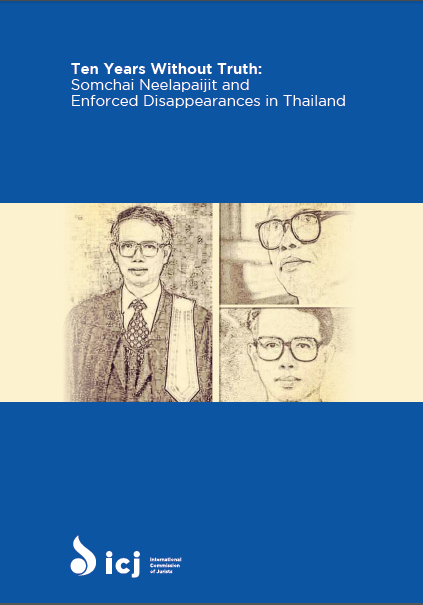
A new ICJ report criticizes the Thai Government’s failure to take the steps necessary to establish the fate and whereabouts of missing lawyer Somchai Neelapaijit, saying it illustrates the challenges of achieving justice in cases of serious human violations in Thailand.
In the report, Ten Years Without Truth: Somchai Neelapaijit and Enforced Disappearances in Thailand, the ICJ documents the tortuous legal history of the case.
It highlights several key problems, such as poor use of forensic evidence, failure to follow and develop leads, unduly restrictive interpretation of national and international law, and above all, a lack of political will to resolve a case that remains emblematic of the culture of impunity in Thailand.
“Over the past 10 years, this case has taken many unexpected turns, including the disappearance of a prime suspect, admissions of Somchai’s death from officials while the courts have rejected such a finding, and most recently, a statement from the Department of Special Investigations that it had lost, and then found, the case files,” said Sam Zarifi, ICJ’s Regional Director for Asia and the Pacific.
“The Royal Thai Government has not exhausted all potential areas of inquiry and it must continue this investigation. There is no statute of limitations on an enforced disappearance and Somchai’s case is not forgotten in Thailand or around the world.”
Somchai, a lawyer and human rights defender, was stopped at a Bangkok roadside on March 12, 2004 and pulled from his car by a group of men. He has not been seen since.
At the time, Somchai was defending clients from Thailand’s restive southern provinces who were accused of attacking a military base as part of the ongoing insurgency in the region. Somchai had alleged police tortured the Muslim suspects.
Ten years later, Somchai’s wife, Angkhana Neelapaijit, and her family are no closer to knowing the truth about what happened to him.
“Somchai’s enforced disappearance, and the failure of the Royal Thai government to provide accountability or even basic information about his fate are emblematic of the challenges of achieving justice in cases of serious human rights violations in Thailand,” said Zarifi. “Enforced disappearance is not only a serious human rights violation but also a crime under international law.”
Thailand signed, but has not yet ratified, the Convention Against Enforced Disappearance in January 2012. Pending the ratification, Thailand must desist from any acts that would defeat the objective and purpose of the convention, which places an obligation on State Parties to make enforced disappearance a criminal offence and treat family members of a ‘disappeared’ person as victims in their own right.
The ICJ has followed Somchai’s case closely and worked with Angkhana Neelapaijit since 2004.
“The Royal Thai government’s failure to shed any more light on the enforced disappearance of Somchai Neelapaijit, despite providing compensation for his family and finding him to be ‘disappeared’, contradicts multiple past declarations of its commitment to seeking justice, or at least truth, including by several former Prime Ministers, Attorneys General, and officials,” the report says.
“It also contradicts official commitments before the United Nations Human Rights Council in March 2008.”
The ICJ’s report calls on the Royal Thai government to prioritize and advance the investigation into Somchai’s disappearance in a manner that conforms to its international obligations. It also recommends that Thailand:
–Ratify the Convention Against Enforced Disappearance;
–Enact legislation that makes enforced disappearance a specific crime in Thai domestic law, together with penalties that recognize its extreme seriousness;
–Amend existing Thai law to conform to the Convention Against Enforced Disappearance, as well as the State’s obligations, including with respect to effective remedy and reparation, under the ICCPR and CAT;
–Provide Angkhana Neelapaijit and her family with effective remedy and full reparation, in particular knowledge and clarification of the facts leading to the enforced disappearance and the progress and results of the Department of Special Investigations, and;
–Address the recommendations the ICJ made to the DSI in its letter of February 4, 2014 with respect to its investigation.
CONTACT
Sam Zarifi, ICJ Asia-Pacific Regional Director, (Bangkok), t:+66 807819002, e-mail: sam.zarifi(a)icj.org
Craig Knowles, ICJ Media & Communications, (Bangkok), t:+66 819077653, e-mail: craig.knowles(a)icj.org
Download the full report in PDF:
Ten Years Without Truth- Somchai Neelapaijit and Enforced Disappearances in Thailand – report – 2014
Thailand-Ten Years Without Truth-Publications-Reports-2014-THAI