May 3, 2018 | Feature articles, News
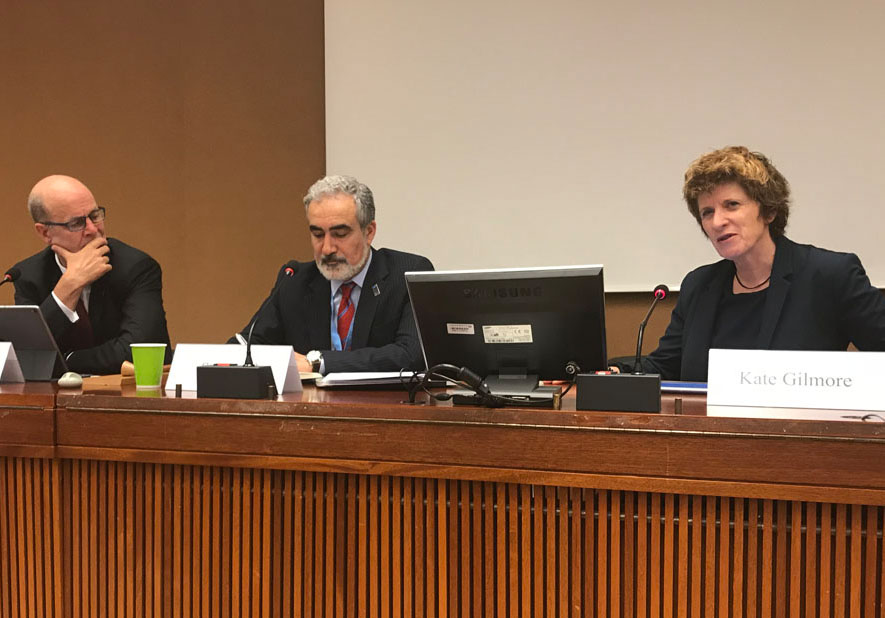
On 3 and 4 May 2018, the ICJ supported by UNAIDS and OHCHR convened an expert meeting on global principles addressing criminalization’s detrimental impact in the areas of sexuality, reproduction, drug use and HIV.
The expert meeting of leading jurists from around the globe aimed at laying the foundations for a set of principles to address the misuse and abuse of the criminal law and its detrimental impact on health, equality and human rights.
The expert group focused on the criminalization of conduct relating to four principal areas: sexuality, reproduction, personal drug use, and the overly broad criminalization of HIV exposure, transmission and non-disclosure.
In these areas, international human rights authorities, as well as domestic courts, have regularly found criminal law provisions to be contrary to international law and standards, and to have a deleterious effect on public health.
“We need to understand why the blunt instrument of the criminal law is used against and affects real people, and why the criminal law ought not to apply in our four areas of concern. Where the criminal law is misused, that is a betrayal of the rule of law. The rule of law must be our guiding compass,” said Justice Cameron, Constitutional Court of South Africa.
“The principles we hope to develop must facilitate the availability of tools which can impact key populations where they are in conflict with the law. They are often at risk of blackmail, stigma and discrimination. It falls on courts to make the difficult decisions. Judges can then consider legality, legitimate purpose and questions of necessity and proportionality in light of a broader understanding of the human rights principles at stake and the relevant scientific evidence,” said Judge Mbaru, Industrial Court of Kenya.
“The law is required to guarantee rights but at same time it can impose arbitrary restrictions. Often those restrictions in the form of the criminal law purport to be necessary in order to ‘protect’ people. That purported purpose ought to be closely scrutinised,” said Justice Ortiz, Constitutional Court of Columbia.
Sam Zarifi, Secretary General of the ICJ, stated: “The misuse of the criminal law affects the most marginalized groups of people and, in particular, the dispossessed and disenfranchised.”
“The centrality of the rule of law at a time when it is under threat globally, and our crucial obligation to stand against laws that are arbitrary, unequal and discriminatory,” he added.
Tim Martineau, Acting Deputy Executive Director of UNAIDS said: “The application of human rights principles to criminal law is key in order to address the detrimental impact of such laws in the areas of sexuality, reproduction, drug use and HIV.”
“While there was significant progress in HIV prevention, treatment and care, there was a big discrepancy in HIV prevention in relation to key populations who are more vulnerable to HIV infection in many respects because of a lack of legal protection, and the unjust criminalization of their behaviour,” he added.
Kate Gilmore, Deputy High Commissioner for Human Rights, stated that the criminal law can readily become a tool of repression or oppression. She said: “Wrongful deployment of criminal law betrays universal human rights standards. By eroding rather than protecting physical and mental integrity specifically in the contexts of sexuality, reproduction and gender identity, misuse of criminal law seeks a wrongful “regulation” of the body of women in particular, with devastating consequences for women’s and girls’ autonomy, health and well being.”
She emphasized that “the criminal law plays an essential role in the recognition, protection and enforcement of rights including by tackling impunity for violations for those rights.”
ICJ, UNAIDS and OHCHR consider that the envisaged principles will help legislators, judges and advocates in the development and review of criminal laws that have adverse consequences on health, equality and human rights particularly where they relate to key populations.
Mar 22, 2018 | Advocacy, Non-legal submissions
The ICJ today highlighted at the UN the need for further action to address impunity in Sri Lanka and in Colombia.
The statement, delivered in a general debate at the UN Human Rights Council, responded to UN reports on Sri Lanka and Colombia, and read as follows:
Sri Lanka has not made sufficient progress on its commitments and obligations as reflected in Council resolution 30/1. Among the mechanisms contemplated, only the Office on Missing Persons (OMP) is operational. The process for establishing the other mechanisms, and the extent to which their composition will be based on the broad national public consultations carried out in 2016, remains unclear. The ICJ reiterates that, in line with operative paragraph 6 of resolution 30/1, the accountability mechanism cannot be seen as credible without involvement of international judges, prosecutors and investigators.
Furthermore, despite promises to repeal the Prevention of Terrorism Act (PTA), arrests still take place. As the High Commissioner recommended, the PTA should be promptly repealed without waiting for replacement legislation. Any proposed counterterrorism law must comply with international human rights standards.
In Colombia, the ICJ shares OHCHR’s deep concern about the exclusion of non-military State agents and private individuals from the scope of mandatory application of the Integrated System of Justice, Truth, Reparations and Guarantees of Non-repetition (per paragraph 90 of the Report). Furthermore, four months of unjustified delay by the Government in accrediting the new representative of the OHCHR Office, which ended only yesterday, undermined the ability of the Office to provide adequate technical assistance to guarantee victims’ rights in the Integrated System, as provided for by the Peace Agreement.”
[Paragraph 6 of Human Rights Council resolution 30/1 provides that the Council, “Welcomes the recognition by the Government of Sri Lanka that accountability is essential to uphold the rule of law and to build confidence in the people of all communities of Sri Lanka in the justice system, notes with appreciation the proposal of the Government of Sri Lanka to establish a judicial mechanism with a special counsel to investigate allegations of violations and abuses of human rights and violations of international humanitarian law, as applicable; affirms that a credible justice process should include independent judicial and prosecutorial institutions led by individuals known for their integrity and impartiality; and also affirms in this regard the importance of participation in a Sri Lankan judicial mechanism, including the special counsel’s office, of Commonwealth and other foreign judges, defence lawyers and authorized prosecutors and investigators;”]
Mar 19, 2018 | Advocacy, Non-legal submissions
The ICJ spoke at the UN today on concerns about a resurgence of communal violence, and a failure to implement reconciliation and justice mechanisms, in Sri Lanka.
The statement, made during the adoption of the outcome of the Universal Periodic Review for Sri Lanka by the Human Rights Council, read as follows:
“The International Commission of Jurists (ICJ) welcomes the report of the Working Group on the Universal Periodic Review (UPR) on Sri Lanka.
Sri Lanka has stated that it maintains zero tolerance for hate speech and religious violence, and that the National Human Rights Action Plan 2017–2021 contains a firm commitment to enforce section 3(1) of the ICCPR Act. The ICJ further notes that a circular was issued requiring all police officers to take immediate action in this regard. Despite these commitments, recent events demonstrate renewed conflict owing to communal violence directed at the Muslim minority. A state of emergency was proclaimed on 6 March following inaction from law enforcement, and its inability to contain the violence, and emergency regulations were in operation until yesterday.
The ICJ urges the government to demonstrate through action, its willingness bring to account those who have incited communal violence, in line with the ICCPR Act and the commitments conveyed by His Excellency the Ambassador here today. Pervading impunity has emboldened perpetrators to incite violent hatred publicly. Justice must follow recent arrests, ensuring impartial and effective investigations and trials, in line with human rights.
The ICJ also notes the limited progress made on implementing HRC resolution 30/1. Of the reconciliation mechanisms promised, only the Office on Missing Persons is operational. There is little transparency with regards to the other proposed mechanisms (including the mechanism on accountability with involvement of international judges, prosecutors and investigators), or in relation to repeal and replacement of the Prevention of Terrorism Act. Any new counterterrorism law must comply with international human rights standards, and we welcome the Ambassador’s affirmation of the Government’s commitment to this today.
The ICJ urges Sri Lanka to accept and implement all relevant UPR recommendations without delay, before the opportunity for reform may be lost.”
Video of the ICJ statement is available here:
Video of the opening presentation by H.E. the Ambassador of Sri Lanka is available here:
Mar 19, 2018 | Advocacy, Non-legal submissions
The ICJ today delivered an oral statement at the UN calling on Pakistan to amend or repeal blasphemy laws, end military trials of civilians, and take effective measures against impunity.
The statement was delivered during the adoption of the Universal Period Review Outcome for Pakistan, at the UN Human Rights Council. It read as follows:
“The International Commission of Jurists (ICJ) regrets that Pakistan has not supported recommendations related to amending its blasphemy laws, ensuring its counter-terrorism measures are compatible with human rights, and combatting impunity for serious human rights violations.
Pakistan’s blasphemy laws are frequently misused; blatantly discriminate against minority religions and sects; infringe upon the rights to freedom of expression and religion; and give rise to serious fair trial concerns. The Government has failed to amend them in accordance with its international law obligations.
In January 2015, Pakistan empowered military courts to try people accused of terrorism-related offences. The ICJ has documented serious fair trials violations in the operation of military courts including: denial of the right to counsel of choice; failure to disclose the charges against the accused; denial of a public hearing; and a very high number of convictions based on ‘confessions’ without adequate safeguards against torture and other ill-treatment.
The Government has also failed to take steps to combat impunity for serious human rights violations such as extrajudicial killings, enforced disappearances, and torture and other ill-treatment, which are facilitated by laws such as the Actions (in aid of civil power) Regulation and other national security legislation.
Despite repeated commitments to do so, Pakistan has also not enacted legislation to recognize torture or enforced disappearance as a distinct, autonomous offence in its penal code.
The ICJ therefore urges the Government to reconsider, accept and implement UPR recommendations to:
- Ensure that military courts have no jurisdiction over civilians, including for terrorism-related offences;
- Repeal or amend all blasphemy laws, in line with international standards; and
- Ensure all perpetrators of serious human rights violations – including enforced disappearance and extrajudicial killings –are brought to justice.”
Video of the ICJ statement is available here:
Mar 15, 2018 | Advocacy, Non-legal submissions
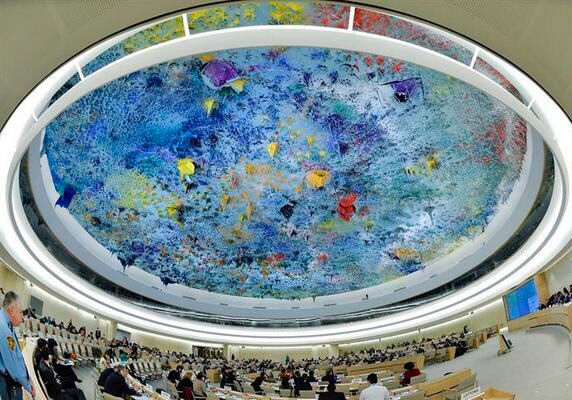
The ICJ today spoke at the United Nations on impunity and the situation for human rights in Peru.
The oral statement was made during the discussion at the Human Rights Council of the Universal Periodic Review outcome for Peru. It read as follows (translation from the original Spanish):
“Mr President,
The International Commission of Jurists (ICJ) recognizes the progress made by the Peruvian State in the field of human rights and its openness in relation to the recommendations made in the current cycle of the Universal Periodic Review.
The ICJ regrets, however, that the investigation and punishment of those responsible for the serious human rights violations that occurred during the internal armed conflict have not received the attention they deserve. On the contrary, the fight against impunity has receded with the granting of pardon and presidential grace to former president Alberto Fujimori who was serving a prison sentence for a series of crimes against humanity committed during his term. The presidential grace grants immunity from investigations and prosecutions in course or to be opened in the future.
One of the recommendations (111.97) that Peru accepts with qualifications refers to investigations and reparations to the thousands of women who suffered forced sterilization during the Fujimori administration. The measures of pardon and grace granted would exonerate Fujimori from investigation and punishment for this and other serious crimes. The ICJ urges the Peruvian State to implement the recommendations of the international community with full respect for international standards that prohibit impunity for serious violations of human rights.
Thank you Mr President.”
The ICJ oral statement complements a related written statement by the ICJ at the session.