Feb 28, 2020 | Advocacy, Non-legal submissions
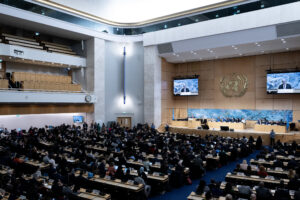
At the UN Human Rights Council, the ICJ today urged renewed international action to ensure justice and accountability for crimes under international law in Sri Lanka.
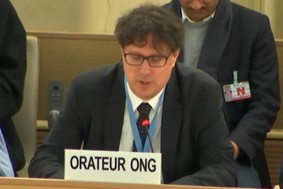
The statement, delivered during a discussion of updates and reports from the High Commissioner for Human Rights, read as follows:
“The ICJ deeply regrets the Sri Lankan Government’s withdrawal of support for the process under resolutions 30/1 and 40/1. ICJ supports the joint statement read by IMADR.
The Sri Lankan legal system and judicial institutions have for decades demonstrated a chronic inability to address systemic and entrenched impunity for crimes under international law perpetrated by the military and security forces.[1] The new President’s promises to protect the military from accountability, and senior command appointments of individuals credibly accused of crimes under international law, only deepen the concern.
As the High Commissioner notes,[2] the failure to deal comprehensively with impunity and to reform institutions may lead to more human rights violations.
The Tamil population have consistently and rightly rejected any reconciliation process that ignores justice and accountability, and it is obvious that no justice or accountability process that is left to domestic Sri Lankan institutions alone can be credible. The compromise national-international “hybrid” judicial accountability mechanism foreseen by resolution 30/1 already fell far short of what the situation actually warrants.
If the Government seeks now to abandon even that compromise, purely international processes, whether before the ICC or through creation of another international accountability mechanism by the Council, and the exercise of universal jurisdiction by other States, are the only remaining options for securing the justice required by international law and indispensable to any credible reconciliation process for Sri Lanka.”
[1] International Commission of Jurists, Authority without Accountability: The Crisis of Impunity in Sri Lanka, 2012, https://www.icj.org/sri-lanka-new-icj-report-documents-crisis-of-impunity/; Human Rights Council must respond to ongoing failure of Sri Lankan justice system to ensure accountability for human rights violations, 2014, https://www.icj.org/human-rights-council-must-respond-to-ongoing-failure-of-sri-lankan-justice-system-to-ensure-accountability-for-human-rights-violations/; Sri Lanka: the need for an international inquiry, 2014, https://www.icj.org/sri-lanka-the-need-for-an-international-inquiry/; Sri Lanka: Joint Open Letter to the Ambassadors of UN Human Rights Council Member States, 2015, https://www.icj.org/wp-content/uploads/2015/07/SriLanka-JointOpenLetter-Accountability-Advocacy-2015.pdf; Sri Lanka’s victims demand and deserve credible justice, 2016, https://www.icj.org/sri-lankas-victims-demand-and-deserve-credible-justice/.
[2] UN Doc A/HRC/43/19, para 36.
Feb 27, 2020 | Events, News
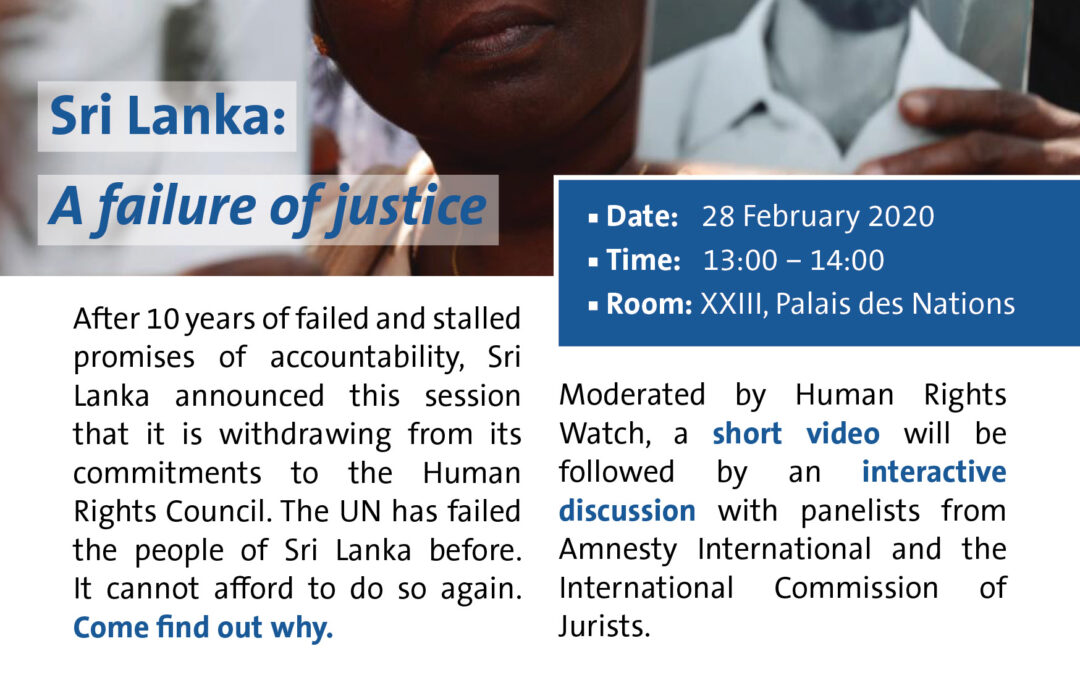
An event at the UN Human Rights Council on 28 February will highlight the continuing failure of Sri Lanka to secure justice for crimes under international law, and discuss ways forward for international efforts to fill the gap.
The event will take place 28 February 2020, 13:00 – 14:00, in Room XXIII of the Palais des Nations in Geneva.
It will be moderated by Human Rights Watch, with a short video will be followed by an interactive discussion with panelists from Amnesty International and the International Commission of Jurists.
A flyer for the event can be downloaded in PDF format here: HRC43 – Sri Lanka
Jan 25, 2020 | News
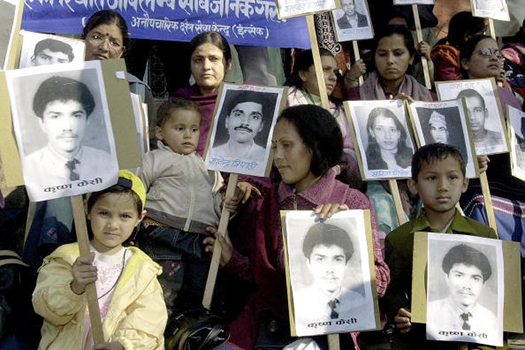
Recent steps taken by the government are a serious setback on Nepal’s transitional justice process, the ICJ, Amnesty International, Human Rights Watch and TRIAL International said today.
The organizations expressed concern about the decision to appoint commissioners to the two transitional justice commissions without adequate consultations, and without amending the legal framework to make it consistent with international human rights law and Supreme Court of Nepal rulings.
“Nepal’s political leaders know that a transparent process is essential to ensure justice and accountability for egregious rights violations during the conflict, but they keep trying to protect those responsible for the abuses,” said Meenakshi Ganguly, South Asia director at Human Rights Watch. “If the political leadership continues to evade responsibility, they leave little choice but for victims to approach courts outside the country.”
On January 18, 2020, a five-member committee formed by the government to recommend names for commissioners for the Truth and Reconciliation Commission (TRC) and the Commission on the Investigation of Enforced Disappeared Persons (CIEDP) submitted its nominations. The committee sent the names forward despite longstanding demands by victims’ groups and civil society for the government to first amend the transitional justice legal framework to ensure that it complies with Nepal’s international obligations and is responsive to victims’ concerns.
Instead, the Ministry of Law, Justice and Parliamentary Affairs on January 13 hastily convened provincial consultations on the transitional justice laws lasting just three hours, which allowed little time for meaningful participation by victims’ groups and civil society.
“The government’s decision to carry out another rushed and secretive set of consultations fails to give due respect to the long-standing demands of victims and civil society,” said Frederick Rawski, ICJ’s Asia-Pacific Director. “It also makes it very difficult to take seriously the statements of political leaders that they are committed to supporting a victim-centred and human rights compliant process.”
Victims’ groups and human rights organizations have rejected these appointments and consultations, and have reiterated that they will not support a transitional justice process that is opaque, non-consultative, and undermines the victims’ right to truth, justice and reparations.
In addition, in its secretariat meeting earlier this week, the Nepal Communist Party (NCP) nominated Agni Sapkota as the speaker of the Federal Parliament. Sapkota, a member of parliament and the party standing committee, has been accused of responsibility for the abduction and killing of Arjun Lama in 2005 in Kavre. The case is the subject of proceedings including before the Supreme Court of Nepal.
NCP should reconsider Sapkota’s nomination as speaker of the parliament until there is a thorough and independent investigation, the organizations said.
“Nepal authorities should not appoint to high office people that are under investigation for human rights abuses, when they could interfere with that investigation,” said Audrey Oettli, Program Manager at TRIAL International. “Such appointments are yet another illustration of the government’s unwillingness to demonstrate a basic commitment to holding perpetrators of conflict-era rights abuses accountable.”
In March 2008, the Supreme Court directed the police to register a case against Sapkota for abducting and killing Lama and to carry out an investigation. The police did not comply. In 2010, Australia and the US rejected visa applications from Sapkota in light of the allegations of serious human rights violations.
When Sapkota was appointed information communication minister in May 2011, the UN Office of the High Commissioner for Human Rights issued a statement expressing concern, saying that states have a responsibility “to ensure that the name of a person is fully cleared following a thorough investigation before any appointment to a high public office is announced.”
The ICJ, Amnesty International, Human Rights Watch and TRIAL International have repeatedly expressed concern about the transitional justice process. An effective transitional justice system requires strong legal foundations consistent with international law and standards, and the political will to address the demands of victims of the conflict, the organization said.
Concerns raised about the legal framework include: disparities between the definitions of specific crimes under international law and human rights obligations and violations under national, and international law; inadequate provisions to ensure that serious crimes under international law are subject to criminal accountability, including punishment proportionate to the seriousness of the crimes; and a reliance on compensation at the expense of other forms of reparation and remedy for conflict survivors and their families.
The government should amend the the 2014 Transitional Justice Act to make it consistent with the Supreme Court’s rulings and international human rights standards, the groups said. It should initiate a genuine consultative and transparent process for the appointment of commissioners. And it should conduct credible and impartial investigations instead of appointing people accused of conflict-era crimes to high public offices.
“The government and the political parties in Nepal are increasingly showing that they are unwilling and incapable to deliver truth, justice and reparations to the conflict victims domestically,” said Biraj Patnaik, South Asia Director at Amnesty International. “Their signal of impunity will further push the victims and activists to seek justice internationally under universal jurisdiction. Instead of putting those suspected of criminal responsibility into positions of power, the government should bring them to justice in fair trials.”
To download the statement in Nepali, click here.
Contact
- Frederick Rawski, ICJ Asia-Pacific Director, e: frederick.rawski(a)icj.org, +66 644781121
- Biraj Patnaik, Amnesty International, South Asia Director, e: biraj.patnaik(a)amnesty.org, t: +94 716123280
- Meenakshi Ganguly, HRW, South Asia Director, e: gangulm(a)hrw.org
- Audrey Oettli, TRIAL International, Program Manager, e: a.oettli(a)trialinternational.org
Dec 15, 2019 | Advocacy, Non-legal submissions
The ICJ has urged the UN Special Rapporteur on Independence of Judges and Lawyers to ensure that his upcoming report on challenges to the independence of prosecutors, fully addresses abuse of prosecution powers to target human rights defenders, political opponents or others, or giving rise to a more general and systemic lack of fair trial for accused persons, or entrenching impunity of State perpetrators of human rights violations, as among the dominant contemporary challenges to prosecutorial independence globally from a human rights perspective.
The Special Rapporteur has made clear his intention to address challenges to prosecutorial independence arising from transnational corruption and organized crime. While the ICJ certainly agrees that such interference can and does have impacts on human rights, to varying extents around the world, the ICJ submission also highlights and documents that threats to prosecutorial independence emanating from the prosecutor’s own Executive government should be seen to be of at least equal concern from a human rights perspective, globally, and should be fully addressed in any report on “contemporary challenges of prosecutorial independence” from a human rights perspective.
The ICJ’s submission can be downloaded in PDF format here: UN-Advocacy-SRIJLProsecutors-2019
Dec 10, 2019 | News
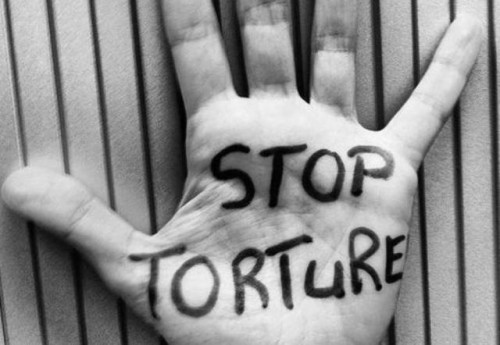
The pervasive practice of torture and other ill treatment can only be addressed if the States in the region ensure perpetrators are held accountable in line with international standards, said lawyers and activists from Bangladesh, India, Nepal, Pakistan and Sri Lanka.
The call came at a regional conference on the investigation and prosecution of torture and other ill treatment in South Asia, organized by the ICJ ahead of Human Rights Day.
“Governments in South Asia have done very little to support the victims and survivors of torture and other ill treatment, or to ensure their rights to truth, justice and reparation,” said Frederick Rawski, ICJ’s Asia Director.
“Despite the persistence of the practice, Governments have failed to follow their legal obligation to treat these crimes as the serious human rights violation they are,” he added.
Torture and other ill treatment are prevalent in South Asia, and in some countries widespread and systematic, with perpetrators enjoying impunity for the crime.
According to the ICJ, States in the region continue to deny the pervasiveness of torture, use torture as a deliberate tool to control and punish dissent, fail to enact specific legislation to criminalize torture, and where a special law exists, fail to implement it in good faith.
Consequently, there have been few concerted efforts to hold perpetrators of torture and ill treatment to account.
All too often, perpetrators get away with only disciplinary sanctions, and even when prosecutions happen, they do not result in convictions and commensurate penalties.
Suspects are often lower or middle-ranking public officials rather than their superiors, who are charged with lesser crimes than torture, such as assault, battery, coercion or abuse of office that carry relatively low punishments.
Prosecutions frequently fail because of the difficulties to prove torture, including securing witnesses for the prosecution, inadequate or conflicting medical evidence as well as threats of reprisals influencing victims and witnesses.
Even when such hurdles are overcome, immunities that protect public officials from prosecutions allow perpetrators to escape accountability.
Furthermore, military and intelligence agencies have extensive and unaccountable powers, including for arrest and detention, which facilitate the practice of torture and other ill treatment.
Under international law, States must ensure protection against torture and other cruel, inhuman or degrading treatment or punishment.
Whenever there are reasonable grounds to believe that torture has been committed, States are required to investigate allegations competently, impartially, independently, promptly and thoroughly.
While a comprehensive set of reforms, both in law and policy, is required to prevent and combat torture and other ill treatment – ensuring accountability for perpetrators would be a first step, said the ICJ.
Contact:
Frederick Rawski (Bangkok), ICJ Asia Pacific Regional Director, e: frederick.rawski(a)icj.org
Reema Omer, ICJ International Legal Adviser for South Asia (Lahore), t: +923214968434; e: reema.omer(a)icj.org