Oct 3, 2019 | News
Today, ICJ and the Defender Center for Human Rights (DCHR) filed a submission to the Human Rights Council’s Working Group on the Universal Periodic Review in advance of its review of Libya’s human rights record in May 2020.
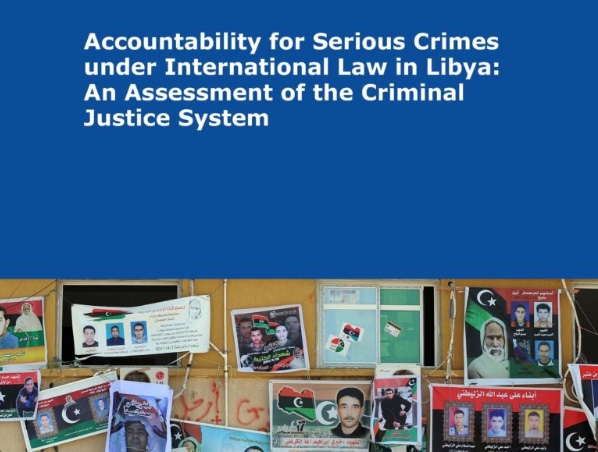
Information provided in the submission was based on the ICJ report titled Accountability for Serious Crimes under International Law in Libya: an Assessment of the Criminal Justice System, published in July 2019.
In the submission, the ICJ and DCHR drew the attention of the Working Group on the UPR to the following concerns with respect to Libya:
- Impunity for crimes under international law committed by State and non-State actors;
- The insufficient penalization of crimes under international law;
- The lack or inadequacy of investigations and prosecutions of crimes under international law;
- The systemic failure to guarantee the right to liberty and fair trial rights at pre-trial and trial stages.
The ICJ and DCHR called on the Working Group and the Human Rights Council to urge the Libyan authorities to take the following actions:
With regard to insufficient penalization of crimes under international law:
- Enact laws criminalizing war crimes, crimes against humanity and arbitrary deprivations of life (in particular arbitrary and summary executions) in line with international law;
- Amend Law No. 10 of 2013 to bring the definition of torture in line with the Convention Against Torture and the definition of enforced disappearance in line with the International Convention for the Protection of All Persons from Enforced Disappearance, and criminalize other acts of cruel, inhuman or degrading treatment or punishment consistent with international law;
- Amend article 425 of the Penal Code to include a definition of the crime of slavery consistent with international law;
- Amend articles 407 and 408 of the Penal Code to criminalize rape in line with international law and standards; enact laws criminalizing all forms of sexual and gender-based violence; and repeal article 424 of the Penal Code which extinguishes a conviction for rape or indecent assault and grants a stay of execution of the penalty imposed against the perpetrator if they marry the victim; and
- Amend (or repeal) Law No. 35 of 2012, Law No. 38 of 2012 and Law No. 6 of 2015 to exclude all crimes under international law from the scope of amnesties.
With regard to the obligation to independently and impartially investigate crimes:
- Amend article 3 of the Code of Criminal Procedure (CCP) to remove the requirement that an investigation can only be commenced upon the receipt of a criminal complaint, extend the three-month deadline for victims to file a complaint and remove the deadline entirely for crimes under international law and for other serious crimes under domestic law;
- Amend article 7 of the CCP to grant victims’ family members the right to file a complaint with a view to ensuring the commencement of an investigation;
- Repeal article 224 of the Penal Code to remove the power of the Minister of Justice to control and direct investigations and prosecutions by the Prosecutor’s Office; and
- Repeal Decree 388 of 2011 granting the “Supreme Security Committee” investigative powers and article 2 of Law No. 38 of 2012 permitting the use of information and evidence collected by “revolutionaries” during investigations and at trial.
With regard to the systemic failure to guarantee the right to liberty and fair trial rights at pre-trial and trial stages, amend the CCP in order to:
- Exclude the possibility of detaining an accused on the sole ground that she or he does not have a fixed place of residence;
- Set a maximum duration of pre-trial detention, and specify that any such detention should be employed as last resort only when necessary, proportionate and reasonable according to the circumstances of the case;
- Ensure that detainees are brought before an independent and impartial judicial authority promptly following arrest, and no later than 48 hours in any event;
- Include a provision recognizing the right to habeas corpus, and the right to compensation and other reparations for unlawful detention;
- Provide for the right to legal counsel from the moment of arrest in all circumstances, and repeal the provision requiring a lawyer to seek authorization from the investigating judge to speak during the interrogation of the accused;
- Require the disclosure of all evidence to the accused and allow them to make copies of the case file before a case is referred to court for prosecution; and
- Grant individuals the right to appeal any conviction and sentence on alleged errors of law and fact and to reconsideration of a conviction upon discovery of a new fact.
Download
Libya-UNHCR submission final-advocay-non legal submission-2019-ENG (submission in PDF)
Sep 26, 2019 | Events, News
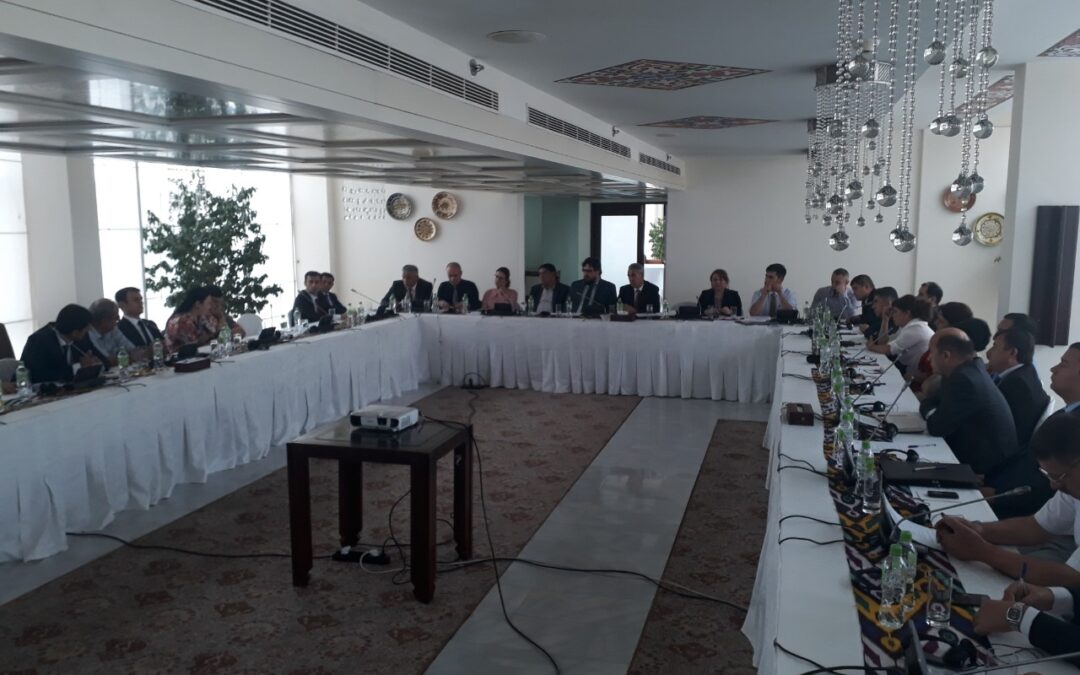
Today, the International Commission of Jurists (ICJ) in cooperation with the Civil Society Coalition Against Torture and Impunity in Tajikistan and the Union of Lawyers of the Republic of Tajikistan hold the final event within the framework of its Global redress and accountability initiative.
This event presents an opportunity to discuss measures to prevent impunity and ensure accountability for the use of torture and cruel, inhuman and degrading treatment (CIDT) in Tajikistan.
The findings of the research on the key challenges for effective investigation of torture and CIDT, carried out by the Coalition Against Torture under the initiative, will be presented at the event. The ICJ will launch its compilation of the cases decided by the UN Human Rights Committee concerning allegations of torture in Tajikistan.
Background information:
The ICJ’s Global redress and accountability initiative focused on seven countries (Cambodia, Mozambique, Myanmar, Nepal, Tajikistan, Tunisia and Venezuela) and it aimed to combat impunity and promote redress for gross human rights violations.
It concentrates on the transformative role of the law, justice mechanisms and justice actors, seeking to achieve greater adherence of national legal and institutional frameworks with international law and standards so as to allow for effective redress and accountability; more independent justice mechanisms capable of dealing with challenges of impunity and access to redress; and judges, lawyers, human rights defenders, victims and their representatives that are better equipped to demand and deliver truth, justice and reparation.
Agenda here.
Sep 25, 2019 | Advocacy, Non-legal submissions
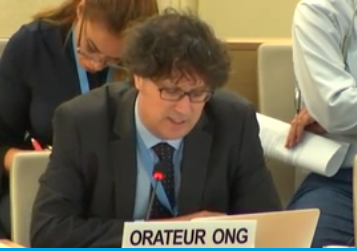
The ICJ today highlighted the need for a Commission of Inquiry or similar accountability mechanism for Libya, at the UN Human Rights Council in Geneva.
The call came in an oral statement, delivered during an interactive dialogue on Libya. It read as follows:
“The International Commission of Jurists (ICJ) welcomes the oral update by the High Commissioner for Human Rights on the situation in Libya.
Violations and abuses under international human rights, humanitarian and refugee law are being committed by State and non-State actors on a widespread and systematic scale in Libya, including since the resurgence of conflict in April. As noted by the High Commissioner on 9 September 2019, the human rights and potentially lives of migrants “intercepted by the Libyan Coast Guard and forcibly returned to Libya … are [also] under serious threat.”
Despite the scale of violations and abuses, only a handful of criminal investigations and prosecutions have been undertaken, resulting in near-total impunity.
A recent ICJ report on the criminal justice system in Libya found that the domestic legal framework governing investigations and prosecutions does not meet international law and standards on the right to a fair trial, the right to liberty and the prohibition on torture and other ill-treatment. As a result, any domestic investigation or prosecution is unlikely to satisfy the requirements of fair and effective justice. Moreover, most crimes under international law, including war crimes and crimes against humanity, are not penalized in domestic law.
These findings undercut the presumption relied upon by States in their engagement with Libya that the Libyan authorities can ensure accountability for crimes under international law.
To fill the accountability gap, the ICJ urges the Human Rights Council to establish a Commission of Inquiry or similar mechanism to document and report on gross human rights violations and to collect and preserve evidence of crimes for future criminal proceedings.
States should also refrain from entering into or implementing agreements with Libyan authorities that could give rise to support for or complicity in violations of international law.”
Sep 16, 2019 | Events, News
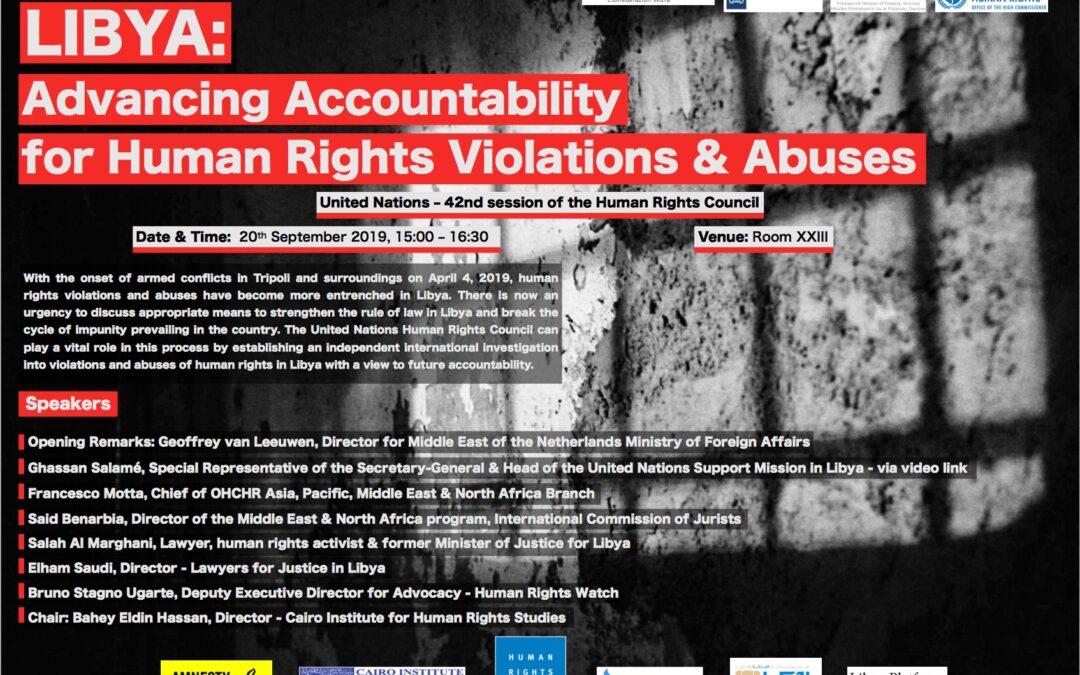
The ICJ, together with the Netherlands, Finland and Swiss missions to Geneva, OHCHR and other NGOs invite you to a panel discussion on Advancing accountability for human rights violations and abuses in Libya at the UN Human Rights Council in Geneva.
The event takes place on Friday 20 September 2019, at 15:00 – 16:30, Room XXIII, in the Palais des Nations.
With the onset of armed conflicts in Tripoli and surroundings on April 4, 2019, human rights violations and abuses have become more entrenched in Libya. There is now an urgency to discuss appropriate means to strengthen the rule of law in Libya and break the cycle of impunity prevailing in the country. The United Nations Human Rights Council can play a vital role in this process by establishing an independent international investigation into violations and abuses of human rights in Libya with a view to future accountability.
The event will be opened by Geoffrey van Leeuwen, Director for Middle East of the Netherlands Ministry of Foreign Affairs, moderated by Bahey Eldin Hassan, Director of the Cairo Institute for Human Rights Studies, and feature:
–Elham Saudi, Director – Lawyers for Justice in Libya
–Ghassan Salamé, Special Representative of the Secretary-General & Head of the United Nations Support Mission in Libya – via video link
–Francesco Motta, Chief of OHCHR Asia, Pacific, Middle East & North Africa Branch
–Said Benarbia, Director of the Middle East & North Africa program, International Commission of Jurists
–Salah Al Marghani, Lawyer, human rights activist & former Minister of Justice for Libya
–Bruno Stagno Ugarte, Deputy Executive Director for Advocacy – Human Rights Watch
A flyer for the event is available here.
Jul 19, 2019 | News, Op-eds
An opinion piece by Emerlynne Gil, Senior Legal Adviser, ICJ Asia-Pacific Programme.
Last week, the UN Human Rights Council adopted a resolution expressing concern over the human rights situation in the Philippines. It specifically expressed grave concern over the killings and disappearances arising from the drug war of the current administration.
Since 2016, when the government began its campaign against illegal drugs, there have been reports of thousands of killings of people who were allegedly involved in the drug trade and drug use.
Furthermore, in the recent report of Lawyers Rights Watch Canada (LRWC), there have been more than 40 lawyers killed under the current administration.
The resolution was, in fact, restrained in tone and content. Human rights groups like the ICJ had hoped that it would establish an international mechanism to investigate the killings and other human rights violations.
However, the Council held back and merely urged the Philippine government to “take all necessary measures to prevent extrajudicial killings and enforced disappearances”.
It also asked the Philippine government “to cooperate with the Office of the High Commissioner on Human Rights” and other international human rights mechanisms, and requested the UN High Commissioner for Human Rights to present a report to the Council for discussion in June 2020.
The Philippine government sent a big delegation to Geneva to lobby against the adoption of any resolution. During the informal consultations among States on this resolution, there were theatrics from the delegation, which walked out during the first consultation.
At the second consultation, nobody from the delegation attended, but former Ambassador Rosario Manalo, who also previously represented the Philippines in the ASEAN Intergovernmental Commission on Human Rights (AICHR), and is now a member of the UN Committee on the Elimination of Discrimination against Women, was present.
Purporting to speak as a ‘human rights defender’, she launched an angry tirade against Iceland as the sponsor of the resolution and the other States who supported it.
She also called the Filipino human rights defenders in the room who were seated right next to her as ‘treacherous’, and accused them of peddling lies about the country.
The theatrics in Geneva did not serve the Philippine government well. In the end, the Council voted to adopt the resolution.
Now that it has been adopted, what does this mean for Filipinos? The UN Human Rights Council, like any international human rights body, has significantly limited ability to directly protect human rights on the ground.
Thus, while it has adopted this resolution, the Council will not have the power to actually stop the unlawful killings and other human rights violations being committed. The Council will be unable to compel the implementation of the recommendations in any resolution it adopts, where a State is unwilling to cooperate.
Hence, the Philippine government still holds the discretion on whether or not to implement the recommendations made by the Council.
This is where ordinary Filipinos come in. The people – as the eyes and ears on the ground – are indispensable to the work of international human rights bodies like the Human Rights Council.
The effectiveness of the Council in protecting human rights on the ground greatly relies upon the extent to which the people on the ground – including human rights defenders – are able to engage and work with them.
The information provided by the general public regarding the situation on the ground is very important to the work of international human rights mechanisms like the Council. This information gives these mechanisms a clearer and more accurate picture of the human rights situation in the country.
We should thus not be silent. We should continue pressing the government to implement the recommendations in this resolution. The key recommendation is that the government should investigate extrajudicial killings and enforced disappearances and hold the perpetrators accountable.
In its formal statement to the Council after adoption of the resolution a few days ago, the representative of the Philippine government at the Council vigorously claimed that the country has ‘fully functioning domestic accountability mechanisms’, ignoring the fact that authorities have been unwilling or unable to conduct effective investigation or prosecutions for any of the numerous allegations of unlawful killings.
Hence, we should press the government to demonstrate that its claim that domestic accountability mechanisms are functioning is true, and that it should then use these mechanisms by investigating the killings and disappearances and punishing the perpetrators.
It is a welcome development that the Human Rights Council passed this resolution on the human rights situation in the Philippines.
But the work does not end there. There is a symbiotic relationship between the actions of the people on the ground and the work of international human rights mechanisms like the Council.
It is now left to us to press our government for the implementation of the recommendations in the resolution.