Dec 7, 2015 | News
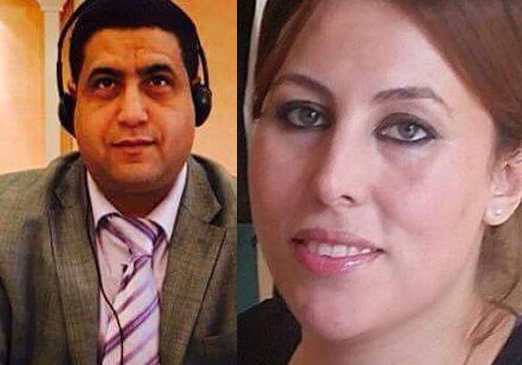
The ICJ today called on the Moroccan authorities to put an immediate end to the disciplinary proceedings initiated against judges Amal Homani and Mohamed Al-Haini.
The two were referred to the High Judicial Council by the Minister of Justice on unfounded allegations of “violating the duty of discretion” and “expressing opinions of a political nature”.
The charges stem from social media comments and media articles written by the judges in which they criticized the government’s Draft Law No. 100.13 on the Conseil Supérieur du Pouvoir Judiciaire and the Draft Law No 106.13 on the Statute for Judges, including provisions that appear designed to maintain executive branch control of the judiciary and the career of judges.
“Instead of subjecting judges who are promoting the rule of law and judicial independence to unjustified and arbitrary disciplinary proceedings, the Moroccan authorities must comply with their obligations under international standards to guarantee, protect and preserve judicial independence,” said Said Benarbia, Director of the ICJ Middle East and North Africa Programme.
“The disciplinary proceedings against judges Amal Homani and Mohamed Al-Haini are clearly without foundation and must be immediately and unconditionally terminated,” he added.
International standards are clear: members of the judiciary are, like other citizens, entitled to freedom of expression, belief, association and assembly.
The exercise of these basic human rights in a manner that preserves the dignity of their office and the impartiality and independence of the judiciary should not constitute a disciplinary offence, the ICJ says.
The social media comments and media articles by judges Amal Homani and Mohamed Al-Haini were clearly within the scope of their rights to freedom of expression, the Geneva-based organization adds.
Under the current legal framework, in particular Law No.1-74-467 of 1974 on the Statute for Judges, the Ministry of Justice has comprehensive and effective control over the entire judiciary, including the High Judicial Council, the career of judges and judicial administration.
Indeed, under the current framework, the Minister of Justice is the Vice-President of the High Judicial Council.
As such the impartiality and fairness of any disciplinary hearings initiated by the Minister of Justice based on statements perceived to criticize the executive branch, must be called into question, the ICJ says.
While provisions of the 2011 Constitution relating to the judiciary constitute an important step towards ending the executive’s control over the judiciary, Moroccan professional associations of judges and civil society organizations have expressed concern that the draft laws perpetuate such control as well as executive interference in judicial matters.
The ICJ has previously called on the Moroccan authorities to revise the two flawed draft laws to ensure their full compliance with international law and standards on judicial independence.
“The Moroccan authorities must end their attacks on judicial independence, including by revising flawed institutional and legal reforms and by ending politicized proceedings against judges,” Benarbia said.
Contact:
Theo Boutruche, Legal Adviser of the ICJ Middle East and North Africa Programme, tel: +961 70 888 961, e-mail: theo.boutruche(a)icj.org
Morocco-Judges Homani-El Haini-News-Press releases-2015-ARA (full press release in PDF, Arabic)
Nov 25, 2015 | News
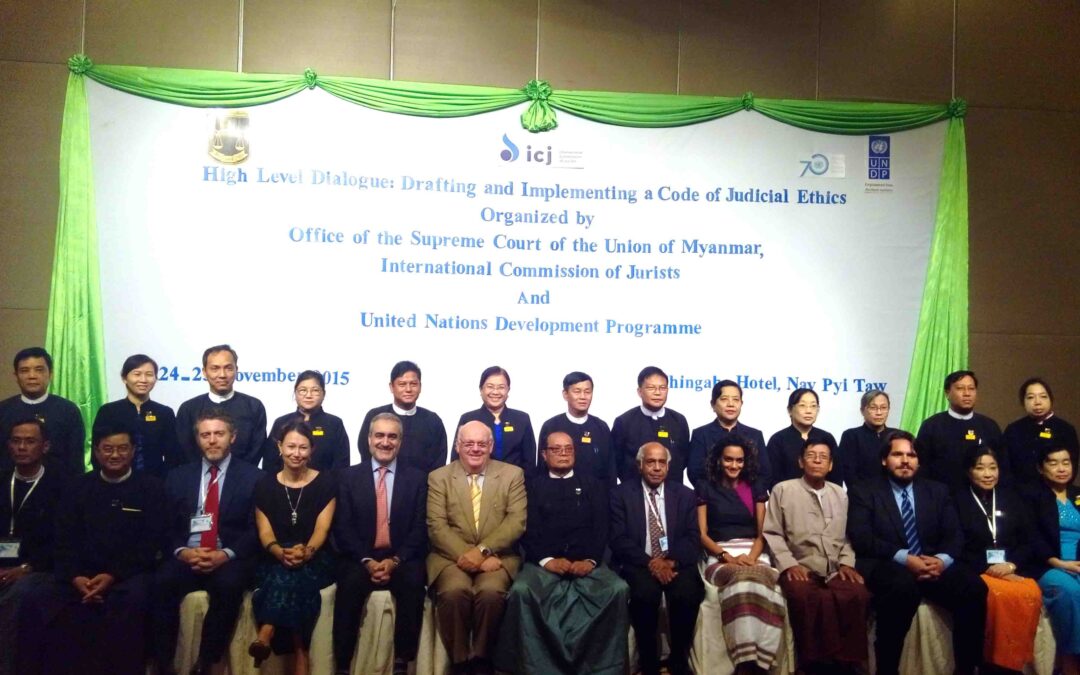
The ICJ, the UNDP and the Office of the Supreme Court of the Union (OSCU) held a High Level Dialogue on “Drafting and Implementing a Code of Judicial Ethics” in Nay Pyi Taw on 24-25 November 2015.
This followed on a commitment by the OSCU to create a new code and to work together with the ICJ and UNDP to ensure it is informed by and implemented in accordance with international best practice.
The Judicial Ethics Review Committee, Regional High Court Judges and other senior court administrators participated in the Dialogue.
The participants and their international counterparts from the ICJ and UNDP discussed the content of the Draft Code of Ethics, international standards on Judicial Codes of Ethics and accountability mechanisms.
In opening the Dialogue, the Honourable Supreme Court Justice of the Union, U Mya Thien explained that the new code reflecting international standards would enhance public trust and promote accountability in the Judiciary.
In his opening remarks, Sam Zarifi, the ICJ’s Regional Director for Asia and the pacific noted the historic occasion in which the world was watching transition in Myanmar.
During the Dialogue, former ICJ Commissioner and UN Special Rapporteur on the Independence of Judges and Lawyers, Dato Param Cumaraswamy, and Justice Murray Kellum of Australia shared their wealth of experience developing codes of ethics and accountability mechanims at the national and international levels.
Both explained that public perception of the Judiciary is key in a transition to the rule of law and human rights.
All participants agreed the Myanmar’s judiciary is not yet independent and that its current judicial code of ethics requires updating.
It was acknowledged that new code of ethics would develop the independence of the judiciary in Myanmar.
Sam Zarifi explained that, “in order for the Supreme Court to assert judicial independence it must demonstrate that it can hold itself accountable to a code of ethics.”
Both the UNDP and the ICJ congratulated the OSCU for following its Strategic Plan for 2015-2018 and engaging in a dialogue designed to further this process.
Both expressed willingness to continue working with Myanmar’s judiciary on the issues of judicial independence, the rule of law and human rights.
Nov 7, 2015 | News
The ICJ, Lawyers for Human Rights Swaziland (LHR(S), Lawyers for Human Rights South Africa (LHR), and Southern Africa Litigation Centre (SALC) organized a training on strategic litigation for lawyers and human rights defenders from 6-7 November 2015 in Ezulwini.
The training was intended to empower Swazi lawyers and human rights defenders with tools for legal empowerment through litigation.
Further the training provided an opportunity for introducing the participants to international, regional and domestic mechanisms for strategic litigation and analysis of strategic litigation cases, opportunities and challenges in Swaziland.
Participants were drawn from different private law firms, human rights organisations, and the office of the Attorney General and women’s rights organisations.
To nurture regional peer learning and approaches the President of the Law Society of Lesotho Advocate Shale gave the key note presentation borrowing on lessons from other regions and Lesotho.
Resources persons included David Cote (LHR), Caroline James (SALC), Otto Saki (ICJ) and Thabiso Mavuso (Swaziland).
The expected impact is that increasingly lawyers and human rights defenders will take up strategic litigation as part of contributing to the achievement of systemic change and positive enforcement of fundamental rights and freedoms.
This training was held with the generous support of the European Union (EU) through the EU Delegation to Swaziland.
Contact:
Arnold Tsunga, ICJ Regional Director for Africa, t: +27 73 131 8411, e: arnold.tsunga(a)icj.org
Mandla Mkhwanazi LHR Swaziland Chairperson, t: +268 7602 6320, e: m.z.mkhwanazi(a)swazi.net
Caroline James, Lawyer, Southern Africa Litigation Centre t: 27 72 200 1813, e: CarolineJ(a)salc.org.za
David Cote, Programme Manager: Strategic Litigation Programme, LHR (South Africa) t: +27 11 339 1960, e: david(a)lhr.org.za
Oct 15, 2015 | News
La CIJ, durante la misión de su Comisionado José Antonio Martín Pallín al país, ha constatado que la trascendencia política y social de los asuntos que el Juez Miguel Ángel Gálvez está investigando, le ha ocasionado numerosos ataques injustificados desde diversos sectores de la sociedad guatemalteca.
Además, la CIJ recibió información que las y los jueces continúan siendo amenazados en el ejercicio de su independencia por la injerencia de la Corte Suprema de Justicia en funciones administrativas, relacionadas con el control del personal, especialmente en el traslado injustificado de jueces.
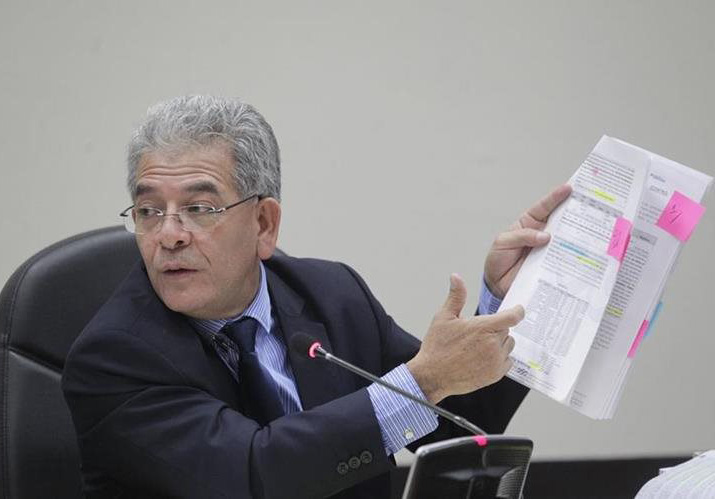
El Juez Miguel Ángel Gálvez (foto) ha afrontado riesgos de traslado en los últimos 6 meses.
La CIJ concluye que la actuación del Juez se ajusta a los principios internacionalmente admitidos del derecho al debido proceso y a las garantías de las y los sindicados.
La CIJ expresa su profunda preocupación por la acumulación excesiva de asuntos judiciales sobre el Juzgado de Competencia Ampliada del juez Gálvez, que hacen absolutamente imposible una actuación dentro de los plazos exigidos por la ley.
La CIJ demanda con toda firmeza que la Corte Suprema de Justicia tome medidas efectivas de apoyo al juzgado de Mayor Riesgo B, para que éste pueda concentrarse en la tramitación de los asuntos que verdaderamente preocupan en este momento a los ciudadanos y ciudadanas guatemaltecas, como por ejemplo el llamado Caso La Línea, el caso Sepur Zarco y el caso Siekavizza, entre otros.
La CIJ considera que ningún órgano judicial puede afrontar la pesada carga judicial a la que el Juez Gálvez tiene que hacer frente; cualquier demora en la tramitación de los asuntos pendientes ante su juzgado, no debe ser atribuida al juez Gálvez, sino a la inactividad de la Corte Suprema de Justicia, que no nombra a jueces de apoyo, que permitan tramitar las causas pendientes.
Oct 12, 2015 | News
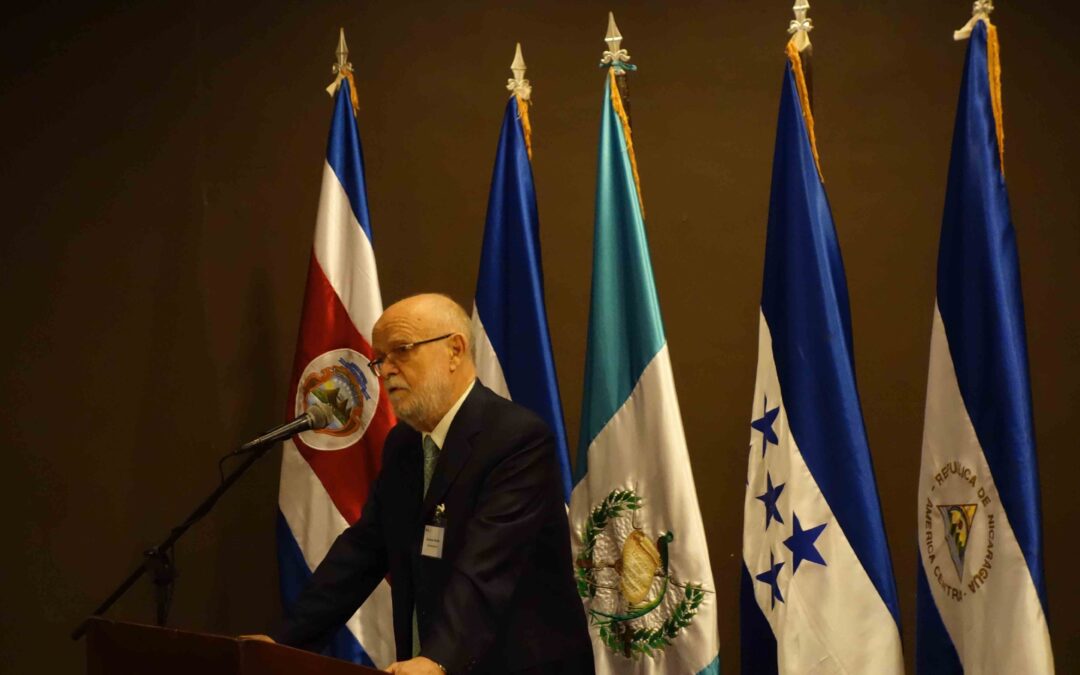
In coordination with the Norwegian Judges’ Association and the Guatemalan Mayan Bar Association, the ICJ inaugurated today a two-day Conference in Guatemala City.
The Conference was inaugurated by Jan Gerhard Lassen (the Norwegian Ambassador for Guatemala), Josué Baquiax Baquiax (President of the Supreme Court ), ICJ Commissioner José Antonio Martín Pallín and Director of the ICJ in Central America, Ramón Cadena.
The main topics of discussion were the need to strengthen the judicial career, and associationism.
Guatemala currently has only one formal judge´s association, which was identified by the speakers at the Conference as not consistently acting in the best interests of independent judges, necessitating the creation of an alternative association.
In terms of the judicial career, judges from around the region discussed the changes necessary to the law in Guatemala to ensure that judges are protected from undue pressures coming from outside, and within the judiciary.
The Conference concludes tomorrow with a public forum which will showcase the results of two forthcoming ICJ studies on judicial independence and specialized justice.