CIJL Newsletter – N°2
This newsletter informs you on recent activities and ongoing situations related to the ICJ’s work on the independence of the legal profession.
EDITORIAL
Annually the ICJ’s Centre for the Independence of Judges and Lawyers organizes the Geneva Forum for Judges and Lawyers, aiming to stimulate reflection among the international legal community on judicial independence issues and on the role of the legal profession in the protection of human rights. The 2012 Geneva Forum for Judges and Lawyers (last December) centred on the role of the domestic court in improving access to justice for victims of human rights violations. The participants reflected inter alia on ways to support and reinforce the use of international human rights norms in the domestic court.
A wide range of legal, political, socio-economic and cultural factors that influence the domestic court’s application of international human rights law were discussed. Legal knowledge and integrity emerged as crucial to the use of international human rights norms by the domestic judge. That is, it is essential to domestic proceedings judges and lawyers know well the substance of international human rights law and that they are aware of techniques to overcome real or ‘invented’ obstacles in its application, on the one hand, and that judges are willing to hear arguments based on international human rights law and comprise them in their reasoning, on the other.
Forum participants outlined three avenues to build legal capacity and stimulate judges to exercise the choice based on integrity. Firstly, both judges and lawyers require education on human rights law; moreover, this training should not be limited to one specific course on international human rights law, but be integrated into criminal law and other courses too. Next, participants adhered much value to the “inter-judicial dialogue”, which allows judges to exchange views and get acquainted with foreign decisions they can use to support their own reasoning. Lastly, this dialogue can be turned into pressure, as judges generally wish to be respected by their peers and accordingly will be more reluctant to exercise the choice that lacks integrity, if they are aware their colleagues are watching.
The ICJ is well placed to put this assessment into action and to contribute to improving access to justice to victims of human rights violations. Active in all regions of the world and building on sixty years of experience, we make use of three concrete tools in this respect: the organization of trainings that build capacity, of forums and workshops that bring together judges and legal professionals and stimulate dialogue, and of trial observations that put specific proceedings in the spotlight.
This newsletter too aims at stimulating discussion and exchange of information. Your feedback on the content of the newsletter is welcome.
OBITUARY
Arthur Chaskalson mourned
The ICJ mourns the death of its former President, Arthur Chaskalson, at the age of 81 on 1 December 2012. Chaskalson, a renowned human rights lawyer and tenacious opponent of the Aparheid regime, was part of Nelson Mandela’s defence team in the 1963 Rivonia Trial. He then helped establish the Legal Resources Centre, a non-profit organization seeking to use the law to pursue justice and human rights, leading the organization from 1978 to 1993. From 1994 to 2001, Justice Chaskalson presided over South Africa’s new Constitutional Court, serving as Chief Justice from 2001 until his retirement in 2005. Chaskalson was elected as ICJ Commissioner in 1995 and served as the organization’s President from 2002 to 2008. From 2005 to 2008, he chaired the Eminent Jurists Panel, which investigated the impact of counter-terrorism laws and practice on human rights globally. The Panel’s report, to which Justice Chaskalson was a major contributor, has proven to be an important reference during the post-9/11 era.
IN ACTION
High-level mission and National Consultation Conference, South Sudan
3 – 6 September: The ICJ undertook a high-level mission in South Sudan in order to analyze the situation and assess avenues for progress, particularly with respect to the state of the independence of the judiciary and legal profession in the country. The delegation met with a broad group of stakeholders in Juba, collecting information and soliciting views from the judiciary, prosecutorial services and legal profession, as well as from high-ranking members of the executive, legislature and civil society. A report is forthcoming. The mission was followed by a national consultation conference, organized in partnership with the South Sudan Law Society. The conference brought together key South Sudanese actors in the administration of justice for a discussion on judicial and legal professional independence and accountability.
Evaluation visit, Guatemala
3 – 6 September: The ICJ undertook a mission to Guatemala, meeting with judges, prosecutors, lawyers and members of civil society to collect information on the smear strategy employed against judges and prosecutors fighting impunity, and on judicial action undertaken to investigate and punish those responsible for crimes committed during the internal armed conflict.
Conference on the independence of the judiciary, Egypt
9 – 10 September: The ICJ, Hisham Mubarak Law Centre and the Egyptian Organization for Human Rights organized a conference, attended by national and international experts, on the independence of the judiciary in Egypt in light of the constitutional reform process and international standards.
Participation in “Open Dialogue with Civil Society”, Tunisia
14 – 15 September: The ICJ participated in the Tunisian “Open Dialogue with Civil Society,” organized by the National Constituent Assembly, taking advantage of the opportunity to present key recommendations to ensure constitutional and other legal guarantees for an independent, impartial and accountable judiciary. The ICJ also submitted its legal memorandum, The Reform of the Judiciary in Tunisia, to the National Constituent Assembly.
Workshop on the right to fair trial, South Sudan
22 – 24 October: The ICJ, in collaboration with the South Sudan Law Society, held a workshop in Juba on access to justice and the right to fair trial. A delegation consisting of experts and ICJ staff led the training and debate sessions, which were aimed at judges, prosecutors, lawyers and legal staff in the Ministry of Justice working in Juba and in the different South Sudanese States.
Report: ‘The Crisis of Impunity’, Sri Lanka
1 November: The ICJ released a comprehensive report entitled, Authority without Accountability: The Crisis of Impunity in Sri Lanka, which documents how and why it has become nearly impossible for people who have suffered serious human rights violations to receive justice. The ICJ urged the Sri Lankan government to immediately cease its assault on the independence of the judiciary and respect its international obligations to investigate human rights violations by bringing the perpetrators to justice through prosecution and providing victims with effective remedies and adequate reparations.
Seminar for lawyers from Central Asia, Switzerland
5 – 9 November: The ICJ organized a five-day seminar in Geneva for lawyers from Central Asian countries on the role of international human rights law in the criminal justice process. The seminar covered to the rights to fair trial, life, liberty, and freedom from torture and cruel, inhuman and degrading treatment. It provided a forum for detailed and practical discussion of international human rights law and its application to national systems.
Report: ‘Securing Justice’, Russian Federation
4 December: Following a mission to the Russian Federation in April 2012, the ICJ released a report entitled, Securing Justice: the Disciplinary System for Judges in the Russian Federation, which focuses on disciplinary action against judges, particularly dismissals, and considers how this affects the independence of judges. The report notes an inability to ensure fair judicial procedure and stresses that a deeper culture of respect for the judiciary and its independence, as well as a sense of autonomy and empowerment within the judiciary itself, is necessary to prevent further abuses. The report makes recommendations that include legal and procedural reforms.
Third ICJ Geneva Forum for Judges and Lawyers, Switzerland
13 December: The third ICJ Geneva Forum for Judges and Lawyers explored the role of the domestic court in improving access to justice. In three brainstorming sessions, the participants focused on the impact of national legal, political and cultural particularities on the operations of domestic courts; on the role of the lawyer in strengthening the protection of international human rights norms through domestic litigation; and on the way judges assess the national integration of international human rights norms. A report is forthcoming.
MONITORING ALERTS
The case of Shirani Bandaranayake, Sri Lanka
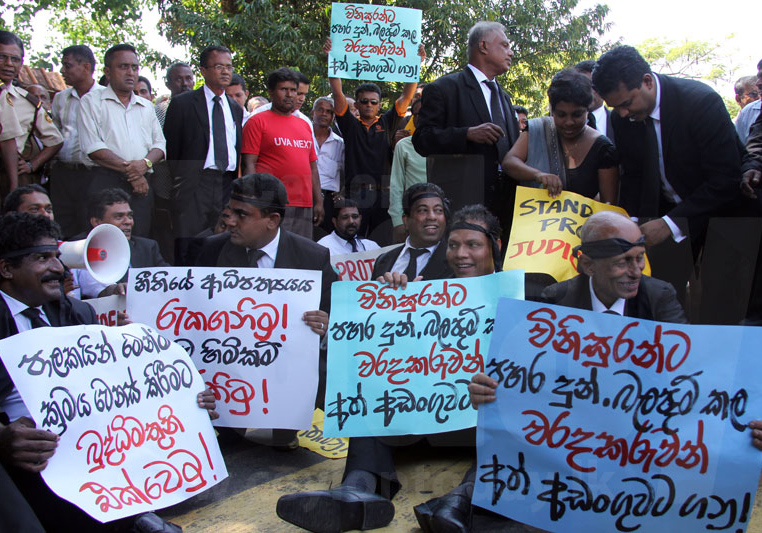
The ICJ condemned the decision of Sri Lanka’s parliament to impeach the country’s Chief Justice, Shirani Bandaranayake. The impeachment defied the rulings of the country’s Supreme Court and Court of Appeal and followed a procedure widely criticized for ignoring international standards and practice. The impeachment comes against the backdrop of increased tensions between the judiciary and the government.
Attacks against judicial independence, Central America
Concerned by developments in 2012 in Honduras, El Salvador and Guatemala, the ICJ urged the pertinent governments to abstain from interfering with judicial independence and to take necessary measures to guarantee judicial independence, by establishing protection mechanisms for judges, prosecutors and other legal professionals and by creating or reinforcing judicial careers, in line with their international obligations. The strengthening of the judicial sector must ensure the effective protection of human rights, including the fight against impunity.
Suspension of the SADC Tribunal, Southern Africa
The Pan African Lawyers Union and the Southern African Litigation Centre, with the support of inter alia the ICJ, has lodged a request for an advisory opinion with the African Court on Human and People’s Rights, seeking a pronouncement on the legality of the suspension of the Southern African Development Community Tribunal by the region’s leaders.
The case of Judge Zhumasheva, Kazakhstan
The ICJ has expressed its concern over disciplinary sanctions and threats of criminal prosecution against Judge Aliya Zhumasheva, following her refusal to abide by improper demands of senior colleagues and the Prosecutor’s Office to issue convictions in two criminal cases. The ICJ called on the Kazakh authorities to initiate a prompt, thorough and independent investigation into this alleged interference with the administration of justice.
Attack on Manjula Tillekaratne, Sri Lanka
The ICJ urged the Sri Lankan government to immediately provide justice for the physical assault of Manjula Tillekaratne, the Secretary of the Judicial Service Commission, who was assaulted by unidentified persons on 7 October. Furthermore, the ICJ called on the Sri Lankan authorities to cease public efforts to undermine the independence of the country’s judiciary.
Violation of the independence of the Bar Association and persecution of Bâtonnier Mbuyi Mbiye Tanayi, DR Congo
The ICJ expressed its grave concern over reports that the National Director of Public Prosecutions in DRC instructed senior members of the Bar Association to dismiss Bâtonnier Mbuyi Mbiye Tanayi, who is a known and vocal advocate of judicial independence. The ICJ urged the National Director to desist from interfering in the affairs of the Bar Association and to put an end to persecutions against Bâtonnier Mbuyi Mbiye.
Activists convicted without fair trial, Bahrain
The ICJ called upon the Bahraini authorities to immediately and unconditionally release 13 human rights defenders and political activists convicted by the Criminal Court of Appeal in Bahrain; the ruling upheld convictions and sentences handed down last year by the National Safety Court and the National Safety Court of Appeal. The ICJ deems the retrial before the civilian court a failure, in that it did not remedy the inadequacies of the initial trials before military courts, which did not meet international standards of fair trial.
CONTACTS AT CIJL:
Ilaria Vena, ICJ Associate Legal Adviser, t +41 22 979 3827, ilaria.vena@icj.org
Laurens Hueting, ICJ Associate Legal Adviser, t +41 22 979 3848, laurens.hueting@icj.org