Oct 31, 2018 | News
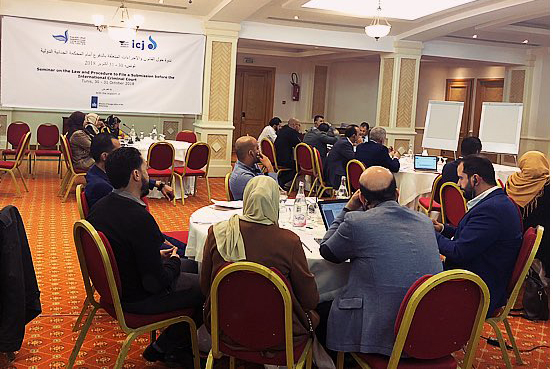
On 28‒31 October 2018, the ICJ hosted two seminars for 30 judges and prosecutors and 26 lawyers from Libya.
The events were co-organized with the Libyan Network for Legal Aid and commenced with opening remarks by ICJ Commissioner, Justice Kalthoum Kennou of Tunisia.
The first seminar on 28‒29 October on “Fair Trial Guarantees in Libya in light of International Standards” aimed to deepen the understanding of Libyan judges and prosecutors of the application of international law and standards regarding fair trials.
The seminar covered pre-trial rights, such as the right to liberty, to effective legal counsel and to be brought promptly before a judge, and rights at trial, such as the right to defend oneself in person, to call and examine witnesses and to an appeal.
International fair trial standards were considered in light of Libyan domestic law and cases, including case 630/2012 involving 37 Ghaddafi-era officials.
The second seminar on 30‒31 October on “The Law and Procedure to File a Submission before the International Criminal Court” aimed to increase Libyan lawyers’ understanding of how to properly file a successful submission to the Office of the Prosecutor.
The Seminar covered the structure and functioning of the ICC, the jurisdictional and admissibility requirements, and the standards for collection and admissibility of evidence.
The Seminar further discussed the roles of NGOs, lawyers and victims in ICC proceedings, providing practical guidance on how and when to file a communication under Article 15 of the Rome Statute of the ICC.
Speakers included judges and prosecutors from international courts and tribunals as well as ICJ staff.
Dec 8, 2017 | News
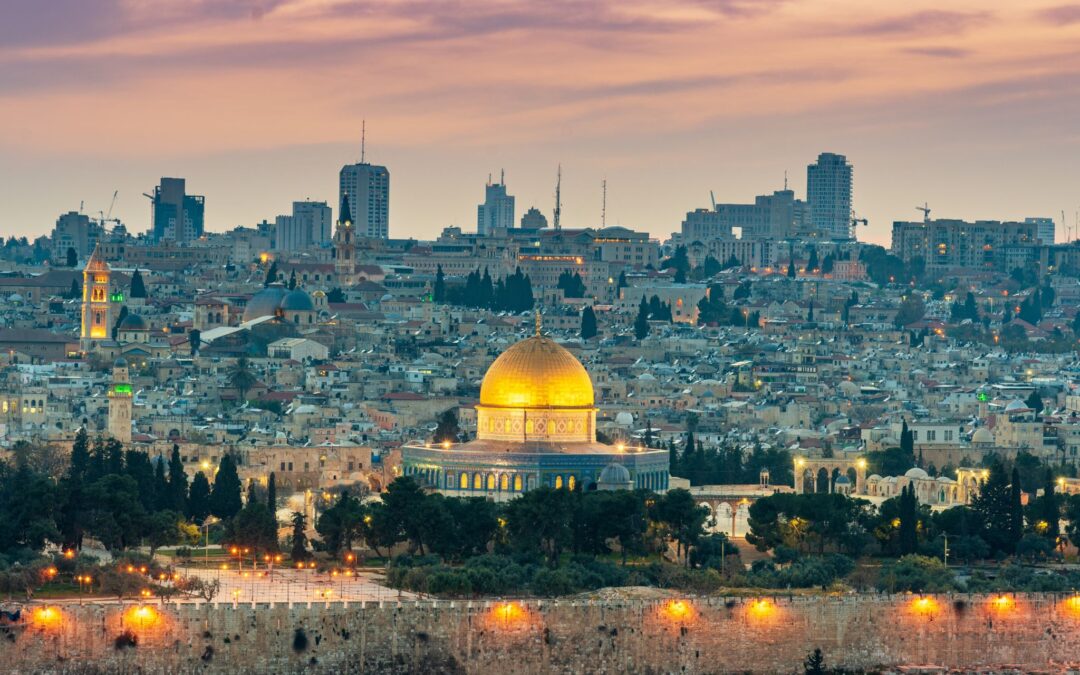
US President Donald Trump’s declaration recognizing Jerusalem as Israel’s capital and indicating an intention to move its embassy there, dangerously ignores long-standing international law, the ICJ said today.
Numerous United Nations Security Council’s Resolutions have reiterated the inadmissibility of the acquisition of territory by war, and have urged the withdrawal of Israel armed forces from territories occupied in the 1967 conflict, including East Jerusalem.
Trump’s announcement turns a blind eye on this legal reality and the related 50 years of occupation.
It also implicitly condones Israeli policies and practices that aim at altering the character and status of the Palestinian territory, including through the annexation of East Jerusalem, particularly by failing explicitly to similarly endorse Palestinian claims to East Jerusalem.
“Trump’s declaration cannot form the basis for any alteration of the status of Jerusalem under international law. However, it has the potential of provoking and fuelling a new cycle of violence in the region,” said Said Benarbia, ICJ MENA Director.
Thousands of Palestinians have taken to the streets to protest against Trump’s declaration. Dozens were injured in clashed with Israeli forces.
“The Israeli authorities should guarantee the right to peaceful protest and refrain from any disproportionate use of force against protesters, including the unlawful use of lethal force,” Benarbia added.
Background
The 2016 UN SC Resolution 2334 specifically reiterate that the Security Council “will not recognize any changes to the 4 June 1967 lines, including with regard to Jerusalem, other than those agreed by the parties through negotiations,” and that “the establishment by Israel of settlements in the Palestinian territory occupied since 1967, including East Jerusalem, has no legal validity and constitutes a flagrant violation under international law and a major obstacle to the achievement of the two-State solute on and a just, lasting and comprehensive peace.”
This reaffirms a series of similar resolutions by the Security Council since 1967.
Palestine-Trump Decla-News-2017-ARA (Statement in Arabic, PDF)
Nov 8, 2017 | News
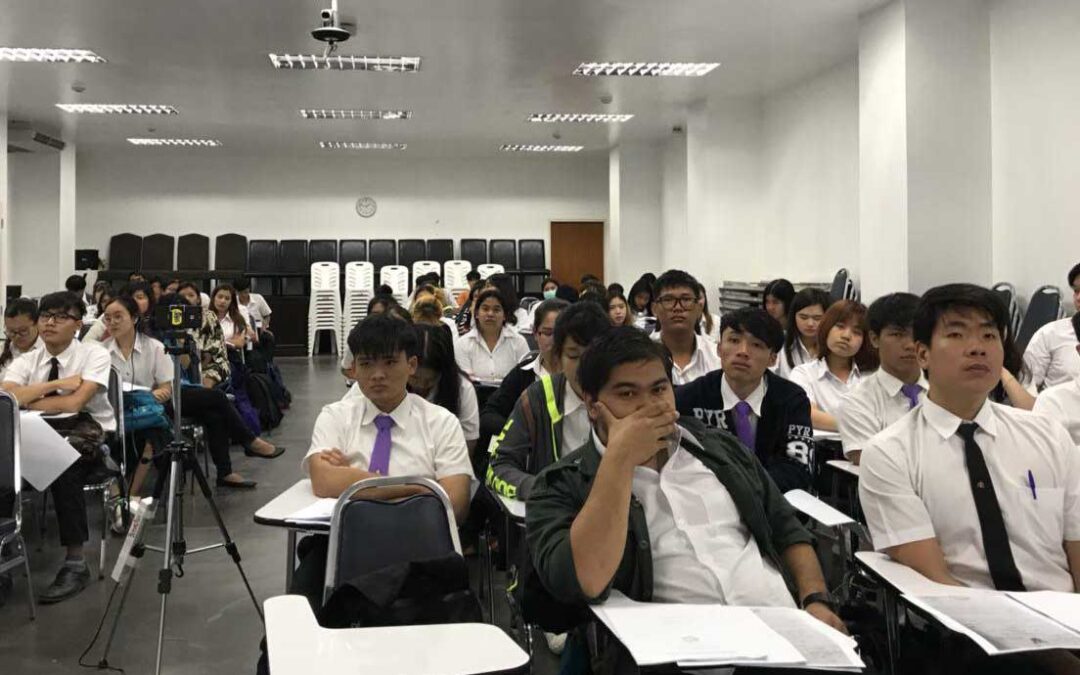
Today, the ICJ addressed an academic seminar on the topic of “Post-mortem Examinations and Inquires”, organized by Chiang Mai University’s Faculty of Law, in collaboration with the Cross Cultural Foundation, a partner of the ICJ.
Participants in the seminar, which was held at Chiang Mai University’s Faculty of Law campus, included undergraduate students and lecturers from Chiang Mai University.
The ICJ’s speakers at the workshop were Sanhawan Srisod, ICJ National Legal Adviser, who delivered an introduction to International Human Rights Law, and Kingsley Abbott, ICJ Senior International Legal Adviser, who addressed the right to life, and the international law and standards as they relate to investigations including the rights of victims and family members.
Other speakers at the Workshop were Preeda Nakphew a lawyer with the Cross Cultural Foundation, and Sarawut Pratoomraj, a Law Reform Officer with the Law Reform Commission of Thailand.
The seminar was part of an ongoing engagement between the ICJ and Chiang Mai University’s Faculty of Law.
Sep 13, 2017 | Advocacy
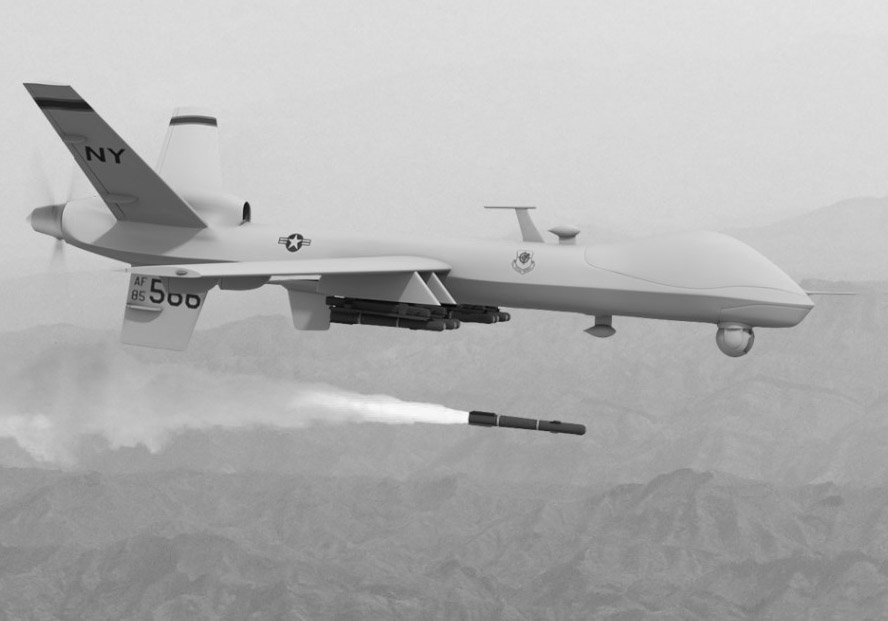
The ICJ joined 17 other organizations in calling for robust and human rights compliant international standards to regulate the use of “Unmanned Aerial Vehicles” , developed through fully inclusive and consultative processes.
Universal-DroneStandards-Advocacy-2017-ENG (full PDF)
Sep 3, 2017 | News
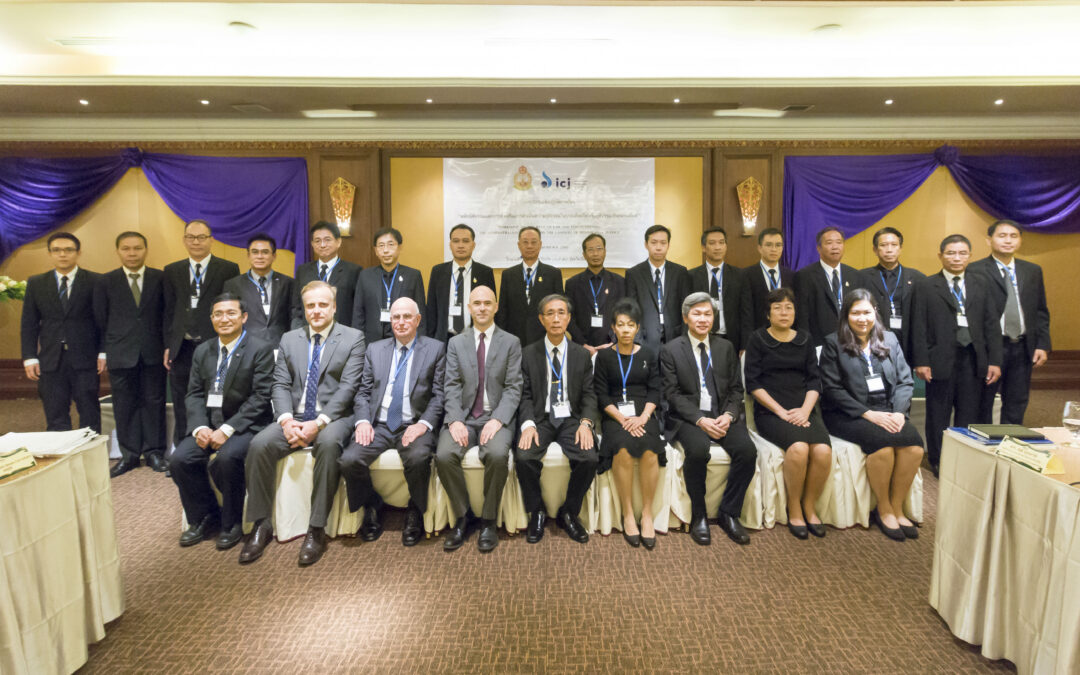
On 2 and 3 September, the ICJ held a workshop on “the Rule of Law and Strengthening the Administration of Justice in the Context of Restorative Justice” for members of the Thai judiciary.
The workshop was held in Chiang Mai.
Twenty-two judges attended the workshop, with an observer from the Thailand Institute of Justice (TIJ).
The objective of the workshop was to discuss how to best apply international standards of restorative justice within Thailand’s justice system.
Restorative justice is based on the fundamental principle that criminal behavior not only violates the law, but also injures victims and the community.
A restorative process is any process in which the victim and the offender and, where appropriate, any other individuals or community members affected by a crime participate together actively in the resolution of matters arising from the crime, with the help of a facilitator.
Frederick Rawski, Regional Director of ICJ Asia and the Pacific, recognized in his opening statement that implementation of restorative justice, including constructive non-custodial sentencing and measures, could assist in combating the problem of overcrowding in detention facilities in the North of Thailand, particularly with respect to drug-dependent offenders.
The workshop made reference to the United Nations Declaration of Basic Principles on the Use of Restorative Justice Programmes in Criminal Matters, which was adopted by the United Nations Economic and Social Council in 2002.
Speakers at the Workshop included Chief Justice Somnuk Panich from Office of the Chief Justice Region V, who formally opened the workshop, Judge Dr. Dol Bunnag, Presiding Judge of Intellectual Property and International Trade Court, who summarized the landscape of restorative justice in Thailand, and Judge Sir David James Carruthers from New Zealand, an international expert on restorative justice in New Zealand.
ICJ’s Senior International Legal Adviser Kingsley Abbott moderated the two-day workshop.
The ICJ ended the workshop with a statement reiterating its commitment towards working with Thailand’s judiciary to strengthen the rule of law and administration of justice in Thailand.