Oct 4, 2013 | News
The ICJ is calling on the Indonesian authorities to ensure that the proceedings against Justice Akil Mochtar fully comply with international law and standards on fair trial and the independence and impartiality of the judiciary.
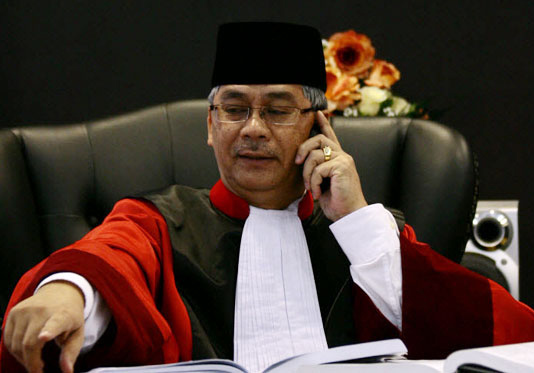
Justice Mochtar, Chief Justice of Indonesia’s Constitutional Court (photo), is accused of taking a bribe to issue a favourable verdict in an election dispute.
Justice Mochtar was arrested on 2 October 2013 and remains in custody. According to a spokesperson for the Corruption Eradication Commission, he is alleged to have received a bribe, through several intermediaries, from Hambit Binti, a district chief whose re-election was contested.
The Constitutional Court has sole jurisdiction over disputes contesting the conduct or results of elections.
The ICJ calls for a prompt, thorough and impartial investigation of these serious allegations.
The impartiality of the judiciary is an essential condition for respect for the rule of law, and is undermined when judicial decisions are made on the basis of financial inducements rather than solely according to evidence and the law.
Integrity is vital to the proper discharge of judicial office, and any judge must ensure that his or her conduct is above reproach, maintaining and enhancing the confidence of the public in the impartiality of both the individual judge and the judiciary as a whole.
According to the Beijing Statement of Principles on Independence of the Judiciary in the LAWASIA Region, signed by 32 judicial heads of Asia Pacific States, including the Chief Justice of Indonesia, “Judges shall uphold the integrity and independence of the judiciary by avoiding impropriety and the appearance of impropriety in all their activities.”
At the same time, the ICJ stresses that any eventual criminal or disciplinary proceedings, should those be warranted, must respect the independence of the judiciary and Justice Mochtar’s right to a fair trial.
Judges charged with a criminal offence, like all other persons, have the right to a fair trial by a competent, independent and impartial tribunal established by law.
The right to a fair trial in criminal cases as recognized in Indonesia and under international law and standards, including Article 14(3) of the International Covenant on Civil and Political Rights, comprises a series of procedural and substantive safeguards that must be respected during the pre-trial and trial phases.
Contact
Sam Zarifi, ICJ Asia-Pacific Regional Director, Bangkok, tel. no. +66 8078 19002 or sam.zarifi(a)icj.org
Laurens Hueting, ICJ Associate Legal Adviser (International Law and Protection Programme), Geneva, tel. no. +41 22 979 3848 or laurens.hueting(a)icj.org

Sep 30, 2013 | News
Last week the ICJ concluded a series of five workshops organized in collaboration with the National Human Rights Commission of the Federation of Bar Associations of Venezuela and states bar associations.
The workshops, that were held in five cities of Venezuela in the course of 2013, provided participants with a space for free reflection and debate on issues of judicial independence and the functioning of rule of law institutions.
The themes discussed in the workshops included human rights in legal education; the role of bar associations in promoting and strengthening an independent, competent and integral legal profession; human rights litigations; professional, civil and criminal responsibility of lawyers; and the role of the Supreme Court and the Office of Public Prosecution in a democratic society.
Participants to the workshops included representatives of bar associations, former Supreme Court justices and senior judges, practicing lawyers and members of Venezuelan civil society.
***
SPANISH TEXT:
La CIJ concluye serie de 5 talleres sobre independencia judicial en Venezuela
La semana pasada la Comisión Internacional de Juristas concluyó una serie de cinco talleres organizados en colaboración con la Comisión Nacional de Derechos Humanos de la Federación de Colegios de Abogados de Venezuela y los Colegios de Abogados de varios Estados en Venezuela.
Los talleres, que tuvieron lugar en cinco ciudades de Venezuela en el transcurso de 2013, ofrecieron a los participantes un espacio de reflexión libre y de debate sobre temas relativos a independencia judicial y el funcionamiento de las instituciones del Estado de derecho.
Los temas tratados en los talleres incluyeron la importancia de la formación en derechos humanos de los abogados; el papel de los Colegios de Abogados en la promoción y fortalecimiento de una profesión independiente, competente e integral; los litigios en materia de derechos humanos; la responsabilidad profesional, civil y penal de los abogados; y el papel del Tribunal Supremo de Justicia y del Ministerio Público en una sociedad democrática.
Los participantes en los talleres incluyeron a representantes del gremio, ex jueces del Tribunal Supremo y jueces de tribunales superiores, abogados en ejercicio y miembros de la sociedad civil venezolana.
Venezuela-CIJ Programa Seminario Barquisimeto-agenda-2013-spa (full text in pdf)
Venezuela-CIJ Programa Seminario Coro-agenda-2013-spa (full text in pdf)
Venezuela-CIJ Programa Seminario Puerto Ayacucho-agenda-2013-spa (full text in pdf)
Venezuela-CIJ Programa Seminario San Cristobal-agenda-2013-spa (full text in pdf)
Venezuela-CIJ Seminario Caracas-Programa-agenda-2013-spa (full text in pdf)
Sep 26, 2013 | News
The ICJ today expressed grave concern over the shooting of a Supreme Court judge of Dagestan and his son.
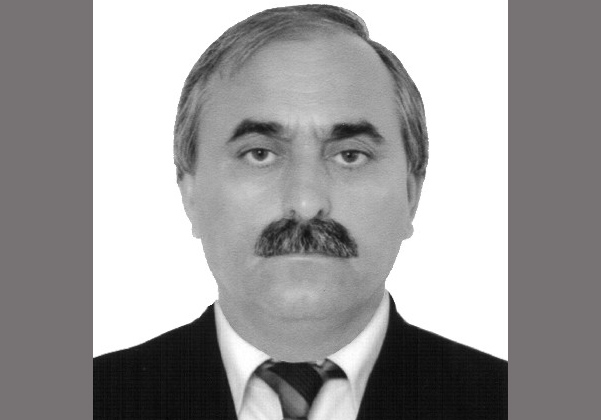
The ICJ calls on the federal and local authorities to ensure prompt, independent, impartial and thorough investigation of the shooting of Judge Mukhtar Shapiyev (photo) and his son.
Those reasonably suspected of responsibility for this crime should be identified and brought to justice in fair and transparent proceedings, where the rights of all the parties, including the victims and the accused are respected.
The ICJ recalls that Mukhtar Shapiyev is the third judge to be killed in Dagestan this year.
On 15 January, Magomed Magomedov, a Supreme Court judge of Dagestan, was shot and died as a result of the attack and, on 9 March, federal judge Akhmed Radzhabov, was shot to death near his house.
“When judges’ security is not guaranteed, and when they face a real and constant risk to their lives, the justice system and the very rule of law are undermined,” Temur Shakirov, Legal Adviser of the ICJ Europe Programme, said. “The UN Basic Principles on the Independence of the Judiciary clarify that it is the obligation of the State to ensure that those who are entrusted with the power to take judicial decisions are effectively protected.”
Reports indicate that Mukhtar Shapiyev and his son, Kamil Shapiyev, were shot at by at least two persons near their home in the capital Makhachkala at about 20:45 on Wednesday 25 September. Both victims later died in hospital.
Judge Shapiyev previously worked as the Prosecutor of one of the districts in Dagestan. In January 2012, he was appointed as a Supreme Court judge of Dagestan and worked in the collegium on civil cases.
Urgent measures, which the ICJ calls for to guarantee that the security of judges in Dagestan is effectively protected, include ensuring effective security against attempts on their lives and lives of their family members.
CONTACTS
Róisín Pillay, Director, ICJ Europe Programme, roisin.pillay(a)icj.org
Temur Shakirov, Legal Adviser, ICJ Europe Programme, temur.shakirov(a)icj.org
Russia-Judge killed in Dagestan-news-web story-2013-rus (full text in pdf)
Aug 15, 2013 | News
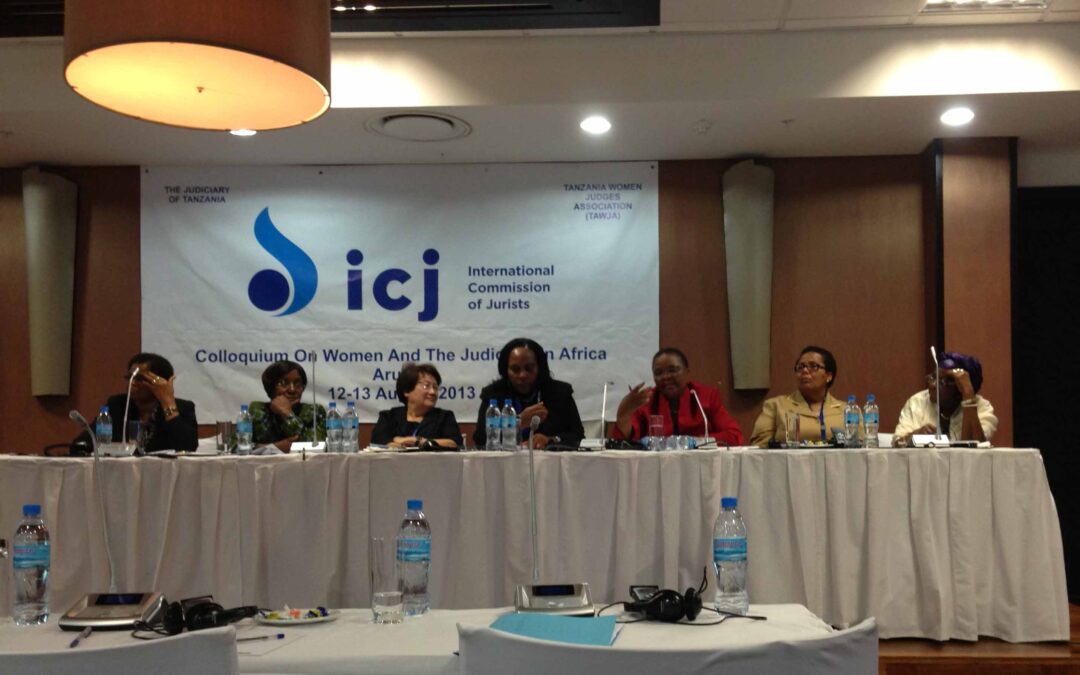
Women judges from across Africa participated in the first ICJ Colloquium on Women and the Judiciary on 12 and 13 August in Arusha, Tanzania.
The Arusha Colloquium, was opened by the Chief Justice of Tanzania and was hosted in collaboration and partnership with the Tanzania Women Judges Association and the Judiciary of Tanzania.
It enabled thirty five senior women judges from over fifteen African jurisdictions to come together to share their stories and reflect on and discuss their personal and professional experiences and challenges as women within the judiciary.
They were joined by over 15 women human rights defenders and lawyers.
Colloquium themes included the importance and role of women within the judiciary, independence and impartiality issues effecting women judges, appointment and promotion procedures, education and training needs and the role of women judges associations.
Discussions also addressed the role of the judiciary in advancing gender equality, women’s access to justice and protection of women human rights defenders.
The Colloquium marks the beginning of an ICJ multi-year initiative on women judges, lawyers and human rights defenders as agents of change.

Jul 27, 2013 | News
La CIJ condenó el asesinato de la jueza del Tribunal de Sentencia de la ciudad de El Progreso y Pro-Secretaria de la Junta de la Directiva Nacional de la Asociación de Jueces por la Democracia de Honduras.
La Jueza Mireya Mendoza fue ultimada por los disparos hechos desde una motocicleta mientras conducía su vehículo en la mañana del 23 de Julio en la ciudad de El Progreso, Departamento del Yoro, Honduras.
Ramón Cadena, Director de la CIJ para Centroamérica señaló: “Condenamos en los más enérgicos términos el asesinato de la Jueza Mendoza Peña”. Más de 50 abogados y abogadas han sido asesinados en Honduras en los últimos tres años
“Ataques de este tipo contra jueces y abogados no solamente constituyen graves crímenes sino que socavan seriamente el Estado de Derecho y la administración de la justicia en Honduras. La CIJ solicita al Gobierno de Honduras que disponga una investigación pronta, efectiva e imparcial sobre este nuevo crimen y que tome las medidas de protección necesarias para abordar la ola de intimidación y hostigamiento que sufren los profesionales del Derecho en ese país”, añadió Cadena.
La CIJ también expresó su solidaridad con la Asociación de Jueces por la Democracia en Honduras (AJD), que ahora se viste de luto por tan infame asesinato. La AJD es una organización profesional fundada en 2006, conformada por jueces y juezas comprometidos con la defensa y promoción de la independencia judicial como un presupuesto esencial para el fortalecimiento del Estado de Derecho, asumiendo la defensa de los derechos profesionales e intereses gremiales de jueces y juezas en Honduras.