May 3, 2018 | News
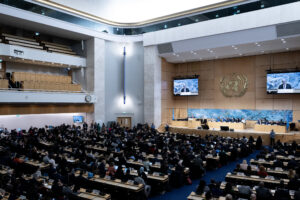
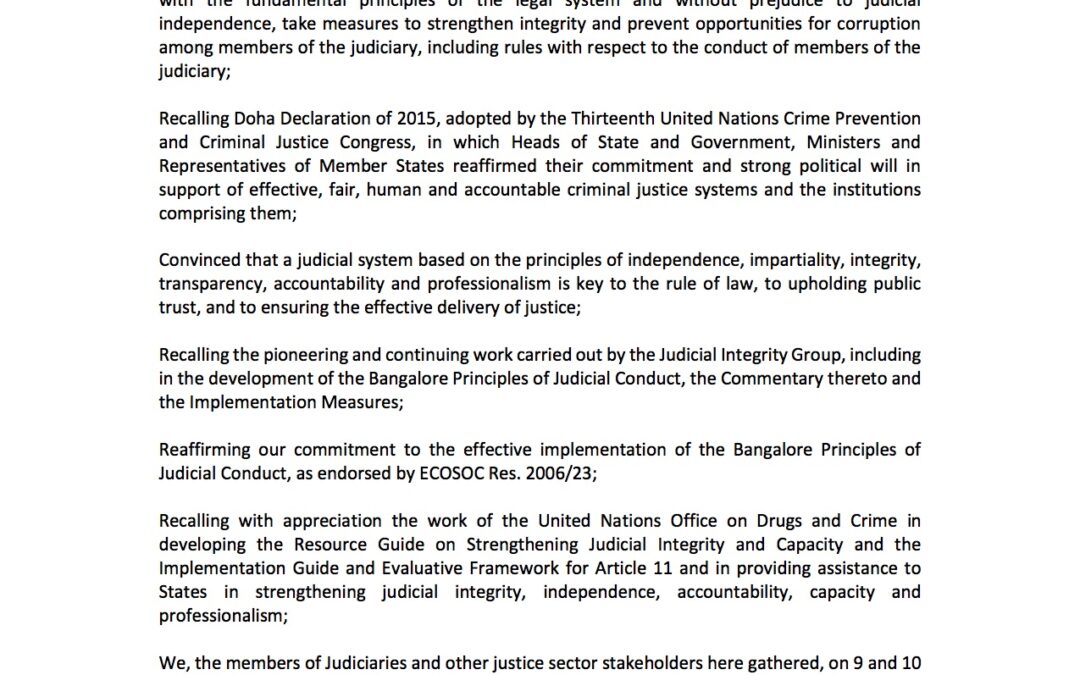
The UN Office on Drugs and Crime (UNODC) today published a Declaration on Judicial Integrity, adopted by Chief Justices and other judges and stakeholders at the launch of a new Global Judicial Integrity Network in Vienna.
ICJ actively participated in the launch event, which took place 9-10 April at the UN offices in Vienna, Austria. It was one of the largest-ever gatherings of Chief Justices and other senior judges, together with other experts and stakeholders.
In addition to organising a panel discussion on judicial selection and appointment procedures in Southern and East Africa, the ICJ made the following statement to the plenary session of the launch event:
Throughout the decades since its inception in 1952, the primary and most effective means by which the International Commission of Jurists has worked to promote the rule of law around the world is precisely by bringing judges from different countries together to share experience and expertise with one another, and together to seek solutions to the common challenges they face. The Judicial Integrity Network should make a huge contribution by creating a platform for this kind of judge-to-judge engagement to take place on a global scale and a continuous basis. The sessions today and yesterday have truly illustrated the very great potential of the Network. The ICJ strongly supports the efforts of UNODC, Chief Justices, and other stakeholders to bring the Network into being, and we look forward to participating in it, promoting it, and using it in our own work with judiciaries around the world, in the years ahead.
The plenary session also accepted, by consensus, the ICJ’s proposal to include key language from the UN Basic Principles on the Independence of the Judiciary, in the Declaration.
The Declaration, Terms of Reference, and Participants List is available on the UNODC website here or can be downloaded from the following links:
Declaration on Judicial Integrity (UNODC event 2018)
UNODC GJIN Terms of Reference 2018
ICJ Practitioners Guide no 13, on Judicial Accountability, can be downloaded here: Universal-PG 13 Judicial Accountability-Publications-Reports-Practitioners Guide-2016-ENG
Apr 10, 2018 | News
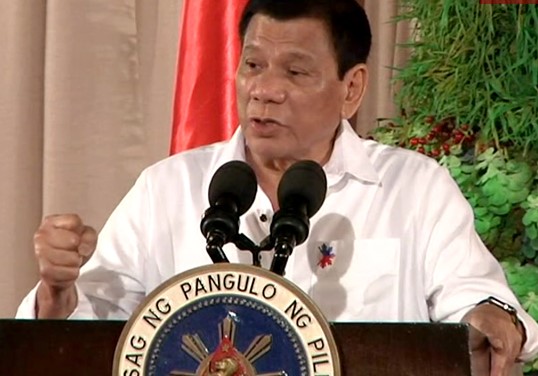
The ICJ today condemned a threatening statement made by Philippine President Rodrigo Duterte attacking Chief Justice Maria Lourdes Sereno of the Philippines Supreme Court.
The ICJ said that the President’s remarks constituted an assault not just on the Chief Justice, but on the independence of the judiciary in the country.
The ICJ urged President Duterte to respect judicial independence and not to exert political pressure on any government official or agency to undermine the independence of the judiciary.
In a press conference on 9 April 2018, President Duterte told reporters: “I’m putting you on notice that I’m your enemy and you have to be out of the Supreme Court.”
He also called on the House of Representatives to expedite impeachment proceedings presently underway against Chief Justice Sereno.
“It is absolutely unacceptable for President Duterte to make such a statement not only because it constitutes direct intimidation of the Chief Justice, but the chilling effect it may have on other independent judges who carry out their professional duties,” said Emerlynne Gil, Senior International Legal Adviser of ICJ.
“By expressing his personal feelings against the Chief Justice and by directing the House of Representatives to accelerate the impeachment proceedings, the President is actively influencing and interfering with the functions of other co-equal branches of government,” Gil added.
The ICJ reminds President Duterte that as enunciated in the UN Basic Principles on the Independence of the Judiciary, “[i]t is the duty of all governmental and other institutions to respect and observe the independence of the judiciary.”
The Principles affirm that the judiciary must be able to carry out its work “without any restrictions, improper influences, inducements, pressures, threats or interferences, direct or indirect, from any quarter or for any reason.”
The ICJ strongly urges President Duterte to retract his comments and to refrain in the future from making any statements attacking individual judges or in any way interfering with the independence of the judiciary.
Contact
Emerlynne Gil, Senior International Legal Adviser, t: +662 619 8477 (ext. 206) ; e: emerlynne.gil@icj.org.
Background
In September 2017, two impeachment complaints against the Chief Justice were filed before the Committee of Justice of the House of Representatives, the Lower House of Congress.
The Committee of Justice approved only one of the complaints, which is scheduled to be put before the plenary of the House of Representatives in May 2018 when Congress resumes its session.
If it obtains one-third vote of all members in the House of Representatives, the articles of impeachment will be transmitted to the Senate, which is the Upper House of Congress.
Any impeachable officer may be removed from office by a vote of two-thirds of all the members of the Senate sitting as the impeachment court.
Some of the points raised in the approved impeachment complaint are the Chief Justice’s failure to report certain income in her statements of assets, liabilities and net worth (SALN), allegations of use of public funds to finance her extravagant and lavish lifestyle, and manipulation of judicial appointments for personal and political reasons, among others.
The Chief Justice maintains she correctly filed her SALNs. She also further claims that the other allegations in the impeachment complaint are baseless or mere fabrications.
In March 2018, the Philippines’ Solicitor General Jose Calida filed a petition before the Supreme Court questioning the Chief Justice’s appointment due to her alleged failure to fully disclose her wealth. Oral arguments on this petition were made on 10 April 2018.
Mar 22, 2018 | News
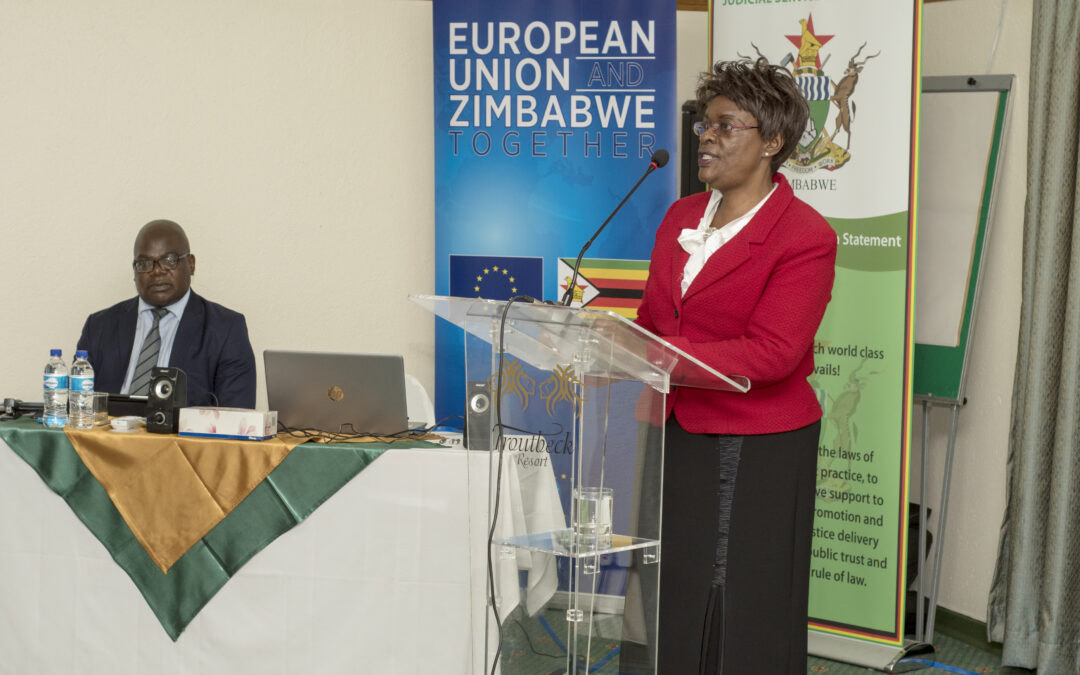
The ICJ and the Judicial Service Commission (JSC) of Zimbabwe, are convening a three-day Orientation Workshop for newly appointed judges.
It is held until 24 March at Troutbeck Inn, Nyanga.
The workshop is the fourth such meeting that the ICJ and the JSC have convened with the support of the European Union.
The training provides a useful bridge for the new appointees as they transition from the bar to the bench.
The topics covered during the training include judgement writing, court procedure and decorum, substantive law, judicial independence and issues of integrity on the bench.
The Hon. Judge President Chiweshe in his opening remarks stated that the objectives of the workshop are to familiarize incoming judges with their new work environment and to acquaint them with the specific divisions of that court.
This is to prepare them for the full assumptions of work in the judiciary. Justice Chiweshe noted that each division, criminal, civil and family law, will expose the judges to its own activities, guided by the judge from that division.
After the training the hope is that the judges will be deployed to their respective regions and stations fully acquitted with the tasks before them and can dispense justice diligently, impartially, fairly, without fear, favour or promise.
In attendance at the first day of the workshop were 17 judges (four female and thirteen male).