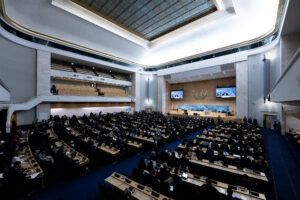
The event will be held Friday, 31 May 2013, from 16.00 to 18.00, in Geneva, Palais des Nations, Room XXVII. It marks the 5th anniversary of the HR Council adoption of the Framework “Protect, Respect and Remedy”.
It also promotes the publication of the ICJ Report on “Corporate complicity in international crimes”. It will highlight the fact that the business and human rights agenda in the Human Rights Council remains unfinished, especially in the critical areas of access to justice and accountability, as well as the need for bold Council action to provide States and other actors with the necessary tools to ensure remedy and justice to victims of serious human rights abuses committed by or with the complicity of corporations in home and host countries.
The inclusion of an amnesty provision, which could cover the worst possible crimes, in Nepal’s new Truth, Reconciliation and Disappearance Ordinance, will make it impossible for thousands of victims of gross human rights violations to obtain justice, ICJ and other right groups said today.
The Asian Centre for Human Rights, Human Rights Watch, the International Commission of Jurists and TRIAL pointed to fundamental flaws in Nepal’s new law, passed by President Ram Baran Yadav on March 14, 2013.
“The new ordinance leaves open the door to amnesties for persons implicated in gross human rights violations and crimes under international law,” said Ben Schonveld, ICJ’s South Asia director in Kathmandu. “Amnesties for serious rights violations are prohibited under international law and betray the victims, who would be denied justice in the name of political expediency.”
At least 13,000 people were killed and over 1,300 subjected to enforced disappearance in Nepal’s decade-long conflict between government forces and Communist Party of Nepal (Maoist) combatants.
The fighting ended with the signing of the 2006 Comprehensive Peace Agreement, consolidating a series of commitments to human rights.
However, the government has yet to take steps to ensure that those responsible for crimes under international law during the fighting are identified and prosecuted.
International and local human rights groups have consistently decried the government’s efforts to side-step promises of justice and accountability, represented most recently by this new ordinance.
The revised ordinance calls for the formation of a high-level commission to investigate serious human rights violations committed during Nepal’s armed conflict from 1996 to 2006.
It grants the commission discretion to recommend amnesty for a perpetrator if the grounds for that determination are deemed reasonable.
The government then decides whether to grant an amnesty. There is no definition of what is reasonable.
Confusion over scope of amnesty provision
The ordinance states that “serious crimes,” including rape, cannot be recommended for an amnesty, but it does not define what other “serious crimes” are not subject to an amnesty.
Gross violations of human rights, such as extrajudicial killing, torture and enforced disappearance, are not mentioned.
Torture and enforced disappearance are not specific crimes under Nepali domestic criminal law.
The organizations expressed concern that the commission’s powers to recommend prosecution may mean little without crimes being adequately defined in law.
The final decision on whether to prosecute can only be made by the attorney general, a political appointee of the government, instead of an independent entity.
Human Rights Watch, ICJ and TRIAL have previously documented the systematic failures of the Nepali criminal law system to address serious human rights violations.
“Nepal has had years to investigate some 1,300 suspected enforced disappearances during the conflict and thousands of other human rights violations, but it has failed to deliver any credible or effective investigations,” said TRIAL Director Philip Grant in Geneva. “The provisions on prosecution contained in this ordinance don’t appear to be strong enough to overcome Nepal’s entrenched practices of safeguarding impunity by withdrawing cases or failing to pursue credible allegations. It does not leave victims with much faith that the commission will fulfill its mandate to end impunity.”
Call for review and consultation
The organizations called upon the government to establish a mechanism to review and amend the legislation in consultation with victims of human rights abuses and representatives of civil society.
“This ordinance was signed by the prime minister and president in record time without any consultation with conflict victims and civil society,” Schonveld added. “If the government had carried out proper consultations, the result would have been different, and we wouldn’t have an ordinance that entrenches impunity.”
The rights organizations also expressed concern about the ordinance’s heavy emphasis on reconciliation at the possible expense of justice for victims.
The ordinance cedes authority to the commission to implement “inter-personal reconciliation” between victim and perpetrator, even if neither the victim nor the perpetrator requests it, which could result in pressure being placed on a victim to give up any claims against a perpetrator.
Although the ordinance mentions the need for victim and witness protection, there are no specific safeguards to ensure the safety and security of victims who become involved in reconciliation processes.
Violation of international obligation for political expediency
Under international law, Nepal is obliged to take effective measures to protect human rights, including the right to life and freedom from torture and other ill-treatment.
Where a violation occurs, Nepali authorities must investigate, institute criminal proceedings, and ensure victims are afforded access to effective remedy and reparations.
“The passage of this ordinance is just the latest example of the Nepali government’s cynical willingness to trade meaningful justice and accountability for political expediency,” said Brad Adams, Asia director at Human Rights Watch. “The government is kidding itself if it thinks it can ignore the voices of Nepal’s thousands of victims of human rights abuses. Nepal needs meaningful government initiatives to address its human rights problems, not the veneer of justice that this flawed ordinance represents.”
The ICJ today requested the UN Special Rapporteur on the situation of human rights defenders to call on Zimbabwe, Angola, the Democratic Republic of Congo and Swaziland to take effective measures to prevent and end attacks on and persecution of human rights defenders.
The ICJ delivered its oral statement today during an interactive dialogue with the Special Rapporteur as part of the Human Rights Council’s 22nd regular session (25 February to 22 March 2013).
The ICJ also noted the need for these States to:
Ensure adherence to international standards on detention and fair trial in cases where human rights defenders have been arrested;
Conduct prompt and impartial investigations and, where human rights abuses are criminal in character, prosecute all persons responsible; and
Ensure that affected human rights defenders have access to effective remedies and reparation for such abuses.
Also addressed to the Special Rapporteur on the situation of human rights defenders was a written statement submitted earlier this month concerning legislative restrictions on ‘homosexual propaganda’ that threaten LGBT human rights defenders.
The 10th ratification of the Optional Protocol to the International Covenant to Economic, Social and Cultural Rights (OP-ICESCR) is an historical boost for the international protection of these rights, the ICJ said today.
“With the deposit today at the UN of the 10th instrument of ratification by Uruguay, we are very close to the long awaited entry into force of this new treaty”, said Sandra Ratjen, ICJ Senior Legal Adviser on Economic, Social and Cultural Rights (ESCR).
The OP-ICESCR will enter into force in three months from today and will provide for remedies at the international level to victims of violations of economic, social and cultural rights.
The Protocol establishes mechanisms that enable the UN Committee on Economic, Social and Cultural Rights to examine complaints and initiate inquiries in cases of violations of these rights in the State parties whenever the victims could not obtain justice at the national level.
“We warmly welcome the 10th ratification of the Optional Protocol and we congratulate Uruguay on this decisive step for the protection of economic, social and cultural rights nationally and internationally”, said Wilder Tayler, ICJ’s Secretary General. “This is an important moment for the ICJ. We have a long-standing commitment and work in favour of the recognition of ESCR as legal and justiciable rights, on the same footing as other human rights.”
The ICJ urges States parties to the ICESCR to join the first ten States who became party to the Optional Protocol – Ecuador, Mongolia, Spain, El Salvador, Argentina, Bolivia, Bosnia and Herzegovina, Slovakia, Portugal and Uruguay.
The ICJ stresses that only when a significant number of States will have become party to the Protocol, the mechanisms it offers will be effectively accessible to a great number of victims of violations of ESCR.
Contact:
Sandra Ratjen, ICJ Senior Legal Adviser on Economic, Social and Cultural Rights, t: +41 22 979 38 35 ; e-mail: sandra.ratjen(at)icj.org
NOTE:
The ICJ is a member of the International NGO Coalition for the OP to the ICESCR. Together with the other members of the Coalition, the ICJ is involved in the Campaign in favour of the ratification of the OP-ICESCR.
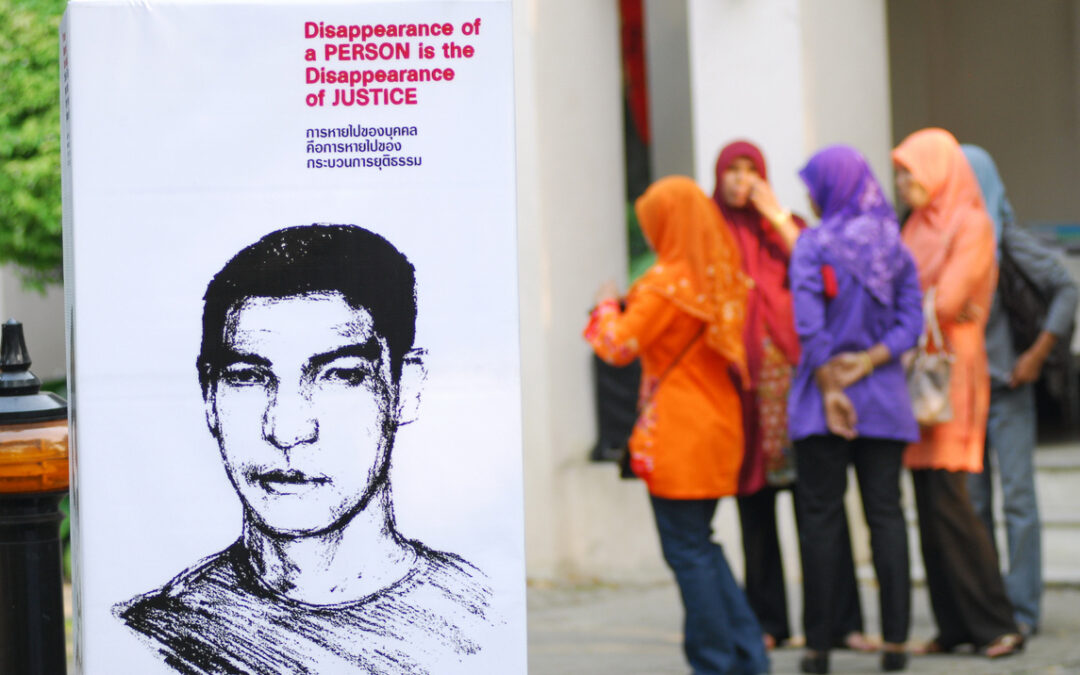
In an interactive dialogue with representatives of its government, the ICJ and the FIDH called on Indonesia to act on its expressed commitment to combat impunity in the country and immediately and effectively resolve all cases of enforced disappearances. Watch the webcast.
The ICJ delivered its statement today during the adoption by the UN Human Rights Council of the Universal Periodic Review outcome document on Indonesia, during the course of the 21st regular session of the Council.
🍪 We use cookies on our website to improve your experience. By clicking "Accept all", you consent to the use of all the cookies. If you'd like to control which cookies we use, please visit "Cookie settings". To find out more, read our privacy policy and cookie policy.
Functional
Always active
The technical storage or access is strictly necessary for the legitimate purpose of enabling the use of a specific service explicitly requested by the subscriber or user, or for the sole purpose of carrying out the transmission of a communication over an electronic communications network.
Preferences
The technical storage or access is necessary for the legitimate purpose of storing preferences that are not requested by the subscriber or user.
Statistics
The technical storage or access that is used exclusively for statistical purposes.The technical storage or access that is used exclusively for anonymous statistical purposes. Without a subpoena, voluntary compliance on the part of your Internet Service Provider, or additional records from a third party, information stored or retrieved for this purpose alone cannot usually be used to identify you.
Marketing
The technical storage or access is required to create user profiles to send advertising, or to track the user on a website or across several websites for similar marketing purposes.