Jan 14, 2021 | News
The ICJ today deplored the comprehensive failure of the Sri Lankan authorities to ensure accountability for conflict-era crimes, marked by the dropping of charges and release of all five accused in the Joseph Pararajasingham murder trial.
Parliamentarian Joseph Pararajasingham was killed by unidentified gunmen on 25 December 2005 while he attended Christmas mass at the Batticaloa St. Mary’s Cathedral, in the Eastern Province of Sri Lanka. Eight other people, including his wife, were injured during the firing.
Yesterday, the Batticaloa High Court acquitted and ordered the released of all five accused, including former-LTTE cadre and now-Member of Parliament, Sivanesathurai Chandrakanthan alias ‘Pillaiyaan’, in the trial of Pararajasingham, a former Tamil National Alliance Parliamentarian. The judgment was delivered after the Attorney General’s Department (AG) informed the Court that it would not proceed with the prosecution. The AG provided no reason publicly for this decision.
“The shelving of this case five years after it began, is a blow to the victims of this serious human rights atrocity.” said Ian Seiderman, ICJ’s Legal and Policy Director.
“This constitutes yet another marker of Sri Lanka’s consistent failure to hold accountable perpetrators of serious conflict-era crimes,” he added.
In November 2020, the AG had informed the Batticaloa High Court that he intended to proceed with the case, notwithstanding the Court of Appeal deemed inadmissible important evidence of the prosecution’s case.
The UN Office of the High Commissioner on Human Rights Investigation on Sri Lanka (2015) had already concluded that “there are reasonable grounds to believe that the Karuna Group (of which Chandrakanthan was a member) killed Joseph Pararajasingham, and that it was aided and abetted by security and army personnel.”
The acquittal in Pararajasingham’s murder case follows that of another Tamil Parliamentarian Nadarajah Raviraj, where an all-Sinhalese jury acquitted five persons including three Navy intelligence officers in December 2016, a decade after his murder.
The UN High Commissioner for Human Rights identified both these cases, in which no progress had been made, emblematic of Sri Lanka’s dismal record on accountability.
The ICJ called on the Attorney General’s Department to reopen fresh investigations into the murder of the deceased legislator so as to ensure justice and justice for the victims of this atrocity.
The ICJ notes that the Attorney General maintains the dual role of public prosecutor and as attorney for the State, positions which are prone to come into tension. The former UN Special Rapporteur on the Independence of Judges and Lawyers, Monica Pinto, following her mission to Sri Lanka in 2016 observed that “there is a general perception that, first and foremost, the [Attorney General’s] department defends the interests of the government and not the public’s interest.”
Background
Sivanesathurai Chandrakanthan who broke away from the Liberation Tigers of Tamil Eelam (LTTE) in 2004, functioned as a paramilitary, in support of the then-Rajapaksa Government. He is presently the leader of Tamil Makkal Viduthalai Pulikal (TMVP), a political party aligned to the Government and was voted into Parliament at the 2020 General Elections.
Investigation into the killing only began in 2015, after a new government was formed following elections which saw the defeat of Rajapaksa. Chandrakanthan was taken into remand custody on 11 October 2015 when he arrived at the Criminal Investigation Department to record a statement in relation to the assassination of the late Tamil politician. The Attorney General indicted that Chandrakanthan (who was 3rd accused) in the High Court of Batticaloa for offences committed under the Penal Code and the Prevention of Terrorism Act. He was granted bail for the first time in November 2020 after the primary evidence against the accused was deemed inadmissible by the Court of Appeal. The case was fixed for January 11 only after the AG informed courts he intended proceeding with the case notwithstanding the Appeal Court ruling.
Contact
Osama Motiwala, ICJ Communications Officer, Asia & Pacific programme, e: osama.motiwala(a)icj.org
Mar 27, 2020 | News
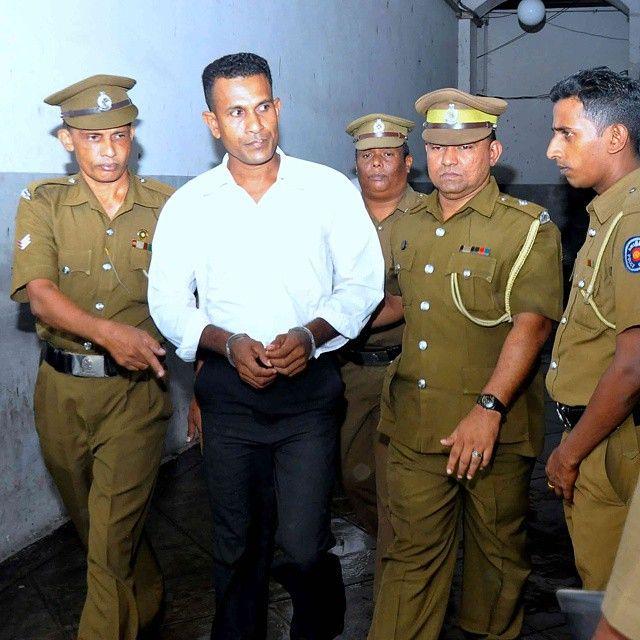
The ICJ today condemned the Presidential pardon granted to murder convict Sunil Ratnayake, Former Staff Sergeant of the Sri Lankan Army.
Sri Lankan President Gotabaya Rajapaksa pardoned Former Staff Sergeant Sunil Ratnayake who was convicted in 2015 for the murder of eight Tamil civilians, including three children, in Mirusuvil in April 2000. The conviction and death sentence was affirmed by the Supreme Court of Sri Lanka in 2019.
The ICJ said that the pardon cast serious doubt upon the Government’s commitment to accountability and the rule of law in Sri Lanka.
While the ICJ welcomes the lifting of the death sentence, the full pardon and extinguishment of serious punishment constitutes a blow to the victims of these violations.
“The prosecution of Staff Sergeant Ratnayake for his involvement in the killing of civilians, including children, at Mirusuvil was a rare exception to the usual lack of accountability for human rights violations committed during the conflict,” said Frederick Rawski, ICJ’s Regional Director for Asia and the Pacific. “Such a pardon is incompatible with international standards relating to impunity and access to justice, and reinforces the well-founded public perception that the military is exempt from any form of accountability, even for the most heinous crimes”.
The ICJ stressed that for serious crimes such as unlawful killing of civilians, there should be no amnesties or pardons that are inconsistent with the right to victims of such violations to reparation.
“It is particularly distressing that a presidential pardon of this nature has been issued at a time when the nation is dealing with the potentially devastating impacts of the COVID-19 outbreak,” said Rawski. “The government would be advised to focus on responding to legitimate calls to release prisoners of minor offences, and take measures to address prison congestion, rather than taking cynical advantage of the crisis to free convicted war criminals.”
It is noteworthy that during his presidential campaign, Gotabaya Rajapaksa had made repeated pledges to release “war heroes languishing in prison over false charges and cases”. The ICJ is deeply concerned that this presidential pardon may be the first of the many to come.
The ICJ has consistently raised concerns about the severe lack of accountability regarding crimes perpetrated by the Sri Lankan armed forces – most recently before the Human Rights Council in February 2020.
The ICJ opposes capital punishment in all cases without exception as a violation of right to life and to freedom from cruel, inhuman or degrading punishment.
Contact
Frederick Rawski, ICJ’s Asia Pacific Regional Director, t: +66 2 619 84 77; e: frederick.rawski(a)icj.org
Feb 27, 2020 | News
The ICJ today condemned the Sri Lankan Government’s announced “withdrawal” of support for the process under UN Human Rights Council (UNHRC) Resolutions 30/1, 34/1 and 40/1.
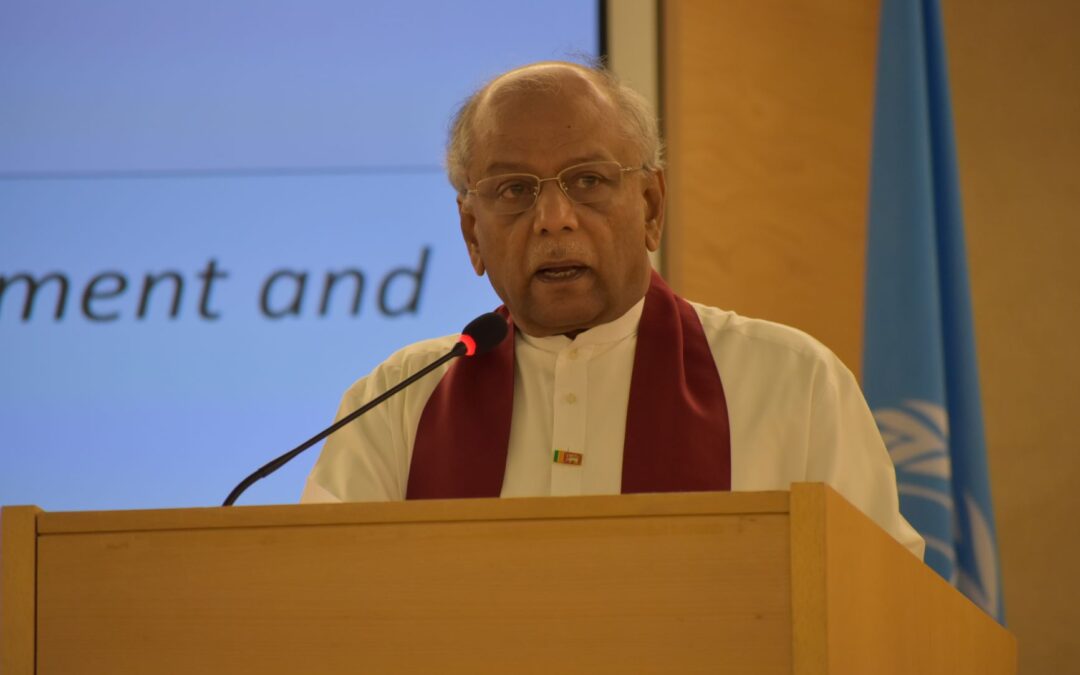
Minister of Foreign Affairs, Dinesh Gunawardane, formally announced the decision on 26 February at a High-Level Segment of the 43rd session of the UNHRC in Geneva.
“The Government of Sri Lanka’s refusal to implement effective measures for truth, justice, accountability and reconciliation, including as set out in the resolutions of the Human Rights Council, places it in violation of its obligations under international law,” said Frederick Rawski, ICJ’s Regional Director for Asia and the Pacific. “Holding perpetrators of human rights violations accountable at the international level now appears to be the only real option – including referral to the International Criminal Court, the creation of an ad hoc international mechanism, and the exercise of universal jurisdiction.”
Gunawardane stated that the Government of Sri Lanka would instead “achieve sustainable peace through an inclusive, domestically designed and executed reconciliation and accountability process, including through the appropriate adaptation of existing mechanisms, in line with the Government’s policy framework.”
“It is the Sri Lankan Government’s failure to initiate a credible and comprehensive approach to transitional justice in the aftermath of the war that led to the intervention of the international community in the first place,” said Rawski. “Sri Lanka’s domestic legal system has repeatedly demonstrated that it is unable to address systemic and entrenched impunity for crimes under international law perpetrated by the military and security forces,” he added.
Pronouncements by the President, on protecting military personnel from any accountability measures coupled with appointments to senior command positions individuals credibly accused of serious human rights violations indicate that the long history of impunity of security forces in Sri Lanka is set to continue.
The ICJ is deeply concerned that the Government’s official refusal to implement the UN resolutions comes at a time when the human rights situation in Sri Lanka is rapidly deteriorating. It threatens to undermine even the meagre progress made over the past few years, which albeit slow and wholly insufficient, has been primarily due to the continued engagement of the Council, OHCHR and international community. The UNHRC process is also the only forum at the global level where Sri Lankan civil society and victim groups have had the opportunity to engage openly in dialogue with the Government and other States on human rights concerns in Sri Lanka.
The validity of adopted resolutions of the Council does not depend on their acceptance by the government concerned. Reporting and discussion of Sri Lanka’s implementation or failure to implement them will take place this year and in 2021 at the Council regardless of the Government’s position.
Contact
Frederick Rawski, ICJ’s Asia Pacific Regional Director, t: +66 2 619 84 77; e: frederick.rawski(a)icj.org
Nov 19, 2019 | News
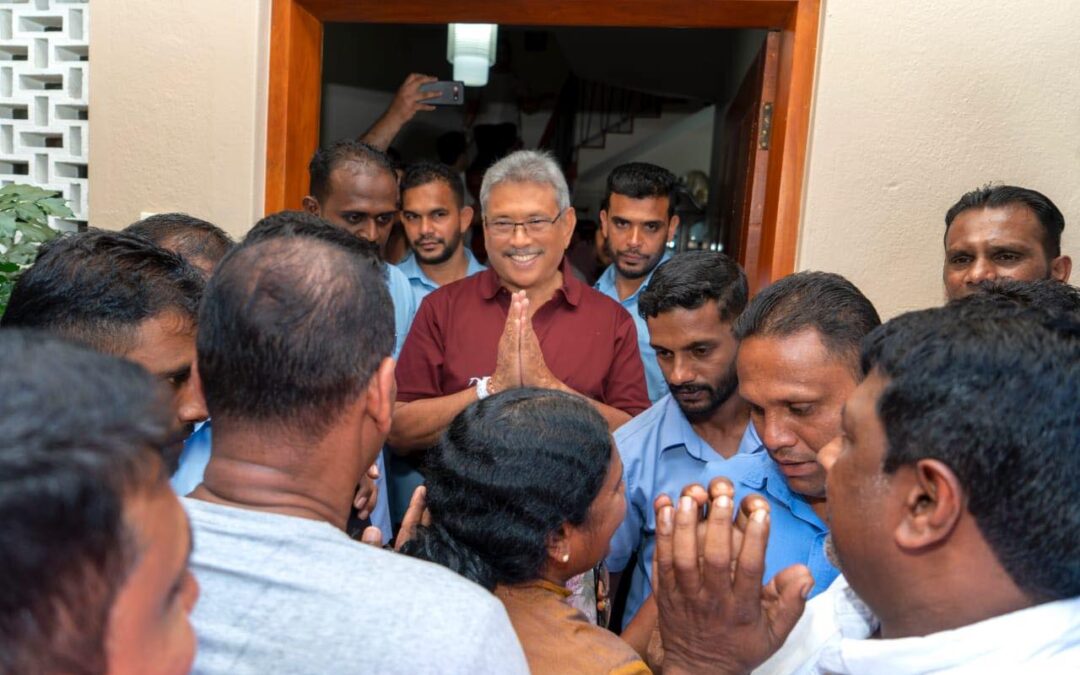
Sri Lanka’s newly elected president, Gotabaya Rajapaksa and his government must demonstrate that they will uphold human rights and rule of law, and ensure that Sri Lanka sustains its international obligations and commitments to justice and accountability, said the ICJ today.
Gotabaya Rajapaksa faces credible allegations of involvement in war crimes and crimes against humanity that took place during the country’s armed conflict.
“The election of Gotabaya Rajapaksa, after a highly polarizing campaign, has alarmed human rights defenders in Sri Lanka and abroad, who have little reason to believe that someone facing such serious allegations of perpetrating human rights violations can be relied upon to meet the country’s obligations under international law,” said Frederick Rawski, ICJ Asia Pacific Director.
Gotabaya Rajapaksa, who won the presidency with 52.25% of votes, served as Sri Lanka’s Secretary of the Ministry of Defence from 2005 to 2015 during the tenure of his brother Mahinda Rajapaksa, at the height of the armed conflict against the Liberation Tigers of Tamil Eelam (LTTE).
Both the military and LTTE perpetrated war crimes and gross human rights violations during the conflict, and particularly during its bloody final stages. As Defence Secretary, Gotabaya was accused of ordering the killing of surrendering LTTE fighters, ordering strikes on civilians and hospitals, and authorizing attacks on human rights defenders.
International condemnation of atrocities committed during the conflict led to the UN Human Rights Council demanding that the Sri Lankan government commit to a process of transitional justice, in view of the systematic failures of accountability mechanisms in Sri Lanka in the past, as documented by the ICJ in its submission to the Human Rights Council, and others. Despite commitments from the Sri Lankan government, the transitional justice process has effectively stalled and impunity has prevailed.
“The ICJ is deeply concerned that even the limited strides made over the past five years in Sri Lanka on transitional justice, positive constitutional amendments and institutional reform will be reversed,” said Rawski.
The ICJ urged the Government to deliver on its commitment to the transitional justice process, including by holding those responsible for human rights violations and abuses accountable, and complying with the obligations set out in United Nations Human Rights Council Resolutions 30/1, 34/1 and 40/1.
Contact:
Frederick Rawski, ICJ’s Asia Director, t +66 644781121; e: frederick.rawski(a)icj.org
Mar 20, 2019 | Advocacy, Non-legal submissions
The ICJ today called at the UN for prompt establishment of a judicial accountability mechanism with international involvement, for Sri Lanka.The statement, delivered during an interactive dialogue on the OHCHR report on Sri Lanka at the Human Rights Council in Geneva, read as follows:
“The ICJ welcomes the comprehensive report of the OHCHR on promoting reconciliation, accountability and human rights in Sri Lanka (A/HRC/40/23). We share OHCHR’s observation that there is a lack of progress and absence of a comprehensive strategy for implementation of all commitments made under Resolution 30/1.
ICJ is particularly concerned about the lack of progress in the area of criminal accountability (as noted in Paragraph 27 of the report). We believe that there is an urgent need to establish a judicial mechanism with the involvement of foreign judges. We echo the sentiments of the OHCHR regarding the inability of the Sri Lankan courts, on their own, to address the impunity of security forces for crimes under international law.
Failure of the criminal justice system to effectively address emblematic cases (as reflected in Paragraph 38 of the report) clearly indicates the level of capacity and willingness on the part of the State even today to prosecute and punish perpetrators of serious crimes when they are linked to the security forces or other positions of power.
ICJ also notes that women are grossly under-represented in the judiciary in Sri Lanka, which prevents women human rights defenders and female victims from having confidence in the ordinary criminal justice system, impeding their full engagement and participation in pursuing accountability for crimes committed against them during the conflict and other transitional justice processes.
A judicial mechanism with the involvement of foreign judges is particularly urgent for women in conflict-affected areas who still live in a highly militarized environment and are compelled to live among their perpetrators – those who have been accused of war crimes including rape and other forms of sexual violence.
We therefore reject calls for a purely domestic mechanism. Indeed, the ICJ considers that the continuing failure of the Government to ensure justice means that referral to the International Criminal Court or the creation of another international mechanism to facilitate criminal accountability would be fully warranted. The draft resolution before this session of the Council, reaffirming all elements of resolution 30/1, thus already represents a deep compromise and anything less than the existing text would be wholly unacceptable.