Feb 23, 2018 | News
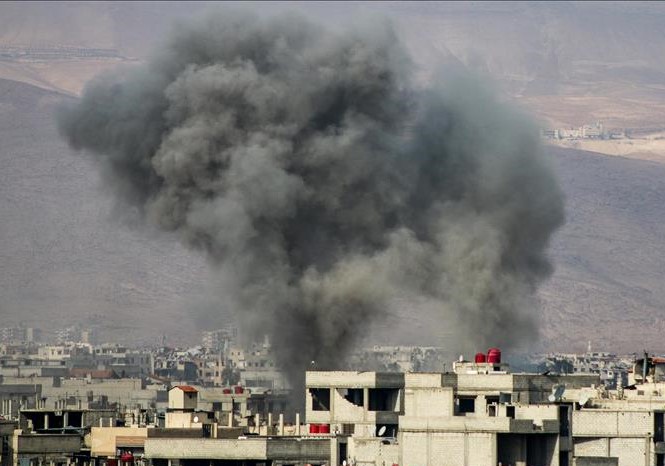
The ICJ today called on the governments of Syria and Russia to cease all attacks on the civilian population in Eastern Ghouta.
Intentionally directing attacks against the civilian population and civilian objects, including hospitals, constitutes a war crime.
All those responsible for such crimes must be held accountable.
“The UN Security Council is blatantly failing to discharge its primary responsibility for maintaining international peace and security. It’s so paralyzed by division that it cannot even enforce its own resolutions on protecting the civilian population in Syria and ensuring unimpeded humanitarian access,” said Said Benarbia, Director of the ICJ Middle East and North Africa Programme.
“After 7 years of shielding the Syrian regime from accountability for its egregious crimes, including the use of chemical weapons, Russia is joining forces with this regime’s cynical enterprise to murder and starve its own people,” he added.
The air and artillery bombing campaign conducted by the Syrian government, with the backing of Russia, have caused hundreds of victims since Sunday.
The destruction of hospitals and the lack of basic supplies and medicines are making the living conditions of the civilian population extremely dire.
Under international humanitarian law, the Syrian government and its ally Russia have obligations to protect the civilian population and to grant rapid and unimpeded passage to humanitarian relief for the residents of Eastern Ghouta.
The UN Security Council imposed a disarmament plan concerning the Syrian chemical arsenal, yet credible reports of government use of chemical weapons against civilians continued to emerge as late as January and February 2018, in particular in Eastern Ghouta and Saraqeb.
In its last report in October 2017, the OPCW-UN Joint Investigative Mechanism established the responsibility of the Syrian government for the use of chemical weapons.
In the same month, Russia vetoed a resolution to renew the Mechanism’s mandate.
“States must act individually and collectively to stop the escalation of horrors we are witnessing in Eastern Ghouta. They must also ensure, including through any means available in their national legal systems, as well as at the regional and international level, that all those responsible for the war crimes, crimes against humanity and other international crimes committed in Syria, irrespective of their nationality, rank or status, are brought to justice,” Benarbia added.
Contact
Said Benarbia, Director of the ICJ Middle East and North Africa Programme, tel: +41 798783546, e-mail: said.benarbia(a)icj.org
Syria – Ghouta Bombing – News – Webstory – 2018 – ARB (Arabic translation in PDF)
Apr 27, 2017 | News
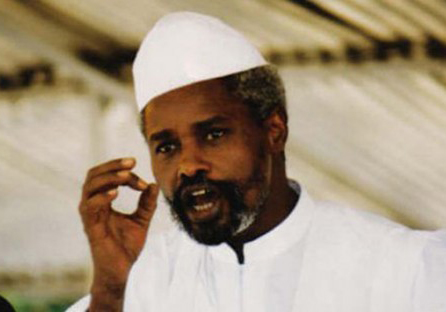
An appeals court’s confirmation of the conviction for crimes against humanity, war crimes and torture of Hissène Habré, the former president of Chad, is a vindication of the decades-long campaign waged by his survivors, the ICJ and two human rights groups supporting the victims said today.
Habré’s May 2016 conviction was upheld by the appeals chamber of the Extraordinary African Chambers in the Senegalese court system on April 27, 2017.
The appeals court also confirmed the life sentence handed down by the trial court and ordered Habré to pay over 82 billion CFA francs (approximately 123 million euros) to his victims.
“This is a crowning victory for Hissène Habré’s victims, who for 26 years never gave up fighting to bring him to justice” said the ICJ Commissioner Reed Brody, who has worked with the survivors since 1999.
“His life sentence is a wake-up call to tyrants everywhere that if they engage in atrocities they will never be out of the reach of their victims,” he added.
The appeals court also upheld the decision to order compensation to Habré’s victims and said that a trust fund created by the African Union (AU) should be tasked with searching for and recovering Habré’s assets.
A summary of the decision was read out in court by chief judge Ougadeye Wafi, a judge of the Supreme court of Mail, who shared the bench with two senior Senegalese judges.
Habré, who ruled Chad from 1982 to 1990, was not in court for the judgment. He did not recognize the chambers’ authority and sat silently throughout the trial.
His court-appointed lawyers filed the appeal on his behalf.
Hissène Habré fled to Senegal in 1990 after being deposed by the current Chadian president, Idriss Déby Itno. Although Habré was first arrested and indicted in Senegal in 2000, it took a long campaign by his victims before the Extraordinary African Chambers were inaugurated by Senegal and the AU in February 2013 to prosecute crimes under international law committed in Chad during Habré’s rule.
“I have been fighting for this day since I walked out of prison more than 26 years ago,” said Souleymane Guengueng, who nearly died of mistreatment and disease in Habré’s prisons, and later founded the Association of Victims of Crimes of the Regime of Hissène Habré (AVCRHH). “Today I finally feel free.”
Habré’s trial was the first in the world in which the courts of one country prosecuted the former ruler of another for alleged human rights atrocities.
“At long last, after so many years of fighting, so many years of setbacks, we have achieved what we set out to do,” said Jacqueline Moudeina of Chad, the victims’ chief lawyer and president of the Chadian Association for the Promotion of Human Rights (ATPDH).
The appeals court said that while it accepted the credibility of the witness Khadidja Hassan Zidane who stated that Habré personally raped her on four occasions, it could not convict Habré of personal having committed rape because the charge was not included in the individual indictment.
In the ruling upheld today, the trial court awarded each survivor of rape and sexual slavery 20 million CFA francs (approximately 30,489 Euros, US$32,702), each survivor of torture and arbitrary detention and each mistreated former prisoner of war 15 million CFA francs (22,867 Euros, US$24,526), and family members of victims 10 million CFA francs (15,244 Euros, US$16,350).
It said that 7,396 victims were eligible for reparations and that 3,489 others who had not produced sufficient proof could apply to the trust fund.
The court has already frozen some assets belonging to Habré including a house in an upscale Dakar neighborhood believed to be worth about 680,000 Euros as well as some small bank accounts. Habré is thought to have much more extensive assets.
“Money will never bring back my friends,” said Clément Abaïfouta, who as a prisoner was forced to bury other detainees in mass graves, and is now president of the AVRCHH. “But money is important to heal the wounds, to take victims out of poverty, and to show that we have rights that must be recognized.”
“With this verdict, we can now try to locate and seize Habré’s assets and make sure the victims are compensated,” said lawyer Moudeina.
Contact
Reed Brody, ICJ Commissioner, t: +221-76-618-79-10 (in Dakar) or +1-917-388-6745 ; e: reedbrody(a)gmail.com
The full text of the press release can be downloaded in English and in French below:
Chad-HisseneHabre Conviction Upheld-News-Press Releases-2017-ENG (English, PDF)
Tchad-Hissene Habre peine confirmee-News-Press Releases-2017-FRE (Français, PDF)
Apr 20, 2017 | News
Nepali authorities should immediately take effective steps to enforce the landmark Kavre district court murder verdict for the 2004 torture and killing of teenage Maina Sunuwar, the ICJ, Amnesty International, and Human Rights Watch said today.
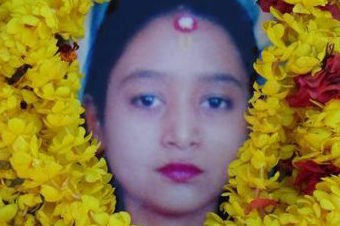
On 16 April 2017, the Kavre district court sentenced three army officers to life imprisonment for the murder of Maina Sunuwar, a 15-year-old girl (photo) who was tortured in army custody and died as a result in February 2004.
Maina’s killing took place during the decade-long armed conflict between the Maoists and government forces that ended in 2006.
A court martial in 2005 found that Maina had died in army custody, convicted the three officers of torture and murder, but only sentenced the three perpetrators to six months’ imprisonment for minor offences, and promptly released them on grounds that they had already served the six months while confined to army barracks during the period of investigation.
“These convictions are an important development in Nepal’s slow-paced justice system’s ability to deal with grave conflict-era human rights abuses,” said Sam Zarifi, the ICJ’s Secretary General.
“What we need now is for the government to demonstrate its commitment to the rule of law and enforce them,” he added.
The trial before the Kavre district court took place in the absence of any of the four accused, despite repeated court summonses, including an arrest warrant, to notify them of the charges and compel them to appear in court.
The three accused army officers who were convicted of Maina Sunuwar’s murder, Bobi Khatri, Amit Pun and Sunil Adhikari, are no longer in the army and are believed to have fled abroad after the court martial proceedings.
The fourth accused, who was acquitted, Major Niranjan Basnet, is still in the army and was repatriated to Nepal from a UN peacekeeping assignment in Chad in 2009 due to the indictment against him.
Maina Sunuwar’s case has become emblematic of the shortcomings in Nepal’s justice system that have repeatedly frustrated efforts of Nepali conflict victims to secure justice for wartime abuses.
Maina Sunuwar’s mother first filed a report with the police in November 2005.
Since then, there have been numerous procedural and political hurdles, and a lack of cooperation by the military as it sought to protect its own.
An arrest warrant issued in 2008 was never enforced by Nepali authorities, with the police telling the court they were unable to trace them.
“Maina Sunuwar’s case was a true test case for the Nepal criminal justice system, but the government has a habit of simply ignoring court orders,” said Brad Adams, Asia director of Human Rights Watch. “This is the first sign of hope for victims after more than ten years since the end of the conflict—and now we need to see all those convicted of murder behind bars.”
The human rights organizations expressed concern that the government might refuse to seek to take measures to enforce the Kavre court’s verdict given its prior record on this and thousands of other conflict-era cases.
In a disturbing example, the police have yet to implement a 13 April 2017 Supreme Court order to arrest Bal Krishna Dhungel, a Maoist politician convicted of a 1998 murder.
Dhungel has yet to serve out his life sentence handed down by the courts.
The court gave the police a week to execute its order and present Dhungel before it.
“The Kavre district court has done its job, reaffirming the independence of the judiciary from political and military pressure, and holding perpetrators of serious crimes committed during the conflict to account,” said Biraj Patnaik, Amnesty International South Asia Regional Office Director. “Now the authorities must do their job by breaking with the practice of successive past governments that ignore and undermine the courts’ decisions. We expect the government to promptly implement this week’s ruling.”
Contact
Nikhil Narayan, ICJ’s South Asia Senior International Legal Adviser, e: Nikhil.narayan@icj.org
Sam Zarifi, ICJ’s Secretery General, e: sam.zarifi@icj.org
Apr 6, 2017 | News
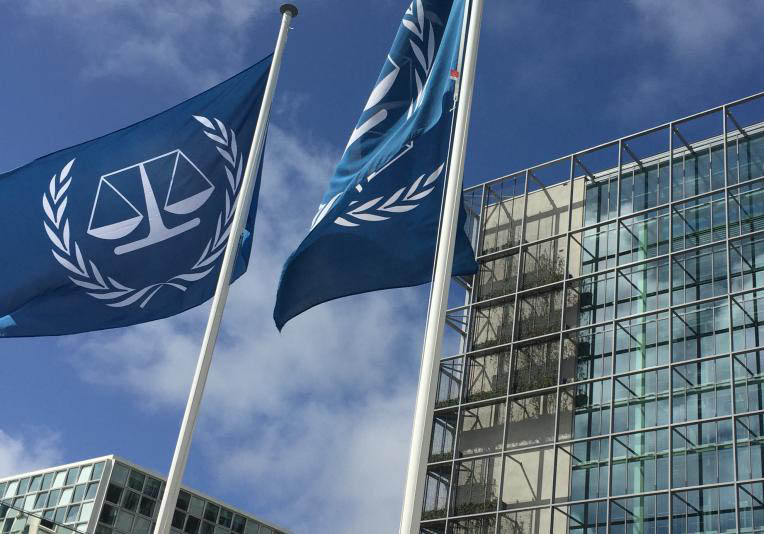
South Africa is to appear before a scheduled hearing at the International Criminal Court on 7 April 2017 (ICC) in The Hague for a hearing on its failure to arrest Sudanese President Omar Hassan Ahmad al Bashir when he visited South Africa in June 2015.
The hearing, before the pre-trial Chamber of the ICC will consider whether South Africa was in breach of its obligations under the ICC Rome statute when it failed to effect the ICC arrest warrant on President Bashir.
The ICJ, represented by South African Justice Johann Kriegler, will be attendance observing the proceedings.
President Bashir has been indicted by the ICC on charges of genocide, war crimes and crimes against humanity in relation to atrocities committed from 2003 to 2008 in Darfur.
“The case is critical for ensuring the effectiveness of the ICC as an institution. The only means the ICC has of enforcing its orders is through the cooperation of States,” said Sam Zarifi the Secretary General of the ICJ.
“The failure to arrest President Bashir and the subsequent efforts to withdraw from the ICC Rome statute raise important questions about South Africa’s commitment to the fight against impunity in Africa and globally,” Zarifi added.
South Africa gave notice last October that it intended to leave the ICC, but this notice has been withdrawn, at least pending debate in Parliament.
The ICJ had filed a brief with the South African Parliament calling on South Africa to remain with the ICC Rome statute.
The brief was signed by retired South African Constitutional Court Justices Laurie Ackermann, Richard Goldstone, Johann Kriegler, Yvonne Mokgoro, Kate O’Regan and Zak Yacoob.
It was co-signed by Navi Pillay, former United Nations High Commissioner for Human Rights, former judge of the ICC and former President of the International Criminal Tribunal for Rwanda (ICTR) and Wilder Tayler, then Secretary General of the ICJ.
Justice Zak Yacoob remarked that “pursuit of justice and pursuit of peace are complementary and mutually reinforcing objectives that South Africa will best achieve by remaining party to the Rome Statute of the ICC. Its not an either or situation. Protecting heads of States from justice whatever they do compromises peace too much.”
Contact
Arnold Tsunga, ICJ Director for Africa, t +27716405926 ; e: arnold.tsunga(a)icj.org
Background
South Africa was among the first States to ratify the Rome Statute of the ICC. It signed the Rome Statute on the day it was adopted, 17 July 1998, and ratified it on 27 November, 2000.
Both during the negotiations preceding the Rome Conference that established the Court in 1998, and at the Conference itself, South Africa played a leading role.
However, the events of June 2015 surrounding the arrival of President Omar al Bashir of Sudan in South Africa appears to have engendered a shift in South Africa’s posture, leading many observers to call into question the country’s commitment to international justice.
The failure by South African authorities to arrest and surrender President al Bashir to the ICC, although he had been indicted by the ICC for war crimes, crimes against humanity and genocide, led to the Southern Africa Litigation Centre (SALC) taking the government to court to compel it to fulfill its obligations both under the Rome Statute and the Implementation of the International Criminal Court Act 27 of 2002 (Implementation Act).
On 19 October 2016, the Minister of International Relations and Co-operation gave notice of South Africa’s intention to withdraw from the Rome Statute.
The Portfolio Committee on Justice and Correctional Services put out a call for submissions to be made to the Parliamentary Portfolio Committee on Justice and Correctional Services on the Implementation of the Rome Statute of the International Criminal Court Act Repeal Bill [B23-2016] to be made by 8th March 2017.

Feb 23, 2017 | Advocacy, Open letters
The ICJ joins South Sudanese, regional and other international non-governmental organizations in a joint letter urging the Human Rights Council to renew and strengthen the mandate and capacity of the UN Commission on Human Rights in South Sudan.
Action is needed to address the continued lack of accountability for severe, widespread and on-going crimes under international law and human rights violations and abuses, many of which amount to war crimes and crimes against humanity, during the upcoming 34th session of the UN Human Rights Council (UN HRC).
South Sudan-letter HRC34-Advocacy-Open letters-2017-ENG (full text in PDF)