Mar 7, 2019 | Events, News
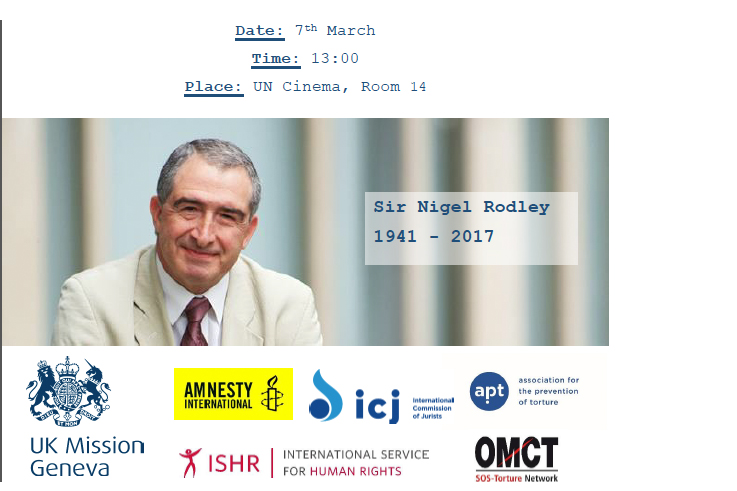
The ICJ is proud to join in presenting the documentary film The Long Haul, to be screened during the UN Human Rights Council session in Geneva.
Inspired by the life of the late Nigel Rodley—one of the principal architects of the modern human rights framework— the documentary The Long Haul addresses the current backlash on human rights and how best to respond.
Sir Nigel’s remarkable life story is an inspiration to stand up against wrongdoing and to continue fighting for equality and justice. At the same time, his family history is a reminder of the WWII tragedies that gave birth to the modern human rights regime and what could happen if we fail to honour these basic rights.
Nigel Rodley dedicated his career to the protection of those most at risk, including as Amnesty International’s first legal adviser and later as UN Special Rapporteur on Torture as then as a member and eventually Chair of the Human Rights Committee. He had a longstanding association with the ICJ as Commissioner and in other roles, and was President of the ICJ at the time he passed away.
The film will be screened at a side event to the UN Human Rights Council session, at 13h00 on Thursday 7 March, in Room XIV (UN Cinema) of the Palais des Nations in Geneva. Access is available only to those who already hold grounds passes for the UN in Geneva, or accreditation for the Council session.
The event is organised by the Permanent Mission of the United Kingdom in Geneva, with participation of the International Commission of Jurists (ICJ), Amnesty International, the World Organisation against Torture (OMCT), Association for the Prevention of Torture (APT), and International Service for Human Rights (ISHR).
For more information contact un(a)icj.org
A flyer for the event can be downloaded in PDF format here: Events-NigelRodleyFilm-2019-En
Mar 1, 2019 | Advocacy, Non-legal submissions
The ICJ today delivered a joint oral statement to the UN Human Rights Council, addressing the abuse of counter-terrorism measures to repress human rights defenders and other civil society actors, and highlighting deep concerns about possible moves to allow Egypt a significant role over the UN’s independent expert on human rights and counter-terrorism.
The statement was delivered in an interactive dialogue with the UN Special Rapporteur on the promotion and protection of human rights and fundamental freedoms while countering terrorism. The ICJ made the statement jointly on behalf of Amnesty International, Article 19, Cairo Institute for Human Rights Studies, CIVICUS, Human Rights Watch, International Federation for Human Rights (FIDH), International Service for Human Rights (ISHR), and Privacy International.
The organisations had earlier sent a joint letter to all States’ delegations to the Council in Geneva, highlighting Egypts appalling record of abuse of counter-terrorism measures, and urging States to strongly oppose any attempts to weaken the mandate of the Special Rapporteur, whether by diluting or distorting it by importing the flawed Egyptian-led approach into the Mexican-led resolution for its renewal, or any moves by longstanding leader Mexico to share co-leadership of the mandate renewal resolution with Egypt or other States with such an appalling record in relation to the very issues the mandate is to address.
The joint oral statement to the Council read as follows (check against delivery):
“Madame Special Rapporteur,
Our organizations welcome your report on the impacts of counter-terrorism and counter-extremism measures against civil society and human rights defenders (A/HRC/40/52).
We strongly concur with your findings regarding the deliberate and targeted abuse of overly broad and vague definitions of terrorism and violent extremism to criminalize and otherwise suppress human rights defenders and other civil society actors. We also appreciate your highlighting the need to prevent indirect impacts on civil society.
Among those States with a particularly appalling record of deliberate and targeted abuse, Egypt, which is mentioned in your report (paras 53 and 56), is a prominent example. As Human Rights Watch recently stated: “Using counterterrorism as a guise to crush all forms of dissent could be Egypt’s hallmark of 2018… There’s simply not much room left to peacefully challenge the government without being detained and unfairly prosecuted as a ‘terrorist’.”[1] Other examples from the reports before the Council include Turkey (para 53), Saudi Arabia (A/HRC/40/52/Add.2 paras 21-29), and China particularly as regards Uyghurs and Kazakhs (paras 55 and 57).
We share your concern about the elements lost from the previous Human Rights Council and General Assembly resolutions on “protection of human rights and fundamental freedoms while countering terrorism” in their March 2018 merger with the deeply flawed Egyptian-led initiative on “effects of terrorism” (para 29). We reiterate our call from March 2018 for future versions of the resolution to address the relevant issues exclusively and comprehensively from the perspective of the effective protection of human rights.[2] We strongly oppose any attempts to dilute your mandate, including by importing the flawed Egyptian-led approach into the resolution for its renewal, or any sharing of co-leadership of the mandate renewal resolution with States that have such an appalling record in relation to the very issues the mandate is to address.
Madame Rapporteur, beyond the particular cases mentioned in your report (para 53), what are your views on the broader situation within Egypt in terms of abuse of counter-terrorism measures and what can States, the United Nations, civil society, and other stakeholders do to stop such abuses in the name of counter-terrorism in Egypt and other egregious situations?
Thank you.
[1] https://www.hrw.org/news/2019/01/17/egypt-new-moves-crush-dissent (17 January 2019). See also among others: Human Rights Watch World Report 2019, https://www.hrw.org/world-report/2019/country-chapters/egypt; EuroMed Rights, Egypt – Finding Scapegoats: Crackdown on Human Rights Defenders and Freedoms in the Name of Counter-terrorism and Security (Feb 2018) https://euromedrights.org/wp-content/uploads/2018/03/EuroMed-Rights-Report-on-Counter-terrorism-and-Human-Rights.pdf; Joint NGO Statement, Egypt: Civil society faces existential threat (23 June 2016) https://www.icj.org/wp-content/uploads/2016/06/Egypt-Advocacy-JointNGOStatement-2016.pdf.
[2] Joint NGO end-of-session statement (23 March 2018) https://www.icj.org/hrc37-endofsession/.”
The statement can be downloaded in PDF format here: HRC40-JointOralStatement-SRCTHR-2019-EN
For more information email un(a)icj.org.
Feb 28, 2019 | Events, News
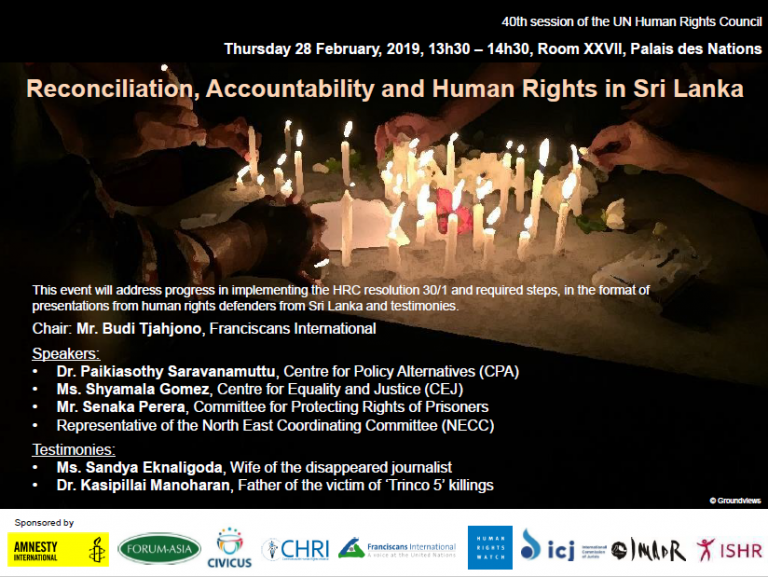
This event will address progress in implementing Human Rights Council resolution 30/1 and required steps, in the format of presentations from human rights defenders from Sri Lanka and testimonies.
Date: Thursday, 28 February 2019
Time: 13.30 – 14.30
Venue: Room XXVII, Palais des Nations
Chair: Mr. Budi Tjahjono, Franciscans International
Speakers:
- Dr. Paikiasothy Saravanamuttu, Centre for Policy Alternatives (CPA)
- Ms. Shyamala Gomez, Centre for Equality and Justice (CEJ)
- Mr. Senaka Perera, Committee for Protecting Rights of Prisoners
- Representative of the North East Coordinating Committee (NECC)
Testimonies:
- Ms. Sandya Eknaligoda, Wife of the disappeared journalist
- Dr. Kasipillai Manoharan, Father of the victim of ‘Trinco 5’ killings
Sponsors:
- Asian Forum for Human Rights and Development (FORUM-ASIA)
- Amnesty International
- CIVICUS
- Commonwealth Human Rights Initiative (CHRI)
- Franciscans International
- Human Rights Watch (HRW)
- International Commission of Jurists (ICJ)
- International Movement Against all forms of Discrimination and Racism (IMADR)
- International Service for Human Rights (ISHR)
Dec 28, 2018 | Multimedia items, News, Video clips
During a week of training and practical experience of UN human rights mechanisms in Geneva, women lawyers spoke of the ways in which civil society actors can use these mechanisms to strengthen advocacy efforts.
As part of a project supported by the German Mission to the United Nations in Geneva the ICJ invited two groups of women lawyers to Geneva to attend training workshops that took place during the course of the June and September ordinary sessions of the UN Human Rights Council.
Participants spoke about their experiences with the interplay between UN mechanisms and domestic changes.
Lebanese lawyer Nina Abdallah noted the limitations of these mechanisms when States do not accept mechanisms that allow for individual complaint. As Lebanon has not yet become party to the Optional Protocol of the CEDAW Convention this means that individuals cannot access the CEDAW Committee to seek a remedy for violations and against that State’s failure to meet obligations under the Convention.
However, she explained that although this limits the accessibility of certain mechanisms, civil society can still play an important role in raising rights issues, calling for removal of reservations and acceptance of complaint procedures for specific Conventions through other mechanisms, such as the Universal Periodic Review reporting process.
Maria Sol Taule, a lawyer from the Philippines working for human rights NGO Karapatan, noted that it is difficult for UN mechanisms to address individual cases when there are so many issues to deal with. However, she said that these mechanisms do still serve as an “effective tool to use as a platform to drumbeat our issues that haven’t been heard by our respective governments.”
Civil society participation in the Human Rights Council, State reporting processes for Committees and the UPR provide an occasion to highlight the human rights difficulties faced within specific countries. Ms Taule said this kind of engagement also offers the opportunity to enhance international solidarity with other organizations from other countries that are dealing with similar rights issues.
Dec 21, 2018 | Multimedia items, News, Video clips
The ICJ invited a number of women lawyers to Geneva to participate in a training workshop and gain practical experience of UN human rights mechanisms as part of a project supported by the German Mission to the United Nations in Geneva.
One group of women came to Geneva in June during the 38th session of the UN Human Rights Council and 70th session of the Committee on the Elimination of Discrimination against Women, and the other group came in September to coincide with the 39th session of the Human Rights Council.
During the week long training workshops participants learned about the international human rights mechanisms available to tackle issues of women’s access to justice and gained hands-on exposure to the operation of these mechanisms in practice.
Participants spoke about the impact that the CEDAW Convention has had in their domestic legislation.
Donia Allani a lawyer and lecturer at the Faculty of Legal, Political and Social Sciences of Tunis, discussed the impact of CEDAW in shaping legislation in Tunis to eliminate violence against women and facilitate access to justice but noted that women still faced stigmatization.
Donia Allani commented, however, that UN mechanisms could be improved to ensure that all activists and feminists can access these mechanisms without fear of reprisals.
Uzbek lawyer Sabina Saparova, also spoke of the impact that international law and standards can have domestically. She explained that Uzbekistan’s ratification of the CEDAW Convention provided an international commitment to incorporating equality between men and women into its legal structure. Recently the president of Uzbekistan initiated the first steps toward the adoption of a law on the prevention of domestic violence.