Jun 13, 2016 | Events
Who judges the judges?
Accountability for judicial corruption and judicial complicity
Side Event Tuesday 14 June 2016, 14:00 – 16:00
Room XXIII, Palais des Nations, Geneva.
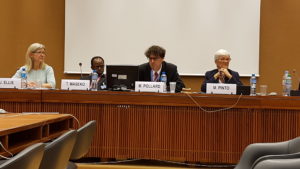
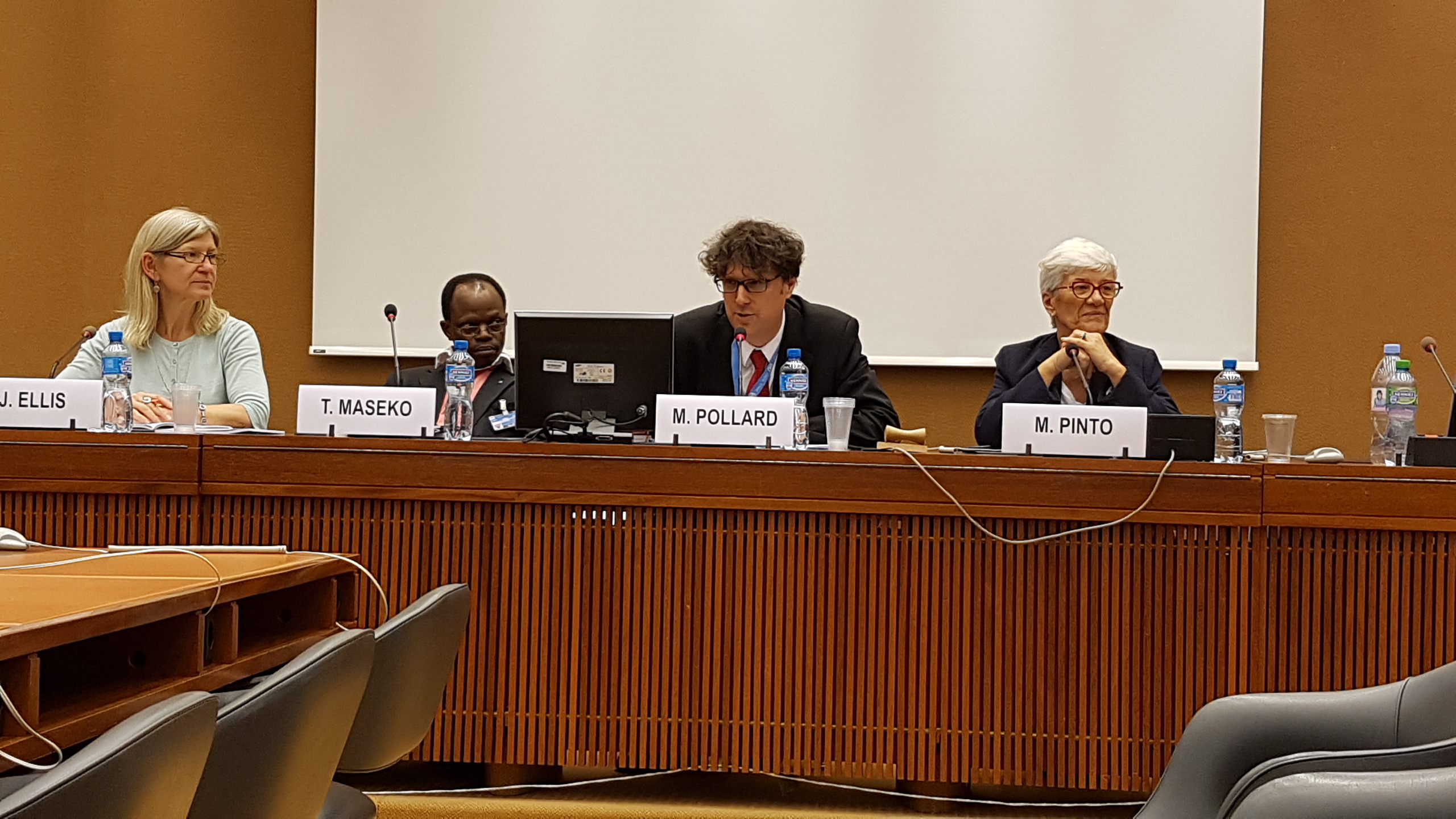
The International Commission of Jurists (ICJ) and the International Bar Association (IBA) organised a side event to the 32nd session of the Human Rights Council, on the topic of accountability for judicial corruption and judicial involvement in human rights violations.
The well-attended event considered the need for judicial accountability, and different options for effective mechanisms and procedures of accountability. Recommendations for ordinary situations were complemented with reflections on circumstances of transitions where the judiciary have been deeply implicated in the violations of the previous regime, as well as particular challenges in developing countries.
At the event the ICJ launched its new Practitioners’ Guide on Judicial Accountability, and the IBA presented the recent report of its Judicial Integrity Initiative on Judicial systems and Corruption. Print copies of both publications were distributed.
A panel discussion also featured the UN Special Rapporteur on the independence of judges and lawyers, as well as Thulani Maseko, a lawyer from Swaziland who was subjected to prolonged arbitrary detention and imprisonment by judges in Swaziland, for speaking publicly about judicial misconduct in the country.
Speakers:
- Mónica Pinto Special Rapporteur on the independence of judges and lawyers
- Thulani Maseko Lawyer, Swaziland
- Jane Ellis, Director, Legal & Policy Research Unit, International Bar Association
- Matt Pollard, Centre for the Independence of Judges & Lawyers, International Commission of Jurists
In addition to the ICJ and IBA, side event co-sponsors included:
- The Permanent Mission of Hungary to the UN
- Commonwealth Magistrates’ and Judges’ Association
- Commonwealth Lawyers Association
- Rechters voor Rechters (Judges for Judges), Netherlands
- International Legal Assistance Consortium
The ICJ Practitioners’ Guide on Judicial Accountability, and the research and consultations on which it is based, was made possible with the financial support of the Republic and Canton of Geneva and the Ministry of Foreign Affairs of Finland.
For more information, please contact Matt Pollard.
ICJ Practitioners’ Guide No. 13 on Judicial Accountability
The ICJ’s Practitioners’ Guide No. 13 on Judicial Accountability aims to help practitioners ensure accountability for serious judicial misconduct, such as corruption or complicity in human rights violations, while preserving the independence of the judiciary.
It focuses on international standards on accountability mechanisms and procedures, illustrated by practical examples. It addresses not only the accountability of individual judges, and the accountability of judiciary as an institution, but also State responsibility under international law, particularly in relation to harm caused to victims of violations by judges.
The Guide was greatly informed by discussions among eminent judges and lawyers from around the world, convened by the ICJ Centre for the Independence of Judges & Lawyers, in Tunisia in October 2015 , and in Geneva in December 2015.
Among the topics covered by the new ICJ Guide are:
- The obligation to ensure an independent, impartial and accountable judiciary.
- The forms of judicial accountability, including:
- Remedy and reparation for victims,
- The responsibility of the State,
- Removal from office, disciplinary sanctions, and other administrative measures,
- Criminal responsibility, and
- The right to the truth.
- The structure and elements of accountability bodies, such as:
- Review of decisions through appeal or judicial review,
- Judicial councils,
- The ordinary courts,
- Parliamentary procedures,
- Ad hoc tribunals,
- Anti-corruption bodies,
- Civil society monitoring and reporting,
- National human rights institutions,
- Professional associations,
- International accountability mechanisms.
- Procedural issues, including:
- Necessary powers for accountability mechanisms,
- Procedural rights of the judge,
- Procedural rights of complainants and victims,
- Publicity and transparency,
- Procedures for lifting judicial immunity,
- Temporary suspension during proceedings, and
- Selective enforcement for improper purposes.
- Mechanisms in exceptional circumstances, such as transitions from undemocratic or authoritarian regimes, including:
- Truth commissions,
- Vetting, and
- Mass removal and re-application.
- Particular challenges in relation to developing countries.
Apr 29, 2016 | Advocacy, Position papers
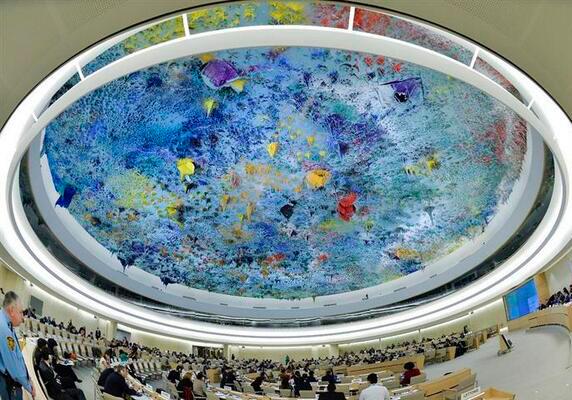
In a joint briefing paper published on the occasion of the anniversary of the Human Rights Council, 20 leading national, regional and international human rights NGOs have outlined a series of concrete steps and proposals that would strengthen the impact of the Council’s work.
The civil society paper outlines a broad vision of a Council that directly guides the actions of State and non-state actors, addresses serious rights violations head on, provides space for civil society, and demands better adherence to basic membership standards.The paper was coordinated by the International Service for Human Rights (ISHR) with the input of global NGOs including the ICJ, as well as organisations from all regions.
The paper can be downloaded here (in PDF): http://www.ishr.ch/HRCat10
Mar 24, 2016 | News
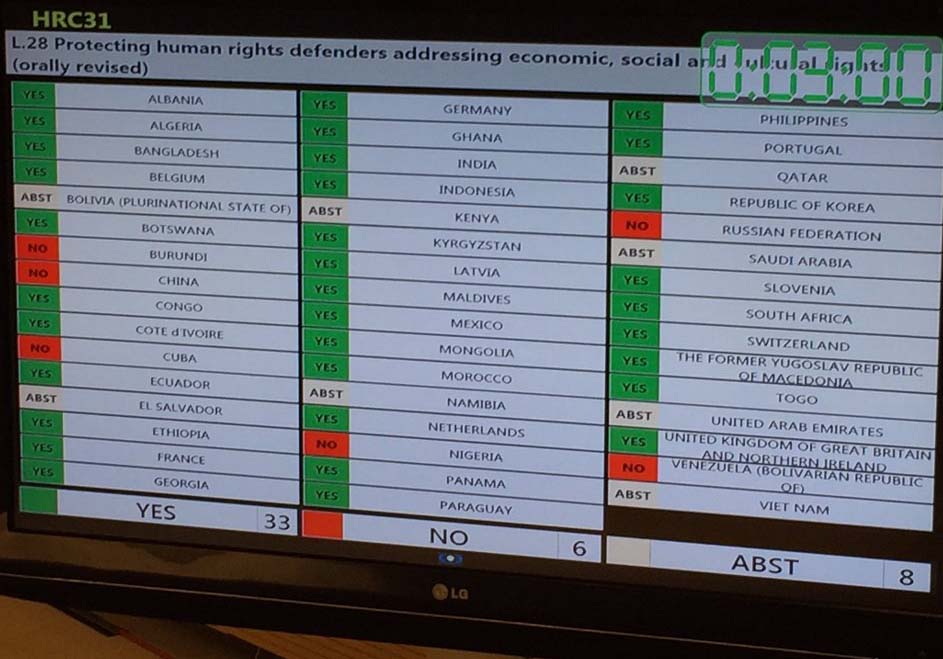
The ICJ welcomes today’s adoption by the UN Human Rights Council of a resolution on human rights defenders addressing economic, social and cultural rights.Negotiation of the resolution was led by Norway, who presented the draft to the Council with co-sponsorship with a large number of states from around the world.
A series of hostile amendments tabled by the Russian Federation, China, Cuba, Egypt and Pakistan, which would have weakened the resolution, were defeated, and the resolution was ultimately adopted by a large majority.
The ICJ had earlier joined advocacy efforts to support the resolution text as presented, and welcomes the strong message the resolution as adopted sends affirming the importance of defenders’ work on economic, social and cultural rights, as well as the need for states to respect, protect and fulfil the human rights of such defenders, including through a range of legislative, policy, and practical measures.
The draft resolution is available in an unofficial version here: 2016 draft resolution HRDs as orally revised.
The voting on the resolution is available here: Result of the vote HRDs
Mar 23, 2016 | Advocacy, Non-legal submissions
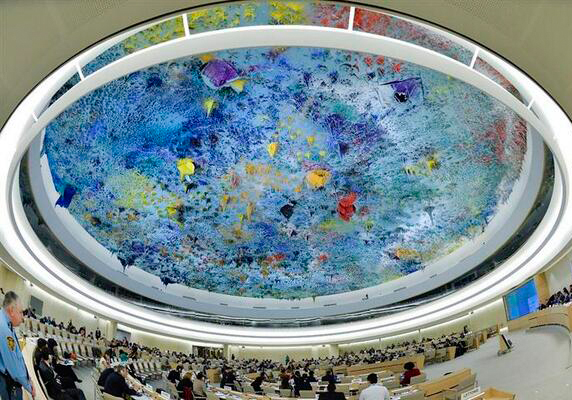
The ICJ today joined other NGOs in an oral statement to the UN Human Rights Council on the findings of the report of the OHCHR investigation mission on Libya.
It includes that violations of international law taking place throughout Libya “may amount to war crimes and other international crimes under international law.”
The statement continued as follows:
All sides to the conflict in Libya continue to perpetrate grave human rights violations and abuses. As highlighted by the UN High Commissioner for Human Rights, these violations continue to take place with “complete impunity” amid the collapse of the domestic justice system.
Unless genuine accountability is provided for these ongoing crimes the cycle of violence in Libya will continue, and the peace process will likely become no more than a well-intentioned piece of paper.
In this context, this Council has a duty to remain seized of the human rights situation in Libya, ensure continued monitoring of the situation and act to strengthen international accountability for crimes committed in Libya if the national system remains incapable of fulfilling this role. We are deeply concerned that the current resolution before this Council falls short of that standard.
Additionally, all UN member states should ensure that the International Criminal Court has the capacity to fulfill the mandate provided to it by the Security Council and begin fully fledged investigations into past and ongoing crimes committed in Libya.
As highlighted by civil society in a letter to this Council: “It is critical that all parties to the conflict are put on notice that their actions are being monitored and that accountability for serious crimes is a real prospect rather than an empty threat. Failure to do so will likely embolden those committing violations of international human rights and humanitarian law and will reinforce the endless cycle of impunity” in Libya.
The statement was on behalf of Cairo Institute for Human Rights Studies, CIVICUS, Human Rights Watch, International Commission of Jurists, FIDH, and OMCT.
Mar 18, 2016 | Advocacy, Non-legal submissions
The ICJ today joined an oral statement on the role of judges, lawyers, and prosecutors, as well as the threats they face, and the Universal Periodic Review of the UN Human Rights Council.
The statement, delivered by the Director of the International Bar Association’s Human Rights Institute, Dr Phillip Tahmindjis, read as follows:
“The International Bar Association’s Human Rights Institute (IBAHRI) released this week its report on the ‘Role of the UPR in advancing human rights in the administration of justice’. The report assesses more than 38,000 recommendations made between 2008 and 2014 for references to the legal profession.
The report’s key findings include:
UPR recommendations still insufficiently address the role of judges, lawyers and prosecutors, or the threats they face, as extensively documented by the Special Rapporteur on the Independence of Judges and Lawyers. Significantly, these recommendations often make no reference to relevant UN standards.
Recommendations relating to the independence of judges are often too vague to be an effective response to the shortcomings of any given jurisdiction. Serious issues in the appointment and removal of judges are mostly ignored.
The independence of lawyers was considered in fewer than 100 of the 38,000 UPR recommendations.
Prosecutorial independence is addressed in less than 10 per cent of the recommendations calling upon States to effectively investigate or prosecute rights violations.
Guarantees for legal professionals’ rights to freedom of expression, assembly and association are barely addressed. This fails to reflect the key role that self-governing organisations of legal professionals should play in upholding human rights and the rule of law, the independence of the legal profession and law reform processes.
As international organisations of legal professionals, we foster the engagement of the legal profession in UN human rights mechanisms and in monitoring the implementation of UPR recommendations.
We call upon the Human Rights Council, as well as States, to ensure that in the third cycle of the UPR, the role of judges, lawyers, and prosecutors receives the heightened attention that it is due, as recognised by the UN Basic Principles on the independence of the judiciary, the UN Basic Principles on the role of lawyers and the UN Guidelines on the role of prosecutors.”
The following organisations endorsed the statement:
- Commonwealth Magistrates’ and Judges’ Association
- Commonwealth Lawyers Association
- International Bar Association’s Human Rights Institute
- International Commission of Jurists
- Judges for Judges
- Lawyers for Lawyers
- Southern Africa Litigation Centre
The statement can be downloaded in PDF format here: HRC31-JointOralStatement-UPRLegalProfessions-2016
The IBAHRI report on ‘The role of the UPR in advancing human rights in the administration of justice’ is available at : http://tinyurl.com/gr525sq