Nov 17, 2017 | News
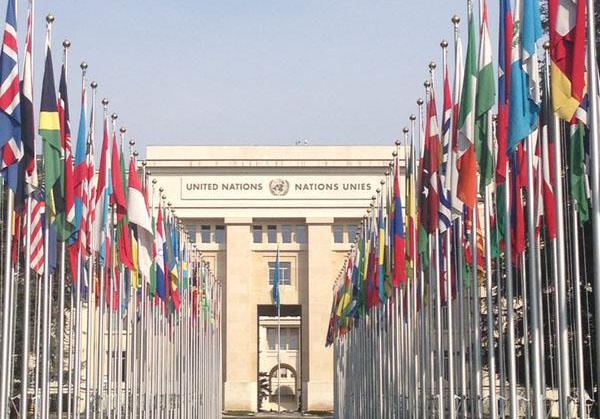
Pakistan’s third Universal Periodic Review (UPR) has drawn global attention to a number of serious human rights failures in the country, said the ICJ today.
On 16 November, the UPR Working Group of the Human Rights Council adopted a draft UPR outcome report for Pakistan. Pakistan received a total of 289 recommendations – a substantial increase from its previous UPR in 2012, when Pakistan received 167 recommendations. As many as 111 State delegations took the floor to make statements, and 14 States submitted their questions in advance.
“That well over a hundred delegations participated in the review indicates the global community’s interest in Pakistan’s human rights situation,” said Frederick Rawski, ICJ’s Asia Director.
Key recommendations urge Pakistan to:
- Reinstate a moratorium on executions with the view to abolishing the death penalty;
- Repeal or amend “blasphemy laws” to bring them in line with international human rights law;
- Ratify the International Convention for the Protection of All Persons from Enforced Disappearance and a number of other human rights treaties;
- Ensure effective protection of the rights of religious minorities, human rights defenders, journalists and other vulnerable groups;
- Strengthen the National Commission for Human Rights;
- Ensure prompt, impartial and effective investigations of human rights violations and bring perpetrators to justice;
- Set 18 as the minimum legal age for marriage; and
- Ensure effective implementation of laws on violence against women.
“The States’ recommendations echo the concerns of dozens of civil society organizations and even the National Commission of Human Rights – who all agree that the Government must take urgent measures to address the downward spiral of rights in the country”, Rawski said.
Pakistan will now examine the recommendations and respond to the Human Rights Council at latest by the Council’s next session in March 2018.
Pakistan’s review comes at a time of serious concern about the rights situation in the country.
The Government lifted the informal moratorium on the death penalty and carried out nearly 500 executions in less than three years – among the highest execution rates in the world; Parliament enacted laws allowing military courts to try civilians for certain terrorism-related offences in secret trials; and the authorities started a new wave of crackdowns on NGOs, journalists and human rights defenders, including subjecting them to enforced disappearance.
Persecution of religious minority communities also continues despite the Government’s claims that religious minorities “enjoy equal rights as equal citizens of Pakistan”. Last month, three Ahmadi men were sentenced to death for blasphemy for allegedly scratching anti-Ahmadi pamphlets that had the “Mohr-e-Nabbuwat” (seal of the Prophet Muhammad) printed on them. And earlier this week, the Islamabad High Court directed the Government to respond to a petition demanding a separate database for Ahmadis in the civil service to ensure they are not “posted in offices involving sensitive matters”.
“As a member of the Human Rights Council, Pakistan is expected to uphold the highest standards in the promotion and protection of human rights, something it has clearly failed to do,” added Rawski.
“Pakistan should make use of this process by accepting the recommendations made during the review and adopting a concrete, action-based national human rights plan to ensure their effective implementation.”
Contact
Frederick Rawski, ICJ Asia Pacific Regional Director, t: +66 64 478 1121, e: frederick.rawski@icj.org
Reema Omer, ICJ International Legal Adviser for Pakistan (London), t: +447889565691; e: reema.omer(a)icj.org
Pakistan-UPR-PressRelease-2017-eng (download the press release)
Additional information
UN Member States reviewed Pakistan’s human rights record for the third time on Monday, 13 November, through the UPR process.
The UPR is a unique mechanism of the UN Human Rights Council aimed at improving the human rights situation of each of the 193 UN Member States. Under this mechanism, the human rights record of all UN Member States is peer-reviewed every four to five years by the UPR Working Group, consisting of the 47 UN Member States of the Human Rights Council; however, any UN Member State can take part in the discussions and the dialogue during the UPR of the reviewed States. States then make recommendations to the country under review, which has the option of accepting or noting the recommendations.
Nov 10, 2017 | News
As Pakistan is set to undergo its third Universal Periodic Review (UPR) on 13 November, the ICJ has urged Pakistani authorities to meaningfully engage with the process to improve the human rights situation in the country.
“Pakistan’s past engagement with the UPR has been characterized by denial and defensive posturing,” said Frederick Rawski, ICJ’s Asia Director.
“As a recently-elected member of the UN Human Rights Council, it is more important than ever for the Pakistan to show that it takes its human rights obligations seriously by engaging with the upcoming UPR in its true spirit,” he added.
During its second UPR in 2012, Pakistan received 167 recommendations, of which it rejected seven, noted 34, and accepted 126.
The seven recommendations rejected by Pakistan relate to some of the most serious human rights violations in the country, including recommendations to adopt an official moratorium on the death penalty with a view to abolishing capital punishment in law and practice, repeal blasphemy laws, and decriminalize adultery and non-marital consensual sex.
Even accepted recommendations have been largely ignored in the four years since the previous UPR, the ICJ notes.
Enforced disappearances are still not recognized as a distinct, autonomous crime; perpetrators of gross human rights violations continue to escape justice; there has been complete inaction to prevent abuse of so-called blasphemy laws; and freedom of expression is often restricted on vague grounds such as “national security” and “immorality”.
“Pakistan’s human rights situation has in many ways deteriorated since 2012,” Rawski added.
“Yet – as reflected by Pakistan’s national report for the upcoming UPR – the authorities apparently remain in a state of denial about the dire human rights implications of these new measures,” he said.
These measures include the lifting the informal moratorium on the death penalty and carrying out nearly 500 executions in less than three years – among the highest in the world; passing laws allowing military courts to try civilians for certain terrorism-related offences; and a new wave of crackdowns on NGOs, journalists and human rights defenders, including retaliating against NGOs for presenting “a very bleak picture” of the country’s human rights situation to the UN.
“UN member states on Monday should urge Pakistan to end the dangerous downward spiral on rights by ending repression, respecting fundamental freedoms, and holding perpetrators of violations responsible,” Rawski said.
Contact
Frederick Rawski, ICJ Asia Pacific Regional Director, t: +66 64 478 1121, e: frederick.rawski(a)icj.org
Reema Omer, ICJ International Legal Adviser for Pakistan (London), t: +447889565691; e: reema.omer(a)icj.org
Additional information
The UPR is a unique mechanism of the UN Human Rights Council aimed at improving the human rights situation of each of the 193 UN Member States. Under this mechanism, the human rights record of all UN Member States is peer-reviewed every four to five years by the UPR Working Group, consisting of the 47 UN Member States of the Human Rights Council; however, any UN Member State can take part in the discussions and the dialogue during the UPR of the reviewed States. States then make recommendations to the country under review, which has the option of accepting or noting the recommendations.
Nov 1, 2017 | News, Publications, Reports, Thematic reports
The arrest of absconding murder convict Bal Krishna Dhungel, a senior Maoist leader, highlights the weaknesses, as well as the promises, for victims seeking accountability through Nepal’s judicial system, said the ICJ as it released a report on accountability mechanisms in the country.
The ICJ’s report Achieving Justice for Gross Human Rights Violations in Nepal concludes that impunity for gross human rights violations is one of the major obstacles to the creation of a stable and legitimate democratic government and lies at the heart of the rule of law crisis in Nepal.
It found that a lack of commitment by Nepal’s political leadership to address past and ongoing human rights violations continues to allow perpetrators to escape justice and undermines victims’ right to effective remedies and reparation.
“In the past, the promise to shield perpetrators for human rights violations has been used as a bargaining chip to garner political support and build political alliances,” said Frederick Rawski, Director of the ICJ’s Asia Pacific Regional Programme.
“It is imperative that accountability for human rights violations remains a priority for Nepal’s political leadership after Parliamentary elections, and that alliances between political parties are not once again used as an excuse to undermine Nepal’s human rights obligations,” added Rawski.
Attempts to thwart justice have also included the cynical manipulation of justice sector actors, from the police to the Attorney General’s office, in a way that threatens the independence and credibility of the institutions responsible for safeguarding human rights and the rule of law in Nepal, the report highlights.
This pattern of impunity persists despite demands for accountability by civil society and victims’ organizations, as well as the National Human Rights Commission and Nepal’s Supreme Court.
“In many ways, the Supreme Court of Nepal has emerged as a beacon of hope for victims of human rights violations,” said Rawski.
“The Court has given domestic effect to Nepal’s obligations under international law and has set high standards for accountability, remedy and reparations,” he added.
However, the Government’s disregard of key judgments has limited the impact of the Supreme Court’s jurisprudence, the report says.
Attacks on the independence of the judiciary, as demonstrated by the impeachment motion against former Chief Justice Sushila Karki, also indicate a worrying trend.
The ICJ’s report found that the mandate and operation of transitional justice mechanisms fall short of international standards despite the repeated reinforcement of such standards by the Supreme Court.
Though ostensibly formed to provide a measure of public accountability, the practice of forming ad hoc commissions of inquiry to investigate rights violations has promoted impunity by diverting investigations from the criminal justice process – where they belong – into parallel mechanisms that are established by means that make them vulnerable to political interference and manipulation.
The ICJ’s report also concludes that gross human rights violations in Nepal are not a thing of the past, but are ongoing.
Notably in the Terai region, the State has responded to the Madhesh movement with excessive use of force, extrajudicial killings, and torture and other ill-treatment.
Political expediency has trumped calls for justice and accountability and the Government continues to use State machinery to shield perpetrators rather than serve the interests of justice.
“In a seemingly perpetual cycle, the weak rule of law in the country contributes to impunity for human rights violations, and this culture of impunity further erodes the rule of law,” said Rawski.
“The search for truth and justice in Nepal will not be realized unless this cycle is ended,” he added.
Additional information
Dhungel had been absconding since the Supreme Court upheld his conviction for murder in 2010. The arrest comes after a contempt of court petition was filed before the Supreme Court against the Inspector General of Police for failing to implement multiple Supreme Court orders directing Dhungel’s arrest.
Contact
Frederick Rawski, ICJ Asia Pacific Regional Director, t: +66 64 478 1121, e: frederick.rawski@icj.org
Alex Conte, ICJ Global Redress and Accountability Initiative, t: +41.79.957.2733; e: alex.conte@icj.org
Download
Nepal-GRA Baseline Study-Publications-Reports-Thematic reports-2017-ENG (full report in PDF)
Read also
ICJ Discussion Paper Nepal’s Transitional Justice Process: Challenges and Future Strategy (August 2017)
ICJ Report Authority without Accountability: The struggle for justice in Nepal (October 2013)

Sep 13, 2017 | Advocacy, News
As proceedings resume in India v. Pakistan (Jadhav case) before the International Court of Justice (ICJ), the ICJ has published a briefing paper to clarify the key issues and relevant laws raised in the case in a Question and Answer format.
The case concerns Pakistan’s failure to allow for consular access to an Indian national detained on charges of serious crimes.
India has alleged “egregious violations of the Vienna Convention on Consular Relations (VCCR)” by Pakistan in connection with the detention, trial and conviction of Indian national Kulbhushan Sudhir Jadhav.
Pakistani authorities arrested Jadhav on 3 March 2016.
India was informed of the arrest on 25 March 2016. On 10 April 2017, Pakistan’s military announced Jadhav had been convicted and sentenced to death by a military court for “espionage and sabotage activities against Pakistan.”
India’s requests for consular access, made at least sixteen times starting from 25 March 2016, were either denied by Pakistan or made conditional upon India’s assistance in the investigation against Jadhav.
India alleges that denial of consular access breaches Pakistan’s obligations under Article 36(1) of the VCCR, to which both States are parties.
In May 2017, the ICJ accepted India’s request for provisional measures and directed Pakistan to “take all measures at its disposal” to ensure Jadhav is not executed pending the final decision of the Court.
India is due to file its written memorial with supporting documents today, 13 September.
Pakistan will have three months to file a counter-memorial.
The ICJ will then decide on dates for oral hearing of arguments.
Following the hearings, the Court will deliberate and issue a judgment.
While the case at issue is limited to denial of consular access under the VCCR, it engages other critical fair trial concerns that arise in military trials in Pakistan.
The International Commission of Jurists has documented how Pakistani military courts are not independent and the proceedings before them fall far short of national and international fair trial standards.
Judges of military courts are part of the executive branch of the State and continue to be subjected to military command; the right to appeal to civilian courts is not available; the right to a public hearing is not guaranteed; and a duly reasoned, written judgment, including the essential findings, evidence and legal reasoning, is denied.
The case also underscores one of inherent problems of the death penalty: that fair trial violations that lead to the execution of a person are inherently irreparable.
The International Commission of Jurists considers the death penalty a violation of the right to life and cruel, inhuman or degrading punishment and notes that a large majority of States, in repeated UN resolutions, have called on retentionist states to declare a moratorium on the practice with a view to abolition.
Contact:
Frederick Rawski (Bangkok), ICJ Asia Pacific Regional Director, e: frederick.rawski@icj.org
Reema Omer (London), ICJ International Legal Adviser, South Asia t: +447889565691; e: reema.omer(a)icj.org
Download the Q&A:
India-ICJ Q&A Jadhav case-Advocacy-2017-ENG (in PDF)

Aug 29, 2017 | News, Publications, Reports, Thematic reports
South Asian states can only address the tens of thousands of cases of enforced disappearances by recognizing enforced disappearance as a serious crime in domestic law, said the ICJ today.
On the eve of the International Day of the Victims of Enforced Disappearances, the ICJ 58-page report No more ‘missing persons’: the criminalization of enforced disappearance in South Asia analyzes States’ obligations to ensure that enforced disappearance constitutes a distinct, autonomous crime under national law.
It also provides an overview of the practice of enforced disappearance, focusing specifically on the status of the criminalization of the practice, in five South Asian countries: India, Pakistan, Bangladesh, Sri Lanka and Nepal.
For each State, the report briefly examines the national context in which enforced disappearances are reported, the existing legal framework, the role of the courts; and the international commitments and responses to recommendations concerning criminalization.
“It is alarming that despite the region having some of the highest numbers of reported cases of disappearances in the world, enforced disappearance is not presently a distinct crime in any South Asian country,” said Frederick Rawski, ICJ’s Asia Director.
“This shows the lack of political will to hold perpetrators to account and complete apathy towards victims and their right to truth, justice and reparation,” he added.
In Nepal and Sri Lanka, draft legislation to criminalize enforced disappearance is under consideration.
Though the initiatives are welcome, the draft bills in both countries are flawed and require substantial improvements to meet international standards.
In the absence of a clear national legal framework specifically criminalizing enforced disappearance, unacknowledged detentions by law enforcement agencies are often treated by national authorities as “missing persons” cases.
On the rare occasions where criminal complaints are registered against alleged perpetrators, complainants are forced to categorize the crime as “abduction”, “kidnapping” or “unlawful confinement”.
These categories do not recognize the complexity and the particularly serious nature of enforced disappearance, and often do not provide for penalties commensurate to the gravity of the crime.
They also fail to recognize as victims relatives of the “disappeared” person and others suffering harm as a result of the enforced disappearance, as required under international law.
“Like torture and extrajudicial execution, enforced disappearance is a gross human rights violation and a crime under international law,” said Rawski.
“South Asian States must recognize that they have an obligation to criminalize the practice with penalties commensurate with the seriousness of the crime–filing “missing” person” complaints in cases of disappearance is not enough, and in fact, it trivializes the gravity of the crime,” he added.
Other barriers to bringing perpetrators to account are also similar across South Asian countries: military and intelligence agencies have extensive and unaccountable powers, including for arrest and detention, often in the name of “national security”; members of law enforcement and security forces enjoy broad legal immunities, shielding them from prosecution; and military courts have jurisdiction over crimes committed by members of the military, even where these crimes are human rights violations, and proceedings before such courts are compromised by their lack of independence and impartiality.
Victims’ groups, lawyers, and activists who work on enforced disappearance also face security risks including attacks, harassment, surveillance, and intimidation.
A comprehensive set of reforms, both in law and policy, is required to end the entrenched impunity for enforced disappearances in the region – criminalizing the practice would be a significant first step, said the ICJ.
Contacts:
Frederick Rawski (Bangkok), ICJ Asia Pacific Regional Director, e: frederick.rawski(a)icj.org
Reema Omer, ICJ International Legal Advisor (South Asia) t: +923214968434; e: reema.omer(a)icj.org
Thyagi Ruwanpathirana, ICJ National Legal Advisor (Sri Lanka), e: thyagi.ruwanpathirana(a)icj.org
Background
Under international law, an enforced disappearance is the arrest, abduction or detention by State agents, or by people acting with the authorization, support or acquiescence of the State, followed by a refusal to acknowledge the detention or by concealing the fate or whereabouts of the “disappeared” person which places the person outside the protection of the law.
The UN General Assembly has repeatedly described enforced disappearance as “an offence to human dignity”.
South Asia-Enforced Disappearance-Publications-Reports-Thematic Reports-2017-ENG (full report in PDF)
Aug 29, 2017 | News
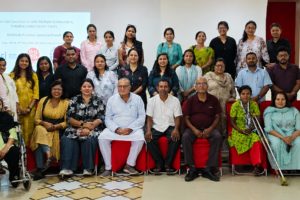
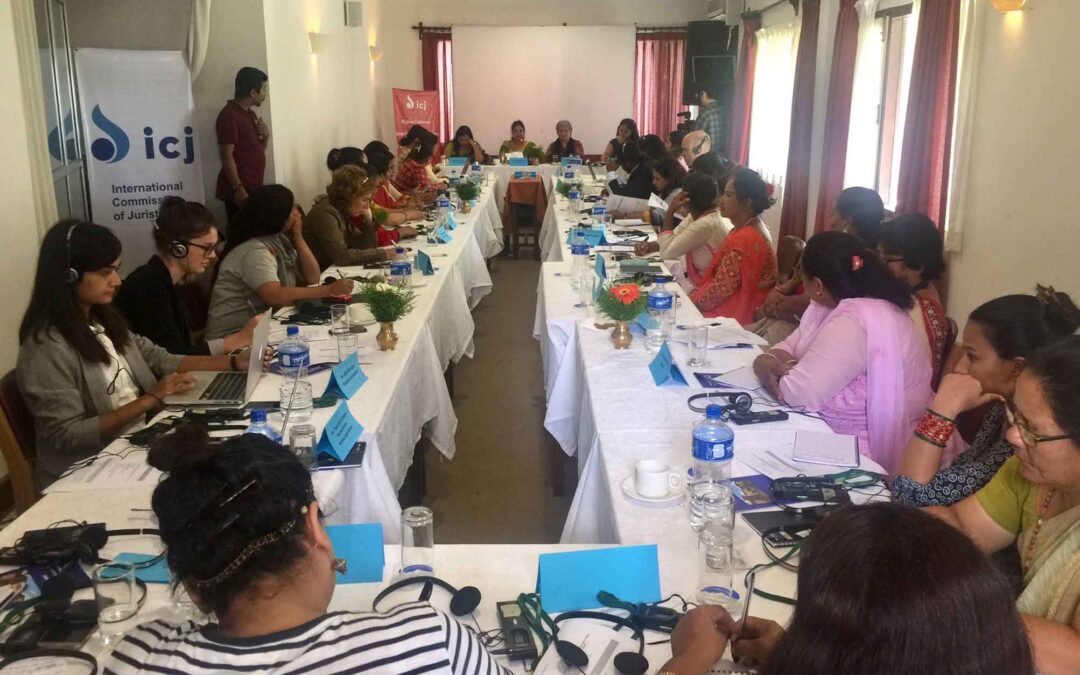
Today, the ICJ concluded its Regional Conference on Women Human Rights Defenders as Political Actors, which gathered in Kathmandu women human rights defenders (WHRDs) from all over Nepal who were recently elected during the local elections in May 2017.
They were joined by Bushra Gohar, a former Member of Parliament in Pakistan, Ahmed Naaif of the Maldivian Democracy Network, and Sherene Xavier, a filmmaker and WHRD from Sri Lanka.
The discussions focused on how the newly-elected WHRDs can continue to advance human rights in their new roles as elected officials.
Under Nepal’s Local Level Election Act 2017, political parties are required to field female candidates for half of the executive posts (mayor/deputy mayor) and at least 40% for membership at the local community councils.
In May 2017, during the first local election held in the country in almost 20 years, approximately 20,000 women stood for elections, including WHRDs.
Most of the women candidates, however, were fielded by the political parties for the deputy mayor posts. At least 92% of the candidates fielded for the mayoral posts were men.
The discussions during the two-day conference (28-29 August 2017) focused on how these affirmative measures should be utilized by women human rights defenders in Nepal to advance equal participation of women in public affairs and further their advocacy for human rights.
There was some caution expressed by some of the women that these measures may reinforce the already disadvantaged place women hold in public life and may also be viewed as tokenism.
Participants in the conference discussed as well how as WHRDs, they would need to deal with human rights abuses allegedly committed by their political parties against women.
The need for WHRDs in politics to have their own support system was also emphasized during the conference.
The participants of the conference ran under the banner of various political parties in Nepal.
The National Alliance of Women Human Rights Defenders of Nepal collaborated with ICJ in organizing the conference.
The conference was opened with a keynote speech from Justice Sapana Pradhan Malla of the Supreme Court of Nepal, who spoke about the challenging path women politicians face.
Former Chief Justice Kalyan Shrestha, Commissioner of the ICJ, chaired the opening ceremonies.