Oct 1, 2018 | Advocacy, Cases, Legal submissions
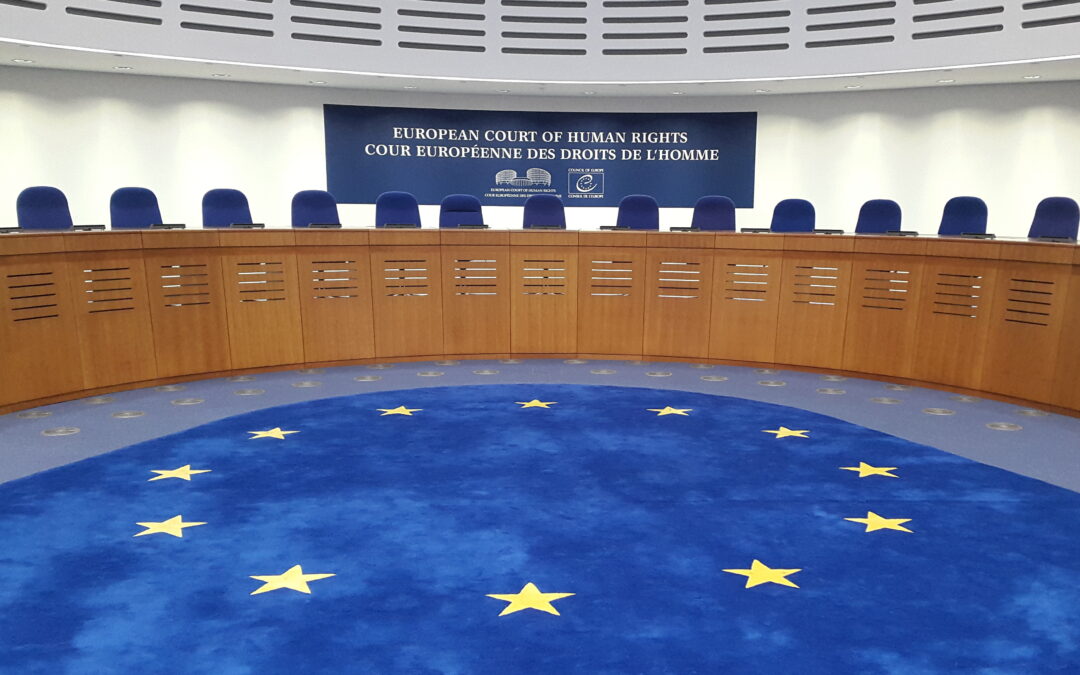
The ICJ made submissions today to the European Court of Human Rights in support of the right of association of Azerbaijan’s lawyers representing applicants before the Court and highlighting the situation of harassment of the legal profession in the country.
The ICJ intervened today in the cases of Democracy and Human Rights Resource Centre v. Azerbaijan and Mustafayev and Democracy and Human Rights Resource Centre v. Azerbaijan.
In these cases, lawyer Asabali Mustafayev and its NGO challenged the compliance of the freezing of their assets and criminal proceedings for financial offences as arbitrary interferences with their work as human rights defenders and in representation of clients before the European Court of Human Rights itself.
The ICJ has intervened to highlight the case-law regarding the right to individual application before the Court under article 34 ECHR and its application to the work of lawyers and legal NGOs.
It further examined the systemic practice in Azerbaijan of harassment of lawyers and of NGOs established by lawyers for the purpose of providing legal advice or representation, including representation of applicants before the European Court of Human Rights.
Finally, the ICJ analyzed the implications of such practices with regard to the State’s obligations under article 18 ECHR read together with article 11 ECHR.
Azerbaijan-icj-DHRRC&other-Advocacy-legal submission-2018-ENG (download the submission)
“Defenseless Defenders: Systemic Problems in the Legal Profession of Azerbaijan” – ICJ report in Azeri, Russian and English.
Question to the parties: http://hudoc.echr.coe.int/eng?i=001-184179
Sep 21, 2018 | Advocacy, News, Non-legal submissions
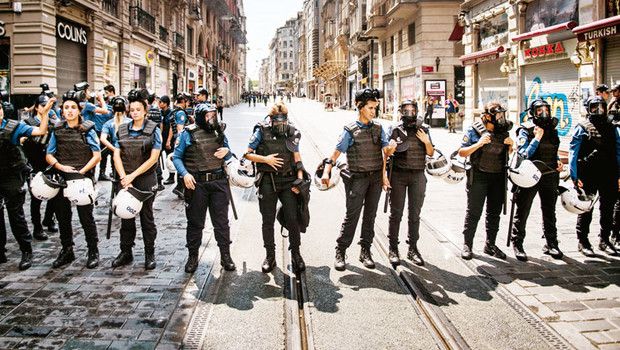
The ICJ wrote today to the Council of Europe’s Commissioner for Human Rights, Dunja Mijatović, to request action against the decision by Turkish authorities to ban entrance to Galatasaray square in Istanbul (Turkey) to a collective of mothers of disappeared persons called “Saturday Mothers”.
On 25 August 2018 , the Sub-Governorship of Beyoğlu District of İstanbul announced the prohibition of gatherings for assembly of any type of demonstrations in Galatasaray Square in Istanbul, the square where the Saturday Mothers have gathered every Saturday since 1995 to 1998 and since 2009 until 2018.
On the 700th week of their peaceful protests, the Saturday Mothers and their supporters congregated in Galatasaray Square at midday to once again raise awareness of the need for those responsible to be held accountable for the extrajudicial killings and enforced disappearances following their time in State custody in the 1990s. The police used tear gas to stop the protest and arrested 47 people. All were released by Saturday evening.
Senior officers of the Turkish authorities have even issued statements accusing the Saturday Mothers of being abused by or in collusion with terrorist organisations.
The ICJ wrote to the European Commissioner for Human Rights, that it “considers this situation to be at odds with Turkey’s obligations under international human rights law, in particular of the right to peaceful assembly under article 11 of the European Convention on Human Rights and article 21 of the International Covenant on Civil and Political Rights.”
The ICJ further added that “given the consistent record and presence of the Saturday Mothers in Galatasaray Square throughout the years, it is hard to see how the restriction on their right to peaceful assembly could in any way be necessary and proportionate to a legitimate purpose. It is clear that no prior warning for the gathering was needed for security reasons in light of its regular occurrence at least since its resumption in 2009, i.e. nine years ago. Furthermore, the demonstration took place on a pedestrian area where cars are not allowed.”
ICJ-Letter-SaturdayMothers-CoEComm-Turkey-2018-ENG (download the letter)
Sep 20, 2018 | Advocacy, Non-legal submissions
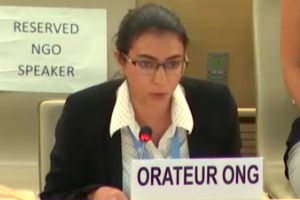
The ICJ today put the spotlight the lack of independence of the legal profession in Azerbaijan speaking at the UN Human Rights Council in Geneva.
The statement, made during the consideration of the Universal Periodic Review (UPR) of Azerbaijan, read as follows:
The International Commission of Jurists (ICJ) welcomes the acceptance by Azerbaijan of the recommendations by France (140.70), by Greece (141.12), Austria (141.13), Estonia (141.68), Slovenia (141.71), and Mexico (141.77), to respect the rights of lawyers.
The ICJ regrets, however, that Azerbaijan only noted and did not explicitly support the recommendations by Sweden (141.33), USA (141.39), Czechia (141.67) and Germany (141.76) and rejected the recommendation by the United Kingdom (141.60) to “End all interference in the work of lawyers through disbarment or other disciplinary measures on improper grounds such as expressing critical views.”
These recommendations call for the amendment of the Law on Advocates and Advocates’ Activities to ensure the effective independence of the Bar Association of Azerbaijan. They also call for the setting up of independent and transparent mechanisms for lawyers’ admission to practice, and disciplinary proceedings against lawyers, in conformity with the UN Basic Principles on the Role of Lawyers.
The ICJ notes that Azerbaijan’s support of most recommendations is predicated on the assumption that the situation of the independence of the legal profession in Azerbaijan is in line with international law.
This, however, is not the situation in the country.
The ICJ expresses concern at the persistent lack of independence of the Bar Association of Azerbaijan; indeed, it has actually played a role in undermining the work of lawyers defending human rights. The situation is exacerbated by recent hasty reforms that prohibit lawyers from appearing in any court hearing unless they are members of this non-independent Bar association, furthermore without a sufficient and meaningful transition period. This seriously curtails access to justice for human rights violations in the country.
Sep 18, 2018 | Advocacy, Non-legal submissions
The ICJ today put the spotlight on serious threats to the rule of law in Hungary, Poland and Turkey, speaking at the UN Human Rights Council in Geneva.The statement, made during general debate on situations that require the Council’s attention, read as follows:
“The International Commission of Jurists (ICJ) would like to bring to the Council’s attention the serious threats to the rule of law in Hungary, Poland and Turkey.
In Poland, the Government has adopted legislation to arbitrarily force into involuntary “retirement” one third of its Supreme Court Justices, delivering a fatal blow to the independence of the judiciary, already strained by past reforms.
In Hungary, multiple legal reforms have weakened judicial independence and effectively criminalized the activities of certain human rights NGOs and curtailed their financing.
Finally, in Turkey, consolidation of emergency measures in ordinary law, regressive constitutional reforms, and the mass dismissal of judges and prosecutors have removed essential protection for the independent functioning of the judiciary.
The ICJ is further concerned by the protest ban against the Saturday Mothers to hold weekly protests in memory of their disappeared family members, in breach of their right to freedom of assembly.
The ICJ is alarmed at the escalation of such threats to the very basic tenets of the rule of law in Europe, without specific action being taken by this Council to address them.
The ICJ urges the Council to give attention to these developments, which indeed form part of a broader global attack on the rule of law,[1] and to keep under observation the human rights situation in these countries.”
[1] See ICJ, “The Rule of Law under Global Threat” (statement in general debate on the oral update of the High Commissioner), 11 September 2018: https://www.icj.org/hrc39-gd2-hc/
Sep 14, 2018 | News
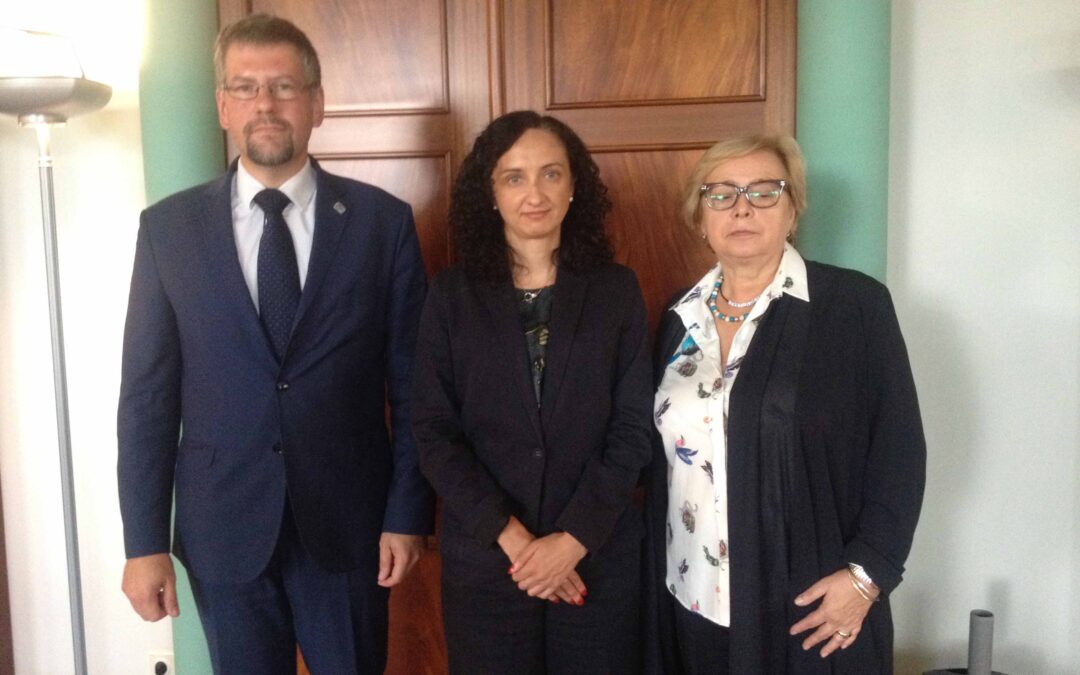
The ICJ met this week in Warsaw with the First President of the Polish Supreme Court, Małgorzata Gersdorf.
Róisín Pillay, Director of the ICJ Europe and Central Asia Programme, met with President Gersdorf to convey the support of the ICJ for the Court’s defence of the rule of law and the independence of the judiciary in Poland, in the face of government attacks.
The ICJ emphasized that a new law on the Supreme Court that attempts to force the “retirement” of 27 of the 72 Supreme Court judges, including the First President, by lowering the mandatory retirement age for its judges from 70 to 65 years, contravenes international human rights law and standards, including the right to a fair hearing.
The measure is contrary to the principle of the security of tenure of judges and therefore to the independence of the judiciary, as expressed in the UN Basic Principles on the Independence of the Judiciary.
In August, the Supreme Court submitted a preliminary ruling request to the Court of Justice of the EU (CJEU) seeking its interpretation on the compliance of the measure with EU law. The Supreme Court has suspended implementation of the law pending the proceedings before the CJEU.
The European Commission has recognized the current situation as undermining “the principle of judicial independence, including the irremovability of judges” and has triggered a procedure under Article 7 of the Treaty of the European Union that could ultimately lead to suspension of Poland’s EU voting rights.
The Commission has also launched infringement proceedings against Poland in respect of the law on the Supreme Court.
An ICJ letter of 11 July 2018, signed by 22 senior judges from all regions of the world, urged the Polish government to act immediately to reinstate the forcibly retired judges in office.