Sep 25, 2019 | Advocacy, Non-legal submissions
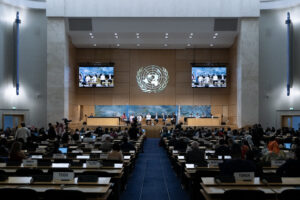
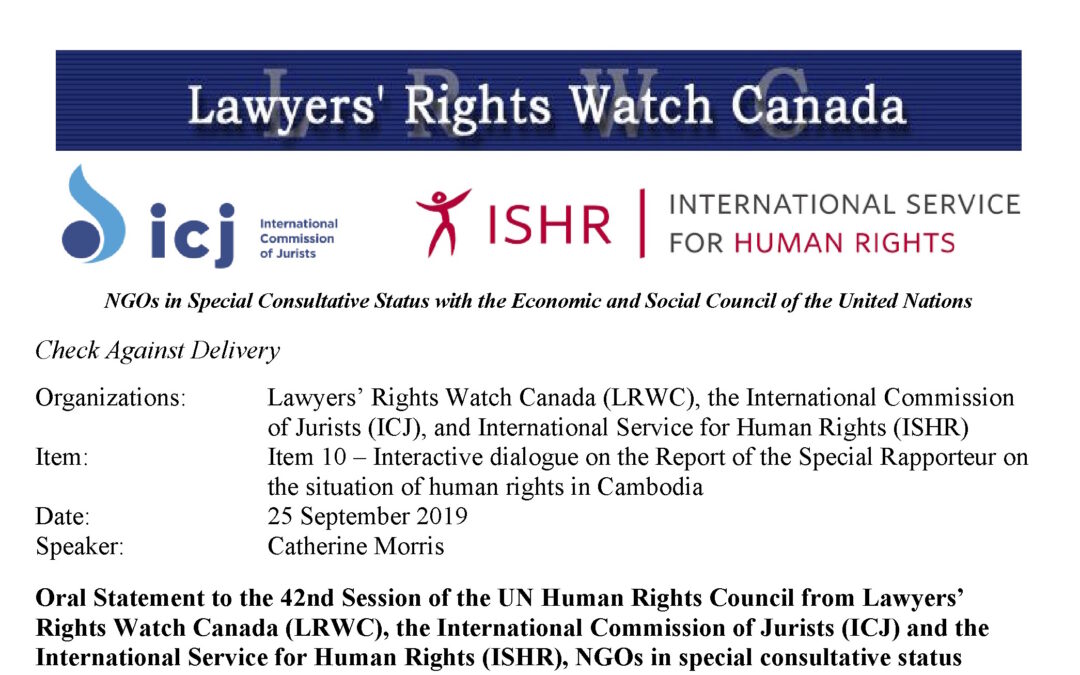
The ICJ today joined other NGOs in drawing the UN Human Rights Council’s attention to the role of the Government of Cambodia in widespread human rights violations and abuses in the country, and called for renewal of the mandate of the UN Special Rapporteur.
The joint NGO statement was delivered by Lawyers’ Rights Watch Canada in a dialogue on the situation in Libya. The statement read as follows:
“Lawyers’ Rights Watch Canada (LRWC), the International Commission of Jurists (ICJ), and the International Service for Human Rights (ISHR) thank the Special Rapporteur for her reports. Implementation of the Sustainable Development Goals, ensuring that no one is “left behind,” necessitates equal access to remedies for rights violations within a trustworthy and independent legal system.
Cambodia has not fulfilled its treaty obligations to establish judicial independence and integrity. Civil society’s rights advocacy is continually resisted. Lawyers, defenders, journalists, politicians, or activists reporting on corruption, election irregularities, labour rights violations, illegitimate land acquisition, environmental degradation, or other rights abuses, often by businesses, are routinely subjected to official vilification; intimidation; interference with rights to expression, association, and assembly; criminalization; arbitrary detention; and even unlawful killings with impunity.
Since 2017, political opposition has been systematically suppressed, including through misuse of the judiciary. Despite the Special Rapporteur’s repeated calls for release of opposition leader Kem Sokha, he remains under court-imposed restrictions tantamount to house arrest. The Special Rapporteur has been denied visits with him contrary to Special Procedures terms of reference for country visits. In May, 25 former opposition members were summoned to court for questioning over two weeks. In September, the government threatened to arrest anyone supporting opposition politician Sam Rainsy’s return to Cambodia.
Cambodia’s responses to Special Procedures’ recommendations for the past twenty-five years have been characterized by disregard, delay, resistance, or hostility. Continued support for the Special Rapporteur’s mandate is critical to ensure that Cambodia fulfils its international human rights obligations. We request that the Council extend the mandate.”
The full written statement, including references, can be downloaded in PDF format here: UN-HRC42-Cambodia-2019
Sep 17, 2019 | Advocacy
In a statement issued today, the ICJ and other human rights groups, as well as lawyers and members of the legal profession, expressed deep concern over the increasing attacks against lawyers under President Duterte’s administration.
Find the full statement available as PDF here: Philippines-attacks against lawyers escalating-advocacy-2019-ENG
Sep 17, 2019 | Advocacy
The ICJ welcomes the final report of the FFM (Independent International Fact Finding Mission).
Having monitored justice and human rights in Myanmar for over 50 years, the ICJ has an established presence in the country, and supports justice sector actors to implement reforms necessary to protect human rights through the rule of law.
With this experience, the ICJ concurs with conclusions of the FFM and the Special Rapporteur: particularly those highlighting the pervasive damage of unchecked military power and impunity on human rights, the rule of law, and development of an inclusive democratic society.
Myanmar’s Government has failed to fulfill international law obligations to investigate, prosecute and punish perpetrators of rights violations. In this context, the launch of an IIMM (Independent Investigative Mechanism for Myanmar) is necessary, and welcome. Myanmar should cooperate with the Mechanism, whose files may enable future prosecutions of individual criminals.
But this Mechanism is not a court: all States, particularly Myanmar, must work toward holding criminal trials, in competent jurisdictions, inline with international standards – noting that prosecutions target criminals, not the country.
Other immediate opportunities for Myanmar to protect human rights include: amending the National Human Rights Commission Law to expand its mandate and independence; amending laws that facilitate impunity such as the 1959 Defence Services Act; enacting an anti-discrimination law; and reviewing the 1982 Citizenship Law. These legislative reforms are urgent and possible steps that are necessary to demonstrate if the Government is genuine about its international law obligations. Any constitutional reform must also expand rights protections.
As the FFM’s mandate is ending, the ICJ would like to ask the experts: how can States best monitor and implement your recommendations, particularly related to international criminal accountability?
See also:
ICJ, Achieving Justice for Gross Human Rights Violations in Myanmar, January 2018
Terms of Reference for the UN Independent International Mechanism for Myanmar (unofficial Burmese translation), 16 January 2019, available here.
Statement to the Human Rights Council by Mr. Nicholas Koumjian, Head of the Independent Investigative Mechanism for Myanmar (unofficial Burmese translation with accompanying English text), 9 September, available here.
Sep 10, 2019 | News
ICJ expressed concern over the decision given on 27 August 2019 by the Malaysian High Court that a fatwa issued against the women’s organization, Sisters in Islam, should be referred to the Syariah Court.
The High Court used as a basis Article 121 (1A) of the Federal Constitution, which states that secular courts do not have jurisdiction over matters pertaining to Islam.
The ICJ called on the Malaysian authorities to ensure that custom, tradition, and religion should not be used as a justification to undermine human rights, including women’s human rights.
In 2014, the Selangor Fatwa Council issued a fatwa declaring the Sisters in Islam a “deviant organization.” For many years, Sisters in Islam has been promoting more egalitarian interpretations of Islamic laws with the aim of ending discrimination against women and achieving equality in the Muslim family.
“For women to fully exercise their religious freedom, they must be able to retain or adopt the religion of their choice, and they must be able to continue belonging to this religion without being discriminated against within the religion,” said Emerlynne Gil, ICJ’s Senior International Legal Adviser.
The ICJ stressed that under international law, States have an obligation to protect people who are prevented from exercising their religious freedom by private actors, such as their own religious communities.
“The Malaysian government, including the judiciary, has the obligation to protect groups like Sisters in Islam when they face persecution from within their religious communities for propounding alternative views about their religion,” said Emerlynne Gil.
Furthermore, the ICJ had previously underscored in a 2019 briefing paper on the challenges to Freedom of Religion or Belief in Malaysia, the tensions emerging from jurisdictional disputes between civil courts, which apply federal and state laws, and Syariah courts, which apply Islamic laws.
In 2018, the UN Committee on the Elimination of Discrimination against Women, in reviewing the performance of Malaysia, voiced its own concern over “the existence of a parallel legal system of civil law and multiple versions of Syariah law, which have not been harmonized in accordance with the Convention on the Elimination of All Forms of Discrimination Against Women (CEDAW).” The CEDAW Committee concluded that this “leads to a gap in the protection of women against discrimination, including on the basis of their religion.
Contact:
Emerlynne Gil, Senior International Legal Advisor, ICJ, e: emerlynne.gil(a)icj.org
Sep 8, 2019 | News
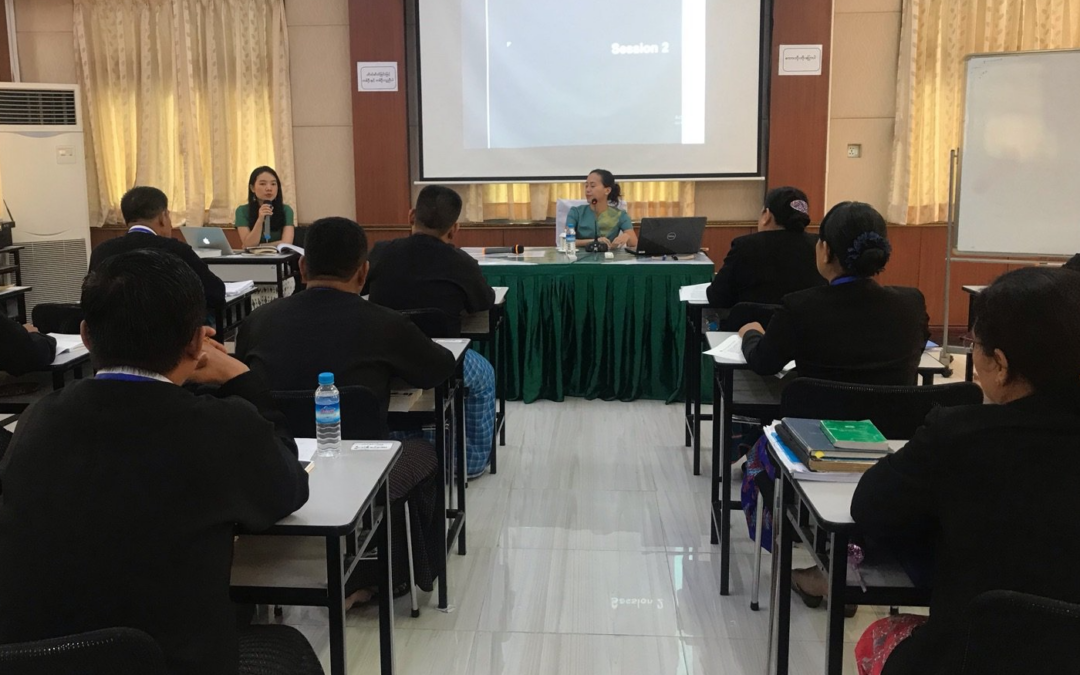
At a training event for senior prosecutors hosted by the Union Attorney General’s Office (UAGO) on 7 September 2019 in Yangon, Nay Pyi Taw, the ICJ made presentations on the international standards and legal obligation on unlawful killings.
Representing each of Myanmar’s 14 states and regions, some 30 law officers attended the activity, which was a capacity-building training hosted by the UAGO. This is part of the ICJ’s ongoing engagement with authorities in Myanmar as well as in neighboring countries on the Minnesota Protocol on the investigation of potentially unlawful death (the Minnesota Protocol).
The Minnesota Protocol provides guidance on the State’s implementation of its duty under international law to investigate potentially unlawful killings, including when State actors may have been involved. It applies to deaths under custody, suspicious deaths, and enforced disappearances. Myanmar has experienced widespread incidents of such deaths, including in recent years those constituting serious crimes under international law.
ICJ Associate Legal Adviser, Jenny Domino, introduced salient points of the Minnesota Protocol and shared relevant examples from experience promoting and protecting human rights in the Philippines. She highlighted the significance of the State’s duty to investigate potentially unlawful killings in upholding the right to life under international human rights law.
ICJ Legal Researcher, Ja Seng Ing, shared the case of Laotian activist Sombath Somphone, who was subjected to enforced disappearance on 15 December 2012 with the apparent consent or acquiescence of State agents. To date, Laotian authorities have failed to conduct effective investigations with a view to revealing the fate or whereabouts of Somphone. ICJ has repeatedly called for accountability on the issue.
Participants discussed these cases in relation to the comparative remedies and practical challenges related to the conduct of investigations in Myanmar, where police and prosecutors both have roles to play in the conduct of investigations.
First published in 1991 and subsequently revised in 2016 under the auspices of the United Nations Office of the High Commissioner for Human Rights, the Minnesota Protocol includes guidelines on conducting investigations to ensure that they are prompt; effective and thorough; impartial and independent; and transparent.
Since December 2017, the ICJ has co-hosted several regional workshops in Asia focused on this topic, with lawyers, academics, and State authorities from Thailand, Cambodia, Nepal, India, and Myanmar attending the events.
See also:
https://www.icj.org/thailand-launch-of-the-revised-minnesota-protocol/
https://www.icj.org/myanmar-reverse-laws-and-practices-that-perpetuate-military-impunity-new-icj-report/