Sep 27, 2018 | News
Today’s decision by the UN Human Rights Council to create an ‘independent mechanism’ to collect evidence of crimes in Myanmar, is a significant step toward accountability for gross human rights violations, the ICJ said.
“The creation of this evidence-gathering mechanism is a welcome concrete step towards justice,” said Matt Pollard, Senior Legal Adviser for the ICJ.
“But this is a stopgap measure, effectively creating a prosecutor without a court, that only underscores the urgent need for the Security Council to refer the entire situation to the International Criminal Court, which was created for precisely such circumstances,” he added.
The Council’s decision follows on conclusions and recommendations by the Independent International Fact-Finding Mission on Myanmar (FFM).
The FFM’s 444-page full report described large-scale patterns of grave human rights violations against minority groups in the country, particularly in Rakhine, Kachin and Shan States.
It also highlighted the need for criminal investigations and prosecutions for crimes under international law, something the FFM concluded that national courts and commissions within Myanmar could not deliver.
“National justice institutions within Myanmar lack the independence, capacity and often also the will to hold perpetrators of human rights violations to account, particularly when members of security forces are involved. The latest government-established inquiry in Rakhine State also seems designed to deter and delay justice,” Pollard said.
The Human Rights Council resolution did not create a new international court or tribunal.
Evidence held by the independent mechanism could be made available to international or national proceedings, whether at the International Criminal Court (ICC) or another ad hoc international tribunal, or to national prosecutors asserting jurisdiction over the crimes under universal jurisdiction or other grounds.
While there is no realistic prospect of effective national prosecutions within Myanmar in the near future, evidence held by the mechanism could also be available in future should national institutions eventually become sufficiently impartial, independent, competent, and capable to do so.
A preliminary examination of the situation of Rohingyas, being conducted by the ICC, may also lead to criminal proceedings but will likely be limited to those crimes that have partially occurred within Bangladesh, such as the crime against humanity of deportation.
Bangladesh is a State Party to the Rome Statute of the ICC whilst Myanmar is not.
The Security Council also has authority to refer the entire situation to the International Criminal Court.
“The Myanmar government should stop denying the truth and should work with the international community, and particularly the United Nations, to improve the horrific conditions facing the Rohingya and other ethnic minorities whose rights have been violated so brutally by the security forces, as documented by the Fact Finding Mission,” Pollard said.
“Myanmar’s international partners, including neighbours like India, China, and members of the Association of Southeast Asian Nations (ASEAN), should exercise their influence to help ensure that Myanmar addresses this serious threat to the stability of the country and the region, by ensuring respect, protection and fulfillment of the full range of civil, cultural, economic, political and social rights of the affected minorities,” he added.
The Council resolution makes several other substantive recommendations, including a call on the Government of Myanmar to review the 1982 Citizenship Law, and a recommendation for the United Nations to conduct an inquiry into its involvement in Myanmar since 2011.
Contact:
Matt Pollard, ICJ Senior Legal Adviser (Geneva), e: matt.pollard@icj.org, +41 79 246 54 75.
Frederick Rawski, ICJ Asia Pacific Regional Director (Bangkok), e: frederick.rawski@icj.org
Read also:
Why an IIIM and Security Council referral are needed despite the ICC ruling relating to Bangladesh (13 September 2018)
Government’s Commission of Inquiry cannot deliver justice or accountability (7 September 2018)
ICJ releases Q & A on crime of genocide (27 August 2018)
Myanmar: reverse laws and practices that perpetuate military impunity (16 January 2018)
Summary report of the Fact Finding Mission (12 September 2018)
Full report of the Fact Finding Mission (published 18 September 2018)
Text of the Resolution (unofficial version tabled in advance of the vote)
Myanmar-IIIM statement-Advocacy-2018-BUR (Full story in Burmese)
Sep 26, 2018 | Advocacy, Non-legal submissions
The ICJ today highlighted the steep decline for human rights and the rule of law in Cambodia, at the UN Human Rights Council in Geneva.
The statement, made during an interactive dialogue with the Special Rapporteur on the situation of human rights in Cambodia, read as follows:
“Mr President,
The findings reported by the Special Rapporteur on the situation of human rights in Cambodia (A/HRC/39/73; A/HRC/39/73/Add.1), detailing the steep decline for human rights and rule of law in Cambodia prior to and during the 2018 national elections, demonstrate the utter inadequacy of the Human Rights Council’s current focus on technical assistance and capacity-building in Cambodia.
The elections, neither free nor fair, resulted in the ruling party winning all seats in the National Assembly. Post-election, the Government continues to misuse laws to violate rights and harass journalists, human rights defenders, political opposition members and ordinary individuals, as evidenced by the following updates to cases highlighted by the Special Rapporteur.
Unjustified espionage charges hang over two journalists, who spent eight months in detention before being released pending trial.[1] A filmmaker, sentenced to imprisonment for alleged espionage after flying a drone over an opposition rally, was only released by royal pardon after more than a year in jail.
Days after release from two years in jail for conducting a peaceful protest, a land rights activist was handed a six-month suspended sentence for a politically-motivated charge from 2012.[2] Following his release after 18 months in prison for alleged defamation and incitement offences, a political commentator fled Cambodia when fresh politically-motivated charges were mounted against him.[3]
Treason charges remain active against Kem Sokha, leader of the now-dissolved main opposition party, now under house arrest.[4]
A barber and a school principal remain imprisoned for allegedly sharing information online in breach of a lese-majeste law.[5] A woman remains imprisoned for alleged insult and incitement offences for throwing a shoe at a ruling party billboard.[6]
Today, four senior staff from a prominent civil society organization and a National Election Committee official were convicted under politically-motivated charges and handed five-year suspended imprisonment sentences.[7]
Madam Special Rapporteur, what approach should the Council, governments and civil society take to ensure human rights and the rule of law in Cambodia, given that technical assistance and capacity-building alone seem clearly not to be having the necessary effect?
Thank you.”
[1] A/HRC/39/73/Add.1, para 42.
[2] A/HRC/39/73, para 13.
[3] A/HRC/39/73/Add.1, para 35.
[4] A/HRC/39/73/Add.1, paras 18 and 19.
[5] A/HRC/39/73/Add.1, para 46.
[6] A/HRC/39/73/Add.1, para 30.
[7] A/HRC/39/73, para 13; A/HRC/73/Add.1, para 35
Sep 18, 2018 | Advocacy, Non-legal submissions
The ICJ today urged the UN Human Rights Council to establish a mechanism to preserve evidence of crimes under international law occurring in Myanmar, with a view to eventual prosecution of those responsible.
The statement, delivered during an interactive dialogue with the UN International Fact Finding Mission, read as follows:
“The International Commission of Jurists (ICJ) has monitored justice and human rights in Myanmar for more than five decades. The ICJ has an established presence in the country supporting justice actors to protect human rights through the rule of law.
With this experience, the ICJ views the Independent International Fact Finding Mission’s conclusions as painting an authoritative picture of the general situation in Myanmar, particularly in its highlighting of the pervasive damage of military impunity upon human rights, rule of law and the nascent democratic process.
The rule of law cannot be established, let alone flourish, without accountability for perpetrators of human rights violations and redress for victims and their families.
The Fact Finding Mission’s findings of crimes under international law, including crimes against humanity in Rakhine, Kachin and Shan states, and the identification of alleged perpetrators, necessitate immediate action.
The Government of Myanmar is unwilling and unable to effectively and genuinely provide justice for crimes, particularly when perpetrated by security forces. International action must not be deterred or delayed by the latest government inquiry, which is incapable of providing accountability or redress and may promote impunity by undermining credible international justice mechanisms.
The ICJ calls for a unified Council resolution at this session to establish an International Impartial and Independent Mechanism. This is urgently required to preserve evidence before its further deterioration, and to demonstrate a commitment to justice. Failing to act now risks further denying justice for victims and emboldening perpetrators.
Violations against Rohingya constitute an egregious yet emblematic example of systematic persecution of minority groups that has persisted in Myanmar for decades.
The ICJ would like to ask the Fact-Finding Mission: how can the Council best ensure accountability for the full range of crimes under international law committed against minorities throughout Myanmar and prevent their continuation and recurrence?”
For more information see:
Myanmar: why an IIIM and Security Council referral are needed despite the ICC ruling relating to Bangladesh
Myanmar: Government’s Commission of Inquiry cannot deliver justice or accountability
Sep 10, 2018 | Events, News
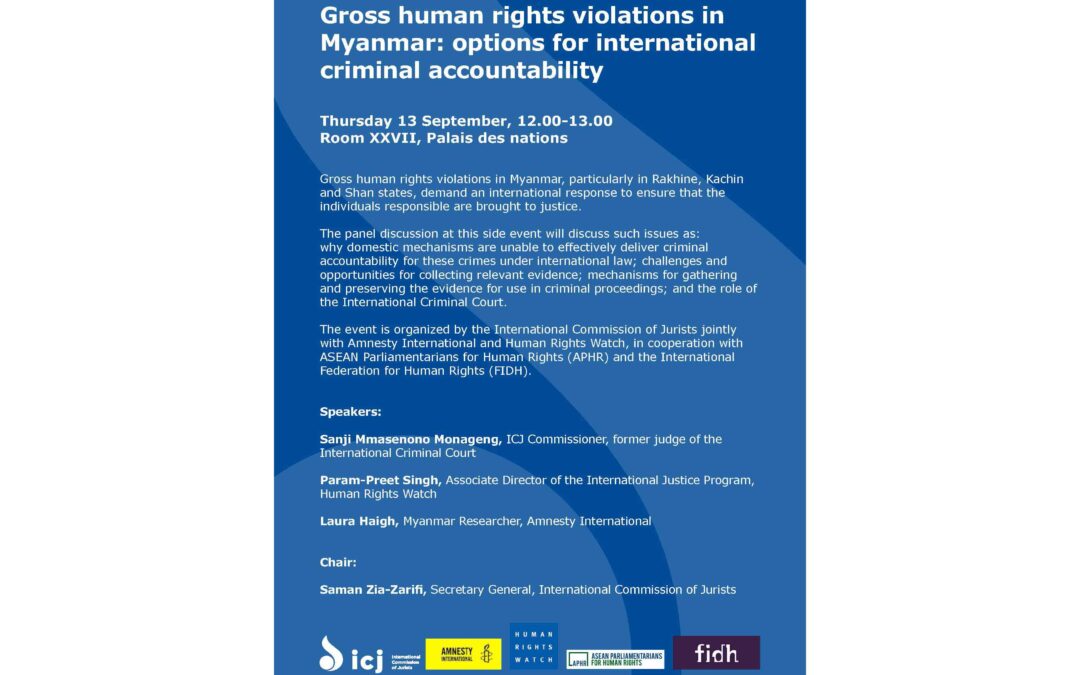
The ICJ will host the side event “Gross human rights violations in Myanmar: options for international criminal accountability” at the Human Rights Council on Thursday 13 September 2018 from 12:00 – 13.00 in Room XXVII of the Palais des Nations.
It is organized by the ICJ, Amnesty International and Human Rights Watch in cooperation with ASEAN Parliamentarians for Human Rights (APHR), the International Federation for Human Rights (FIDH) and Physicians for Human Rights (PHR).
The issues of documenting violations, possible evidence-gathering mechanisms and the role of the International Criminal Court will be discussed.
Speakers:
- Justice Sanji Mmasenono Monageng, Commissioner of the ICJ and former judge of the International Criminal Court
- Param-Preet Singh, Associate Director of the International Justice Program, Human Rights Watch
- Laura Haigh, Myanmar Researchers, Amnesty International
Moderator:
Saman Zia-Zarifi, Secretary General, International Commission of Jurists
Myanmar side event 13 Sept flyer (flyer of the event in PDF)
Sep 4, 2018 | News
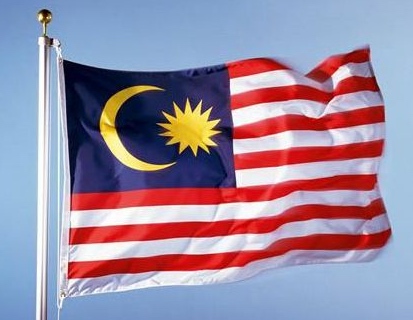
The ICJ today condemned the public caning of two women, a punishment imposed upon them by the Terengganu High Court after conviction on charges of ‘attempting to have sexual intercourse’.
The ICJ called on the Government of Malaysia to immediately abolish the practice of caning as it constitutes a form of cruel, inhuman or degrading punishment prohibited under international human rights law and standards.
Furthermore, it also called on the Government to ensure that its laws, policies and practices at the local, state, and federal levels are in full compliance with its international legal obligations, including under the Convention on the Elimination of all forms of Discrimination against Women (CEDAW).
On 3 September 2018, two women, aged 23 and 33, were publicly caned in front of a hundred people in Terengganu, a coastal state of Malaysia, located northeast of Kuala Lumpur.
The two women were convicted under Section 30 of the Syariah Criminal Offences (Terengganu) Enactment 2001, for the crime of ‘Musahaqah’ (sexual relations between female persons).
“This punishment is a clear violation of Malaysia’s obligations to prevent, prohibit and prosecute all forms of torture and other cruel, inhuman or degrading treatment or punishment. The Government of Malaysia should immediately abolish the practice of corporal punishment, which has been condemned by international authorities such as the UN Human Rights Council’s Special Rapporteur on torture,” said Emerlynne Gil, ICJ’s Senior International Legal Adviser.
“It is equally deplorable that Malaysia continues to criminalize consensual same sex relations. The criminalization of private consensual sexual activities – whatever the sex, gender identity and sexual proclivities of those involved, and whatever the actual sexual practices – violates international human rights law. It also undermines women’s enjoyment of their rights to privacy, personal integrity, and equality,” she added.
The Human Rights Committee has said that criminalizing private sexual acts between consenting adults constitutes an arbitrary interference with privacy and cannot be justified.
It has also observed in a number of Concluding Observations that the criminalization of private consensual sexual activities between adults of the same sex violates the prohibition of discrimination, and the right of equality before the law.
The ICJ also notes that early this year, the CEDAW Committee recommended to Malaysia to “take effective measures to ensure that civil law and Syariah law are in full compliance with the provisions of the Convention at local, state, and federal levels” so as to guarantee the rights of all women throughout the country.
The ICJ calls on the Government of Malaysia to abide by its obligations under international law and follow through with its commitment to human rights, non-discrimination and equality by abolishing the sentence of caning and the criminalization of consensual same sex relations in the country.
Contact
Emerlynne Gil, ICJ Senior International Legal Adviser, t: +66 840923575, e: emerlynne.gil(a)icj.org
Background
On 8 April 2018, religious state authorities arrested the two women who were in a car and accused them of preparing to ‘commit sexual acts’, which is an offense in the State of Terengganu, under the Syariah Criminal Offences (Terengganu) Enactment 2001. The women pleaded guilty to the offence without being represented by a lawyer and did not appeal their case.
On 12 August 2018, the two women pleaded guilty and were sentenced by the Terengganu Shariah to a fine of RM3,300 ($800 USD) and six strokes of caning for attempting to have sexual intercourse.
This is the first case of caning of women for ‘Musahaqah’ (sexual relations between female persons) crime and its attempt in Malaysia and it marks a steady decline in Malaysia’s commitment to protect the rights of its sexual minorities and the members of the LGBTIQA community.
In Malaysia’s Criminal Procedure Code, under Federal law, it states that
“No sentence of whipping shall be executed by installments, and none of the following persons shall be punishable with whipping: (a) females;”
Malaysia’s Federal Constitution provides that Islamic law falls under the matters of State law, with the exception of the Federal States.
It is concerning that the Syariah legal system in Malaysia continues to carry out caning in a manner that is discriminatory against women, and women sexual minorities, as seen in the 2010 case, where three women were found guilty of ‘illicit sex’ by the Kuala Lumpur Syariah Court, as well as the continuing use of Syariah legal enactments to harass, intimidate and prosecute the transgender community in Malaysia.