Sep 3, 2018 | News
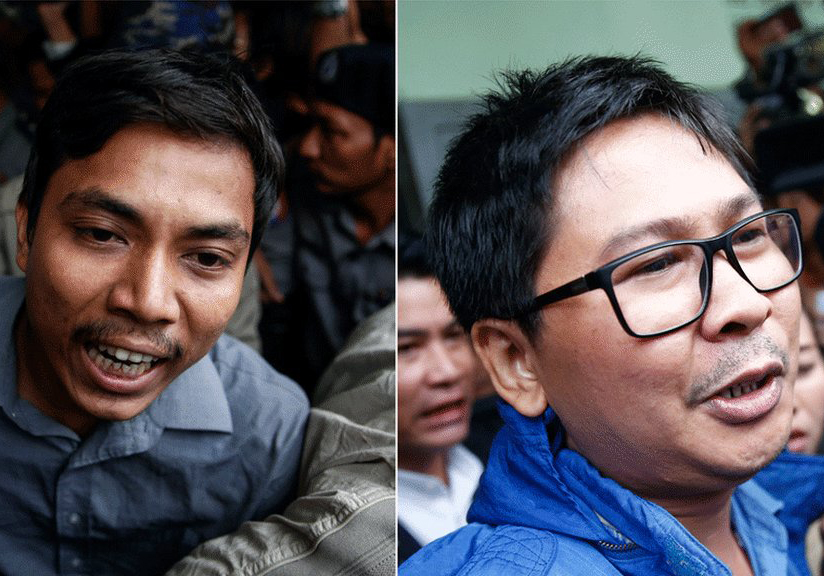
The Yangon District Court’s decision today to sentence Reuters journalists Wa Lone and Kyaw Soe Oo to seven years’ imprisonment for violating the Official Secrets Act deals a massive blow to human rights and the rule of law in Myanmar, said the ICJ.
“The Court’s decision effectively punishes these two courageous journalists for exposing human rights violations, following a grossly unfair trial,” said Frederick Rawski, Asia Pacific Director for the ICJ.
“The decision is a miscarriage of justice that inflicts needless suffering on them and their families, threatens freedom of expression, damages Myanmar’s global standing, and undermines its justice institutions all at once,” he added.
The ICJ has monitored the case since the journalists’ initial detention in December 2017.
As previously noted by the ICJ, the detention and trial has violated numerous basic fair trial guarantees.
The prosecutors had a duty to drop charges and the judge should have dismissed the case given the lack of evidence and the unlawfulness of detention because of fair trail rights violations.
“The case is emblematic of how the justice system ends up reinforcing rather than challenging military impunity,” said Rawski.
“The result undermines government claims that it can deliver accountability for human rights violations on its own, and does nothing to build trust that justice system can act independently and impartially after emerging from decades of military rule,” he added.
Members of security forces generally enjoy impunity for the perpetration of human rights violations, including for crimes under international law.
The ICJ has previously reported that victims and their families, as well as journalists, often face retaliation for publicizing human rights violations by the military.
Wa Lone and Kyaw Soe Oo were arrested in December 2017, and held incommunicado for nearly two weeks, before being charged under the colonial-era Official Secrets Act for allegedly possessing documents related to the operations of security forces in northern Rakhine State, during “clearance operations.”
The two reporters had been reporting on human rights violations in Rakhine State, including the killing of Rohingya by the military in Inn Dinn Village.
In a report issued just last week, the UN Independent International Fact Finding Mission found that security forces had perpetrated crimes under international law during these operations, including crimes against humanity and possibly the crime of genocide.
The detention and prosecution of anyone, including journalists, based solely on the collection and publication of evidence relevant to serious human rights violations, is a violation of international law and standards on freedom of expression, the right to participation in public affairs and on the role of human rights defenders.
Legal options remaining for the journalists include appealing of today’s decision, and requesting a Presidential amnesty.

Sep 3, 2018 | News
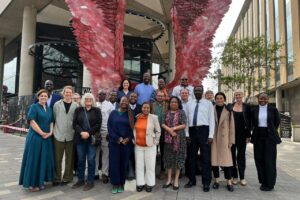
The ICJ held a workshop on reforming Myanmar’s 1982 citizenship law in Yangon from 1 to 2 September 2018.
The workshop convened a group of international and national legal experts, human rights defenders, political scientist, academics and researchers to jointly consider the way forward to identify creative legal and non-legal advocacy approaches for reforming Myanmar’s 1982 Citizenship Law.
The ICJ, UN organs and civil society organizations, through research and legal analysis, have consistently found this law to be discriminatory both in its content and application.
Unlike many other laws promulgated during the military junta era of General Ne Win, this law remains in force. Its tiered hierarchy of citizenship has effectively rendered many individuals as second- or third-class citizens, or in some instances stateless.
In August 2017, the government’s own Advisory Commission on Rakhine State, chaired by the late Kofi Annan, recommended a review of the Citizenship Law. The recommendation was accepted by the Government of Myanmar in principle, but in practice this commitment has not been followed up by any implementing measures.
The workshop’s participants included academics, researchers, human rights defenders, political scientist, legal and non-legal experts of different ethnic and religious backgrounds from a range of organizations from the U.K, Spain, Australia, Kachin, Chin, Mandalay, Rakhine, and Yangon.
The ICJ’s legal adviser, Sean Bain, introduced the workshop by noting that legal recognition of nationality is central to the enjoyment of many human rights.
Noting that protecting the right to nationality is an essential part of the rule of law in any democratic society, he highlighted that too often it is members of minority groups who experience a violation of their human rights due to discriminatory laws and their application with regards to citizenship.
The ICJ’s legal researcher Dr. Ja Seng Ing presented the overview and assessment of the Citizenship Law, including problematic provisions and key institutional actors with authority in Myanmar.
Amal de Chickera, a Sri Lankan Human Rights lawyer and Co-Director of Institute on Statelessness and Inclusion, delivered an introduction on the International law and comparative studies and the approaches and strategies for law reform from international perspectives.
José María Arraiza, Information, Counselling and Legal Assistance Specialist, Norwegian Refugee Council, spoke about a number of approaches and strategies for legal reform, including imperative role of collective identities, inclusive dialogue and evidence based advocacy strategies with comparative international experiences.
Michelle Yesudas, a Malaysian Human Rights lawyer, shared good practices and lesson learned from application of strategic litigation in citizenship related cases in Malaysian context to raise the awareness of the public and also discussed potential strategies for pushing the legislative reform and enforcement of the law in Myanmar.
The ICJ’s legal adviser Daw Hnin Win Aung, facilitated a panel discussion where the Senior legal scholars and researchers from Myanmar also provided their perspectives, based on their own independent research and writing on the legal and non-legal opportunities and challenges for law reform in Myanmar.
Advocate lawyer, Daw Zar Li Aye highlighted the legal consequences of mixed-nationality marriage in Myanmar, for instance, the authorities used physical appearance of the children as a determining factor when considering provision of citizenship / documentation in practice.
The participants considered a wide range of issues relating to statelessness and citizenship in Myanmar with comparative case studies, including the varying approaches for law reform across the region to improve understanding of the advocacy target groups on the issue and potentially inform public policy.
The participants also recognized the importance of multidisciplinary approaches, including strategic litigation in citizenship related cases, for developing advocacy strategies for law reform and to increase knowledge and understanding of the general public on the issue.
This event is part of the ICJ’s ongoing efforts to convene civil society actors including lawyers to discuss critical human rights issues in Myanmar with a view to advancing the protection of human rights in the country.
Sep 2, 2018 | News
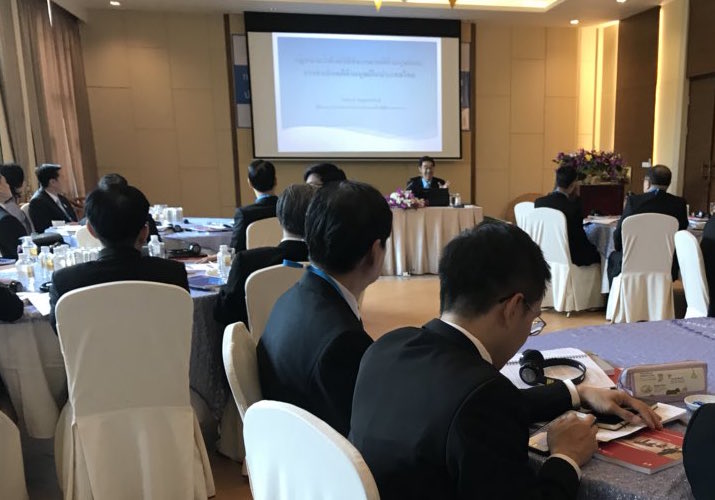
On 1 and 2 September, the ICJ held a “Workshop on the Independence of the Judiciary in the Context of the Inquisitorial Judicial System in Thailand” for members of the Thai judiciary in the north of the country.
Some 31 judges from 21 courts and the Administrative Office of the Court of Justice, Region V, attended the workshop, which was held in Chiang Mai.
The objective of the workshop was to discuss the role of judges and exercise of judicial power within the inquisitorial system, particularly in the context of adjudicating cases of human trafficking.
In an effort to combat human trafficking in Thailand, the Procedures for Human Trafficking Cases Act B.E. 2559 (2016) established inquisitorial system procedures for adjudication of cases of human trafficking.
With an increasing number of cases of human trafficking in Northern Thailand, judges in Northern Thailand are increasingly required to utilize inquisitorial processes in human trafficking cases.
Courts in Thailand generally adjudicate cases based on the adversarial judicial system.
In this context, the ICJ held the workshop in collaboration with the Administrative Office of the Court of Justice, Region V, in the North of Thailand, to share information and expand collaboration between Thai and international judges about inquisitorial processes.
Justice Aree Thecharuwichit, Chief Justice of the Office of the Chief Justice, Region V, Frederick Rawski, Regional Director of ICJ Asia and the Pacific, and Justice Radmila Dragicevic-Dicic, Vice-President of the ICJ, ICJ Commissioner, Acting President of the Belgrade Court of Appeals and Judge of the Supreme Court of Serbia delivered opening statements at the Workshop.
Justice Sittipong Tanyaponprach, Chief Judge of the Office of the Chief Justice, Region I, spoke about existing procedures in Thailand’s justice system to deal with human trafficking cases under the Procedures for Human Trafficking Cases Act 2016.
Justice Marcel Lemonde, Honorary President of Chamber in France’s Court of Appeal and an International Consultant in Judicial Matters, delivered an introduction to the inquisitorial system based on the French judicial system and spoke about existing challenges in inquisitorial processes.
Justice Radmila Dragicevic-Dicic, of the Supreme Court of Serbia and ICJ Vice-President spoke about judicial practice in cases involving human trafficking and shared her experience in adjudicating human trafficking cases in Serbia.
ICJ’s Senior Legal Adviser Kingsley Abbott moderated the workshop and provided an introduction to the ICJ’s resource materials on the independence of the judiciary and judicial accountability, including the ICJ’s Practitioners’ Guide No. 13 on Judicial Accountability.
The ICJ ended the Workshop with a statement reiterating its commitment towards working with Thailand’s judiciary to strengthen the rule of law and administration of justice in Thailand.
This Workshop is the second workshop held by the ICJ for Thailand’s judiciary in the North of Thailand.
Aug 30, 2018 | News
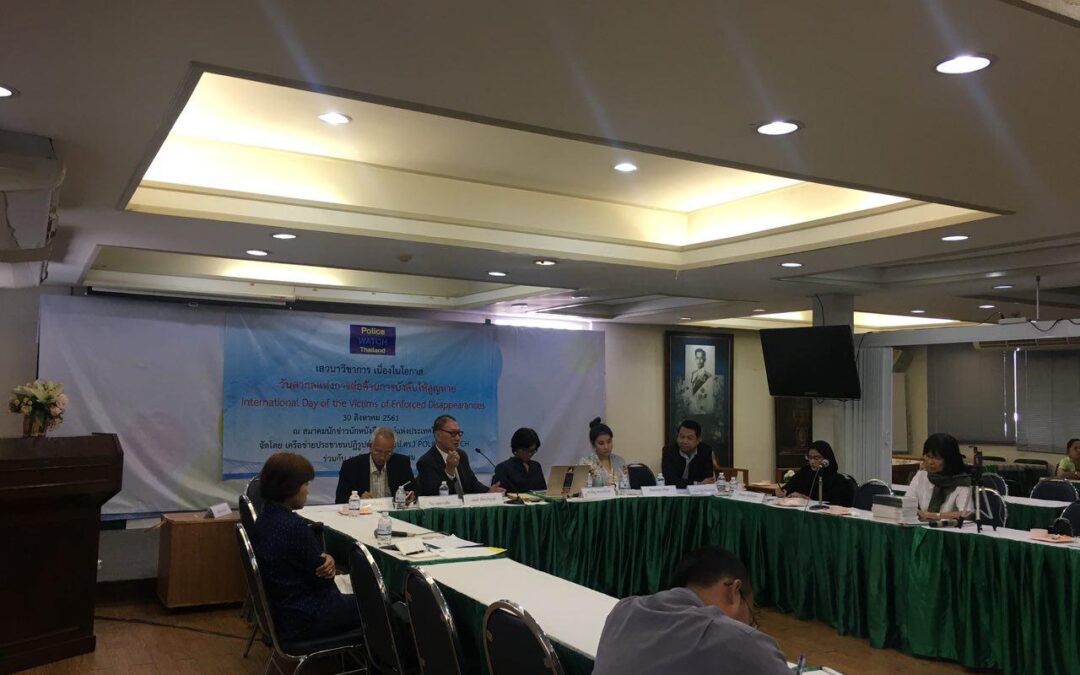
The ICJ participated in a panel discussion to commemorate International Day of the Victims of Enforced Disappearances, organized by Police Watch Thailand and Cross Cultural Foundation.
The discussion was held at the premises of the Thai Journalists’ Association.
The event began with opening remarks by Surapong Kongchantuk, Chairperson of the Cross Cultural Foundation, who called on the Thai Government to ratify the International Convention for the Protection of All Persons from Enforced Disappearance (ICPPED) and for the existing Draft Prevention and Suppression of Torture and Enforced Disappearance Act (‘Draft Act’) to come into force without undue delay.
He also emphasized that perpetrators of the crime of enforced disappearance needed to be brought to justice, and victims and relatives of victims of enforced disappearance must be provided with effective remedies and reparation.
A panel discussion followed the opening remarks, moderated by Pornpen Khongkachonkiet, Director of Cross Cultural Foundation. Panelists included Sanhawan Srisod, ICJ’s National Legal Adviser, Veera Somkomkid, from People Anti-Corruption Network, Pol.Col. Wirut Sirisawadibuth, Columnist and police reform activist, and Adul Kiewboribon, Chair of a committee of persons whose relatives disappeared during May 1992 protests against the government of General Suchinda Kraprayoon.
In her remarks, Sanhawan Srisod expressed concern at the absence of domestic legislation making torture and enforced disappearance specific crimes in Thai law and gaps in the existing Draft Act.
She also called for prompt, independent, impartial and effective investigations into the fate and whereabouts of disappeared persons consistent with international law and standards.
Human Rights Commissioner, and wife of disappeared lawyer and human rights defender Somchai Neelapaijit, Angkhana Neelapaijit, made closing remarks for the event.
The panel discussion followed a forum the ICJ co-hosted in March this year, commemorating the 14th year anniversary of the enforced disappearance of Somchai Neelapaijit, which also raised awareness about amendments to the Draft Act.
During the forum, the ICJ raised concerns about the independence of the ‘Committee managing complaints of torture and enforced disappearance cases’, which was established in May 2017, and expressed the need for further clarification on the legal framework – domestic and/or international – that will ground the Committee’s operation.
Background
The International Day of the Victims of Enforced Disappearances falls on 30 August every year.
Thailand is bound by international legal obligations under the International Covenant on Civil and Political Rights (ICCPR) and Convention against Torture and Other Cruel, Inhuman or Degrading Treatment or Punishment (CAT) – both of which it has acceded to – to investigate, prosecute, punish and provide remedies and reparation for the crimes of torture, other acts of ill-treatment, and enforced disappearance.
However, Thailand has not enacted domestic legislation recognizing enforced disappearance as a criminal offence. Thailand is also yet to ratify the ICPPED, despite signing the Convention in January 2012.
Thailand’s Ministry of Justice concluded a second round of public consultation on the Draft Act and is now reportedly in the process of evaluating the results of the consultation.
On 30 August 2017, 23 November 2017 and 12 March 2018, civil society organizations, including the ICJ, Amnesty International and Human Rights Watch, sent open letters to the Government, including to Thailand’s Minister of Justice, outlining amendments that would be necessary to bring the Draft Act in line with Thailand’s international human rights obligations.
In the absence of domestic legislation criminalizing torture and enforced disappearance, on 23 May 2017, a ‘Committee managing complaints for torture and enforced disappearance cases’ was established by the Prime Minister, pursuant to Prime Minister’s Office Order No. 131/2560 (2017).
The Committee, chaired by the Minister of Justice, consists of 15 officials drawn from different ministries,including the Ministry of Defence, the Royal Thai Police and the Internal Security Operations Command (ISOC).

Aug 27, 2018 | News
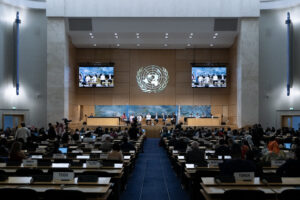
The ICJ today joined other International Non-Government Organizations operating in Myanmar in a statement marking one year since the commencement of military ‘clearance operations’ that caused the exodus of around 700,000 Rohingyas into neighbouring Bangladesh.
The statement reads:
As the UN Security Council meets in New York to mark one year since nearly 700,000 Rohingya refugees fled to neighboring Bangladesh, International Non-Governmental Organizations (INGOs) working in Myanmar say 600,000 Rohingya still left in Myanmar face daily discrimination and human rights abuses, making conditions unsafe for refugees to return.
INGOs urge the Security Council to use the one-year anniversary as an opportunity to step up pressure on the government of Myanmar to take action on three critical areas: addressing the root causes of the crisis in Rakhine State; ensuring accountability for human rights violations and improving humanitarian access.
Discriminatory policies mean that Rohingya communities in Rakhine State continue to lack citizenship and face restrictions on their freedom of movement, impeding their ability to go to school, seek medical care, find jobs or visit friends and family.
128,000 Rohingya and other Muslim communities remain trapped in closed camps in central Rakhine for the sixth year since the intercommunal violence of 2012.
Although some steps have been taken to relocate camp residents to new sites, the displaced communities have not been adequately consulted, are unable to return to their original homes, or another location of their choice, and continue to lack freedom of movement, access to jobs and services, thus further entrenching their confinement and segregation.
At the same time, a full and independent international investigation into human rights violations – sexual violence, killings, beatings and destruction of homes and properties – that caused refugees to flee has not happened and the perpetrators who facilitated these abuses have not been brought to justice.
The rights violations committed in Rakhine State are part of a pattern of ongoing military abuses against ethnic minorities throughout Myanmar, including in Kachin State, Shan State and the southeast of the country.
Humanitarian organizations working throughout Rakhine State continue to face serious restrictions on their access to affected communities and bureaucratic and administrative barriers hamper their ability to carry out their daily work.
In northern Rakhine, from where the majority of refugees in Bangladesh fled, full humanitarian access for most organizations has not been restored more than one year since restrictions were first put in place.
Although a Memorandum of Understanding was signed between UNHCR, UNDP and the Government of Myanmar in June with a view to enabling both agencies to resume operations in northern Rakhine, they still await full, unfettered access, and have not yet been able to begin the work of supporting affected communities and monitoring conditions.
The recommendations of the Kofi Annan-led Advisory Commission on Rakhine, published one year ago, provide the best roadmap for addressing the root causes of the crisis in Rakhine State, improving the lives of all communities and creating the conditions for an inclusive, fair and prosperous society for all the people in Rakhine.
INGOs welcome the progress made by the Government of Myanmar in implementing some of the recommendations, including those related to improving development and infrastructure, such as building new roads, schools, and hospitals, but conclude that not enough progress has been made in addressing structural human rights issues or in creating an environment where all communities can benefit from these developments without discrimination.
Without citizenship rights and freedom of movement, Rohingya communities in Rakhine State cannot equally benefit from improved development and refugees in Bangladesh will not feel safe to return.
INGOs call on the UN Security Council to set time-bound and measurable targets for the Government of Myanmar to make meaningful progress in all three of these areas and to hold regular public meetings on the crisis.
Specifically, the Security Council should call on the Government of Myanmar to implement the recommendations of the Advisory Commission in their entirety, including addressing structural problems of discrimination, restrictions on movement and denial of citizenship faced by Rohingya communities.
Implementation of the Advisory Commission recommendations also requires listening to the perspectives of all ethnic groups in Rakhine in an effort to break down the divisions that have pitted communities against each other.
Second, the Security Council should request the government of Myanmar to grant full and unfettered access for humanitarian organizations to all parts of Rakhine State as well as full access for independent media and journalists.
And finally, it should step up efforts with the government of Myanmar to allow independent human rights investigators full and unimpeded access to investigate human rights abuses, gather untampered evidence and refer cases to an international tribunal.
The Security Council must send a strong message to the Government of Myanmar to end impunity and prevent future violations.
Unless these measures are implemented, the international community risks perpetuating impunity and cementing segregation in Rakhine State for decades to come.
Myanmar-RohingyaJointNGOstatement-News-webstory-2018-ENG (full story in PDF)