Mar 13, 2018 | News
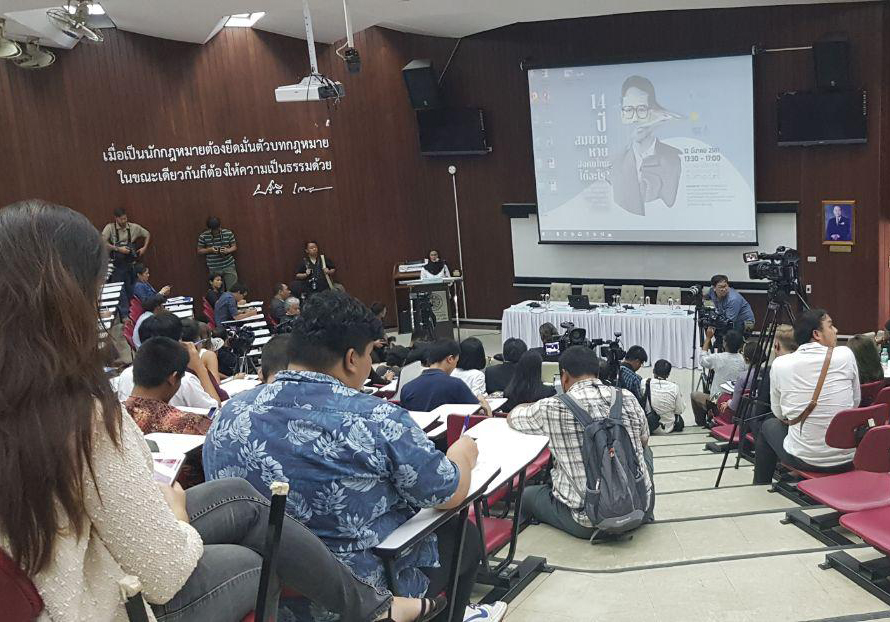
On 12 March 2018, the ICJ co-hosted the forum “14 Years after Somchai’s Disappearance, What Have We Learned?” to commemorate the 14th anniversary of the enforced disappearance of prominent lawyer and human rights defender Somchai Neelapaijit.
The forum was held at the Faculty of Law in Thammasat University’s Tha Pra Chan campus.
More than 80 participants attended the event, including alleged torture victims, family victims of torture and enforced disappearance, students, lecturers, lawyers, civil society organizations, diplomats, members of the Thai authorities and media.
The objectives of the forum were to (i) mark the 14th anniversary of the enforced disappearance of Somchai Neelapaijit and the lack of progress in the investigation (ii) raise awareness and discuss the latest amendments to the Draft Prevention and Suppression of Torture and Enforced Disappearances Act (‘Draft Act’) and its deficiencies; and (iii) discuss the newly constituted Committee managing complaints of torture and enforced disappearance, which was established by the Prime Minister on 23 May 2017.
Opening remarks were delivered by Angkhana Neelapaijit, wife of Somchai Neelapaijit, and Laurent Meillan, OHCHR’s Deputy Regional Representative.
Sanhawan Srisod, the ICJ’s National Legal Advisor, spoke during the first panel discussion on recent amendments to the Draft Act, which was moderated by Poonsuk Poonsukcharoen from Thai Lawyers for Human Rights (TLHR) and also included the following panelists:
- Nongporn Rungpetchwong, Human Rights Expert, Rights and Liberties Protection Department, Ministry of Justice
- Assistant Professor Dr. Ronnakorn Bunmee, Faculty of Law, Thammasat University
- Somchai Homlaor, Lawyer and Senior Advisor to Cross Cultural Foundation (CrCF)
The second panel discussion on the roles and duties of the Committee Managing Complaints for Torture and Enforced Disappearance Cases was moderated by. Yingcheep Atchanont from Internet Law Reform Dialogue (iLaw) and included the following speakers:
- Manunpan Rattanacharoen, Office of Foreign Affairs and International Crimes, Department of Special Investigation (DSI), Ministry of Justice
- Professor Narong Jaihan, Chair, Sub-committee on Prevention of Torture and Enforced Disappearance Cases
- Angkhana Neelapaijit, Family of “disappeared” person
- Isma-ae Tae, Alleged victim of torture and ill-treatment
During the event, the ICJ also highlighted its open letter to Thailand’s Minister of Justice, dated 12 March 2018, on the recent amendments to the Draft Act, which sets out concerns that the recent amendments would, if adopted, fail to bring the law into compliance with Thailand’s international human rights obligations.
The forum was co-organized with the Neelapaijit family, Thammasart University’s Faculty of Law, Amnesty International Thailand, Cross Cultural Foundation (CrCF), together with the United Nations’ Office of the High Commissioner for Human Rights (OHCHR) Regional Office for South East Asia.
Read also
ICJ and Amnesty International, Open letter to Thailand’s Minister of Justice on the amendments to the Draft Prevention and Suppression of Torture and Enforced Disappearances Act, 12 March 2018
English
Thai
ICJ and Thai Lawyers for Human Rights, Joint submission to the UN Committee against Torture, 29 January 2018
ICJ and Amnesty International, Recommendations to Thailand’s Ministry of Justice on the Draft Prevention and Suppression of Torture and Enforced Disappearances Act, 23 November 2017
To mark the 10-year anniversary of Somchai Neelapaijit’s ‘disappearance’, the ICJ released a report documenting the tortuous legal history of the case, Ten Years Without Truth: Somchai Neelapaijit and Enforced Disappearances in Thailand, 7 March 2014
Contact
Kingsley Abbott, ICJ Senior International Legal Adviser for Southeast Asia, e: kingsley.abbott(a)icj.org
Thailand-Amendments-to-Prevention-and-Suppression-of-Torture-2018-ENG (Full text in ENG, PDF)
Thailand-Amendments-to-Prevention-Suppression-of-Torture-2018-THA (Full text in THA, PDF)
Feb 27, 2018 | Events, News
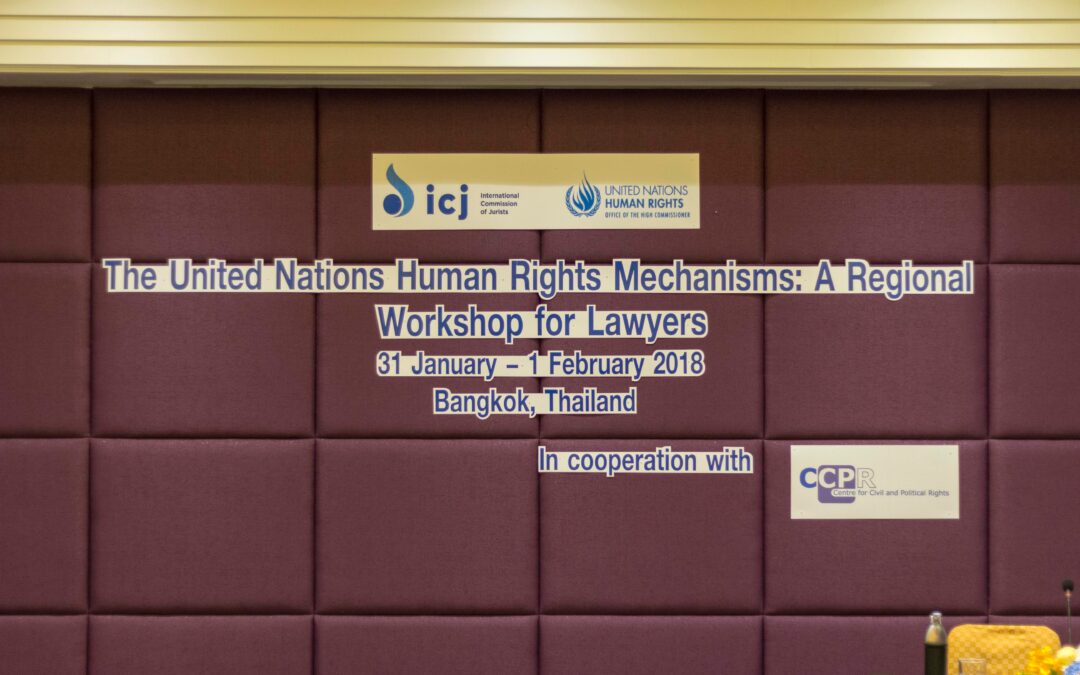
The ICJ, in collaboration with the UN High Commissioner for Human Rights Regional Office for South-East Asia (OHCHR), and the Centre for Civil and Political Rights, organised a workshop for lawyers from southeast Asia, on engaging with UN human rights mechanisms.
The two-day workshop provided some thirty lawyers from Thailand, Cambodia, Vietnam, and Lao PDR with knowledge, practical skills and expert advice about UN human rights mechanisms, with the participants themselves sharing their own experiences and expertise.
In addition to explaining what the UN mechanisms are and how they work, the workshop discussed how lawyers can use the outputs of UN human rights mechanisms in their professional activities, as well as how to communicate with and participate in UN human rights mechanisms in order to ensure good cooperation and to best serve the interests of their clients.
Sessions were introduced by presentations by the ICJ’s Main Representative to the United Nations in Geneva and OHCHR officials, followed by discussions and practical exercises in which all participants were encouraged to contribute questions and their own observations.
A special discussion of effective engagement of lawyers with Treaty Bodies was led by Professor Yuval Shany, a member of the Human Rights Committee established to interpret and apply the International Covenant on Civil and Political Rights (ICCPR).
The workshop also aimed to encourage the building of relationships and networks between the lawyers from across the region.
The workshop forms part of a broader project of awareness-raising and capacity-building for lawyers from the region, about UN mechanisms.
A similar workshop was held in January 2017 for lawyers from Myanmar.
The project has also published (unofficial) translations of key UN publications into relevant languages, and is hosting lawyers in a mentorship programme in Geneva.
More details are available by contacting UN Representative Matt Pollard (matt.pollard(a)icj.org) or by clicking here: https://www.icj.org/accesstojusticeunmechanisms/
Feb 15, 2018 | News
Thailand should immediately cease misusing criminal and civil defamation laws to legally harass victims, human rights defenders and journalists who raise allegations of torture or other ill-treatment, the ICJ said today.
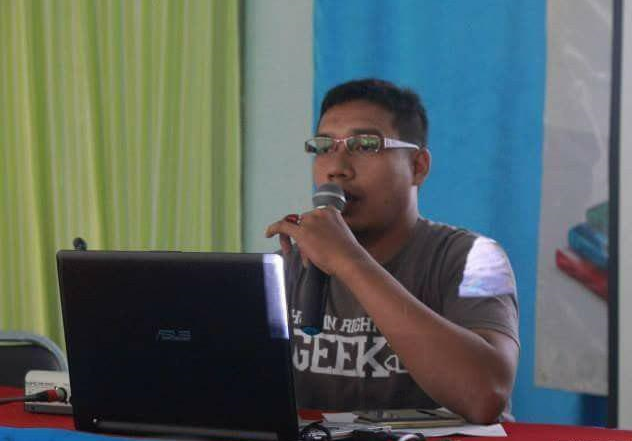
Yesterday, the Director of the Internal Operations Security Command (ISOC) Region 4, Lt. Gen. Piyawat Nakwanich, reportedly authorized Lt. Col. Seathtasit Kaewkumuang to lodge defamation complaints against Isma-ae Tae, a founder of Patani Human Rights Organization (HAP).
ISOC is responsible for security operations in Thailand’s deep South.
“It is astonishing that after all of the Government’s repeated commitments to address allegations of torture and protect victims and human rights defenders, ISOC is now misusing the justice system to legally harass an alleged victim of torture,” said Kingsley Abbott, the ICJ’s Senior International Legal Adviser for Southeast Asia.
“Thailand should immediately stop these defamation complaints against Isma-ae Tae and ensure an investigation that meets international law and standards is conducted into all allegations of torture or other ill-treatment without delay,” he added.
The accusations relate to a TV program entitled “Policy by People” that aired on the Thai PBS channel on 5 February 2018 in which Isma-ae Tae described being tortured and ill-treated by Thai soldiers when he was a student in Yala, located in Thailand’s restive deep South.
Criminal defamation in Thailand carries a maximum penalty of two years imprisonment and a fine of up to 200,000 Baht (USD $6,300).
The imposition of harsh penalties such as imprisonment or large fines under these laws has the effect of discouraging victims of torture or other ill-treatment from coming forward to seek the remedies and reparations to which they are entitled under international human rights law binding on Thailand, the ICJ said.
The complaints were made against the backdrop of a ruling by the Supreme Administrative Court on 19 October 2016, which ordered the Royal Thai Army and the Defence Ministry to pay 305,000 baht (USD $9,700) compensation to Isma-ae Tae, after it found he was “physically assaulted” during detention and had been illegally detained for nine days – exceeding the limit of seven days permitted under Martial Law Act B.E. 2457 (1914) (Martial Law).
“Even more astonishing is that a superior Thai court has already found that the military physically assaulted Isma-ae Tae and awarded him compensation, which only serves to highlight the injustice of these complaints”, added Abbott.
In 2008, Isma-ae Tae was arrested pursuant to Martial Law and allegedly tortured in order to purportedly extract a confession in relation to a national security case. To date, no perpetrators have been brought to justice.
Contact
Kingsley Abbott, Senior International Legal Adviser, ICJ Asia Pacific Programme, t: +66 94 470 1345, e: kingley.abbott@icj.org
Thailand-Isma-ae Tae defamation case-News-Press releases-2018-ENG (full story with additional information, in PDF)
Thailand-Isma-ae Tae defamation case-News-Press releases-2018-THA (Thai version of full sory, in PDF)
Read also
Thailand: ICJ welcomes decision to end proceedings against human rights defenders who raised allegations of torture
Thailand: ICJ welcomes dropping of complaints against human rights defenders but calls for investigation into torture
Thailand: stop use of defamation charges against human rights defenders seeking accountability for torture
Thailand: immediately withdraw criminal complaints against human rights defenders
Further reading on the Draft Prevention and Suppression of Torture and Enforced Disappearance Act
UN Committee against Torture: ICJ and TLHR’s joint submission on Thailand
Thailand: ICJ, Amnesty advise changes to proposed legislation on torture and enforced disappearances
Thailand: ICJ commemorates international day in support of victims of enforced disappearances
Thailand: pass legislation criminalizing enforced disappearance, torture without further delay
Feb 14, 2018 | News
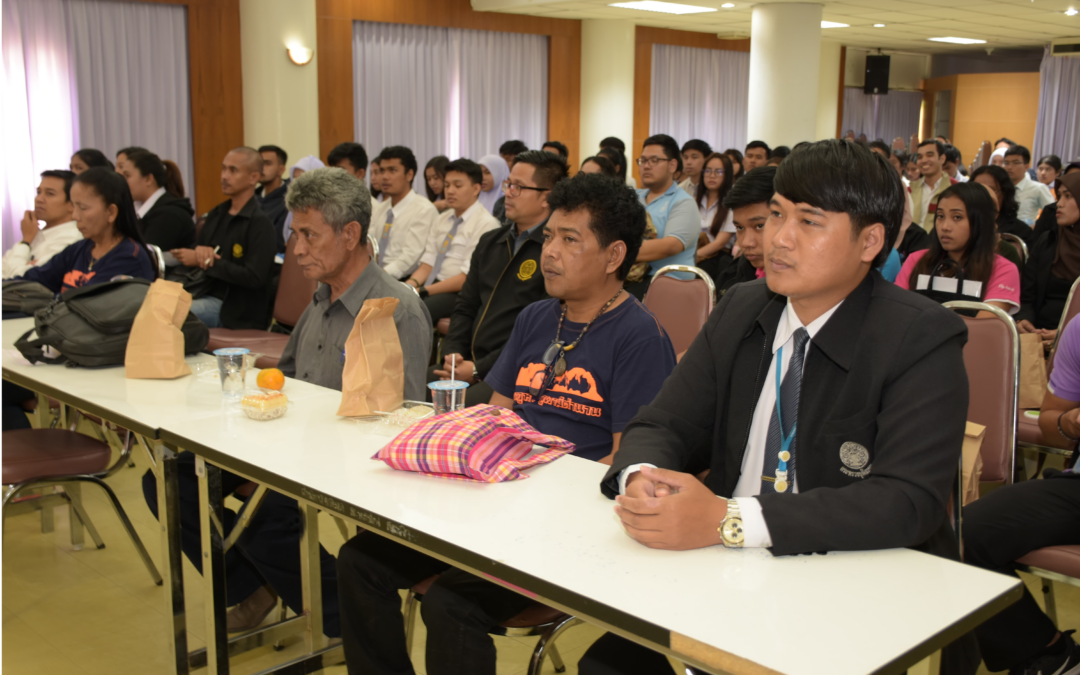
Today, the ICJ addressed an academic seminar on the topic of “Public interest and the anti-strategic lawsuit against public participation (SLAPP)”.
It was organized by Thaksin University’s Faculty of Law, in collaboration with the Embassy of Canada in Bangkok, the Thai Ministry of Justice’s Justice Office, and the Community Resources Centre Foundation (CRC).
Participants in the seminar, which was held at Thaksin University, included more than 50 undergraduate students and lecturers from Thaksin University, around 20 villagers from affected communities, and approximately 20 justice officers from the Justice Office of Songkhla Province, Ministry of Justice.
Sanhawan Srisod, ICJ National Legal Adviser, delivered an introduction to basic international human rights law on the rights to freedom of expression, association, and peaceful assembly, and Thailand’s international legal obligations in relation to these rights.
Other speakers at the Workshop were Ms. Jantima Thanasawangkul, Special Prosecutor, Department of Legal Aid and Civil Rights Protection, Office of the Attorney General; Ms. Sor.Rattanamanee Polkla, Lawyer, Community Resources Centre Foundation; and Mr. Tawan Puakpong, Justice Office of Songkhla Province, Ministry of Justice.
Jan 29, 2018 | Advocacy, Non-legal submissions
Today, the ICJ and Thai Lawyers for Human Rights (TLHR) filed their joint submission to the UN Committee against Torture (Committee).
The Committee will consider it during the adoption of a list of issues prior to reporting (LOIPR) for the examination of the Second Periodic Report of Thailand under Article 19 of the Convention against Torture and Other Cruel, Inhuman or Degrading Treatment or Punishment (CAT).
During its 63rd session, from 23 April to 18 May 2018, the Committee will prepare and adopt a LOIPR on Thailand.
Once adopted, the LOIPR will be transmitted to the State party. Thailand’s formal response to the LOIPR will then constitute its Second Periodic Report under article 19 of the Convention.
Thailand ratified the CAT in 2007. Following its review of Thailand’s initial report under CAT, the Committee adopted its Concluding Observations at its 52nd Session in May 2014.
The ICJ and TLHR’s joint submission to the Committee highlights a number of ongoing concerns with respect to the country’s implementation of and compliance with the provisions of the CAT.
In addition, the joint submissions formulates certain questions and recommends that the Committee should include them in its LOIPR and address them to the Government of Thailand, including on the following pressing issues:
- The fact that, since the coup d’ état of 22 May 2014, the constitutional and legal framework in force in Thailand has increased opportunities for legally-sanctioned impunity;
- The failure to criminalize through the adoption of bespoke domestic legislation the crimes of torture, cruel, inhuman or degrading treatment or punishment and enforced disappearance, consistent with the CAT and other relevant international law;
- The failure to conduct investigations of credible allegations of enforced disappearances, as well as into credible reports of the widespread use of torture and other ill-treatment in a prompt, effective, independent and impartial manner in numerous cases; and
- Threats and reprisals against persons working to bring to light cases of alleged torture, other ill-treatment and enforced disappearance.
Contact
Kingsley Abbott, Senior International Legal Adviser, ICJ Asia Pacific Programme, t: +66 94 470 1345, e: kingley.abbott@icj.org
Thailand-CAT Submission-Advocacy-non-legal submission-2017-ENG (Full submission in PDF)
THAILAND-CAT additional info-Advocacy-2018-ENG (additional information, updated in April 2018)