Mar 9, 2016 | News
The recent decision of the Thai Supreme Court in the case of the enforced disappearance of Somchai Neelapaijit demonstrates Thailand must urgently ratify the Convention against Enforced Disappearance and enact domestic laws consistent with the Treaty, said the ICJ today.
On 29 December 2015, the Supreme Court of Thailand upheld the acquittals of five police officers charged with gang-robbery and coercion. These charges related to Somchai’s abduction and the taking of his property.
The authorities have blamed the failure to charge anyone to date with Somchai’s actual enforced disappearance or presumed death, in part, on the absence of physical remains.
The Supreme Court further held that Somchai Neelapaijit’s wife, Angkhana Neelapaijit, and his children could not participate in the proceedings as plaintiffs as, under Thai law, it had to be shown that Somchai Neelapaijit was either injured or killed such that he could not represent himself.
The Court reasoned that this was not the case as “it is not currently known whether or not Mr. Somchai is alive” and the accused had only been charged with gang-robbery and coercion.
“The Supreme Court decision does not in any way end Somchai’s case,” said Sam Zarifi, ICJ’s Asia Director.
“The Thai government is obliged to seek and provide truth and justice for Somchai and his family,” he added.
The Department of Special Investigations (DSI), often described as the FBI of Thailand, has been conducting an ongoing investigation into Somchai Neelapaijit’s fate or whereabouts since 2005.
“The glacial pace of the DSI’s investigation and unfortunate decision of the Supreme Court after all these years is heart-breaking,” said Zarifi.
Before the United Nations Human Rights Council in May 2008, the Royal Thai Government pledged “to do its utmost and leave no stone unturned in order to bring to justice the case of Mr Somchai.”
“But to do its ‘utmost’ to resolve this case, Thailand must take urgent and concrete steps to ratify the Convention against Enforced Disappearance and pass domestic laws that retrospectively recognize enforced disappearance as a distinct offence and the full rights of victims, including family members,” Zarifi added.
Promisingly, the Ministry of Justice is in the process of drafting a Prevention and Suppression of Torture and Enforced Disappearance Bill, which, in a draft seen by the ICJ, defines and criminalizes enforced disappearance and torture in Thailand.
Contacts
Sam Zarifi, ICJ Regional Director, Asia-Pacific Programme, t: +66807819002 ; e: sam.zarifi(a)icj.org
Kingsley Abbott, International Legal Adviser for Southeast Asia, t +66 94 470 1345 ; e: kingsley.abbott(a)icj.org
Additional information
Angkhana Neelapaijit, now Commissioner of the Thai Human Rights Commission, told the ICJ: “The decision of the Supreme Court acquitting the five accused and denying my children and me the right to participate in the proceedings shows that victims of enforced disappearance have nowhere to turn to obtain justice in Thailand. It is clear that nothing will change until Thailand urgently ratifies the Convention against Enforced Disappearance and amends its laws to ensure the rights of victims are upheld.”
Thailand signed, but has not yet ratified, the Convention Against Enforced Disappearance in January 2012. Pending the ratification, Thailand must desist from any acts that would defeat the objective and purpose of the Convention, which among other things places an obligation on State Parties to make enforced disappearance a criminal offence, to thoroughly and impartially investigate cases, bring those responsible to justice and treat family members of a ‘disappeared’ person as victims in their own right.
Forthcoming event
On 11 March 2016, the ICJ, together with Amnesty International (Thailand), Human Rights Watch, and the Justice for Peace Foundation will hold “a discussion on enforced disappearance in Thailand focusing on the recent decision of the Supreme Court in Somchai Neelapaijit’s case and the draft Prevention and Suppression of Torture and Enforced Disappearance Bill” to mark the 12-year anniversary since Somchai Neelapaijit “disappeared” on 12 March 2004.
Date: 11 March 2016
Time: 10.00am -12.00pm
Location: The Sukosol Hotel, room Kamolthip 3, Sriayutthaya Road, Bangkok
The speakers will be:
- Angkhana Neelapaijit
- Kingsley Abbott, International Legal Advisor, the International Commission of Jurists
- Sunai Phasuk, Senior Researcher, Human Rights Watch
- Laurent Meillan, Acting Representative, Office of the High Commissioner for Human Rights Office for South-East Asia
- A representative from the Department of Rights and Liberty Protection, Ministry of Justice
Related readings
To mark the 10-year anniversary of Somchai Neelapaijit’s “disappearance”, the ICJ released a report Ten Years Without Truth: Somchai Neelapaijit and Enforced Disappearances in Thailand, in which it documented the tortuous legal history of the case.
On 11 December 2015, the ICJ published an English version of its Practitioners Guide “Enforced Disappearance and Extrajudicial Execution: Investigation and Sanction”, originally published in Spanish in March 2015.
Thailand-Somchai disap anniversary 2016-News-Press releases-2016-THA (full text in Thai, PDF)

Feb 5, 2016 | News
The ICJ today called on the Royal Thai Government to immediately drop criminal proceedings against human rights lawyer Sirikan Charoensiri.
On 2 February 2016, Sirikan Charoensiri received two summons to appear at the Chanasongkram Police Station on 9 February 2016 to be charged with two offences under the Criminal Code of Thailand: “giving false information regarding a criminal offence” and “refusing to comply with the order of an official”.
Such charges could result in punishment of up to two years’ imprisonment.
“The charges against Sirikan Charoensiri apparently relate to her efforts to protect the legal and human rights of her clients, students who never should have faced arrest or criminal proceedings for peacefully exercising their freedoms of expression and assembly in the first place,” said Matt Pollard of the ICJ’s Centre for the Independence of Judges and Lawyers.
“Prosecuting Sirikan Charoensiri for her efforts to defend human rights is totally unacceptable and will only put Thailand further in violation of its international obligations,” he added.
The charges appear to relate to the circumstances surrounding Sirikan Charoensiri’s provision of legal aid to 14 students who were arrested on 26 June 2015 after carrying out peaceful protests calling for democracy and an end to military rule.
Although the precise basis for the changes is not set out in the summonses, the complainant is named as Pol. Col. Suriya Chamnongchok, a police officer involved in the investigation of the 14 students.
Sirikan Charoensiri, a lawyer with Thai Lawyers for Human Rights (TLHR), has provided legal aid to many individuals, including activists and human rights defenders, since military rule was imposed in May 2014.
The ICJ first expressed concern about the Government’s targeting of Sirikan Charoensiri on 2 July 2015, after the Royal Thai Police threatened Sirikan Charoensiri with legal action, publically announced they were considering charging her with a crime, and visited her home and questioned her family.
These threats and harassment, like the currently pending charges, appeared to be in retaliation for her having refused consent for police to search her car after the students’ court hearing, and for having filed a complaint with the police when they proceeded to impound it.
The ICJ has brought the case to the attention of the United Nations Special Rapporteurs on the Independence of Judges and Lawyers, and on the Situation of Human Rights Defenders.
The situation of human rights in Thailand will be examined by the UN Human Rights Council in May 2016, as part of the Council’s Universal Periodic Review of all States.
“Ahead of Thailand’s human rights review by the United Nations in May, and against the background of the tabled ‘roadmap’ towards democratic rule, the need for the Royal Thai Government to restore respect for human rights only grows more urgent by the day,” said Pollard.
Contact
In Bangkok: Kingsley Abbott, International Legal Adviser for Southeast Asia, t +66 94 470 1345 ; e: kingsley.abbott(a)icj.org
In Geneva: Matt Pollard, ICJ Senior Legal Adviser, t: +41 22 979 38 12 ; e: matt.pollard(a)icj.org
Background
The International Covenant on Civil and Political Rights (ICCPR), to which Thailand is a Party, guarantees the right to peaceful assembly; the right to freedom of expression; the prohibition of arbitrary arrest or detention; the right to a fair and public hearing by a competent, independent and impartial tribunal established by law (including the right of prompt access to a lawyer and precluding jurisdiction of military courts over civilians in circumstances such as these); and the prohibition of arbitrary or unlawful interference with privacy, family, home and correspondence (which includes arbitrary searches or seizures).
The UN Declaration on Human Rights Defenders affirms the right of everyone peacefully to oppose human rights violations. It prohibits retaliation, threats and other harassment against anyone who takes peaceful action against human rights violations, both within and beyond the exercise of their professional duties. It protects the right of persons to file formal complaints about alleged violations of rights. The UN Basic Principles on the Role of Lawyers provide that governments are to ensure that lawyers are able to perform their professional functions without intimidation, hindrance, harassment or improper interference.
Thailand-Sirikan Charoensiri-News-Press releases-2016-THA (full text in PDF, Thai)
Dec 22, 2015 | News
The upcoming Supreme Court verdict in the case of Somchai Neelapaijit is an important test of Thailand’s treatment of cases of enforced disappearance, the ICJ said today.
The Supreme Court is expected to rule on whether the Court of Appeal was correct in overturning the conviction of one police officer for coercion and upholding the acquittals of four other police officers, and whether Somchai Neelapaijit’s family should be permitted to participate in the proceedings as plaintiffs.
The case concerns the 2005 trial of five police officers for coercion and gang-robbery after Somchai Neelapaijit, a leading Thai lawyer and human rights defender, was last seen on 12 March 2004 being pushed into a car by several men in Bangkok.
In March 2014, the ICJ published a report in Thai and English, which summarises the history of the case and provides a background to the upcoming decision, which will be delivered in Bangkok on 29 December 2015.
“This decision is an important milestone in the long and torturous history of this case,” said Sam Zarifi, the ICJ’s Regional Director for Asia and the Pacific.
“But whatever the result, Thailand must not waver from its repeated commitments to promptly and effectively investigate this enforced disappearance, to seek to identify those responsible and bring them to justice, and to provide the family with full remedies and reparation,” he added.
The police never charged the five police officers with more serious crimes – despite the statements of numerous officials, including past Prime Minister Thaksin Shinawatra, expressing certainty about his death – as Somchai Neelapaijit’s body or remains were never found.
The Department of Special Investigations (DSI), often described as the FBI of Thailand, is still conducting an investigation into his fate or whereabouts.
Angkhana Neelapaijit, Somchai Neelapaijit’s wife and now Commissioner of the Thai Human Rights Commission, told the ICJ: “Ensuring that all victims of enforced disappearance have their rights fully recognised by the Thai courts is equally important to me as seeking justice in my own case. My long battle through Thailand’s justice system has shown me Thailand’s laws are currently inadequate to deal with cases of enforced disappearance and that significant reforms are needed before the rights of victims are fully recognized.”
Contacts
Sam Zarifi, Regional Director, Asia-Paicific Programme, sam.zarifi(a)icj.org, +66 (0) 80 781 900
Kingsley Abbott, International Legal Adviser for Southeast Asia, Asia-Pacific Programme, kingsley.abbott(a)icj.org, +66 (0) 94 470 1345
Additional information:
On 11 December 2015, the ICJ published an English version of its Practitioners Guide “Enforced Disappearance and Extrajudicial Execution: Investigation and Sanction”, originally published in Spanish in March 2015.
Thailand-Somchai Verdict-News-Press releases-2015-ENG (full text, in PDF)
Dec 10, 2015 | News
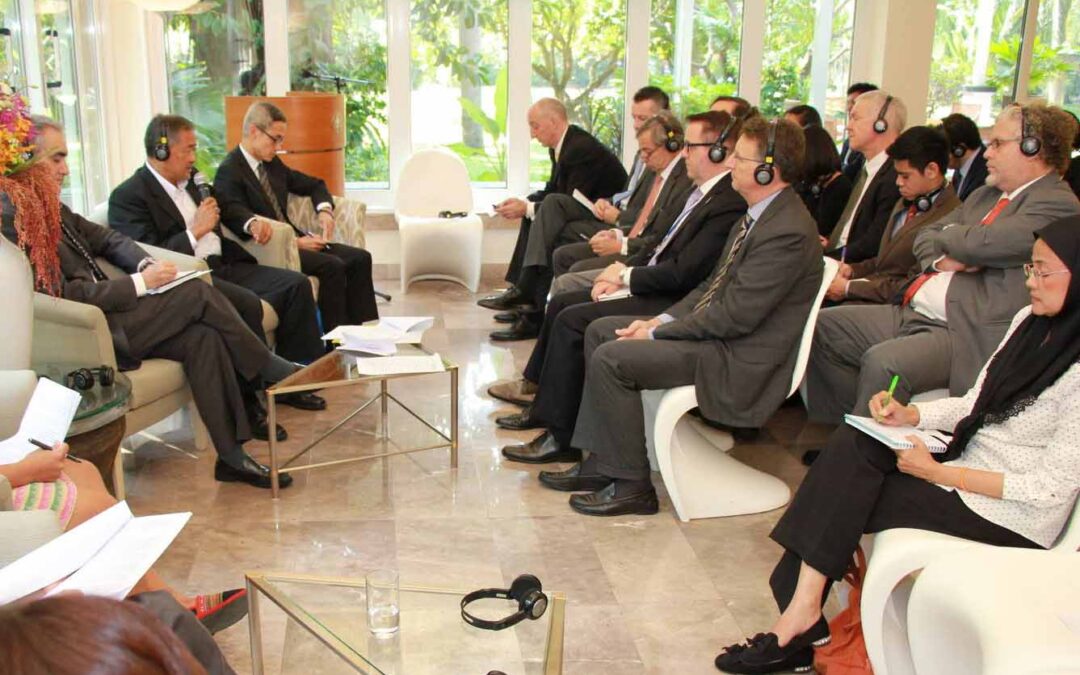
The Ambassador of the Federal Republic of Germany to Thailand and the ICJ held an event at the German Residence in Bangkok to mark Human Rights Day.
In his welcome speech, the Ambassador, Peter Prügel, stressed the importance of the protection of universal human rights which are essential for peace, long-term stability and sustainable development worldwide and referred to Germany’s long-standing support of the ICJ and its partners in Thailand.
Angkhana Neelapaijit, newly appointed Commissioner of Thailand’s National Human Rights Commission, respected human rights defender and victim of enforced disappearance then spoke about her new role and the human rights challenges currently facing Thailand.
A panel discussion on the prevailing human rights situation in Thailand then followed, which touched on a range of topics including the situation in deep South, community rights, migrants and refugees, the current legal framework, freedom of expression and assembly, the requirement to protect human rights defenders under international law and the upcoming Universal Periodic Review of Thailand by the Human Rights Council in 2016.
The panelists were:
- ICJ Commissioner, Professor Emeritus Vitit Muntarbhorn, Law Faculty, Chulalongkorn University;
- Sitthipong Chantarawirod, Chairperson of Muslim Attorney Centre Foundation;
- Pranom Somwong, Representative of Protection International Thailand;
- Somchai Homlaor, Chairperson of Cross Cultural Foundation; and
- Yaowalak Anuphan, Head of Thai Lawyers for Human Rights.
Approximately 100 members of Thailand’s civil society, the diplomatic community, the National Human Rights Commission, affected communities, academia, the United Nations, and Thailand’s Ministry of Foreign Affairs attended the event.

Sep 29, 2015 | Events, News
From 30 September to 1 October 2015, the Asian Forum for Human Rights and Development (FORUM-ASIA), International Commission of Jurists (ICJ), and Boat People SOS (BPSOS) will jointly organize a conference in Bangkok.
The regional conference will discuss pressing concerns on the promotion and protection of freedom of religion or belief.
The UN Special Rapporteur on Freedom on Religion or Belief, Mr. Heiner Bielefeldt, will be joined by approximately 60-70 human rights defenders, members of religious groups, rights groups, UN agencies and representatives from the ASEAN Intergovernmental Commission on Human Rights, ASEAN Commission on the Promotion and Protection of Rights of Women and Children, National Human Rights Institutions and other government agencies.
The event will provide a multi-stakeholder platform to discuss key emerging issues, distinct and shared challenges faced by various Southeast Asian religious groups and advocates of religious freedom, identify advocacy strategies and best practices to overcome these obstacles, and to strengthen cooperation between the different stakeholders important in promoting freedom of religion or belief in Southeast Asia.
The event will also be an opportunity for participants to have a better understanding of the mandate of the UN Special Rapporteur on freedom of religion or belief.
Some of the key topics expected to be discussed include state control and regulation of religion, extreme interpretations of religion, and how freedom of religion together with other human rights are complementary or mutually reinforcing.
Upon the completion of the conference, the Special Rapporteur will hold a press briefing at the Foreign Correspondents’ Club of Thailand (FCCT) at 7.30pm on 1 October 2015 to provide an overview of the status of freedom of religion or belief in Southeast Asia and how this right could be better protected and promoted.