
Sep 21, 2015 | Advocacy, Non-legal submissions
Today, the ICJ and Thai Lawyers for Human Rights (TLHR) made a joint submission to the Human Rights Council’s Working Group on the Universal Periodic Review in advance of the Human Rights Council’s review of Thailand in April/May 2016.
In their submission, the ICJ and TLHR expressed concern about the following issues:
(1) the impact of the new legal and institutional framework, imposed since the May 2014 coup d’état, on human rights in Thailand;
(2) instances of suspected enforced disappearance and torture; and
(3) issues concerning international human rights instruments and mechanisms.
A copy of the submission can be found here:
THAILAND-UPR SUBMISSION FINAL AS LODGED-Advocacy-Non legal submission-2015-ENG (full text in PDF)

Sep 1, 2015 | News
The Thai government must end proceedings against two journalists who were today acquitted of charges of defaming the Royal Thai Navy and immediately repeal the country’s criminal defamation laws, the ICJ said today.
The two journalists with the Phuketwan online news outlet, Alan Morison and Chutima Sidasathian, were charged with criminal defamation under the Thai Criminal Code and violation of Article 14(1) of the Computer Crimes Act.
“Today’s verdict affirms the right of journalists in Thailand to freely express their views, even if – especially if – they sometimes have to criticize public authorities when it is in the public interest to do so,” said Kingsley Abbott, ICJ International Legal Adviser for Southeast Asia, who observed the proceedings.
“The verdict today is a relief not only for the two brave journalists who could have faced jail sentences for doing their job, but also for other journalists in Thailand who followed this case with anxiety about potentially significant new restrictions on their ability to work,” he added.
The prosecution now has 30 days to appeal the verdict.
“The charges against these two journalists generated severe international criticism for Thailand and harmed the country’s reputation more than any article in Phuketwan,” said Abbott. “The prosecution should take heed of this verdict and drop the case without further appeal.”
The Royal Thai Navy had complained that the journalists defamed it when, on 17 July 2013, the journalists reproduced a paragraph from a Pulitzer prize-winning Reuters article that alleged “Thai naval forces” were complicit in human trafficking.
In a decision read out today at the Phuket Provincial Court, with respect to the charges of criminal defamation, the Judge held that the journalists had reproduced information from a news source, Reuters, that they believed to be reliable.
Regarding the charges under the Computer Crimes Act, the Judge found that the information that was published was not “false computer data” and was not information that could “cause damage” to national security which are elements of Article 14(1).
The Judge also noted that the Computer Crimes Act was not intended to cover allegations of defamation.
“Thailand must repeal its criminal defamation laws in recognition that criminal penalties are a disproportionate means to address reputational damage,” Abbott added.
“Thailand should also reform the Computer Crimes Act to more precisely define that its purpose and scope is not intended to place limitations on freedom of expression.”
Background
Article 19 of the International Covenant on Civil and Political Rights (ICCPR), to which Thailand is a State Party, guarantees the right to freedom of expression, which includes the right to impart information.
The UN Human Rights Committee, which monitors State compliance with the ICCPR, has expressed its concern at the misuse of defamation laws to criminalize freedom of expression and has said that such laws should never be used when expression is made without malice and in the public interest.
It has also clarified that imprisonment is never an appropriate penalty for defamation.
The ICJ, the Human Rights Committee, the UN Special Rapporteur on freedom of opinion and expression and other international human rights bodies and an increasing number of governments believe that criminal defamation laws should be abolished. Such laws are incompatible with the right to freedom of expression.
Criminal penalties are a disproportionate means to protect against reputational harm and pose an impermissibly severe impediment to the exercise of free expression.
Thailand was criticized in May 2014 when the United Nations Committee against Torture expressed its concern “at the numerous and consistent allegations of serious acts of reprisals and threats against human rights defenders, journalists, community leaders and their relatives, including verbal and physical attacks, enforced disappearances and extrajudicial killings, as well as by the lack of information provided on any investigations into such allegations.”
The Committee recommended that Thailand “should take all the necessary measures to: (a) put an immediate halt to harassment and attacks against human rights defenders, journalists and community leaders; and (b) systematically investigate all reported instances of intimidation, harassment and attacks with a view to prosecuting and punishing perpetrators, and guarantee effective remedies to victims and their families.”
Read also:
The Phuketwan trial: an insidious prosecution of free expression
Contact:
Kingsley Abbott, ICJ International Legal Adviser, (Bangkok), t:+66 944701345, e: kingsley.abbott(a)icj.org
Thailand-Phuketwan trial-News-Press releases-2015-THA (full text in PDF, Thai version)

Aug 20, 2015 | News
The bombing in Bangkok that killed 20 people and injured more than 120 constitutes a serious attack on human rights and demands an impartial and effective investigation to bring the perpetrators to justice, the ICJ said today.
“Targeting ordinary people, mostly tourists visiting a religious shrine, is an assault upon our shared humanity and human rights,” said Sam Zarifi ICJ’s Regional Director for Asia and the Pacific. “Thailand must counter this vile attack with a credible investigation that aims to deliver justice to the victims by identifying the perpetrators and bringing them to justice in accordance with the rule of law.”
“The Thai authorities must also resist the pressure to display progress through hasty conclusions and commit unwaveringly to an investigation that meets international standards and respects all legal and due process guarantees. Only a credible and fair process will provide truth and justice to the many victims and survivors,” he added.
As part of an effective investigation, the ICJ recommends Thailand to:
- protect the rights of the victims including by ensuring they:
o are treated with respect,
o receive regular information about the progress of the investigation and their rights in relation to it,
o receive all necessary support and assistance;
- ensure that the investigation hypothesis is not influenced by discrimination or bias based on ethnic, religious, political or other such grounds; and
- actively seek out and accept offers of assistance from other states including in the areas of:
o intelligence,
o forensic examination of crimes scenes, bodies and vehicles,
o analysis of phone material including call data and cell sites, and
o enhancement and analysis of Closed Circuit Television (CCTV) footage.
Thailand is required to effectively investigate the attack, to prosecute and punish those responsible, and to ensure victims have access to effective remedies and reparation, as part of its international legal obligations as a Party to the International Covenant on Civil and Political Rights (ICCPR), including pursuant to the right to life and the right to security of person.
Background:
On 17 August 2015 at approximately 19:00, an Improvised Explosive Device (IED) was detonated near the popular Erawan religious shrine at the Ratchaprasong intersection in central Bangkok.
On 18 August 2015 at approximately 13:00, a second IED was detonated near Bangkok’s Sathorn boat pier that exploded harmlessly in the water.
To date, no groups or individuals have claimed responsibility for either attack.
Contact:
Sam Zarifi, ICJ Asia Regional Director, (Bangkok), t:+66 807819002, e-mail: sam.zarif(a)icj.org
Kingsley Abbott, ICJ International Legal Adviser, (Bangkok), t:+66 944701345, e-mail: kingsley.abbott(a)icj.org
Thailand-BKK Blast-News-Press releases-2015-THA (full text in pdf, THAI)
Photo: Xinhua / Li Mangmang

Aug 6, 2015 | News
Thailand’s Department of Special Investigations (DSI) should launch a special investigation into the apparent enforced disappearance of Karen activist, “Billy,” the ICJ and the Justice for Peace Foundation (JPF) said today.
Today, Billy’s wife, Phinnapha Phrueksaphan, delivered a letter to the DSI requesting it to assume jurisdiction over the case after the police investigation has presented little progress since Billy was last seen in the custody of Kaeng Krachan Park officials on 17 April 2014.
“This is precisely the kind of case the DSI was created to investigate,” said Kingsley Abbott, International Legal Adviser at the ICJ.
“The investigation is complex, the suspects include influential administrative officials and if Billy was forcibly disappeared then an extremely serious crime under international law has been committed. The police investigation does not appear to have advanced significantly in more than a year and so now it’s long past time for the DSI to take over,” he added.
Phinnapha Phrueksaphan also asked the DSI for Pol. Col. Traiwit to be part of any DSI investigation team due to the commitment she thinks he has demonstrated to the investigation so far and to disclose the results of the DNA testing of the blood allegedly found in a Park Official’s vehicle (in which Billy was last seen).
She was supported by Angkhana Neelapaijit, the head of JPF, whose own husband, Somchai Neelapaijit, was the victim of enforced disappearance in 2004 and whose case the DSI is still investigating.
“Thailand must act on its repeated commitments to combating enforced disappearance by handing this case over to the DSI. There are strong parallels between Billy’s case and the case of my husband and there is no reason why the DSI should be investigating one and not the other,” said Angkhana Neelapaijit.
The DSI was created by The Special Investigation Act B.E. 2547 (2004) and is sometimes referred to as the FBI of Thailand. It has the power to assume jurisdiction over special criminal cases including complex cases that require special inquiry; crimes committed by organized criminal groups; and cases where the suspect is an influential person or an administrative official.
Background
Since Billy “disappeared” his wife has been raising their five children on her own.
Thailand, pursuant to its international legal obligations, including as a party to the International Covenant on Civil and Political Rights, is required to promptly, independently and effectively investigate and, where appropriate, prosecute, punish and provide a remedy and reparation for the crime of enforced disappearance.
The Royal Thai Government has signaled its recognition of the gravity of the crime of enforced disappearance and its commitment to combating it by signing (but not yet ratifying) the International Convention for the Protection of All Persons from Enforced Disappearance on 9 January 2012. The Convention affirms the absolute right not to be subject to enforced disappearance and places an obligation on states to make it a criminal offence punishable by appropriate penalties that take into account its “extreme seriousness.”
The Thai Cabinet is currently considering a draft law that would make enforced disappearance and torture stand-alone crimes in Thailand.
Since July 2014, the ICJ has repeatedly called for the DSI to assume jurisdiction over the case.
For more information see:
https://www.icj.org/thailand-strengthen-efforts-to-solve-the-apparent-enforced-disappearance-of-billy/
https://www.icj.org/thailand-disappearance-of-billy-demands-special-investigation/
https://www.icj.org/thai-authorities-must-urgently-investigate-billys-disappearance/
Contact
Kingsley Abbott, ICJ International Legal Adviser, email: kingsley.abbott(a)icj.org or mobile: +66 94 4701345
Angkhana Neelapaijit, Justice for Peace Foundation, email: angkhana.nee(a)gmail.com or mobile: +66 84 7280350
Thailand-Disappearance Billy-News-PR-2015-ENG (full text of the press release)
Thailand-Disappearance Billy-News-PR-2015-THA (full text of the press release in Thai)
Jul 19, 2015 | News
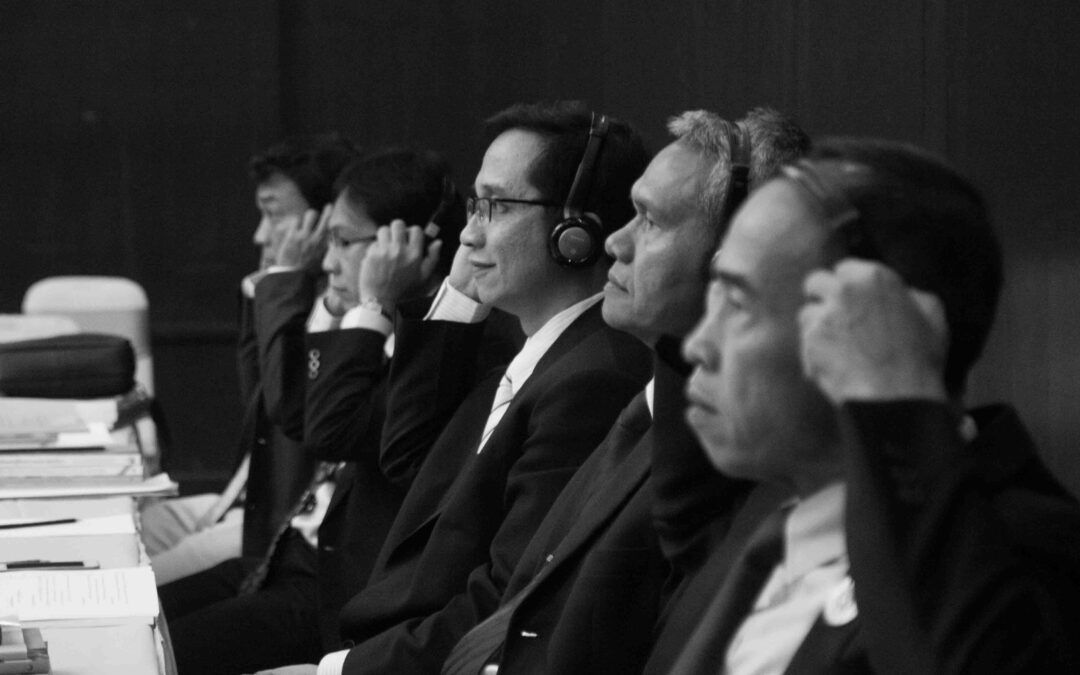
On 18-19 July 2015, the ICJ held a workshop on “The Protection of Victims in Criminal Cases” for 35 judges in Thailand’s deep South. This is the fifth workshop the ICJ has held with the judges of Region 9 since 2011.
The objective of the workshop, held in Hat Yai, was to discuss how to improve procedural measures to protect victims in Thailand with reference to international law and standards.
Speakers at the workshop included Justice John Lawrence O’Meally, an ICJ Commissioner from Australia, Judge Dol Bunnag, Chief Judge of the Juvenile and Family Court of Sakonnakorn Province, Chief Judges from Region 9, and Marie Guiraud, International Civil Party Lead Co-Lawyer at the Khmer Rouge Tribunal in Cambodia.
Background:
Previous ICJ workshops with the Judges of Region 9 have covered the following topics:
- Rule of Law and Strengthening the Administration of Justice in the Context of the Application of Emergency Laws in the Southern Border Provinces (2011)
- Rule of Law and Strengthening the Administration of Justice in the Context of Bail in the Southern Border Provinces (2012)
- Rule of Law and Strengthening the Administration of Justice in the Context of Habeas Corpus in the Southern Border Provinces (2012)
- The Principle of Inadmissibility of Evidence Obtained by Unlawful Means and Hearsay Evidence: International Standards Compared to Thai Law (2014)